

You're balancing programs, donors, staff, and board expectations when someone asks whether the organization is ready for an audit. If your records live across spreadsheets, QuickBooks classes, email threads, and shared folders, that question can feel larger than the audit itself.
The practical answer is straightforward. Nonprofit audit requirements depend on federal expenditures, state rules, funder terms, and governing documents, while audit readiness depends on clean fund accounting, restricted-fund records, reconciliations, and accessible evidence.
Quick Answer: Nonprofit Audit Requirements
Nonprofit audit requirements can come from federal award spending, state charity rules, funder contracts, or your own bylaws. A U.S. Single Audit generally applies when you expend $1 million or more in federal funds in a fiscal year, using the current Uniform Guidance threshold.
Compare what is a single audit with OMB A-133 and the single audit. For the ledger, see fund accounting.
Why Audit Readiness Feels Overwhelming
The anxiety usually starts with a calendar reminder. Your fiscal year is closing, the board wants financial statements, and a funder has requested assurance that restricted money was spent properly. Then someone mentions an audit, and you realize that several important decisions exist only in email or in someone's memory.
That reaction is understandable. An audit asks people outside your organization to follow the financial story from the original funding source through the ledger, bank activity, program spending, and final report. If each step sits in a different system, your staff must rebuild that story manually.

The audit is evidence, not an accusation
An independent audit examines whether your financial statements are fairly presented, whether controls support accurate records, and whether funding restrictions were followed. It's an assurance exercise, not automatically an investigation into fraud or wrongdoing.
That distinction matters because many executive directors treat audit preparation as an annual emergency. I recommend treating it as a year-round operating discipline instead. Reconciliations, approval records, grant files, board minutes, and restricted-fund schedules should accumulate as part of normal work.
Your financial statements preparation process should make that evidence easy to explain. A reader should be able to see what came in, where it was restricted, what the organization spent, and what remains available.
Several authorities can require scrutiny
Federal rules are only one layer. State charitable registration requirements may impose their own standards, while a grant agreement, lender, board policy, or bylaw can require an audit even when federal rules don't.
The operational problem isn't memorizing every rule. It's maintaining records that let you answer four questions quickly:
- Where did the money come from?
- What restrictions apply?
- Which costs were charged to each fund or grant?
- What evidence supports the transaction and approval?
Practical rule: If your team can answer those questions without rebuilding the books, audit preparation is already part of your operating system.
Federal and State Audit Triggers Explained
The first question is not, “What's our revenue?” It's, “How much federal money did we expend during the fiscal year?”
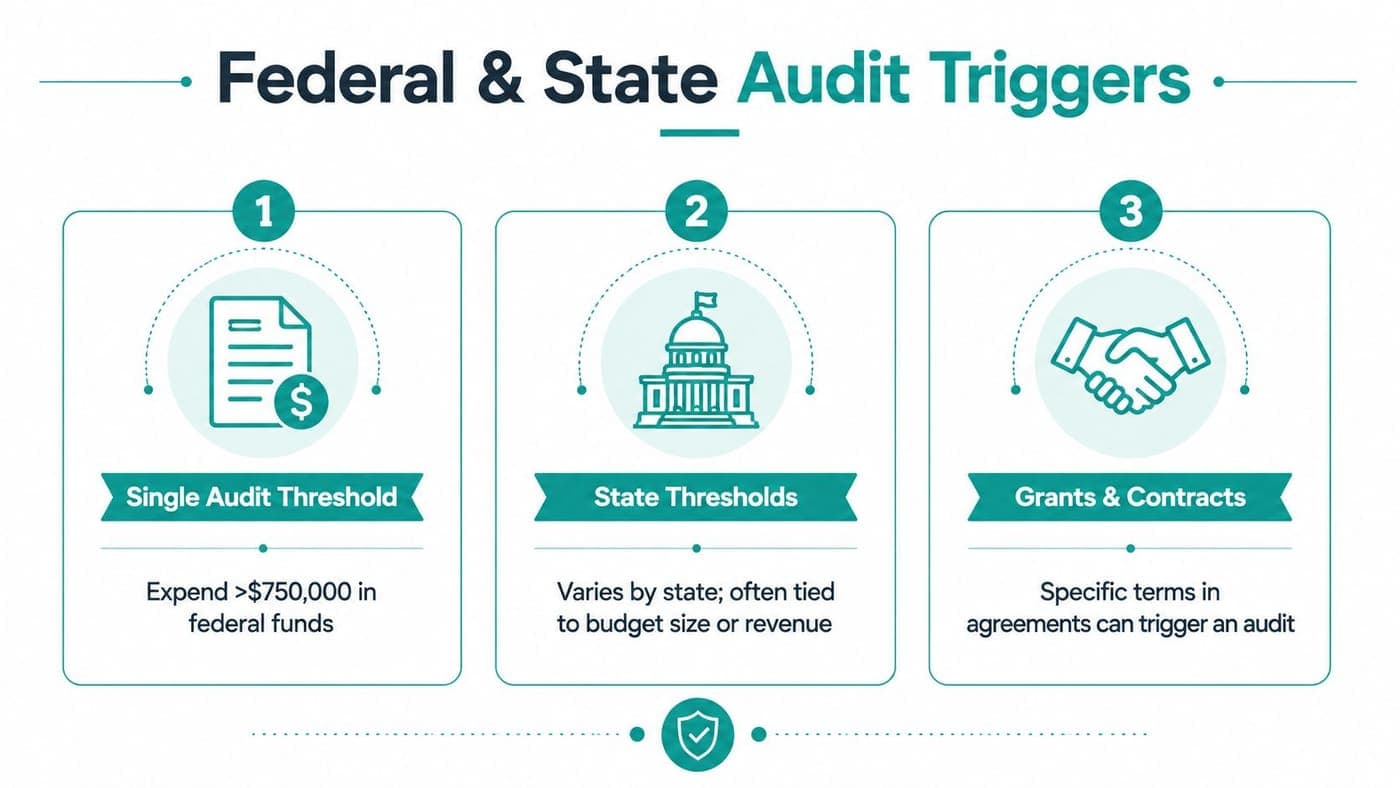
Under Uniform Guidance, a U.S. nonprofit that expends $1 million or more in federal funds in a fiscal year must obtain a Single Audit, including federal dollars passed through another organization. The trigger is based on expenditures, not awards, revenue, or the amount promised in a grant. See the federal audit requirements guide for the governing framework.
The threshold changed from $750,000 to $1 million in April 2024. The updated threshold applies to federal awards issued after October 1, 2024, and BPM states that the rule is effective for fiscal years ending on or after September 30, 2025. Review the award date and fiscal-year applicability with your CPA rather than applying the new threshold casually.
Separate the federal trigger from other requirements
The federal calculation requires disciplined tracking. A grant award may sit in your records without being fully spent, while pass-through funding may arrive under another organization's name but still count once your nonprofit expends it.
Keep a grant-level schedule showing the award, restrictions, expenditures, and reporting status. That schedule supports the Schedule of Expenditures of Federal Awards, or SEFA, when a Single Audit applies.
State rules follow different patterns. In England and Wales, charities with gross income over £1 million generally need an audit, while those with income between £25,000 and £1 million may need an independent examination. An audit is also required above £250,000 when gross assets exceed £3.26 million, according to the UK guidance for charity accounts.
New Zealand uses another size-based structure. Charities with operating expenditure over NZ$550,000 in the prior two years need either a review or audit, while those over NZ$1.1 million must have an audit, as described in the same guidance.
Build a trigger review into annual planning
For U.S. nonprofits, state requirements vary widely. Your state may tie an audit to gross income, contributions, charitable solicitation registration, or another measure. Your funders may also require audited statements, and your bylaws may create an internal obligation.
That means a nonprofit below the federal threshold can still need a financial statement audit. For broader context on the tax agency's role, the discussion of why the IRS audits in 2026 can help distinguish tax administration from nonprofit audit obligations.
Review these items before year-end:
- Federal spending: Calculate actual federal expenditures, including pass-through funds.
- Award timing: Check whether the revised threshold applies to each award and fiscal year.
- State rules: Confirm current charitable registration and reporting requirements.
- Funding contracts: Read audit language in grant, lender, and donor agreements.
- Governance documents: Check bylaws and board policies for voluntary audit commitments.
If federal spending may approach the threshold, use this Single Audit overview to frame the conversation with your finance committee and CPA.
Financial Statement Audits vs Single Audits
A financial statement audit and a Single Audit answer different questions. Confusing them creates bad planning, especially when leaders assume that one engagement automatically satisfies every requirement.
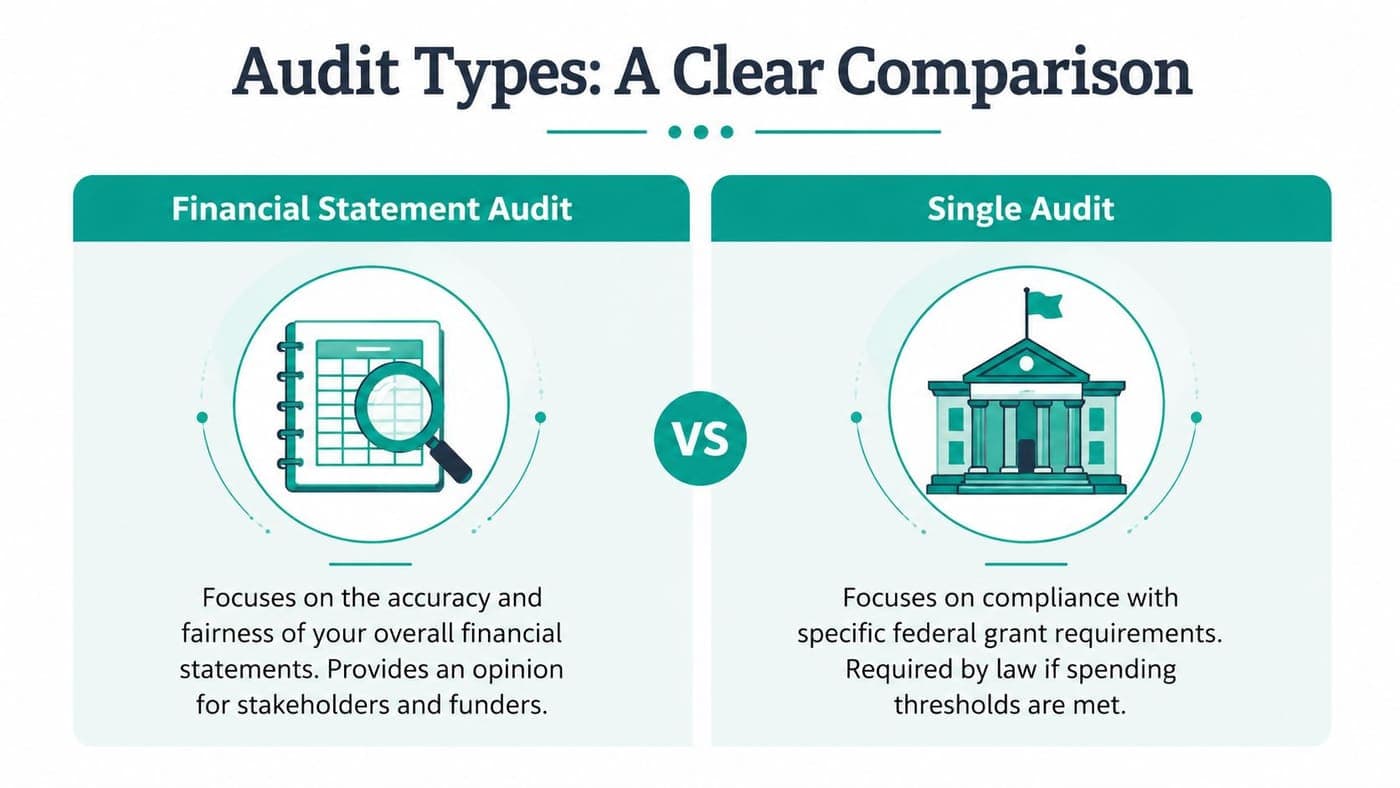
A financial statement audit examines whether the organization's overall financial statements are fairly presented under applicable accounting standards. The auditor reviews account balances, transactions, controls, supporting documentation, and financial reporting judgments before issuing an opinion for stakeholders, funders, lenders, or the board.
A Single Audit includes financial statement work but adds federal program compliance testing. The auditor examines whether your organization followed requirements attached to federal awards, including controls over those programs and the way you documented eligible spending.
What each engagement asks from your team
| Audit type | Main focus | Records that matter most |
|---|---|---|
| Financial statement audit | Accuracy and fair presentation of overall financial statements | General ledger, reconciliations, schedules, policies, and governance records |
| Single Audit | Compliance with federal program requirements | Grant agreements, federal expenditure records, cost allocation, approvals, and SEFA support |
A financial statement audit may identify weaknesses in revenue recognition, expense classification, account reconciliation, or restricted-fund presentation. A Single Audit may also test whether costs were allowable under a federal program, whether spending was allocated correctly, and whether your organization maintained evidence required by the award.
Fund accounting becomes critical because the auditor must trace activity to the correct purpose and funding source. A generic accounting file may show that an expense was recorded, but it may not show which grant paid for it, whether the cost was allowable, or which allocation method supported the charge.
One organization can face both
Your state, funder, board, or lender can require a financial statement audit even when you don't meet the federal Single Audit threshold. If your federal expenditures meet the threshold, you may need the Single Audit as well.
The practical response is to ask your CPA to map every obligation before the engagement begins. Use the audit glossary definition as a shared reference when your board or leadership team uses “audit” as though it describes one universal process.
A financial statement audit tells stakeholders whether the financial statements are reliable. A Single Audit tells federal stakeholders whether applicable federal program rules were followed. They overlap, but neither should be treated as a substitute for the other.
Your Audit Preparation Checklist
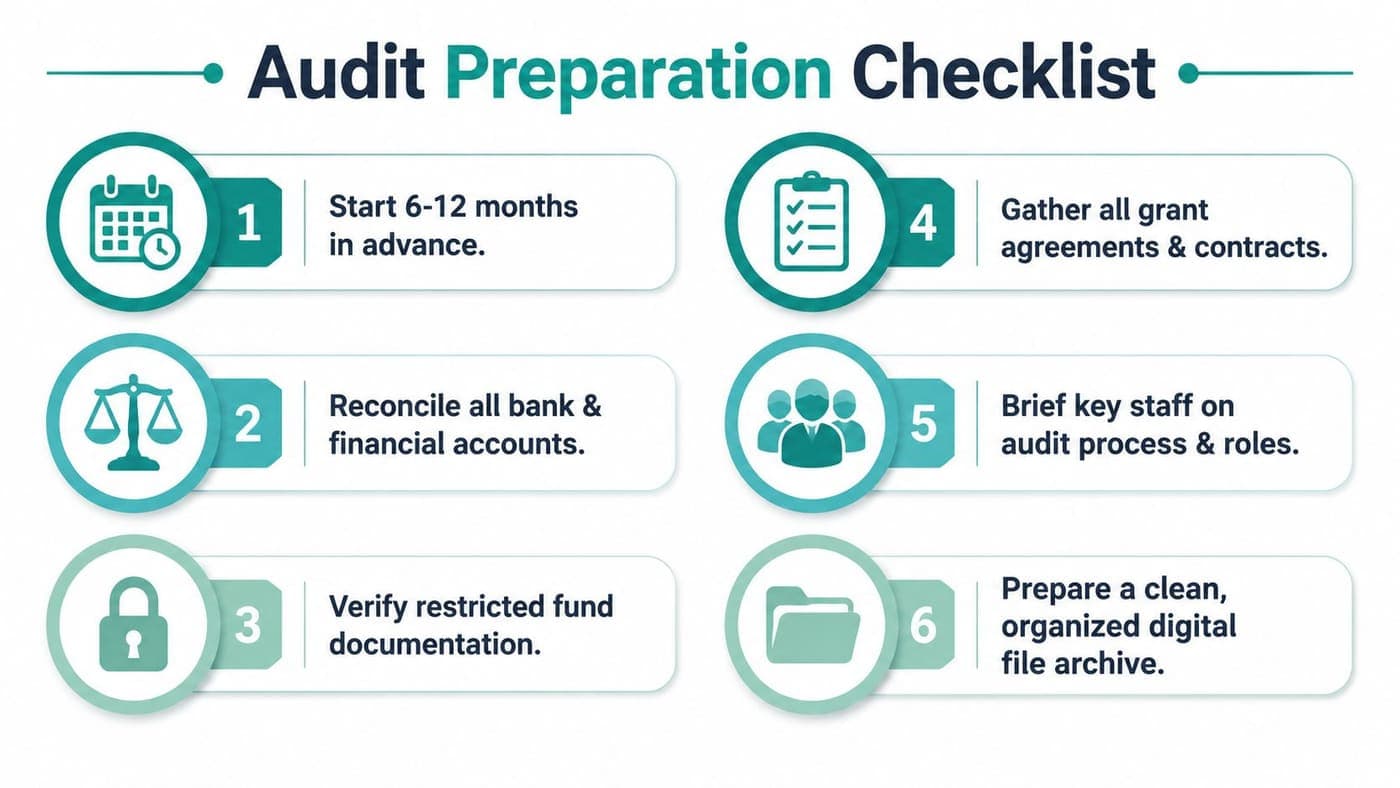
Good audit preparation starts months before the auditor sends a request list. The exact lead time depends on your fiscal calendar and complexity, but beginning six to twelve months in advance gives your team time to correct records without disrupting programs.
Start with the calendar, then assign one owner for each evidence category. Audit preparation fails when everyone assumes someone else has the grant agreement, board minutes, or final reconciliation.
Establish control before gathering documents
Reconcile every account. Complete bank, investment, credit-card, payroll, and other balance reconciliations. Investigate old reconciling items instead of carrying them forward because unresolved differences often become larger evidence problems during testing.
Confirm restricted-fund balances. For each donor-restricted or grant-restricted fund, document the purpose, time limit, spending to date, remaining balance, and supporting approval. Current U.S. GAAP presents two net-asset classes, net assets without donor restrictions and net assets with donor restrictions, under ASU 2016-14. Donor or grantor restrictions may apply to purpose, time, or perpetuity, and only the original source can lift them, as explained by Good Circles' fund accounting guidance.
Gather grant evidence. Keep award letters, executed agreements, amendments, budgets, expenditure reports, reimbursement requests, and correspondence in one grant file. Match each report to the ledger and retain the allocation method behind shared costs.
Prepare the SEFA when applicable. If your federal expenditures meet the Single Audit trigger, prepare the Schedule of Expenditures of Federal Awards early. Don't wait for the auditor to discover that program names, assistance listings, award identifiers, or pass-through information are incomplete.
Give the auditor a clean trail
Your documentation should show who approved a transaction, which fund paid it, what service or item was received, and how the cost relates to the program. Missing board minutes, outdated policies, incomplete cost allocation plans, and undocumented journal entries can slow the engagement even when the underlying spending was proper.
Use a consistent archive structure for financial records, governance materials, grant compliance, contracts, and internal controls. A clear document request process helps staff respond consistently instead of sending scattered attachments.
Brief program directors, development staff, volunteer coordinators, and finance personnel on their roles. The finance team shouldn't be the only group that understands where evidence lives.
For a broader planning perspective, Disputely's Q4 audit campaign offers another way to organize year-end audit work around deadlines, ownership, and document collection.
How Integrated Systems Prevent Audit Pain
Your audit should test the organization's records, not the endurance of your finance director. When accounting, donor management, volunteer activity, events, and marketing operate separately, staff create spreadsheet bridges that introduce duplicate entries and missing context.
The strongest system is the one that keeps the source information attached to the transaction. A donation should connect to the donor, campaign, fund, receipt, bank activity, and restriction without requiring someone to reconcile five disconnected tools.
Fund accounting must reflect the mission
True fund accounting is different from using QuickBooks classes as labels. Classes can help organize reports, but a nonprofit needs restrictions, grants, programs, allocations, and release rules represented in the accounting structure itself.
That distinction matters during an audit. Your team should be able to produce a current restricted-fund balance, explain activity by grant, and support each material transaction without rebuilding the report from spreadsheets.
The financial statements should also present revenue and expense activity by restriction class. Restricted contributions are recognized as revenue when received and classified as net assets with donor restrictions on the Statement of Financial Position, according to Zeffy's restricted-funds explanation.
Connect people, activity, and money
A donor-centric CRM reduces the gap between fundraising records and accounting records. Staff can connect gifts, pledges, receipts, campaigns, and deposits, while finance can trace the resulting activity to the correct fund.
The same principle applies to volunteers and events. Volunteer hours, event registrations, ticket payments, promo codes, and program activity should not disappear into separate tools that finance never sees.
A platform such as AlignMint combines accounting, CRM, volunteer management, events, marketing, online giving pages, and team communication in one environment. Its stated product model includes true fund accounting rather than QuickBooks classes, a built-in marketing suite, the Minty assistant for questions about organizational data, and plan-based access without per-seat fees.
Choose integration over software sprawl
You don't need every department working in the general ledger. You do need each department's operational activity to reach the financial record with clear ownership and an audit trail.
For organizations comparing options, our guide to CRM with accounting integration offers useful criteria. Salesforce can provide powerful donor relationship management, Blackbaud offers established nonprofit fundraising and reporting products, and QuickBooks remains familiar for general bookkeeping. Their strengths are real, but you should verify whether your chosen tools provide native fund accounting, grant-level evidence, and connected operational records without manual workarounds.
Common Pitfalls and Frequently Asked Questions
Most audit problems don't begin with a dramatic failure. They begin with a restricted gift coded to a general fund, a pass-through award omitted from the federal schedule, or a reconciliation that nobody reviewed after posting.
The fix is rarely another policy sitting in a shared folder. Your staff need clear ownership, consistent approval steps, and systems that preserve the connection between funding source, restriction, transaction, and report.
Mistakes that create avoidable findings
- Treating awards as expenditures: A federal award isn't the same as federal money spent. Track actual expenditures and pass-through funding separately.
- Using labels instead of fund accounting: A class or department tag may not document the restriction, grant terms, or remaining balance.
- Waiting for the request list: Collect agreements, approvals, reconciliations, and reports throughout the year.
- Ignoring shared costs: Maintain a written cost allocation method and apply it consistently.
- Assuming one audit covers everything: A financial statement audit and a Single Audit have different purposes.
- Forgetting governance evidence: Preserve board minutes, bylaws, conflict policies, approval records, and documented decisions.
A useful standard: Every material transaction should tell its own story without requiring a former employee to explain it.
Questions executive directors ask
Does a nonprofit below the federal threshold still need an audit?
Possibly. State law, grant or lender terms, donor requirements, board policy, and bylaws can independently require a financial statement audit. The federal threshold only addresses the federal Single Audit trigger.
How do the recent changes affect smaller nonprofits?
Organizations near the former threshold may no longer require a federal Single Audit when the revised rule applies. That change doesn't cancel state, funder, lender, or board expectations, and the award date and fiscal-year applicability still need review.
What should we do after finding an error?
Document the issue, determine its effect, correct the records through an approved process, and tell your auditor early. Don't overwrite entries or delete supporting files.
Do restricted contributions belong in ordinary revenue?
They're recognized as revenue when received, then classified as net assets with donor restrictions when donor limits apply. Your statements and supporting schedules should make that classification visible.
What else should leadership review?
Consider operational risks alongside accounting controls. Organizations that work with children, volunteers, property, or public programs may also need to review resources such as nonprofit liability coverage in California with qualified insurance professionals.
Your organization's audit readiness should not depend on one person remembering which spreadsheet contains the final answer. Keep the records connected, review the rules annually, and correct gaps while they're still manageable.
AlignMint brings true fund accounting, donor and volunteer records, events, marketing, online giving, team communication, and Minty into one nonprofit operations platform. Visit AlignMint to see how a connected system can keep restricted funds, grant records, and audit evidence organized throughout the year.
Ready to try AlignMint with your nonprofit?
Start free — set up donor tools, giving pages, and Minty. Upgrade when you need accounting.