

Why Bank Reconciliation Is Important for Nonprofits
You're staring at the cash balance before a board meeting, wondering whether the number on the report reflects reality. The bank account appears reconciled, yet restricted grants, donor instructions, or program expenses may still be coded incorrectly.
Why bank reconciliation is important goes beyond tidy bookkeeping. It gives you evidence that cash exists, transactions are legitimate, funds are classified properly, and your board can trust the reports guiding mission decisions.
Quick Answer: Why Bank Reconciliation Matters
Bank reconciliation compares the bank's record with your ledger so cash, cleared items, and outstanding differences are documented. A matching balance is not finished until each difference has an owner and evidence.
Start with fund accounting and the bank reconciliation process. For tools, see bank reconciliation software.
The Real Reason You Reconcile Every Month
The most uncomfortable board meetings rarely begin with an obvious crisis. They begin with a cash report that looks plausible, followed by a quiet question from the treasurer: “Can we rely on this balance?”
If your team can't answer quickly, the problem isn't merely a delayed close. You may be making hiring, program, grant, or spending decisions without a dependable view of available cash. Monthly reconciliation gives you a documented comparison between the bank's independent record and your internal ledger.
That comparison can reveal altered checks, duplicate payments, missing deposits, unauthorized withdrawals, bank fees, timing differences, and transactions never entered into the books. It also gives your finance committee something better than verbal assurance. They receive evidence showing what cleared, what remains outstanding, and what someone investigated.
The Association of Certified Fraud Examiners' 2024 Report to the Nations analyzed 1,921 occupational-fraud cases and reported a median loss of approximately $90,000 in cases involving account reconciliation controls. The report also found that more than half of occupational frauds involved either missing internal controls or management override of existing controls. Read the ACFE's 2024 Report to the Nations for the underlying findings.
Governance rule: A reconciliation isn't complete because two balances appear equal. It's complete when every meaningful difference has an explanation, supporting evidence, and an owner.
Cash visibility supports mission decisions
Suppose your program director wants to expand a food distribution effort. Your ledger shows sufficient cash, but a large grant deposit hasn't cleared, several checks remain outstanding, and unrestricted funds are lower than reported. A balanced-looking report could encourage a commitment your organization can't safely make.
This is why I recommend treating reconciliation as part of the monthly management rhythm, not as an accounting task performed after leadership has made decisions. Use the month-end close checklist to assign responsibility, confirm review, and document unresolved items.
Teams also benefit from practical closing discipline. Jumpstart Partners' guidance on how to close your books in 5 days offers a useful operating model for reducing month-end drift without asking a small nonprofit team to work miracles.
Your goal isn't to make the finance team look organized. Your goal is to know which cash is available, which cash is committed, and which transactions deserve attention before your board relies on the report.
Catching Errors Before They Reach Your Board
A useful reconciliation separates legitimate timing differences from actual accounting problems. An outstanding check belongs in the first category when the payment was recorded correctly but hasn't cleared. A deposit in transit may also be valid when your records show receipt before the bank processes it.
Book-side omissions require a different response. Bank fees, electronic transfers, returned payments, duplicate entries, and recording mistakes must be added or corrected in the ledger. Unauthorized withdrawals and unexplained deposits require investigation, not a convenient adjustment that forces the totals to agree.
The Washington State Auditor specifies that reconciliations should cover both ending cash balances and cash activity at least monthly, with unrecorded deposits investigated and unresolved differences followed up. Review the Washington State Auditor's bank reconciliation practices for a practical control standard.
Build a bounded exception list
Your bookkeeper shouldn't send you a spreadsheet filled with unexplained differences. Ask for a short exception report that identifies each item, its cause, its supporting document, and its expected resolution.
Use these review questions:
- What cleared the bank but isn't in the ledger? Look for fees, transfers, returned payments, and automatic withdrawals.
- What appears in the ledger but hasn't cleared? Separate valid outstanding checks from stale or suspicious items.
- Which deposits remain unrecorded? Match receipts to deposit records, donor information, and bank activity.
- Which entries changed manually? Require a clear reason and supporting documentation for edits.
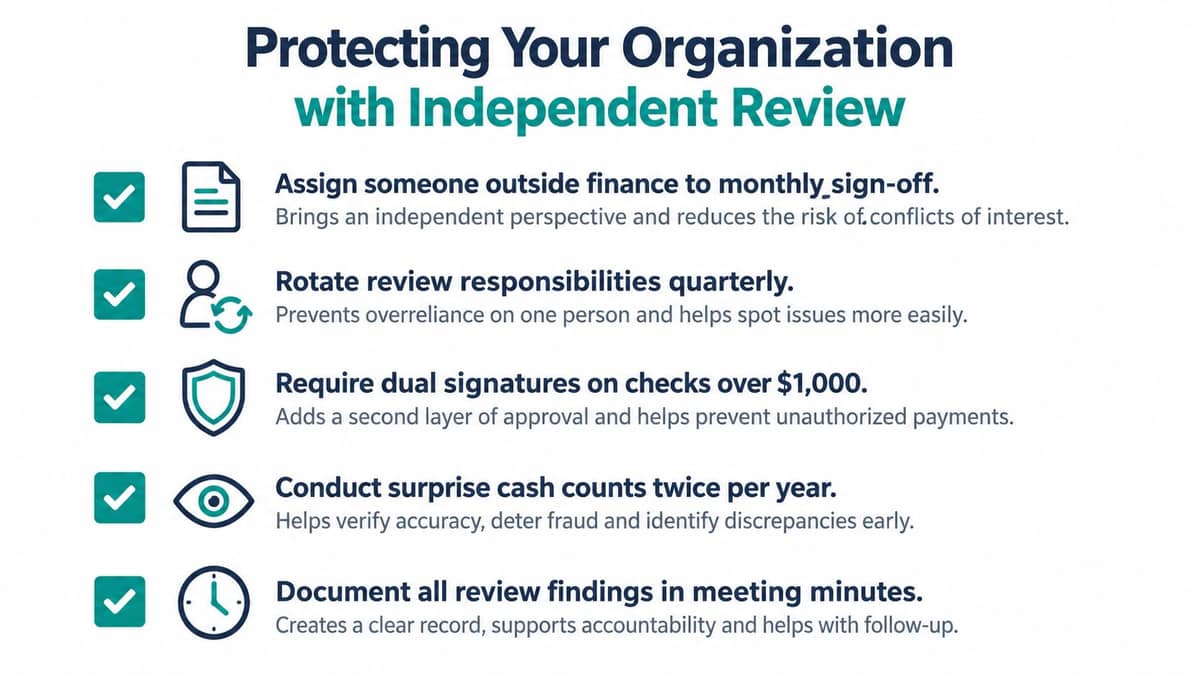
- Who reviewed the reconciliation? Look for a dated sign-off from someone independent of payment preparation.
This process creates a bounded exception population. Finance staff can trace each open item to an invoice, deposit record, canceled check, donor record, grant document, or journal entry. You're no longer asking whether the books “look right.” You're asking whether each difference has a defensible explanation.
Duplicate charges deserve particular attention because they can hide among recurring vendors and electronic payments. Compass+ provides a practical resource on saving money with Compass+, which can help your team think clearly about duplicate transaction review.
For a consistent record, use bank reconciliation reports that preserve cleared transactions, outstanding items, ending-balance comparisons, and review history. A board packet becomes more credible when the report shows both the conclusion and the work supporting it.
Why a Balanced Bank Statement Is Not Enough
A bank balance can reconcile perfectly while your nonprofit remains financially wrong.
Consider a donor who gives money for a youth program. The deposit clears the bank, and your accounting system records the cash correctly. If the transaction lands in unrestricted funds instead of the designated program fund, the bank reconciliation succeeds while your stewardship fails.
Under current nonprofit accounting standards, net assets are divided into net assets with donor restrictions and net assets without donor restrictions. Your records must show the original restriction, spending against it, and the remaining balance. Review this overview of nonprofit accounting standards for the fund-accounting framework.
A bank statement can prove that money arrived. It can't explain whether that money belongs to a particular grant, campaign, program, or donor restriction. Your accounting records must carry that meaning.
Reconciliation validates cash, not classification
The same issue appears with grant spending. A payment can clear the bank and reconcile to the ledger while staff charge it to the wrong award. The total cash remains accurate, but the grant report becomes unreliable, and the organization may struggle to support its drawdown.
Program reporting creates another risk. A shared invoice might include program services, administration, and fundraising. A payroll payment may support several activities. If the accounting system stores only a general bank category, you'll need manual work to reconstruct the allocation later.
That's why true fund accounting differs from QuickBooks classes or tags. Classes can help organize information, but they don't automatically create a complete relationship between donor intent, grant requirements, spending, and remaining balances. Spreadsheets often fill the gap, especially during audit preparation.
A reconciled cash account tells you what cleared. Fund accounting tells you what that cash may be used for.
Your review should therefore ask two separate questions. Did the transaction clear the bank and enter the books correctly? Did the organization assign it to the right fund, grant, program, donor restriction, and expense category?
Use a clear reconciliation definition when training staff and board members. The distinction matters because a clean cash balance can still conceal an overstated unrestricted balance or an unsupported grant report.
Protecting Your Organization with Independent Review
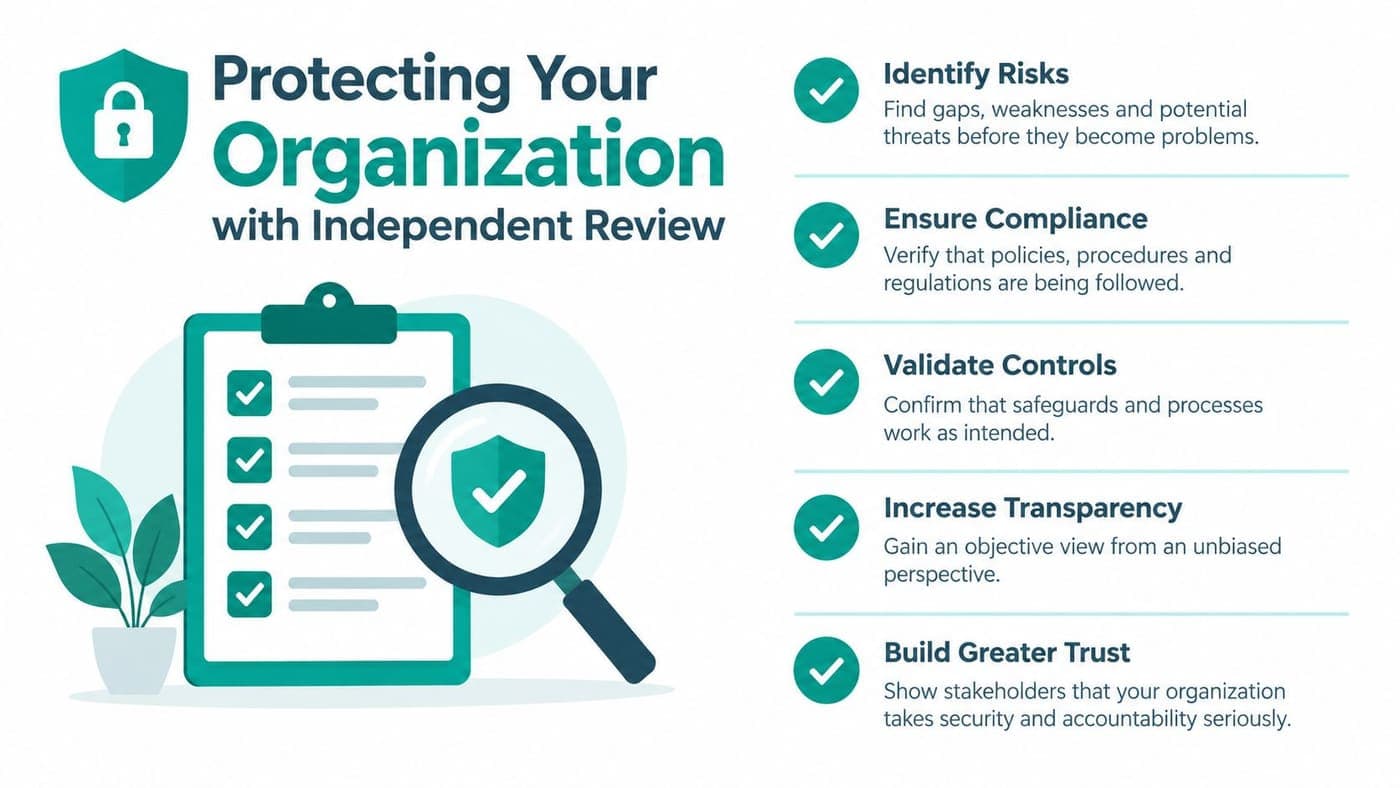
Small nonprofits often can't separate every finance duty perfectly. One employee may receive donations, prepare deposits, enter transactions, and prepare the reconciliation. That staffing reality doesn't justify skipping the control. It requires a compensating review designed by the board.
Federal internal-control guidance identifies cash and bank accounts as especially vulnerable assets and recommends monthly reconciliations plus independent reviews to reduce the chance that misappropriation remains hidden. Read the Oregon Department of Justice's financial-control recommendations for small nonprofits.
Separate preparation from approval
Start by assigning the reconciliation to someone who doesn't issue or sign checks whenever possible. If your finance manager prepares payments, the executive director, board treasurer, or finance committee member should review the bank statement and reconciliation.
The reviewer should inspect more than the final balance:
- Review the full bank statement, including canceled checks, electronic withdrawals, transfers, and deposits.
- Compare unusual transactions with invoices, donor records, grant approvals, and payment authorizations.
- Examine open reconciling items for age, explanation, and planned resolution.
- Confirm restricted activity against fund records and donor or grant documentation.
- Date and sign the review, then retain the evidence with the monthly close materials.
This arrangement doesn't need a large finance department. It needs a clear assignment and enough access for the reviewer to challenge unusual activity. A board treasurer can review the report remotely, ask questions, and document approval without taking over daily bookkeeping.
Design controls your team can maintain
Don't create a policy nobody follows. If you can't add staff, use compensating controls such as board review of statements, canceled checks, unusual transactions, reconciliation reports, and unresolved differences. Document the arrangement in your finance policy so responsibilities remain clear when staff change.
For deeper governance context, this internal audit independence guide offers useful principles for separating review from operational responsibility. An audit trail also matters. Your audit log should show who changed a transaction, when the change occurred, and what review followed.
Technology can reduce mechanical matching work by connecting donor records, bank feeds, and ledger activity. It can't replace judgment. Someone independent still needs to examine exceptions and decide whether the accounting meaning is correct.
Choosing Software That Understands Fund Accounting
A green “matched” label can hide a serious governance problem. The transaction may clear the bank while the software leaves your team guessing which restricted fund, grant, or program should receive it. Choose a system that makes those decisions visible and reviewable.
QuickBooks Online is familiar, widely supported, and useful for general bookkeeping. Aplos offers a nonprofit-focused option, while Blackbaud Financial Edge supports organizations with more developed finance requirements. Compare each product by the manual work it leaves around restricted funds, grants, functional expenses, donor records, and reconciliation evidence.
Compare the workflow, not the brand promise
Bank matching confirms that money moved. It does not, by itself, preserve the original restriction, record its release, or show the remaining amount available for a grant or program. Classes and tags may help with reporting, but they do not always provide the full history your board, auditor, or grantor needs.
Part IX of IRS Form 990 reports expenses across program services, management and general, and fundraising, so one payment may require allocation between multiple functional categories. Review this explanation of functional reporting for nonprofit expenses.
| Platform | Fund Accounting Method | Reconciliation Workflow |
|---|---|---|
| QuickBooks Online | Classes, tags, and configured nonprofit workflows | Bank matching with additional review and reporting work |
| Aplos | Nonprofit-focused accounting and fund tracking | Reconciliation designed for nonprofit records, with workflow details to assess |
| Blackbaud Financial Edge | Dedicated nonprofit financial management | Structured reconciliation and reporting for organizations with established finance operations |
| AlignMint | Native fund accounting for restricted funds, grants, and programs | Bank-feed matching, discrepancy review, and connected donor-finance records |
Ask these questions before switching
Ask whether the system preserves the original restriction, spending against it, and the remaining balance. Confirm that grant drawdowns, Statements of Functional Expenses, and Form 990 reporting use the same underlying records. If staff must rebuild those reports in spreadsheets, the system is increasing review risk.
Check every handoff between donor management, volunteer management, events, online giving pages, marketing tools, team communication, and accounting. Separate tools can work, but each transfer creates another opportunity for incorrect coding or incomplete reconciliation.
AlignMint combines accounting, CRM, volunteers, events, and marketing in one platform. Its stated offering includes fund accounting, direct bank-feed reconciliation, Minty AI for questions about organizational data, plan-based access without per-seat fees, and a free tier for nonprofits under $100K in annual fundraising.
Choose software based on evidence, not automation claims. Your reviewer should be able to see exceptions, your finance team should explain classifications, and your board should follow how each balance connects to its purpose.
Building Confidence in Your Financial Oversight
Good reconciliation gives your organization more than an accurate cash balance. It supports grant drawdowns, donor reporting, board oversight, audit preparation, and the daily decisions that keep programs operating.
Fiscal sponsorship makes this discipline even more important. Fiscal sponsorship requires tracking receipts, approved expenses, and remaining balances for each project, rather than combining activity into one unrestricted cash pool. Review the IRS comment concerning fiscally sponsored projects.
A sponsor may hold project money in a shared bank account, but the bank statement won't identify which project owns each dollar. Your internal fund records must connect deposits, approved expenses, transfers, and remaining balances to the right sponsored project.
The same principle applies to churches and schools managing multiple programs, grants, events, and giving campaigns. A single account can hold money with different purposes, and reconciliation alone can't determine whether each dollar remains available for its intended use.
Board-level test: Can someone outside daily finance explain what cleared, what remains open, and what each restricted balance can fund?
Review your current process against that question. If your team relies on spreadsheets to reconstruct donor restrictions, grant codes, or functional expense allocations, you have a governance gap, even if the bank balance ties out.
Start by assigning an independent reviewer, documenting every exception, and requiring fund-level evidence before reports reach the board. Then evaluate whether your current software connects accounting, donor management, volunteers, events, marketing, and communication closely enough to support that discipline.
AlignMint brings accounting, true fund accounting, donor records, bank-feed reconciliation, volunteers, events, marketing, and team communication into one platform, with Minty AI available to answer questions about your real data. Visit AlignMint to see whether it can give your team clearer monthly controls without adding per-seat fees or another disconnected system.
Ready to try AlignMint with your nonprofit?
Start free — set up donor tools, giving pages, and Minty. Upgrade when you need accounting.