

For related tools, see AlignMint features.
Nonprofit Tax Filing Requirements Guide
Quick Answer: Nonprofit Tax Filing Requirements: A Director's Guide
Nonprofit tax filing requirements depend on gross receipts and total assets, not program size. Most exempt organizations file a 990-series return annually-even with no activity-and missing three consecutive years can revoke status. Match the form early, close books monthly, track restricted funds, and keep federal and state deadlines on one compliance calendar.
If you're staring at nonprofit tax filing requirements with a stack of spreadsheets, old donor reports, and a nagging sense that something is missing, you're not alone. Most filing stress doesn't start in tax season. It starts months earlier, when finance, fundraising, volunteer records, and board details live in different places.
The good news is that filing doesn't have to become an annual fire drill. When your daily systems are organized, your return becomes a summary task instead of a rescue project.
Understanding Which IRS Form Is Right for You
A nonprofit can spend months keeping programs on track and still hit confusion at filing time because no one confirmed which 990-series form applies. I have seen that happen even in organizations with solid missions and active boards. The fix is straightforward. Match the form to your current financial reality early, and your year-end filing gets much easier.
For most nonprofits, the IRS expects an annual information return from the Form 990 series. The version you file depends on gross receipts and total assets, not program complexity or staff size. The Council of Nonprofits federal filing guide lays out the core thresholds clearly.
| Form Name | Annual Gross Receipts | Total Assets |
|---|---|---|
| 990-N | Under $50,000 | Not the deciding threshold for this filing level |
| 990-EZ | Under $200,000 | Under $500,000 |
| Form 990 | $500,000 or more | Full form required at this level |
The practical judgment call usually shows up around growth. A nonprofit that started the year expecting to file a 990-N may need a 990-EZ by year-end because grants arrived, events performed better than expected, or a large pledge was recognized. That is why strong day-to-day accounting matters. If revenue, restrictions, and asset balances live in one system instead of separate spreadsheets, the right form is usually obvious well before the close.
The IRS also draws a hard line on the full Form 990. An exempt organization must file it if gross receipts are $200,000 or more, or total assets are $500,000 or more at year end. Organizations with gross receipts normally $50,000 or less file Form 990-N instead. Missing filings for three consecutive years can trigger automatic revocation of exempt status, as explained in IRS Publication 4839.
Here is the shortcut I recommend. Decide your likely filing tier during the year, then confirm it again as part of your close. Do not rely on memory, last year's form, or a casual comment that you are "still small enough for the postcard." Threshold mistakes usually start with stale numbers.
That is one reason finance teams benefit from all-in-one systems. When contributions, grants, expenses, and balance sheet activity are already connected, the 990 becomes the output of clean records rather than a separate data-gathering project. Teams comparing tools often start with outside evaluations such as 2026 nonprofit accounting software reviews, but the ultimate test is simpler. Can your system show your filing position without manual consolidation?
If you are filing for the first time or setting up your process after exemption, review a Form 990 guide for new nonprofits before year-end. It is much easier to choose the right form when your books have been built for that decision from the start.
Key Deadlines and How to Prepare Your Financial Data
The deadline is predictable. The scramble is usually self-inflicted.
Your annual Form 990-series return is due on the 15th day of the 5th month after your fiscal year ends. For a calendar-year nonprofit ending on December 31, that means May 15. For a July-June fiscal year, common in schools, the deadline is November 15, as outlined by Nixon Peabody's nonprofit filing overview.
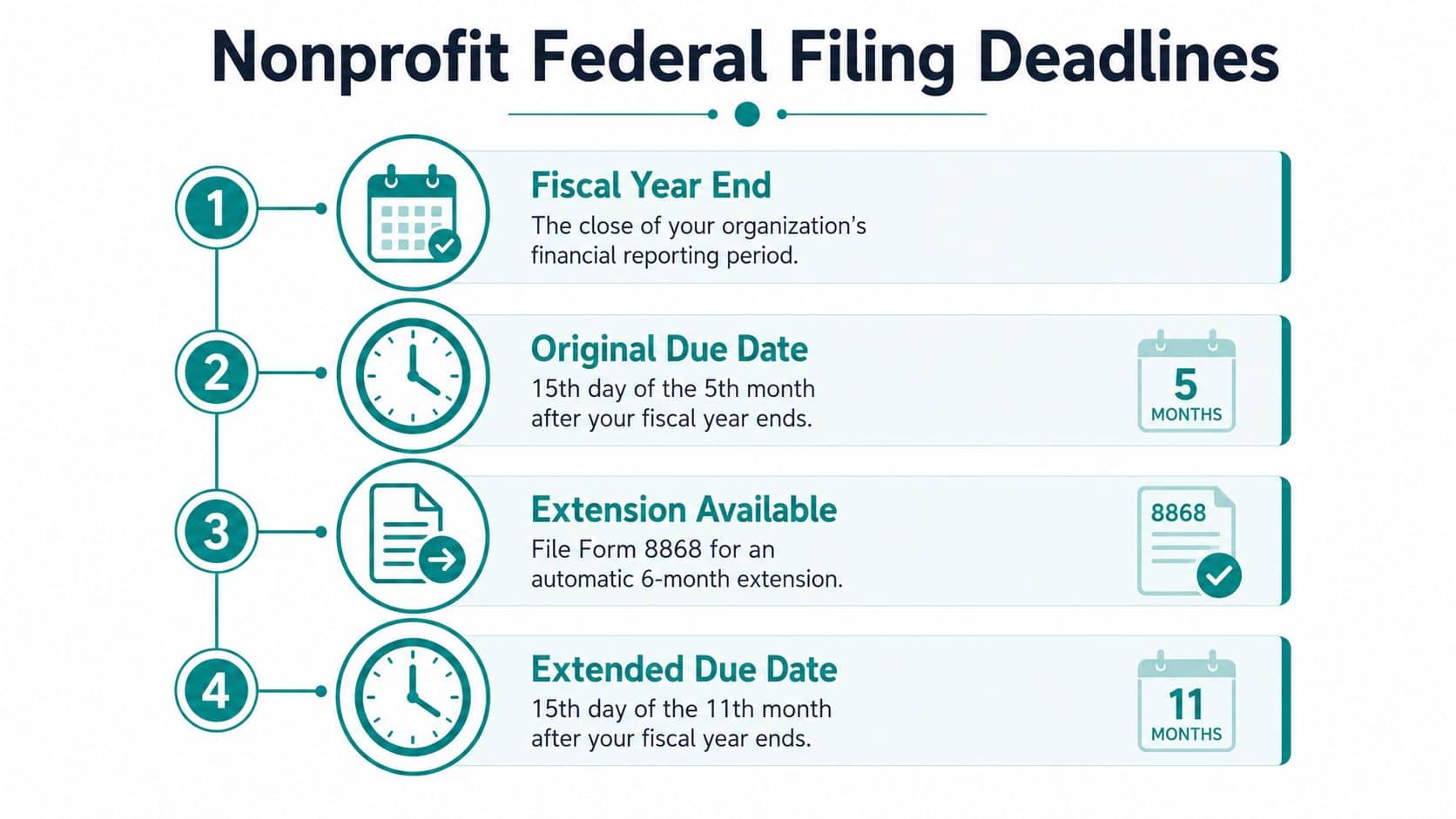
Deadlines are manageable when your close is clean
Missing a deadline often starts with weak month-end discipline. If your bank accounts aren't reconciled, restricted funds aren't current, and grant activity sits in side spreadsheets, the form becomes the least of your worries.
A cleaner approach is to prepare the same way every month:
- Close cash first: Reconcile bank and credit accounts before anyone starts pulling reports.
- Review restricted activity: Make sure grants, donor restrictions, and program spending are coded correctly.
- Confirm functional expenses: Expenses need to reflect how work was carried out across programs, management, and fundraising.
- Update leadership records: Officer and board information gets forgotten more often than finance teams expect.
A simple month-end close checklist for nonprofits can prevent most of the year-end panic.
True fund accounting changes the workload
Now, software choices become practical, not philosophical. QuickBooks is familiar, and many nonprofit teams know it well. Its strength is general bookkeeping. Its gap is that many nonprofits end up using classes and workarounds to imitate fund accounting.
That usually means extra exports, more spreadsheets, and more room for inconsistency. A system built around true fund accounting tracks restricted funds, grants, and programs directly, so the reports behind your filing are already shaped the way nonprofit finance teams need them.
If you're comparing options without wanting a sales pitch, these 2026 nonprofit accounting software reviews offer a useful outside view of what different tools handle well.
The smoothest filing season starts in August, not in April.
One practical option is AlignMint's fund accounting tools, which combine accounting with donor, volunteer, event, and marketing records in one platform. That matters because tax prep gets easier when receipts, grants, donor acknowledgments, and program spending aren't scattered across separate systems.
Looking Beyond the Form 990
Many directors think the annual return is the whole game. It isn't.
Some of the most common compliance problems sit just outside the main filing. They don't always take much activity to trigger, and they often catch small teams because no one thought to look.
Watch for unrelated business income
If your organization earns $1,000 or more in unrelated business income, it must file Form 990-T and may owe unrelated business income tax, according to Brady Martz's nonprofit tax compliance overview.
That can surprise a team that sees a side activity as harmless support for the mission. Common examples include merchandise sales, ticketed events, or income streams that feel routine but don't fit the core exempt purpose.
A good internal habit is to flag any revenue stream that feels commercial before it grows. If you need a plain-language refresher, this unrelated business income glossary entry is a useful reference.
State filings are a separate track
Federal compliance doesn't cover state compliance. If you fundraise, many states require charitable solicitation registration or annual renewal. Some states also expect separate exemption forms or state-level reporting.
That matters for growing organizations, church ministries with broader outreach, schools running development campaigns, and fiscal sponsors overseeing several projects with activity across state lines. The filing calendar gets harder when each office keeps its own notes.
Here is the practical distinction I recommend:
- Federal return: Your annual IRS filing based on organization-wide financial reporting.
- State charitable registration: Your permission and obligation to solicit support in a given state.
- State tax and exemption maintenance: Additional filings tied to state rules, sales tax treatment, or exempt status renewals.
What works is keeping one compliance calendar that includes both IRS and state dates. What doesn't work is treating state registration as an afterthought once a campaign is already live.
Common Pitfalls That Can Jeopardize Your Status
Most serious compliance failures don't begin with bad intent. They begin with ordinary assumptions that go unchallenged for too long.
The dangerous ones sound familiar. "We had no activity." "We're too small for the IRS to care." "We'll catch up next year." Those statements have put many otherwise careful organizations in a weak position.

The no-activity myth is costly
The IRS requires every tax-exempt organization under Section 501(c) to file an annual return or notice even when there is no financial activity, and failure can lead to penalties or revocation after three years of non-filing, as explained in this NATP article on Form 990-N for inactive nonprofits.
This catches dormant groups, start-up charities, and faith-based organizations more than people realize. A board takes a pause, a founder steps away, or a church ministry has a quiet year. The organization still exists, so the filing duty still exists.
If the entity is alive, the filing requirement is alive.
Three misses can become a governance crisis
Automatic revocation is not a paperwork inconvenience. Once status is lost, donor confidence gets shaky, grant eligibility becomes harder to protect, and leadership has to spend time fixing something that should never have broken.
The cleanest prevention habit is simple:
- Assign one owner for annual filing responsibility.
- Put the due date on the board calendar, not just the finance calendar.
- Review filing status midyear, while there's still time to correct gaps.
- Keep last year's return and current-year close documents together in one controlled place.
Weak systems create avoidable errors
Another pitfall is fragmented reporting. Finance has one list of officers. Development has another donor record. Programs track volunteers separately. Marketing sends acknowledgments from yet another tool.
That split creates mistakes in donor acknowledgments, board reporting, and year-end disclosures. It also makes your Statement of Functional Expenses much harder to defend because staff often reconstruct allocations after the fact.
The better habit is year-round consistency. Record expenses properly when they happen. Keep donor data tied to finance records. Use one source of truth for officers, grants, and program activity.
For a practical look at the systems side of prevention, this article on nonprofit tax compliance tools is worth reviewing.
Your Actionable Filing Readiness Checklist
You don't need a heroic tax season. You need a short list that tells you whether your records are ready.
When nonprofit tax filing requirements feel heavy, the answer usually isn't more effort. It's better preparation in the right places. A filing checklist works best when each item confirms that your normal operations already produced what the return needs.
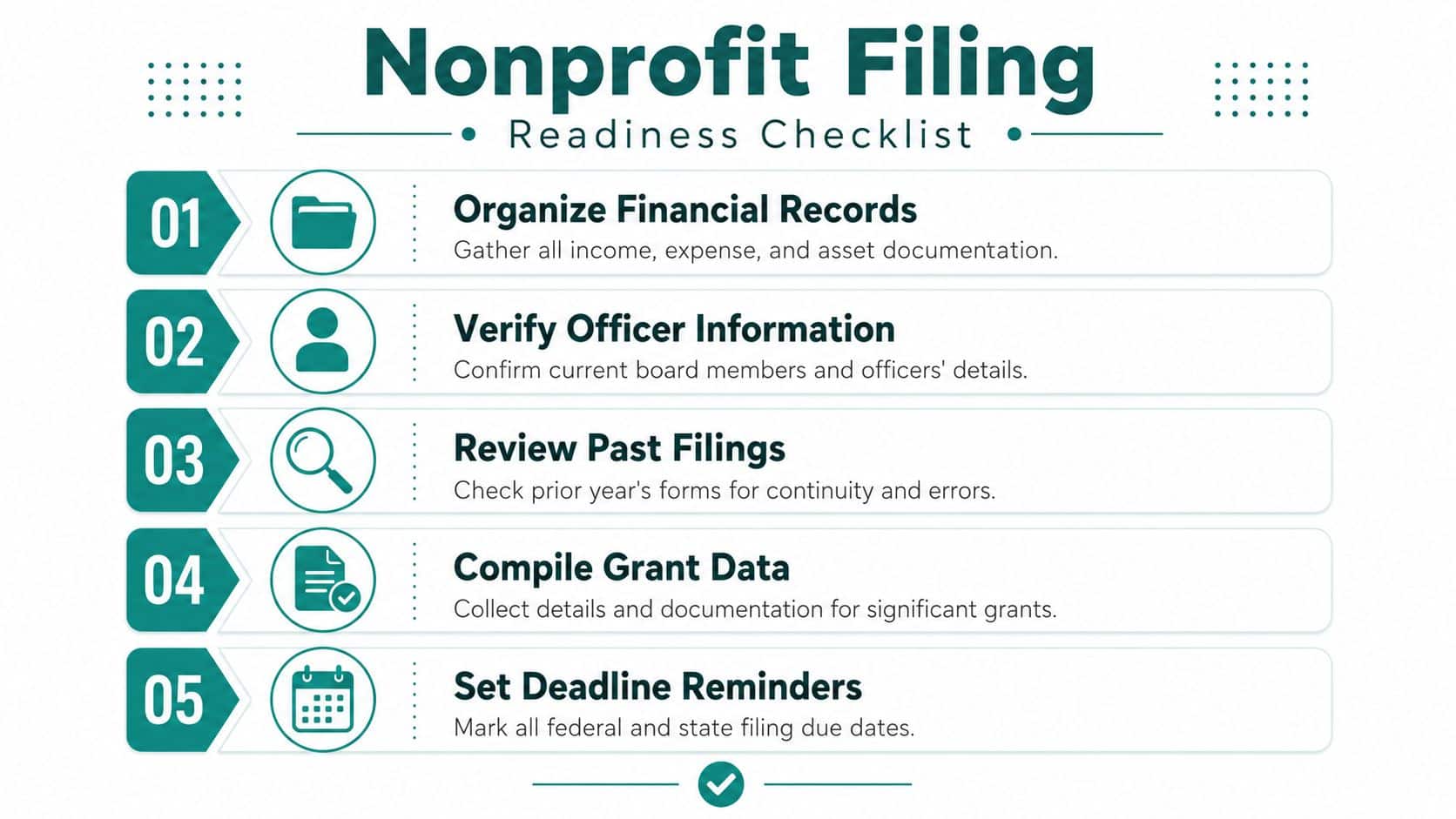
The five checks that matter most
- Organize financial records: Confirm your income, expenses, and asset balances tie back to your general ledger and bank reconciliations.
- Verify officer information: Make sure current officers and board leaders are accurate before anyone drafts the return.
- Review the prior filing: Last year's return tells you where continuity matters and where recurring schedules may appear again.
- Compile grant activity: Gather restricted revenue, releases, and grant spending support in one place.
- Set all reminders early: Federal and state deadlines should live on a shared compliance calendar.
A more detailed Form 990 checklist for nonprofit teams can make this review faster.
Why all-in-one systems reduce last-minute work
The filing itself happens once a year. The data behind it is created every day.
That is why all-in-one software matters more than tax-prep software alone. If your accounting, donor management, volunteer management, events, team communication, and marketing suite live together, many year-end tasks become confirmations instead of reconstruction. Your online giving pages already feed donor records. Your donor acknowledgments are easier to track. Your grant reports line up with your books. Your church or school team isn't chasing updates across disconnected tools.
That same logic helps with staff handoff. If you're training a finance manager, development lead, or office administrator, documented procedures save real time. A plain-English SOP playbook for training managers is useful for turning recurring compliance tasks into repeatable routines.
A filing checklist should support daily work
The strongest checklist isn't a tax-season document. It's an operating discipline.
Here are the habits I trust most:
- Monthly confirmation: Review restricted balances and unusual transactions while details are still fresh.
- Quarterly donor review: Make sure giving records, acknowledgments, and campaign tags still match finance records.
- Leadership updates: When board roles change, update records once, not in four different systems.
- Program coordination: Volunteer activity, events, and campaign results should be easy to connect back to the underlying finances.
- Simple reporting: Board-ready financial reports should come from your system, not from a fresh spreadsheet every meeting.
Good filing preparation feels uneventful. That's the sign your systems are doing their job.
If your current setup requires repeated exports between accounting software, CRM records, email tools, and volunteer systems, the load compounds. If your records live together, your AI assistant can answer practical questions from actual data, donor management stays connected to accounting, and even fiscal sponsorship reporting becomes more predictable.
For many directors, that's the genuine relief. Not a flashy dashboard. Just fewer loose ends when the form is due.
Achieve Confidence in Your Compliance
Strong compliance is really a stewardship practice. Your return shows that your board, staff, donors, volunteers, and community can trust how the organization handles money and records its work.
That confidence doesn't come from working harder in one month. It comes from running finance, fundraising, and operations in a way that leaves a clear trail all year. When your fund accounting is current, donor management is connected, volunteer records are organized, and team communication isn't scattered, filing becomes much simpler.
Competitors like QuickBooks, Bloomerang, DonorPerfect, Aplos, Blackbaud, and Little Green Light each have strengths in their own areas. The gap many teams run into is consolidation. They still have to move information between accounting, CRM, volunteers, events, and marketing before they can prepare year-end reporting cleanly. An all-in-one approach removes much of that manual stitching.
If your nonprofit is under $100K in revenue, our free tier removes one barrier to getting organized early. That matters for start-ups, smaller churches, school support groups, and lean community nonprofits that need real structure without adding another line item to the budget.
If you want nonprofit tax filing requirements to feel routine instead of risky, take a look at AlignMint. We bring together fund accounting, donor management, volunteer management, events, online giving pages, team communication, marketing tools, fiscal sponsorship support, and Minty in one place, with unlimited users and no per-seat fees.
Ready to try AlignMint with your nonprofit?
Start free — set up donor tools, giving pages, and Minty. Upgrade when you need accounting.