

A volunteer program can look healthy from across the room and still feel shaky in the office. People show up. Staff make it work. But behind the scenes, your team is chasing forms, filling shifts at the last minute, and hoping everyone got the same instructions.
That strain wears people down. It also puts your mission at risk when volunteer experience depends on whoever had time to coordinate it that week. Volunteer management certification gives you a professional framework for running the program with more consistency, less guesswork, and better stewardship of staff time.
Introduction
If you've ever thought, “Our volunteers are wonderful, but the process is held together with emails and goodwill,” you're not alone. Many nonprofits treat volunteer coordination like a set of small tasks. In practice, it's closer to financial management. Small mistakes add up, and good intentions don't replace clear standards.
That's why volunteer management certification matters. It isn't just another workshop for a staff member's file. It's a formal way to build a stronger volunteer function, with clearer expectations, better risk awareness, and more dependable follow-through.
The field has a real professional standard behind it. The Council for Certification in Volunteer Administration is the primary global body that awards the professional Certificate in Volunteer Administration, which has become the foundational credential for the field according to this overview of volunteer management training programs. That matters because it separates serious practice from informal trial and error.
A workshop can give your coordinator a few ideas. A credential asks for demonstrated competence.
Practical rule: If volunteers are essential to delivery, volunteer leadership needs standards just like finance, compliance, and development do.
You can also see the difference in day-to-day execution. Certified managers are trained to think in systems. They pay attention to role design, training consistency, documentation, recognition, and risk. Those aren't abstract concepts. They're the habits that keep your team from spending Friday afternoon cleaning up Monday's preventable problems.
If your current process relies on memory, spreadsheets, and a few dedicated staff members, it helps to review what a modern volunteer management system should support before you invest more time in patchwork fixes.
What Is Volunteer Management Certification Really
You see the difference during a busy week. One volunteer manager spends the day chasing missing forms, filling shifts at the last minute, and answering the same basic questions over and over. Another has clear roles, consistent onboarding, documented policies, and volunteers who know where to go and what success looks like. Certification points toward the second kind of operation.
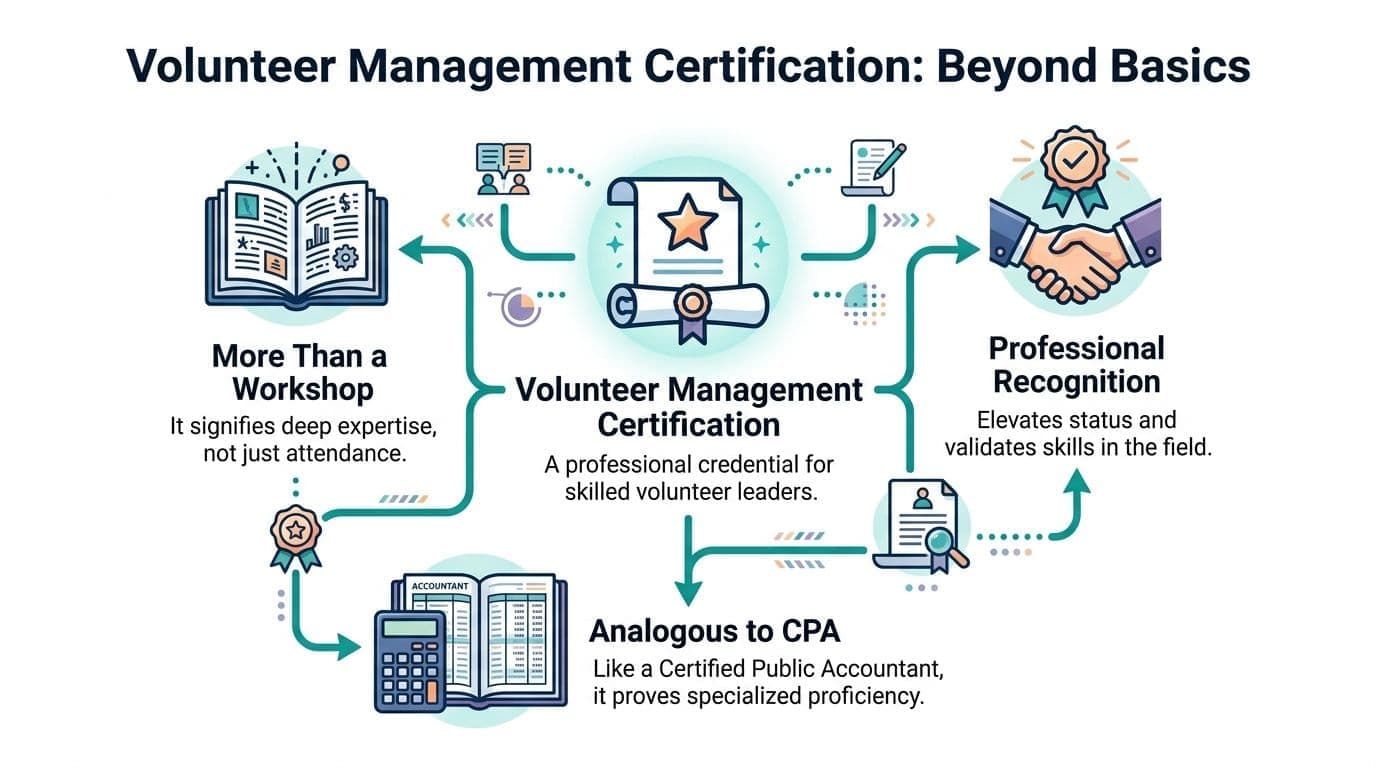
It signals that a staff member has done more than attend training. They have met a recognized professional standard for leading volunteers in a structured, accountable way.
That matters when volunteers represent your organization in public, support direct service, or carry work that staff alone cannot absorb. In those settings, volunteer management is part of operations, risk management, and program quality.
More than attendance
Plenty of nonprofit training is helpful. A webinar can give someone a few good ideas. Certification asks for something harder. It measures whether a person can apply established standards to real situations such as screening, placement, supervision, conflict, recognition, and recordkeeping.
The main benchmark in this field is the CVA, administered by the Council for Certification in Volunteer Administration. As noted earlier, the CVA is widely treated as the profession's standard credential, and the CCVA is the body that awards it.
For an executive director, that distinction matters because credentials affect execution. A certified volunteer leader is more likely to build repeatable systems, document decisions, and make judgment calls that hold up under pressure. That saves staff time and protects the mission when things get busy or messy.
What certified practice looks like
In practice, certified management usually shows up in ordinary but important work. Role descriptions are written clearly. Orientation is consistent. Screening standards are not left to personal preference. Recognition is planned, not improvised in April because someone remembered National Volunteer Week.
It also shows up in retention. Volunteers stay longer when expectations are clear and their time is respected. Simple gestures help, but appreciation works best when it sits inside a well-run system. If your team needs ideas for that piece, these 10 ideas for volunteer appreciation are useful. Appreciation alone will not fix a weak program.
That is the trade-off leaders need to understand. Certification does not replace good software, and software does not replace management discipline. Certification helps your team decide what standards to set and how the program should run. The right platform helps staff carry out those standards consistently across sites, shifts, and seasons.
For organizations trying to connect those principles to daily execution, this guide to building a volunteer management program that staff can actually maintain is a practical next read.
Why This Matters for Your Mission and Bottom Line
A volunteer program that runs on instinct costs more than it appears to. The cost shows up in staff time, inconsistent service, avoidable risk, and volunteer churn that forces your team to keep starting over.
That's why certification should be viewed as an organizational investment, not a personal perk. You're not only paying for education. You're strengthening a function that touches program delivery, public trust, and internal capacity.

The volunteer pool is tighter
This issue has become more urgent because volunteer supply is harder than it used to be. According to Rosterfy's review of volunteer training programs, average active volunteers per organization fell post-COVID from 101–250 to 51–100. When the pool is smaller, weak management hurts more.
You can no longer assume that generous people will tolerate disorganization. Skilled volunteers, especially, want clarity. They want to know what they're doing, who they report to, and whether their time is being respected.
Certification improves the quality of the operation
Here's the practical payoff. A certified volunteer leader is more likely to build structure before chaos hits. That means clearer roles, better documentation, stronger training habits, and more intentional recognition.
Those improvements help your mission in visible ways:
| Area | Informal coordination | Professionally managed program |
|---|---|---|
| Volunteer roles | Vague and reactive | Defined and matched to need |
| Training | Inconsistent by staff member | Documented and repeatable |
| Recognition | Occasional and last-minute | Planned and tied to retention |
| Risk handling | Based on memory | Based on process |
| Staff burden | Heavy follow-up | More self-sufficiency |
Recognition is a good example. Leaders often know appreciation matters, but they treat it as a seasonal event. Certified managers usually build it into the year. If your team needs fresh ideas, these 10 ideas for volunteer appreciation are practical and easy to adapt.
A better program protects scarce staff time
The hidden return is time. When volunteer files are current, expectations are clear, and supervisors follow the same process, staff spend less time chasing paperwork and correcting misunderstandings.
That matters in finance and development too. If your office already uses separate tools for accounting, donor records, communications, and volunteers, every handoff creates another chance for something to get dropped. Better volunteer management doesn't live in isolation. It supports cleaner communication, better team coordination, and more dependable stewardship across the whole organization.
The strongest volunteer programs don't rely on heroic staff effort. They rely on repeatable practice.
For a deeper operational checklist, this article on volunteer management best practices is worth sharing with your leadership team.
Comparing the Leading Volunteer Management Certifications
If you're weighing options for your team, the field can feel more crowded than it really is. There are short courses, university-based certificates, webinars, and national qualifications. Those can all help. But they don't all serve the same purpose.
For many organizations, the question isn't “Should our volunteer lead learn more?” It's “What kind of credential is worth funding?” That's where a side-by-side review helps.
The benchmark option
The Certified in Volunteer Administration, or CVA, is the credential most leaders should understand first. According to Galaxy Digital's overview of the CVA, candidates must document at least three years of full-time experience in volunteer resources management, with a minimum of 30% of their current position dedicated to volunteer management.
That requirement is useful because it filters for real practice. This isn't designed for someone who occasionally helps with signups. It's built for people who actively lead volunteer engagement as a meaningful part of their role.
The same source explains that the CVA is organized around seven standardized competencies. Those competencies give you a practical window into what your staff member will be expected to know.
The seven competency areas
These areas are what make the credential relevant to executive leadership. They reflect real operating needs.
-
Plan and design strategic volunteer engagement This is the difference between “we need more help” and an actual volunteer strategy tied to program outcomes.
-
Advocate for volunteer involvement Good leaders don't just manage volunteers. They help staff and board members understand where volunteers fit and where they don't.
-
Attract and onboard volunteers Recruitment matters, but fit matters more. Strong programs define roles well and set expectations early.
-
Prepare and train volunteers Training protects your mission. It also protects your staff from repeating the same instructions all year.
-
Document volunteer involvement Documentation is often neglected until there's a problem. Certified practice treats it as normal operating discipline.
-
Manage volunteer performance and impact Volunteers deserve feedback and support. So do staff who supervise them.
-
Recognize, celebrate, and sustain engagement Retention is built here. Appreciation works best when it's thoughtful, specific, and consistent.
If a credential doesn't improve the way your organization plans, documents, and supervises volunteer work, it's probably education, not transformation.
Other valid pathways
Not every team member needs the CVA. In some cases, a course-based certificate or a national qualification may fit better, especially for earlier-career staff or teams outside the United States.
Australia, for example, has the Certificate IV in Coordination of Volunteer Programs, a formal qualification noted in the earlier source material. There are also university and provider-based certificate programs that offer structured learning without the same competency assessment model.
Those pathways can be very good for foundation building. They're often more accessible to newer staff. The trade-off is that they may not carry the same professional weight as a competency-based credential.
Comparison of Volunteer Management Credentials
| Credential | Best For | Est. Cost | Time Commitment | Renewal |
|---|---|---|---|---|
| CVA | Experienced volunteer leaders who want a recognized professional credential | Qualitative only. Costs vary, and this credential includes fees tied to certification and renewal | Moderate to significant. Requires portfolio preparation, exam readiness, and documented experience | Yes. Renewal is required |
| Certificate IV in Coordination of Volunteer Programs | Teams in Australia seeking a formal qualification in volunteer program coordination | Qualitative only | Significant, as part of formal vocational study | Depends on provider and qualification rules |
| University or provider-based certificate | Staff who need structured learning but may not yet meet CVA eligibility | Qualitative only | Varies by provider | Usually depends on the issuing program |
| Short workshops and webinars | Staff who need topic-specific help quickly | Qualitative only | Short | Usually no formal renewal |
How to make the call
For a busy executive director, the best decision usually comes down to three questions:
- Is this person already leading volunteers at a meaningful level? If yes, the CVA deserves serious consideration.
- Do you need immediate skill building or long-term professional validation? Those are different purchases.
- Will your organization support the process? Certification works best when the staff member has time, documentation, and leadership backing.
A credential is only as useful as the operating changes it enables. If your staff member earns one and then returns to disconnected spreadsheets, duplicated records, and unclear reporting lines, the organization won't see the full benefit.
Your Path to Getting Certified
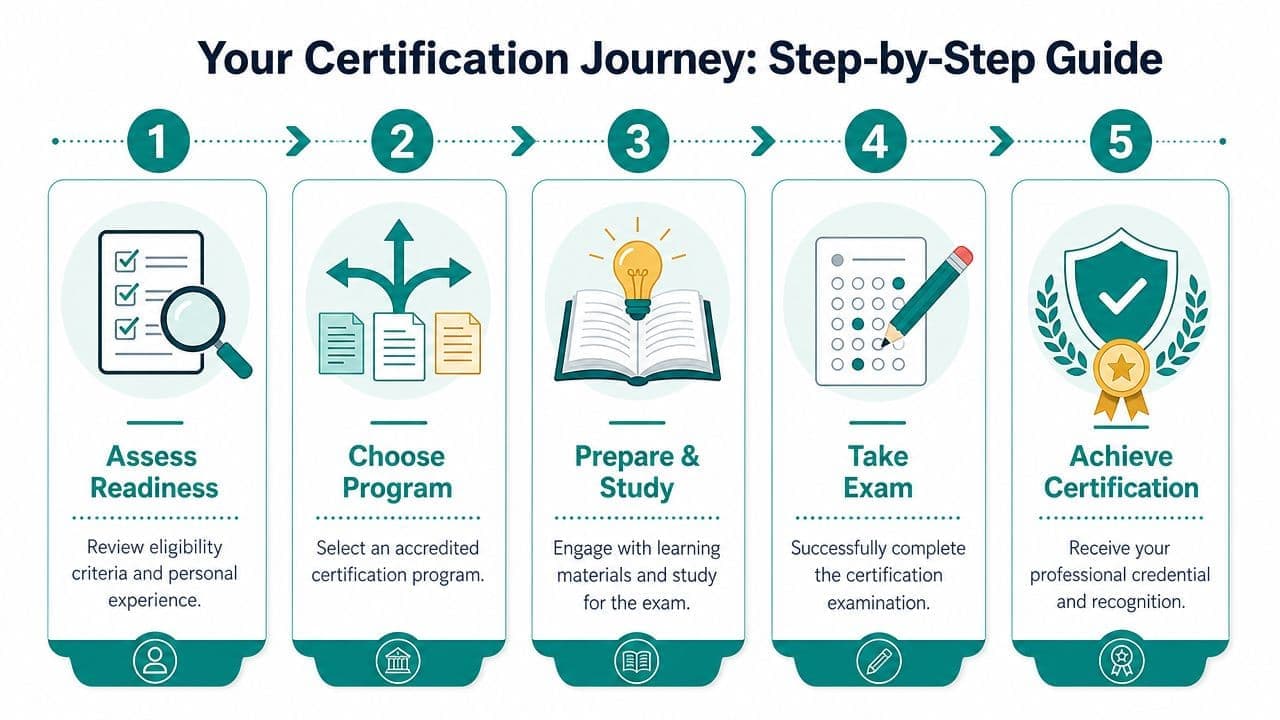
For many teams, the hardest part of certification is not the content. It's the uncertainty around where to start. Once the process is broken into steps, it becomes much more manageable.
The CVA path is especially workable when the organization treats it like a project, not a side hobby. That means setting aside time, gathering records early, and giving the staff member real support.
Step one is checking fit
Start with eligibility. The CVA is intended for people already working in volunteer resource management, so your first task is confirming that the staff role matches the standard. If volunteer leadership is only a small side duty, another training path may make more sense for now.
Then look at your internal records. Can the candidate show examples of role planning, volunteer training, recognition, documentation, and performance support? Those examples matter because the credential is competency-based, not attendance-based.
Step two is gathering real evidence
Organizations either help or hinder the process. Candidates need practical examples from their work, not just good intentions. If your volunteer records are scattered across spreadsheets, email threads, and paper files, documentation takes far longer than it should.
Clean systems help. A team that already tracks volunteer roles, service history, communication, and hours in one place will have an easier time pulling together evidence. The same is true when volunteer information connects with broader office operations like donor records, event participation, and internal team communication.
Step three is planning around the exam cycle
The process also has fixed dates. According to the CVA certification page, the exam is offered twice annually, in windows such as April 1–14 and October 1–14, with application and payment deadlines of March 1 and September 1.
That schedule is useful for planning. It means you can work backward from a clear deadline rather than leaving the effort open-ended.
A practical planning sequence looks like this:
- Confirm readiness early so the candidate isn't rushing to prove experience at the last minute.
- Set aside time for documentation because portfolio-quality examples take thought.
- Block study time on the calendar instead of hoping it appears between meetings.
- Assign internal support from a supervisor or executive sponsor who can review materials.
Certification goes better when the organization plans for it like grant reporting. Deadlines, documentation, and review all matter.
Step four is tying learning to daily work
Many nonprofits overlook the significant value. Certification should change operations while the person is preparing, not only after they pass. As they work through competencies, they can tighten volunteer role descriptions, improve staff guidance, standardize training steps, and clean up recordkeeping.
That is also why the practical tools matter so much. A well-run volunteer process needs a place to track skills, availability, hours, communication, and service history. Without that, the certified manager still knows what good looks like, but has to implement it manually.
If your team is also reviewing software choices, compare systems that connect volunteer work to fundraising, accounting, event coordination, and staff communication. That gives your certified staff member a way to put the framework into action instead of managing around your tech stack.
Connecting Strategy to Action with the Right Tools
A staff member finishes a certification course, comes back with better standards for screening, training, and retention, and then runs straight into the same old problem. Volunteer applications sit in one system. Schedules live in a spreadsheet. Hours are tracked by email. Donor history is somewhere else. Good strategy gets buried under admin work.
Certification improves judgment. It helps a leader make better decisions about role design, documentation, recognition, and accountability. The organizational return comes when your team can put those standards into daily practice without adding another layer of manual work.
Why disconnected tools keep good strategy from sticking
I've seen this pattern in a lot of nonprofits. The volunteer manager knows the right next step. The system around them makes that step harder than it should be.
Many familiar products handle one function well. Bloomerang is known for donor management. QuickBooks handles basic bookkeeping. Mailchimp covers email. Planning Center often fits church operations. SignUpGenius works for simple scheduling. The issue is not tool quality. The issue is fragmentation.
When volunteer data, finance, donor records, event participation, and staff communication live in separate places, staff start rebuilding the same record over and over. That costs time, but it also weakens decisions.
Common problems show up fast:
- Volunteer records drift because profile updates are spread across multiple systems.
- Finance lacks context when service activity is disconnected from programs, grants, or restricted funds.
- Development misses patterns when volunteer engagement never appears alongside giving history.
- Staff duplicate communication because email, text, and internal notes are stored in different tools.
For an executive director, that usually means more checking, more exceptions, and less confidence that the numbers and records match reality.
Hybrid and remote service raise the standard for execution
Volunteer work is no longer limited to on-site shifts. Many organizations now run a mix of in-person, hybrid, and fully remote roles. Earlier research on online volunteer management has pointed to a persistent training gap around remote engagement, and that gap shows up in operations every day.
Remote service asks for more structure, not less. Teams need clear role expectations, clean communication trails, reliable hour logging, and an easy way to confirm follow-through. Certification gives staff the framework for that work. The right system makes the framework usable at scale.
That is the strategic case for better software. You are not just buying convenience for one coordinator. You are giving the organization a way to apply certified practices consistently across departments.
What to look for in practice
A stronger setup usually brings these functions into one connected system:
| Need | What helps in practice |
|---|---|
| Volunteer coordination | Self-service profiles, scheduling, skills tracking, hour logging |
| Donor relationship history | Shared records across giving and service |
| Fund accounting | Native support for restricted funds, grants, and programs |
| Marketing | Email, text, and campaign tools tied to the same contact record |
| Team communication | Shared visibility across departments |
That matters because volunteer involvement often leads to something else. A volunteer becomes a donor. A donor joins an event committee. A committee member turns into an advocate or board prospect. If those relationships stay disconnected, your staff misses the full picture and your mission loses momentum.
If you're reviewing systems, look for software built for volunteer management within broader nonprofit operations. The strongest options help certified staff carry good standards into recruiting, scheduling, reporting, and cross-team coordination without forcing them to patch five tools together.
Making the Smart Choice for Your Organization
A common mistake happens after a staff member earns a certification. The executive director feels good about the investment, the board hears that the organization is adopting stronger practices, and then nothing changes in the day-to-day work. Volunteers still get scheduled in spreadsheets, donor and service records stay disconnected, and reporting takes hours longer than it should.
The smart choice is to treat certification as an organizational capacity decision. If you pay for training but do not give that staff member the authority, process support, and software to apply what they learned, you bought education without getting operational change.
That is the board-level question. Will certification help us recruit and retain volunteers more consistently, reduce staff time spent on manual coordination, improve compliance and recordkeeping, and give leadership a clearer view of how volunteer activity supports programs, fundraising, and community reach?
A good answer usually includes more than the course fee. It includes implementation. Certified staff need documented workflows, shared expectations across departments, and tools that support the full volunteer lifecycle in the same place the rest of the organization works. That is how training turns into better execution.
If your team is weighing that investment, this guide to nonprofit volunteer management software is a useful starting point for evaluating what your staff will need to carry certified practices into daily operations.
The goal is not to add another credential to the org chart. The goal is to build a stronger system for mission delivery.
If you're ready to connect stronger volunteer leadership with better daily execution, take a look at AlignMint. We built it as an all-in-one platform for nonprofits that need true fund accounting, donor management, volunteer coordination, events, marketing, online giving pages, team communication, and Minty in one place. Your team can work from the same operating record, and nonprofits under $100K can start on our free tier.
Ready to try AlignMint with your nonprofit?
Start free — set up donor tools, giving pages, and Minty. Upgrade when you need accounting.