

Planning a volunteer appreciation event often lands on your desk at the worst possible moment. You're closing the month, answering board questions, and trying to keep staff from burning out. The event can feel optional until you remember that volunteer retention, morale, and community trust all ride on whether people feel seen.
A good volunteer appreciation event fixes more than mood. It gives you a practical way to strengthen retention, document stewardship, and show your board that recognition is an investment with a clear purpose.
The Why Before the How for Volunteer Appreciation
A volunteer recognition event usually gets judged on the visible pieces first. Food, turnout, photos, maybe the room setup. Then the bill hits your desk, and the event gets written off as a nice gesture.
That is the wrong lens.
A well-run volunteer appreciation event is a stewardship decision. It helps protect the time, training, and staff effort already invested in your volunteer program. If people leave feeling generic appreciation, you paid for an evening. If they leave feeling known, connected, and clear about their impact, you strengthened retention.
I have found that this shift matters with boards as much as with volunteers. The conversation improves when you stop asking what kind of event sounds pleasant and start asking what kind of recognition helps people return, refer friends, and stay engaged with the mission over time.
Good event planning from the corporate world reinforces the same point. The ABC Hire guide to corporate events emphasizes starting with purpose, audience, and outcomes before logistics. Nonprofits have different constraints, but the operating principle holds. The event should serve a defined result, not just fill a date on the calendar.
A better question than what should we serve
Start with the volunteer experience you want to create and the management problem you want to solve.
Sometimes the problem is retention. Sometimes it is reconnecting occasional volunteers who drifted after a busy season. Sometimes it is showing the board and staff that volunteer labor is being stewarded with the same care you give donor funds. Those are different jobs, and they call for different event choices.
Generic praise rarely changes behavior. Specific recognition does.
Practical rule: If your agenda could work for any nonprofit in town, it probably will not make your own volunteers feel recognized.
That is why the event belongs inside your broader volunteer management best practices, not in a separate bucket labeled celebrations. The strongest programs connect appreciation to records you already track, such as service history, milestone contributions, team leadership, referral activity, and re-engagement goals. An all-in-one platform helps because it ties invitations, attendance, notes, and follow-up back to the volunteer record. That makes the return easier to explain later.
The same recordkeeping becomes easier with connected volunteer management tools.
What this changes in day-to-day leadership
The event should confirm three things:
- Their work had real value: Name the contribution clearly and connect it to mission outcomes.
- They have a place in the organization: Give volunteers a reason to reconnect with staff, peers, and future opportunities.
- You paid attention: Recognition should reflect who they are and how they served, not just that they showed up.
This approach also keeps spending honest. Once the goal is clear, it becomes easier to cut what does not support it. I have seen nonprofits spend too much on décor and too little on the moments volunteers actually remember, such as a story from a program lead, a handwritten note, or a brief recognition tied to a milestone. That is good event design and good financial stewardship at the same time.
A volunteer appreciation event should leave you with more than warm feelings. It should leave you with stronger relationships, cleaner engagement data, and a clearer case that recognition is an investment worth repeating.
Lay the Foundation with a Smart Plan and Budget
A calm event starts with a disciplined timeline. Without that, even a small gathering turns into rushed emails, muddled spending, and last-minute compromises.
This is the point where many nonprofits overspend in the wrong places. They wait too long, then pay for speed.
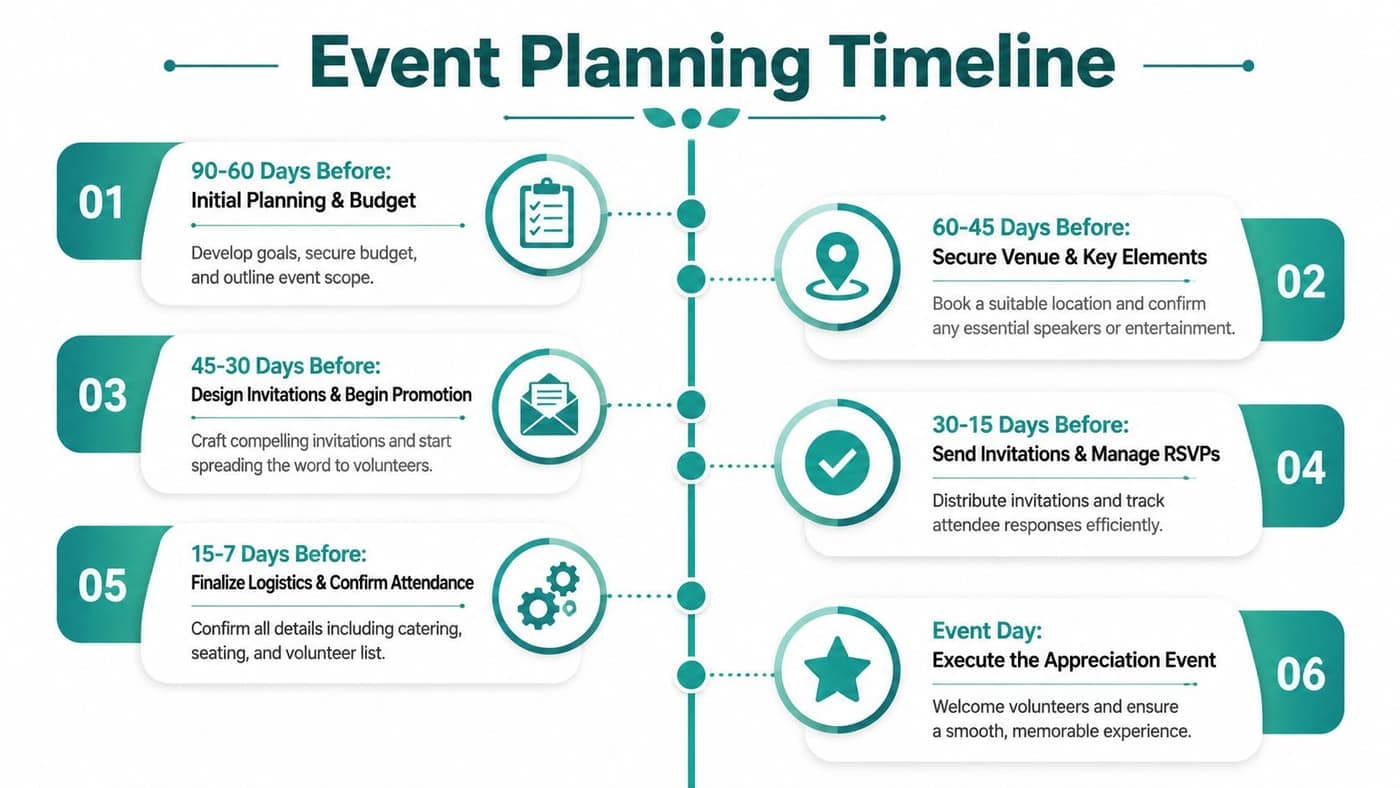
Start with the timeline, not the theme
A simple planning rhythm keeps the event grounded.
- Set the purpose early: Decide whether the event's main job is retention, relationship-building, donor-facing storytelling, or a mix.
- Lock the budget before details multiply: Venue ideas expand fast when the spending guardrails are vague.
- Choose format based on your volunteers: Dinner isn't always the right answer. Coffee hour, open house, hybrid recognition, or a legacy project may fit better.
- Confirm logistics while choices are still open: Venue, access, dietary needs, transportation, and timing matter more than centerpieces.
- Invite with enough lead time: Good attendance usually starts with clear notice and thoughtful reminders.
- Build the follow-up before the event happens: Survey, thank-you message, and attendance tracking should already be prepared.
If you want a practical companion for the cost side, our team has found this guide on budgeting for an event helpful for keeping line items realistic.
Budget for recognition, not display
Many planning articles assume you have room for gifts, catering, and branded extras. That's disconnected from real nonprofit conditions. Seventy-eight percent of small nonprofits have under $50K in annual revenue, according to the Nonprofit Learning Lab's volunteer appreciation ideas article. The same source notes that in the last year, legacy project appreciation such as digital scrapbooks has been adopted by 45% of mid-sized nonprofits as a zero-cost, high-engagement alternative.
That should give you permission to stop chasing expensive optics.
A stronger budget usually puts money into access and meaning first:
| Budget area | Worth protecting | Easy to trim |
|---|---|---|
| Volunteer experience | Accessibility, food needs, name accuracy, thoughtful recognition | Décor upgrades |
| Relationship building | Time for conversation, mission stories, staff presence | Extra entertainment |
| Stewardship | Tracking attendance, feedback, and outcomes | One-off novelty gifts |
The most persuasive budget is the one you can explain in one minute to a board treasurer.
Keep spending tied to value
One practical discipline helps here. Before approving costs, write one sentence for each major expense: “This helps volunteers feel seen because…” If you can't finish the sentence clearly, the item is probably optional.
If you're planning a larger in-person gathering and want a venue checklist that translates well from the corporate side, the ABC Hire guide to corporate events is useful for thinking through flow, timing, and guest comfort without overcomplicating the day.
A smart volunteer appreciation event budget doesn't try to look bigger than the organization. It makes the people who already give their time feel that your organization pays attention.
Design an Agenda That Truly Appreciates
A volunteer walks into your event after six months of early shifts, missed lunches, and last-minute coverage. Ten minutes later, they are still waiting in line to check in while staff scramble over name tags. By the time the program starts, the room has already learned something important about how your organization handles gratitude.
The agenda does more than fill 90 minutes. It shows whether appreciation is organized, personal, and worth repeating. That matters for morale, but it also matters for stewardship. A well-run event supports retention, protects the time and money you already invested in recruiting and training volunteers, and gives you cleaner signals about who is likely to stay engaged.

Build the schedule around how volunteers actually experience the night
The strongest agendas are usually less packed than staff expect. People need time to arrive, reconnect, and settle in before anyone steps to a microphone. If every minute is programmed, the event starts to feel like another obligation.
A practical flow often includes:
- Arrival with real welcomes: Staff or board members greet volunteers by name and help them get oriented fast.
- Conversation time up front: Give people room to catch up before formal remarks.
- A short opening: One speaker is usually enough. Keep it focused on the mission and the volunteers' role in it.
- Recognition with details: Mention what people did, not just their attendance.
- One impact story: Show what changed because volunteers showed up.
- A clean finish: End while energy is still good, and save operational updates for another channel.
That sequence works because it respects attention spans. It also creates space for the part many organizations underplan: connection between volunteers. Earlier in the article, we noted that relationship-building is one of the highest-return parts of the experience. The agenda should protect it on purpose.
Specific recognition holds up better than polished speeches
Generic praise is cheap to deliver and expensive in the long run.
Volunteers remember whether you noticed their actual contribution. “Thank you for everything you do” covers the room, but it does not make anyone feel seen. “James picked up three last-minute transportation shifts in February and kept appointments on schedule” does.
That level of specificity depends on your records. If your team has to piece recognition together from old emails and spreadsheets, the event will show it. One easy planning exercise is to draft certificates or recognition notes before the event. These volunteer certificates templates are useful because they force clarity on what each person is being thanked for.
Thank people for what they did, and why it mattered.
This is also where the event connects to retention. A volunteer who hears a clear, accurate account of their contribution is more likely to believe your organization notices effort year-round, not just when it is time to fill seats at next month's shift.
Avoid the agenda choices that make appreciation feel like a staff meeting
The common failure point is not lack of care. It is poor editing.
I have seen well-intentioned events lose the room with four speakers, a board update, a fundraising pitch, and awards that all sound the same. None of that is dramatic. It is just tiring. Volunteers came to feel appreciated, not to sit through a compressed annual meeting.
A few guardrails help:
- Keep the speaker list short: More speakers usually means more repetition.
- Ask before public recognition: Some volunteers love the spotlight. Others do not.
- Vary the format: A story, a brief presentation, a handwritten note, and a small group thank-you can work better than one long awards block.
- Separate gratitude from solicitation: If you need to make an ask, do it another day or keep it very light.
- Use names accurately: Mispronouncing a name undercuts the moment fast.
These choices are not cosmetic. They affect whether volunteers leave feeling valued or managed.
Include people who cannot attend in person
An appreciation agenda should match the shape of your volunteer program. If some volunteers serve remotely, cover micro-shifts, help on weekends, or cannot make an evening event because of work or caregiving, the event needs another path for them.
That does not mean building a bigger production. It means building fairer recognition.
Practical options include a short recorded thank-you from leadership, mailed notes, digital certificates, a photo recap with personalized captions, or a second touchpoint scheduled for volunteers who serve in different ways. The trade-off is simple. A single in-person event is easier to run. A broader recognition plan does a better job of reaching the whole volunteer base.
The best agenda leaves volunteers with two clear impressions: this organization knows what I contributed, and it uses resources carefully enough to make appreciation feel thoughtful instead of performative. That is the standard.
Get the Word Out and Manage RSVPs Simply
The invitation sets the tone before the event begins. If the message feels like a bulk reminder, the appreciation already feels diluted.
That's why old manual systems create more work than they seem to save. A spreadsheet, a separate email platform, and a back-and-forth RSVP list can get the job done. They also make it easier to miss people, duplicate messages, and lose track of who's coming.
The manual way versus the integrated way
Here's the practical difference:
| Task | Manual setup | Integrated setup |
|---|---|---|
| Build invite list | Export names into a spreadsheet | Filter active volunteers inside one system |
| Personalize message | Mail merge or copy-edit by hand | Use saved fields and segmentation |
| Track responses | Update sheet manually | Responses record automatically |
| Send reminders | Create separate follow-up list | Trigger reminders from RSVP status |
| Share event details | Multiple emails with scattered info | One event page with updates |
If you're comparing tools, it's fair to say platforms like Bloomerang, Little Green Light, and DonorPerfect each do useful parts of this work well. QuickBooks remains familiar for many finance teams. Eventbrite is straightforward for ticketing. Mailchimp handles email nicely. The gap is that most nonprofits end up stitching these systems together, then asking staff to do the connecting work.
What good invitation copy sounds like
The message should feel personal even if you send it at scale.
Use plain language. Mention the volunteer's role or relationship to the program. Keep logistics visible and easy to scan. Don't bury the date and time below a long paragraph about your mission.
A strong invitation usually includes:
- A direct thank-you: Open with appreciation, not event details.
- A clear reason for the gathering: Tell them why this moment matters.
- Simple logistics: Date, time, location, parking, dress, and accessibility.
- An easy response path: One click or one short form.
- A respectful tone: Invite, don't pressure.
For teams still sorting out the mechanics of event signups, this guide to volunteer registration software for nonprofits is a useful place to simplify the process.
One practical test: If a volunteer has to reply with “Do I need to register somewhere?” your invitation wasn't clear enough.
RSVPs should reduce staff work, not create it
The best RSVP process answers questions before they reach your inbox. It confirms attendance, collects dietary or access needs, and gives your team a current headcount without constant hand edits.
That matters because your communication load doesn't stop at the first send. You still need reminder messages, final details, and a clean attendance list on event day. If your tools are disconnected, each of those tasks becomes a mini-project.
A volunteer appreciation event should feel warm to the recipient and boring to administer. Boring is good here. Boring means your team isn't chasing details across three systems.
Measure What Matters After the Celebration
A week after the event, the test starts. The room felt good. Volunteers smiled, staff exhaled, and leadership moved on to the next priority. Then budget season arrives and someone asks a fair question. What did the event change?
That answer should never rely on warm impressions alone.
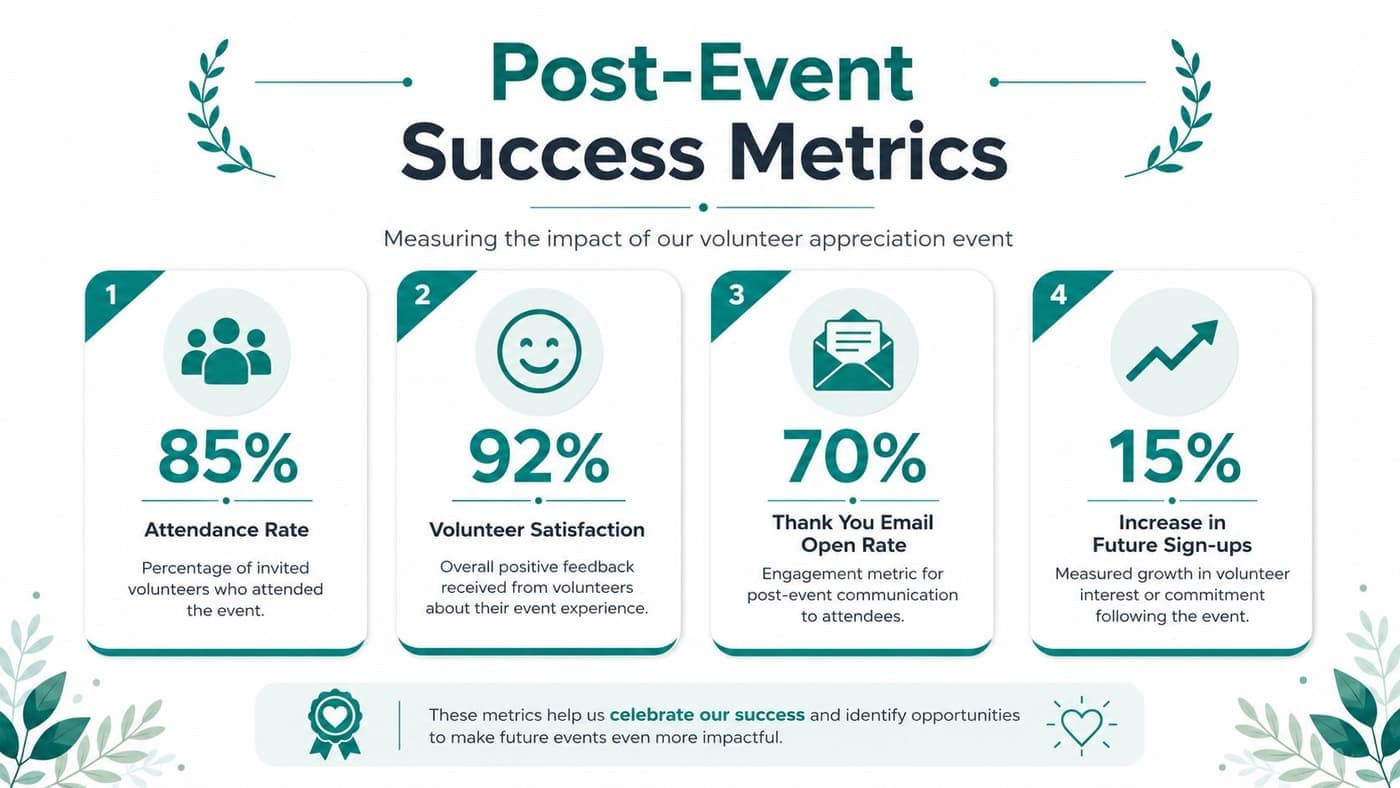
Measure response first, then retention
Start within 24 hours. Send a thank-you note, then a short survey while the event is still fresh. Four questions is usually enough. If the form takes longer than two minutes, completion rates drop and the feedback gets less useful.
Ask practical questions:
- Did you feel recognized in a way that mattered to you?
- Did the event make it easier to connect with staff or other volunteers?
- What part of the event was most worthwhile?
- What would make you more likely to stay involved this year?
Then compare answers with behavior over the next 30, 60, and 90 days. Attendance is a lagging indicator of interest. Retention and renewed service are the stronger signals. A simple review compares attendees and non-attendees by shifts served, hours logged, and response rates to the next invitation. If your team needs a cleaner system for that follow-through, this guide to volunteer hour tracking for nonprofits shows how to connect recognition with actual participation.
The event transforms into a stewardship question, not just a hospitality question. If volunteers who attended are more likely to return, accept another shift, or increase hours, the event earned its place in the budget.
Use Return on Volunteer Investment as a board-level measure
Return on Volunteer Investment, or ROVI, helps frame that case. The formula is straightforward. Compare the value of volunteer service with what the organization spent to recruit, support, train, and recognize those volunteers, including the event.
I use ROVI less as a perfect accounting exercise and more as a management tool. It forces a team to count the full cost of appreciation, including staff time, while also showing whether recognition supports continued service. That changes the board conversation. Instead of debating whether appreciation is “extra,” leadership can ask which event format produces stronger retention for the dollars spent.
Keep the analysis honest. A fancy venue may impress people and still perform worse than a modest breakfast with specific recognition and strong attendance. Lower-cost events often produce better results because they protect staff capacity and are easier to repeat consistently.
If you can connect event cost, volunteer feedback, and later service activity, the budget discussion gets much easier.
Don't ignore the Form 990 implications
Volunteer appreciation still needs clean financial treatment. If the event includes a fundraising element, the IRS requires organizations to separate the fair market value of benefits received from the charitable contribution amount. For example, if a donor pays $250 for a ticket and receives goods or services worth $100, the organization reports $100 as gross income from the fundraising event and $150 as a contribution, as explained in the IRS guidance on annual reporting requirements for Form 990 Part VIII, IX, and Schedule D.
Expense allocation matters too. Form 990 reporting requires nonprofits to allocate expenses by function, including program services, management and general, and fundraising. Appreciation event costs should follow the event's primary purpose, with a reasonable method for splitting shared costs when needed, as outlined in the IRS instructions for Form 990 and discussed in the National Council of Nonprofits guide to nonprofit financial management.
In-kind support needs attention as well. If the organization receives more than $25,000 in noncash contributions during the year, including donated event space or goods used for the celebration, Form 990 asks for that disclosure in the return instructions covered by the same IRS instructions for Form 990.
The practical standard is simple. Track event costs clearly, document donated items, and tie the event back to volunteer retention results. That gives leadership a cleaner Form 990 process and a stronger case that appreciation is an investment in mission delivery, not a discretionary expense.
Conclusion Making Your Next Event Even Easier
A volunteer appreciation event works when it does three jobs at once. It honors people well, strengthens the likelihood they'll stay involved, and gives leadership a defensible record of good stewardship.
That's why the best events don't feel overproduced. They feel attentive.
The practical standard worth keeping
If you remember only a few things, keep these:
- Plan early enough to stay calm: Good timing protects both budget and staff energy.
- Recognize people specifically: Generic praise is easy to give and easy to forget.
- Make room for human connection: Social time belongs in the agenda.
- Measure after the event: Feedback and later participation tell you what worked.
- Report costs correctly: Appreciation still needs clean financial treatment.
This approach also helps in settings with extra complexity. Churches often need appreciation that fits ministry culture and varied volunteer schedules. Schools may need tighter parent communication and easier signups. Fiscal sponsors need reporting discipline across multiple projects. In each case, the principle stays the same. Recognition should connect mission, people, and financial clarity.
Why integrated systems matter more than more tools
The main burden isn't usually the event itself. It's the scattered work around it. Volunteer records in one place, email in another, donations somewhere else, and accounting handled separately creates friction your staff feels every week.
An all-in-one setup changes that. Fund accounting supports cleaner stewardship than QuickBooks classes. Donor management, volunteer management, event coordination, online giving pages, team communication, and a built-in marketing suite belong in the same operational picture. AI intelligence can help answer practical questions from your real data without sending staff into another export cycle.
That's the point. Less software choreography. More managerial clarity.
If your next volunteer appreciation event is easier to plan, easier to explain, and easier to measure, you're not just running a nicer evening. You're building a healthier organization.
AlignMint brings your accounting, donor management, volunteer management, events, online giving pages, marketing suite, team communication, and Minty assistant into one place. You get true fund accounting, connected team workflows, and a free tier for nonprofits under $100K. If you want fewer spreadsheets, clearer Form 990 readiness, and a simpler way to connect volunteer recognition with financial stewardship, take a look at AlignMint and explore our guide to fund accounting for nonprofits.
Ready to try AlignMint with your nonprofit?
Start free — set up donor tools, giving pages, and Minty. Upgrade when you need accounting.