


Boost Giving with Donor Wall Recognition
Quick Answer: Boost Giving with Donor Wall Recognition
Unlock donor loyalty and boost giving with donor wall recognition. Compare physical and digital walls and keep recognition tied to clean donor records.
For related tools, see AlignMint features. You’re probably already thanking donors in private. You send letters, make calls, and mention key supporters at events. Yet many organizations still miss a simple stewardship tool that keeps gratitude visible every day.
Donor wall recognition works best when it isn’t treated as decor. It should reinforce belonging, reduce manual follow-up, and help your team recognize people accurately without another spreadsheet project.
What Donor Wall Recognition Really Means for Your Mission
A donor wall isn’t just a list of names. It’s a public record of who helped carry your mission forward.
That sounds simple, but it changes how people experience your organization. A thank-you letter is personal and important. A donor wall adds something different. It says, “You are part of this story, and this community can see it.”
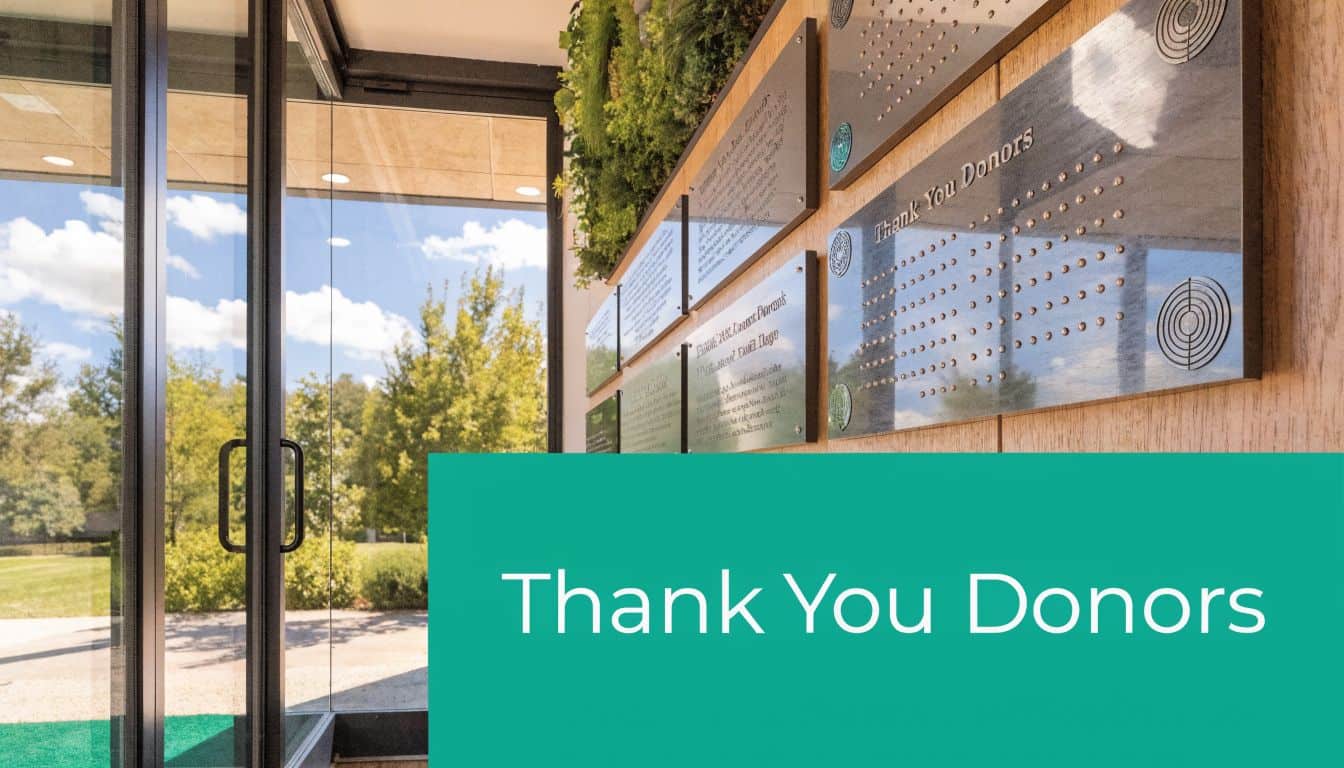
It’s stewardship made visible
I think of donor wall recognition like a town’s monument or a family photo album. It helps people see where they belong in a shared history.
For nonprofits, that matters because giving is social as well as personal. Individual givers account for nearly 65% of all global giving, and publicly recognized donors give 30-50% more over their lifetimes, while first-year donor retention averages only 19-27% across the sector, according to this data-driven guide to donor recognition.
When donors feel seen, they’re more likely to stay connected. When visitors see generosity honored, they understand that giving is part of your culture.
Practical rule: Private thanks build trust. Public recognition builds community. You need both.
Recognition shapes donor identity
Many leaders get stuck on the mechanics. Should names be alphabetical. By giving level. By campaign. Those details matter, but they come after the primary question.
What do you want a donor to feel when they see the wall?
A good answer usually includes three ideas:
- Belonging: Donors should feel they’re part of something larger than a single transaction.
- Continuity: The wall should show that support has history, momentum, and future purpose.
- Confidence: New supporters should see that others have already stepped in.
That last point is often overlooked. A donor wall is also social proof. It tells a hesitant prospect, “People like you support this mission.”
It supports retention without adding noise
Recognition doesn’t replace a sound donor retention plan. It strengthens one.
If you’re working on recurring giving, renewal, or upgrade strategy, a public recognition system can support those efforts by making support visible and meaningful. This is one reason many teams revisit their nonprofit donor retention strategies before designing a wall.
The strongest donor walls don’t try to impress with size alone. They reflect your values clearly. A school might honor scholarship donors and legacy families. A church might recognize ministry partners and memorial gifts. A community nonprofit might highlight annual supporters alongside people who funded a specific program.
A donor wall should answer one quiet question for every visitor who sees it. “Who believes in this mission enough to stand behind it?”
When you frame donor wall recognition this way, the project gets easier. You’re not just buying a fixture. You’re creating a durable habit of gratitude that people can see, understand, and join.
Choosing Your Approach Physical vs Digital Donor Walls
Most organizations choose between two paths. A physical donor wall with plaques, panels, or tiles. Or a digital donor wall with a screen, searchable display, or virtual page.
Both can work well. The right choice depends on your space, culture, update frequency, and tolerance for manual work.
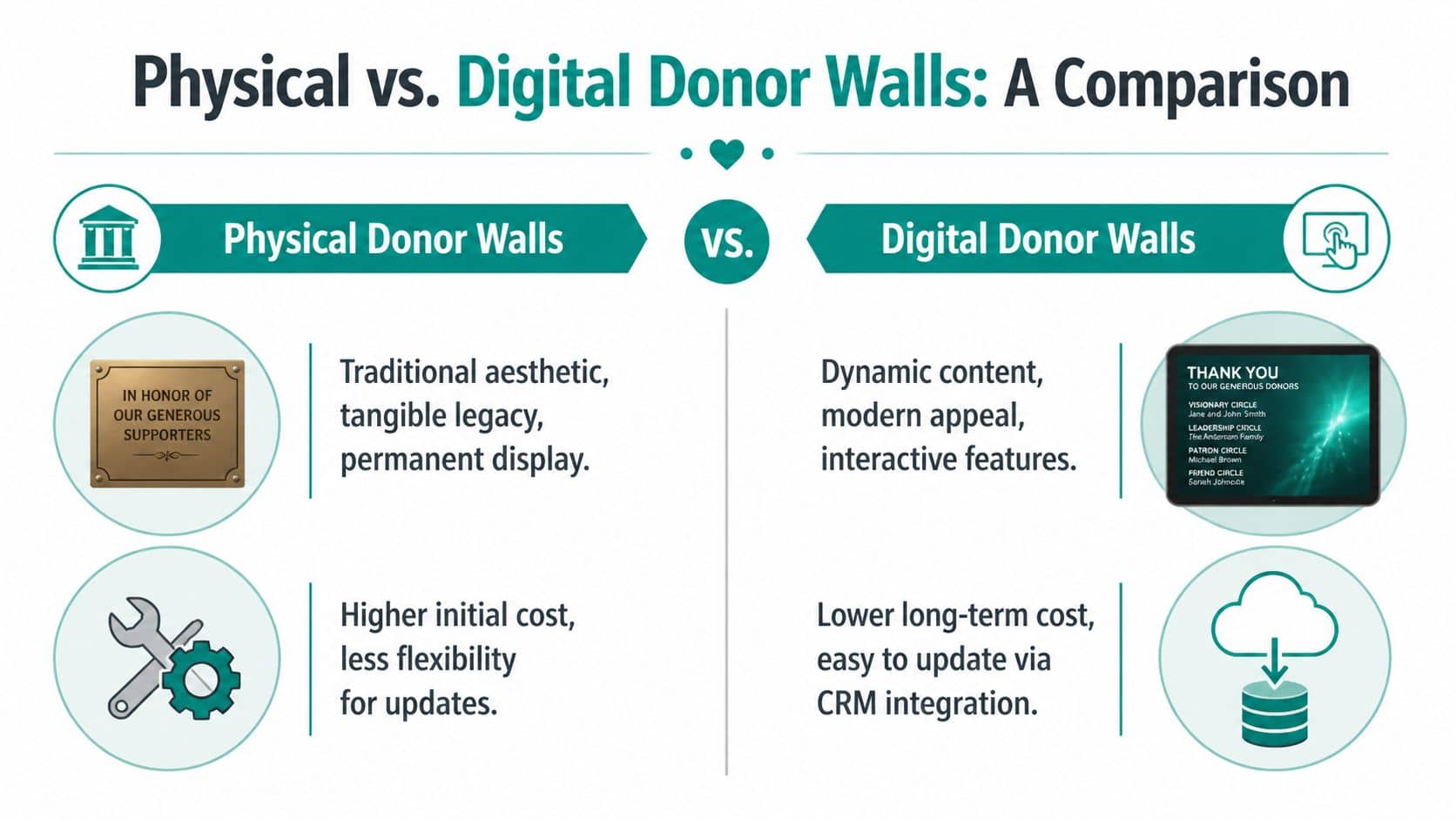
What physical walls still do well
A physical wall has weight to it. Stone, metal, glass, wood, and tile feel permanent in a way screens often don’t.
That permanence can matter in places where tradition carries meaning. Churches, schools, hospitals, and historic institutions often prefer a material installation because it feels established and ceremonial.
If you’re exploring finishes, patterns, or architectural styles, this overview of all types of tile is useful for thinking through what fits your building and maintenance reality.
Physical walls also work well when your recognition structure changes rarely. If you’re honoring a capital campaign, a building fund, or a fixed set of legacy gifts, static materials may be enough.
Where physical walls create work
The trouble starts after launch. Names change. New gifts come in. One campaign ends and another begins.
Over time, a wall that felt timeless can become hard to maintain. Over a 20-year period, a traditional plaque wall can cost $90,000-180,000, while a digital donor wall typically costs $75,000-125,000, with positive ROI often achieved within 18-24 months from increased giving, according to this complete guide to donor walls.
That long-term cost difference matters. So does the hidden operational drag. With a physical wall, staff often have to verify names manually, send revision files back and forth, and wait on production and installation.
If your donor list changes often, a static wall can turn into a recurring admin task with a construction wrapper around it.
Why digital walls appeal to busy teams
A digital wall gives you room to grow. You aren’t boxed in by the square footage of a lobby.
You can recognize annual donors, campaign donors, planned giving supporters, sponsors, memorial gifts, volunteers, or scholarship funds without redesigning the whole installation. You can also add photos, stories, videos, and searchable records that help visitors connect names with impact.
For organizations that want online and on-site recognition to match, a digital wall can also tie neatly to a donation page builder. That keeps your public-facing donor experience more consistent.
What digital walls require from you
Digital isn’t automatically easier. It’s easier only if someone owns the content and the donor data is clean.
You’ll need a process for approvals, naming rules, privacy choices, and updates. If your donor records are scattered across accounting software, spreadsheets, and email threads, a digital wall can expose those gaps quickly.
That said, digital usually wins when your organization wants any of the following:
- Frequent updates: New names can appear without waiting for fabrication.
- More than names: Stories, campaign progress, and program impact fit naturally.
- Broader access: You can mirror recognition online for donors who never visit your building.
- Operational relief: Connected systems reduce hand entry and duplicate lists.
Physical vs. Digital Donor Walls at a Glance
| Feature | Physical Wall (e.g., Engraved Plaques) | Digital Wall (e.g., Interactive Screen) |
|---|---|---|
| Overall feel | Permanent, traditional, ceremonial | Flexible, current, story-driven |
| Updates | Slower and more manual | Faster and easier to manage |
| Capacity | Limited by wall space | Can recognize far more supporters |
| Content | Mostly names and tiers | Names, photos, video, impact stories |
| Maintenance style | Fabrication and installation work | Content management and hardware care |
| Best fit | Fixed campaigns and legacy spaces | Ongoing annual recognition and mixed audiences |
A hybrid model often works best. Keep a permanent physical display for lead gifts and use a digital component for annual and evolving recognition. That gives major donors the permanence they may value while sparing your team from constant rework.
If your board is split, that middle path is often the most practical answer.
Designing Your Recognition and Naming Rights Strategy
A donor wall only works when the recognition rules are clear. If your team makes naming decisions case by case, confusion builds fast.
Good donor wall recognition starts with a simple framework. Decide who should be recognized, how they’ll be grouped, and what qualifies someone for public naming.

Start with categories, not materials
Before you choose fonts or wall finishes, sort recognition into buckets. Most organizations need some version of these:
- Annual giving tiers: Useful for recurring yearly support and broad participation.
- Campaign recognition: Best for capital projects, special appeals, or anniversaries.
- Legacy and planned gifts: Often separate because the intent and donor expectations differ.
- Naming rights: Reserved for major commitments tied to rooms, programs, or visible assets.
These groups keep your wall understandable. They also keep your staff from debating every new gift.
Build rules your staff can apply consistently
Your policy should answer practical questions in plain language. Does cumulative giving count. Are household names combined. How are corporate matches handled. What about anonymous donors.
Write those answers down before you announce anything. A donor wall becomes harder to manage once expectations are public.
A simple process usually works best:
- Define the recognition group. Annual fund, campaign, planned giving, or naming right.
- Set the qualification rule. Base it on a clear gift threshold or commitment type.
- Decide the display format. Individual name, family name, memorial language, or class year.
- Create approval steps. One person checks gift eligibility. One person confirms display text.
- Record exceptions. Keep a written log when leadership approves a one-off arrangement.
The fairest recognition system is the one your staff can explain in one minute and apply the same way every time.
Naming rights need more discipline
Naming rights can be powerful, especially in schools, churches, and community facilities. They can also create lasting headaches if terms are vague.
For example, a classroom, fellowship hall, scholarship fund, or youth program may be named for a donor or family. That should always be documented in a gift agreement, along with timing, recognition language, and what happens if the space changes use later.
If you’re drafting support materials around larger gifts, these examples of sponsorship proposals can help you think through the language and structure.
For installations that are part donor wall and part public art, it also helps to study experienced Colorado art installation experts so your recognition plan fits the space and traffic flow.
Design for access, not just appearance
A beautiful wall that some supporters can’t read or access misses the point. Modern digital donor walls should meet WCAG 2.1 AA standards, including screen reader support and high-contrast fonts, and a cloud-based CMS allows instant remote updates, as outlined in this digital donor recognition wall design guide.
That accessibility standard is not a technical flourish. It’s basic hospitality.
If older donors, visually impaired visitors, or family members using assistive tools can’t engage with your wall, the recognition experience breaks down. Clear type, sensible contrast, and readable layouts matter just as much as elegant materials.
Budgeting Maintenance and Avoiding Hidden Costs
Boards often ask the wrong budget question first. They ask, “What does the wall cost?”
A better question is, “What will this cost us to maintain, update, and administer over time?”
The visible budget is only the start
The startup cost is the easy part to price. Design, materials, fabrication, installation, and if digital, hardware and setup.
The harder part is the ongoing cost in staff time. Someone has to confirm names, check giving status, manage donor preferences, coordinate approvals, and keep finance records aligned with recognition records.
That work doesn’t show up neatly in a vendor quote. It still lands on your team.
Why small nonprofits often hesitate
This is especially true for smaller organizations. A 2023 survey found that 68% of small nonprofits prioritize low-cost recognition, but only 22% use digital walls because they perceive them as expensive, highlighting an opportunity for integrated platforms to generate digital donor lists at zero hardware cost, according to this guide to donor wall recognition.
That finding rings true in practice. Many leaders assume digital means complicated and costly, so they postpone the idea or settle for a wall that staff can’t keep current.
Boardroom test: If your recognition system depends on one staff member remembering a monthly export, it isn’t low-cost. It’s fragile.
Common hidden costs to plan for
Some costs are predictable. Others creep in through workarounds.
Keep these in view when you budget:
- Manual list cleanup: Merged households, duplicate records, and inconsistent name formats take time.
- Approval bottlenecks: Last-minute signoff by leadership can delay updates and create donor errors.
- Vendor coordination: Physical additions often require outside scheduling, proofing, and installation windows.
- Policy drift: Without written rules, staff spend time resolving exceptions one by one.
- Replacement cycles: Digital setups may need periodic refreshes. Physical installations may need repairs or redesign when space fills.
If you’re building a realistic project budget, this nonprofit budget template in Excel is a good starting point for capturing both direct and indirect costs.
The smartest budgeting move is simple. Price the wall, then price the process around the wall. That second number is often what determines whether donor wall recognition remains a living stewardship tool or becomes another overdue project.
Automating Your Donor Wall with Your CRM
The cleanest donor wall is usually the one your staff touches the least.
That doesn’t mean giving up control. It means building a process where recognition flows from the same donor records you already trust for gifts, receipts, and reporting.
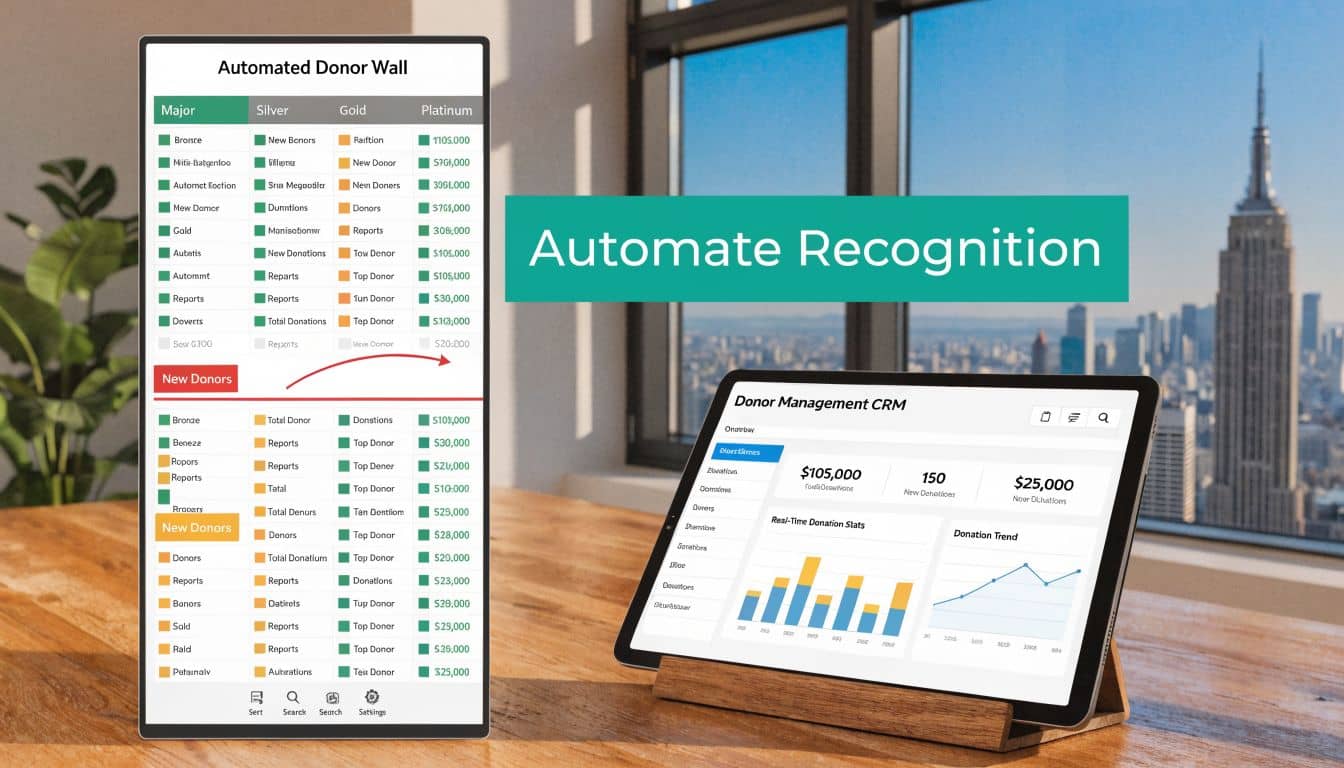
What manual donor wall management looks like
Many nonprofits still manage recognition with disconnected tools. Donations come in through one system. Accounting lives somewhere else. Donor notes sit in a CRM. The wall update starts with an exported spreadsheet.
That process usually creates the same problems:
- Finance and development disagree on who qualifies.
- Names appear inconsistently across receipts, reports, and recognition displays.
- Anonymous preferences get missed because they live in a note field no one checked.
- Updates stall while staff reconcile records by hand.
This is common when organizations pair accounting software with a separate fundraising platform. QuickBooks is familiar, and tools like Bloomerang and Salesforce each have strengths. But when systems don’t share the same underlying records, your team often becomes the bridge.
What an automated workflow should do
A better setup connects gift entry, donor management, and recognition rules. When a donor gives, the gift record updates once. If the donor crosses a recognition threshold, the wall list updates based on that rule.
That’s the practical value of a connected donor CRM. It creates one source of truth for display names, giving history, recognition level, and privacy choices.
Here’s the workflow I recommend:
- Capture the gift through your giving page, event form, pledge record, or manual entry.
- Post it to the donor record and finance record without rekeying the same data.
- Apply your recognition rules based on campaign, cumulative giving, or designation.
- Flag exceptions like anonymity requests or naming approvals for human review.
- Publish approved updates to the digital wall or export a clean list for a physical vendor.
When donor wall recognition runs from live donor records, your wall becomes a reporting output, not a side project.
Where automation helps most
The biggest gain isn’t speed alone. It’s confidence.
Your development director can trust that the wall reflects approved giving data. Your finance lead can trust that recognition isn’t drifting from booked revenue. Your executive assistant doesn’t have to cross-check three spreadsheets before a board event.
This is especially valuable in churches, schools, and fiscal sponsorship settings where one donor may support several funds, programs, or sponsored projects. Recognition needs to reflect the right relationship without forcing staff into manual sorting every time.
A strong workflow also makes reporting easier. If a leader wants to know which new donors reached a recognition circle this quarter, your team should be able to answer from the system directly instead of building a report from scratch.
That’s when donor wall recognition stops feeling like maintenance and starts working like stewardship.
Legal and Reporting Considerations You Cannot Ignore
Recognition is public. That means it sits close to privacy, tax, and governance issues whether you intend it to or not.
Most problems are avoidable if you set rules early and document them carefully.
Get consent before you publish names
Never assume a donor wants public recognition. Many do. Some don’t. A few care intently about how their names appear.
Your gift form, pledge process, or follow-up should include a plain-language choice. Public name, family name, company name, or anonymous. Keep that choice in your CRM, not in someone’s inbox.
Anonymous donors deserve the same care as recognized donors. If someone asks not to be listed, record it once in the main donor record and make sure every recognition report respects that setting.
Keep recognition separate from tax promises
A donor wall is usually acknowledgment, not a material benefit. Still, your team should be careful not to describe recognition in ways that blur tax treatment.
If you’re offering anything beyond simple acknowledgment, especially in sponsorship contexts, your finance and development staff should review the language together. The safest practice is straightforward documentation. What was given, what was promised, and how it was approved.
That record matters later when you prepare reports, answer board questions, or support your Form 990 process.
Public gratitude is appropriate. Sloppy documentation is not.
Write a policy before a conflict forces one
You need a donor recognition policy even if your organization is small. It doesn’t have to be long. It does have to be clear.
Include these basics:
- Eligibility rules: Which gifts count toward wall recognition.
- Name display standards: Individual, household, memorial, corporate, and anonymous formats.
- Approval process: Who confirms eligibility and final display text.
- Exception handling: How leadership approves unusual requests.
- Removal or revision rules: What happens if a donor changes preference or a space is renamed.
A written policy protects relationships. It also protects staff from making judgment calls under pressure.
Tie the wall back to sound reporting
Recognition should reflect your official records, not override them. That matters most when gifts are restricted, split across funds, or connected to grants, scholarship pools, or sponsored projects.
Disciplined finance practices are beneficial. When your accounting structure clearly tracks restricted funds, donor intent, and program activity, your recognition decisions are easier to support and explain.
Done well, donor wall recognition strengthens trust. Done casually, it creates avoidable risk. The difference is usually documentation.
Your Implementation Checklist
A donor wall project becomes manageable when you break it into decisions your team can make. Start small, keep the rules clear, and build from your real capacity.
-
Name a small owner group. Include development, finance, and one person who handles donor records day to day.
-
State the purpose in one sentence. Is this about annual giving, campaign recognition, legacy donors, or a mix.
-
Choose your format. Decide whether a physical, digital, or hybrid wall best fits your building and staffing reality.
-
Set recognition categories. Separate annual donors, campaign donors, planned giving, sponsors, and naming rights if needed.
-
Write eligibility rules. Clarify what counts, how cumulative gifts work, and how anonymous requests are handled.
-
Create naming standards. Confirm how individuals, couples, families, and businesses will appear in public.
-
Review donor consent. Update forms and procedures so public recognition choices are captured consistently.
-
Audit your donor data. Clean duplicates, confirm display names, and check that finance and development records agree.
-
Design for readability. Make sure visitors can understand the wall quickly and that accessibility is built in.
-
Plan your content. Beyond names, gather brief impact stories, photos, campaign language, or memorial text where appropriate.
-
Choose vendors carefully. Ask who handles revisions, approvals, update timing, and support after launch.
-
Connect the wall to your CRM process. Even if updates aren’t fully automated at first, define one trusted workflow.
-
Schedule review dates. Recognition rules, names, and content should be checked regularly, not only when something goes wrong.
-
Launch with gratitude. Use the unveiling to thank donors warmly and explain what the wall represents.
-
Measure the admin load. After launch, ask a simple question. Is this easier to maintain than what we had before.
A good donor wall doesn’t create more operational clutter. It reduces it by turning recognition into a repeatable habit.
If you want donor wall recognition to run from the same place as your donor records, fund accounting, volunteers, events, and marketing, take a look at AlignMint. We built it for nonprofits that want one practical system, not more disconnected tools, and our free tier helps smaller organizations get organized before manual work piles up.
Ready to try AlignMint with your nonprofit?
Start free — set up donor tools, giving pages, and Minty. Upgrade when you need accounting.