

For related tools, see the fiscal sponsor fee calculator, fiscal sponsor software, and fund accounting.
Quick Answer: What Is a Fiscal Sponsor?
A fiscal sponsor is an established 501(c)(3) that lets a project receive tax-deductible donations and grants under its legal and financial structure while the project gets started. Model A integrates the project inside the sponsor; Model C keeps the project more independent while the sponsor manages charitable funds with documented discretion and control.
You've probably seen this happen. A strong program idea gets real traction, donors ask whether gifts are tax-deductible, and the room goes quiet because nobody wants to spend months building a brand-new nonprofit before the project even starts.
That's where a fiscal sponsor can be the practical answer. If you're weighing whether to join one, become one, or tighten up operations you already have, the essential question isn't legal theory. It's whether the structure gives your mission enough speed, control, and financial clarity to work effectively.
Starting a Project Without Starting a Nonprofit
A neighborhood food access project has volunteers, early donors, and a clear need. What it doesn't have is federal tax-exempt status, payroll capacity, insurance, or anyone eager to draft bylaws after dinner.
That's a familiar moment. The project is ready, but the structure isn't.
A fiscal sponsor can give that project a lawful administrative home while it starts raising funds and delivering work. Instead of pausing momentum to form a separate entity first, the project operates under an existing nonprofit's umbrella and follows the sponsor's rules, systems, and oversight.
For some leaders, the first instinct is still to form a new organization. Sometimes that is the right move. If you're sorting through entity choices more broadly, this overview that helps compare business entities for North Georgia is a useful reminder that structure choices affect governance, taxes, liability, and day-to-day administration long before they affect mission.
The better question is usually simpler. Do you need independence right now, or do you need to start serving people well and stay compliant while you do it?
If you're still deciding whether to launch your own organization or start under another umbrella, this guide on how to start a nonprofit helps frame the trade-off clearly.
The mistake isn't choosing fiscal sponsorship. The mistake is choosing any structure without being honest about what your team can actually manage this year.
What Fiscal Sponsorship Really Means for You
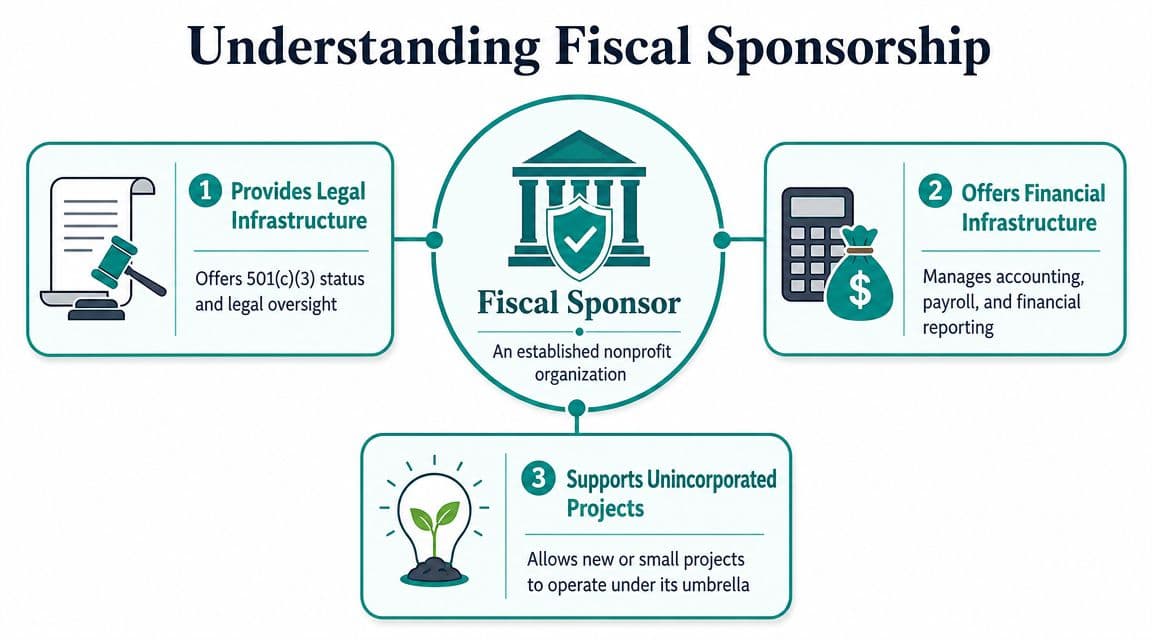
A fiscal sponsor is an established nonprofit that lets a project operate under its legal and financial structure. That usually means the sponsor can receive charitable donations and grants for the project, handle compliance, and provide back-office support the project can't yet support on its own. You may also hear this called a fiduciary sponsor, because the sponsor is legally responsible for the money it receives for your project.
The simplest way to think about it is this. A fiscal sponsor is the general contractor for a charitable project. You may have the vision and the community trust, but the sponsor handles the permits, paperwork, financial controls, and oversight that keep the project lawful.
What you gain immediately
The main benefit is speed with structure. A project that isn't yet tax-exempt can still receive tax-deductible contributions through the sponsor's 501(c)(3) status, so long as the relationship is set up properly.
You also gain access to systems most early projects underestimate. Sponsors commonly provide finance, HR, legal, insurance, and risk management support as part of shared infrastructure, which is one reason the model has expanded so widely. In a 2022 to 2023 field survey, 100 fiscal sponsors collectively stewarded more than $2.6 billion in community investments, showing that fiscal sponsorship is no longer a niche workaround.
What it does not mean
It does not mean you're renting someone else's tax status.
That distinction matters. For donor deductibility and IRS compliance, the sponsor must retain discretion and control over the funds and keep records showing the spending furthers its exempt purpose. That's why the agreement, workflows, and approval process matter so much. If you want a short plain-English definition before you go deeper, AlignMint's fiscal sponsor glossary entry is a useful reference.
Practical rule: If the sponsor acts like a pass-through and the project acts like it owns the money outright, the relationship is already drifting into dangerous territory.
In good sponsorship arrangements, the project gets room to lead the program. The sponsor still governs the funds, reporting, and compliance. That balance is where healthy partnerships live.
Comparing the Common Sponsorship Models
Not every fiscal sponsor relationship works the same way. If you skip this distinction, you can end up with the wrong expectations about staffing, decision rights, contracts, and liability.
The two models most leaders run into are Model A and Model C.
Model A in plain terms
In Model A, often referred to as a fully integrated fiscal sponsorship, the project becomes part of the sponsor's legal and financial structure. The sponsor receives donations and grants directly, reports them on its own filings, and project staff or volunteers may become staff or volunteers of the sponsor. Adler & Colvin's overview of fiscal sponsorship explains this structure clearly in its synopsis of the six ways to do it right.
Operationally, that means the sponsor carries the legal and compliance burden for payroll, contracts, insurance, taxes, debts, and related liabilities. The project gets administrative relief, but the sponsor takes on more exposure.
Model C in plain terms
In Model C, the sponsor usually works more like a grantmaker. The project remains separate, and the sponsor accepts funds for the charitable purpose, then regrants them under an approved relationship.
This is not rare. In the Fiscal Sponsor Directory, 63%, reported as 237 organizations, used Model C, and nearly 96% charged a percentage of project revenues. Nearly half of those fees fell between 5% and 10%. The same directory also reported that many sponsors provide bookkeeping, bill pay, payroll, organizational development, and tax reporting through these relationships, which shows how far the field has moved beyond simple donation pass-throughs in practice, as shown in the Fiscal Sponsor Directory facts and stats.
Model A vs. Model C Fiscal Sponsorship
| Attribute | Model A (Comprehensive) | Model C (Pre-Approved Grant) |
|---|---|---|
| Legal home | The project sits inside the sponsor | The project remains separate |
| Who receives funds | The sponsor receives and reports funds directly | The sponsor receives funds and regrants for approved purposes |
| Staffing | Project staff may become sponsor employees | Project staffing usually remains outside the sponsor |
| Contracts and liabilities | The sponsor usually carries them | More separation, though oversight still matters |
| Autonomy | Less day-to-day independence | More operating independence, but within grant conditions |
| Administrative load | Higher for the sponsor | Often shared differently, with grant monitoring and approvals |
The best model depends on what problem you're trying to solve.
If the project needs a full administrative home, Model A often fits. If the project needs charitable funding access but wants to remain more operationally distinct, Model C may be more appropriate.
Where leaders get tripped up
Most mistakes happen when the paperwork says one thing and daily behavior says another.
A sponsor may think it has accepted a full internal project. The project leader may think they're just borrowing tax status while making independent decisions. That mismatch becomes painful fast when someone signs a contract, hires staff, or promises restricted funds before checking approval authority.
If you want a more operations-focused breakdown of how these structures affect ledgers, reporting, and project-level oversight, this piece on fiscal sponsorship accounting models is worth reading.
If you can't explain to a program director who employs the staff, who approves spending, and who signs contracts, you don't have the right model yet.
Understanding Your Responsibilities and Risks
A fiscal sponsorship relationship works when both sides know who is responsible for what. It breaks down when everybody assumes the other party is handling the hard parts.
The sponsor's responsibility is larger than many project leaders realize. For tax-deductibility and IRS compliance, a sponsor must retain discretion and control over sponsored funds and keep adequate records showing that expenditures further its own exempt purpose. The Council of Nonprofits guidance on fiscal sponsorship makes clear that a written agreement is critical to defining that authority.
What the sponsor must own
A capable sponsor does more than process donations.
It has to govern receipts, acknowledgments, approvals, reporting, and spending controls. It also needs records that show restricted funds were used as intended and that project activity fits the sponsor's charitable purpose.
That means the sponsor should be ready to answer questions like these:
- Who approves expenses: If this isn't clear, the relationship will drift.
- Who signs donor acknowledgments: Donors need accurate receipts from the legal organization receiving the gift.
- How restrictions are tracked: Verbal understandings are not enough.
- What happens if a project underperforms: Sponsors need authority to intervene, redirect, pause, or end activity when needed.
What the project must own
Sponsored projects aren't passive participants. They need to deliver the program, communicate promptly, and follow the sponsor's procedures even when those procedures feel slower than working alone.
That usually includes:
- Program reporting: Show what happened, what changed, and what still needs attention.
- Spending documentation: Submit requests, invoices, and backup in the form the sponsor requires.
- Fundraising discipline: Don't promise donor terms the sponsor hasn't approved.
- Boundary awareness: Don't act like an independent charity if the agreement says otherwise.
A weak agreement doesn't create flexibility. It creates confusion, and confusion usually lands on the finance team first.
The agreement should earn its keep
Too many sponsorship agreements read like a form downloaded in haste and signed with relief. That's not enough.
A sound agreement should define authority, approval rights, the administrative allocation, reporting expectations, treatment of staff and contractors, use of the sponsor's name, handling of restricted funds, and what happens when the relationship ends. The allocation is often a percentage of the project budget, moving project-fund resources to the sponsor's operating activity for fiduciary oversight and back-office services. Agreements still call that share an administrative fee. The ledger treatment is an internal allocation.
There's another issue many guides glide past. Advocacy and lobbying can complicate sponsorship in ways that standard FAQ pages don't answer well. Some practitioners have pointed out that operational questions around funder restrictions, lobbying reporting, and whether a project needs a different structure are often underexplained, as discussed in this podcast conversation on advocacy and fiscal sponsorship.
If your project plans to influence policy, don't treat that as a footnote. Treat it as a structure question from day one.
For a more detailed operational checklist on documentation and controls, this resource on fiscal sponsor compliance is a practical place to start.
How to Choose the Right Partner
The wrong fiscal sponsor creates drag. The right one gives you enough structure to move without turning every payment, contract, or donor conversation into a negotiation.
If you're a project leader, don't shop for a sponsor the way you'd shop for a mailbox. You're choosing a fiduciary partner.
Checklist for projects reviewing sponsors
Start with fit before fees.
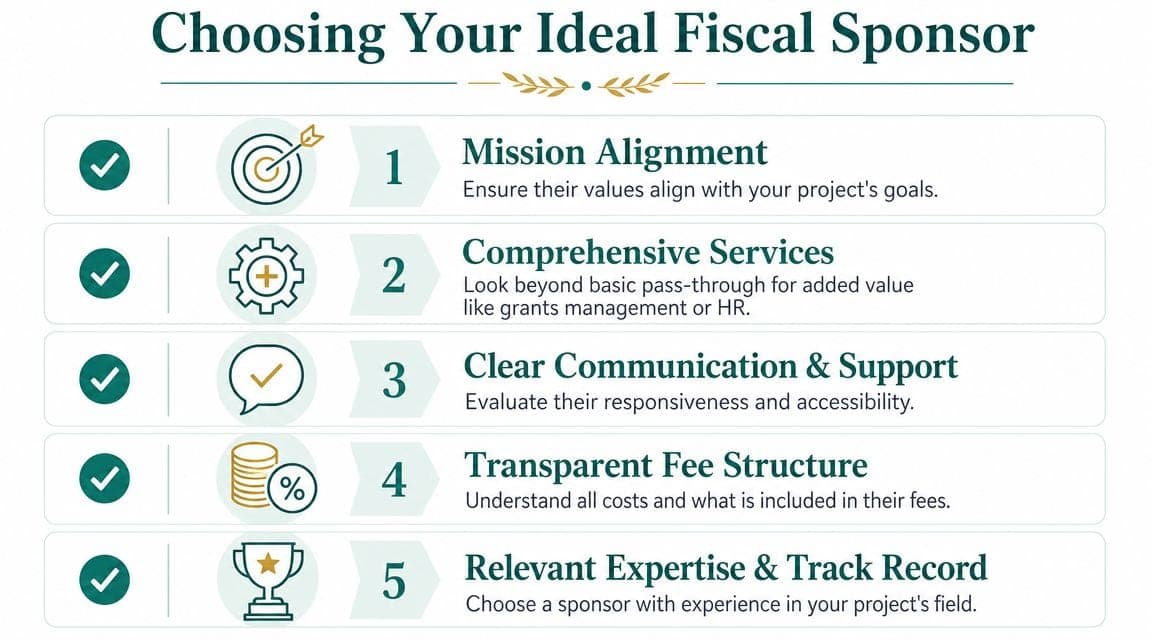
- Mission fit matters first: If the sponsor's charitable purpose and values don't line up with your work, tension will show up later in approvals and reporting.
- Ask what services are included: Some sponsors handle bookkeeping, bill pay, payroll, and development support. Others mainly process funds.
- Review approval flow: Ask how reimbursements, contracts, and restricted gifts move through the system.
- Study the communication pattern: A sponsor may look polished on paper and still be hard to reach when your grant report is due.
- Clarify exits early: If the relationship ends, ask what happens to remaining funds and records.
When you're reviewing financial health, it helps to borrow a discipline from transaction work. This plain-language look at Lighthouse Consultants' financial due diligence guide is useful because it reminds leaders to examine process, not just promises.
Checklist for nonprofits considering becoming a sponsor
If you're the established nonprofit, the standard should be just as high.
- Check mission alignment carefully: Don't sponsor projects that sit at the edge of your purpose and expect easy oversight.
- Test leadership strength: The project needs a credible lead who can manage program delivery and communicate consistently.
- Inspect your internal systems thoroughly: If your accounting and donor records are already messy, adding sponsored projects will make that visible.
- Set a reporting standard before intake: Don't invent the process one project at a time.
- Know your risk tolerance: Sponsorship can be a strong model, but only when the board understands the added fiduciary load.
A sponsor is not just saying yes to a project. It's saying yes to years of documentation, approvals, and accountability.
For a fuller due-diligence framework, this guide on how to choose a fiscal sponsor walks through the questions worth asking before anyone signs.
Managing Projects Without Spreadsheet Chaos
Many fiscal sponsorship arrangements start well and then slowly come apart. Not because the mission is weak, but because the accounting setup can't keep up with the complexity.
A sponsor may be managing separate donor restrictions, project balances, payable approvals, grant reports, and board reporting across many initiatives at once. If that work lives partly in QuickBooks, partly in spreadsheets, and partly in someone's inbox, your finance team ends up reconstructing the truth every month.
Why general business tools fall short
Fiscal sponsorship needs more than basic bookkeeping. You need clean separation between projects, reliable restricted fund tracking, donor records that match finance records, and reports that make sense to both project leaders and auditors.
That's difficult when the accounting system thinks in generic categories while your day-to-day depends on funds, grants, and program restrictions. It's also difficult when your donor system and your accounting system disagree about what gift went where.
Competitors like QuickBooks, Bloomerang, and Salesforce each do useful work in their lanes. QuickBooks is familiar. Bloomerang is strong for donor relationships. Salesforce can be flexible with the right setup. But fiscal sponsors often need all those functions tied together around fund accounting, project balances, and compliance workflows, not spread across separate tools.
What better operations look like
A cleaner setup gives each project its own financial identity inside one system. Gifts post to the right fund. Donor records stay connected to the transaction. Expense approvals follow the sponsor's workflow. Project leaders can see what they have available before they spend.
That's the operational value of an all-in-one platform built for nonprofit work. AlignMint is one example. It combines accounting, donor records, volunteer management, events, team communication, marketing tools, and Minty in one system, with true fund accounting and no per-seat fees. For sponsors managing many projects, that means fewer exports, fewer duplicated records, and less manual reconciliation.
What this changes day to day
The gain is clarity.
- Finance sees clean balances: Each sponsored project can be tracked as its own fund rather than as a rough class or spreadsheet tab.
- Development sees the same truth: Gift records and financial records stay aligned.
- Program leaders stop guessing: They can work from current balances instead of last month's spreadsheet.
- Boards get readable reporting: Consolidated oversight doesn't require days of assembly.
Fiscal sponsorship now operates at serious scale. A 2022 to 2023 survey found that 100 fiscal sponsors collectively stewarded more than $2.6 billion in community investments. When that much charitable activity sits inside shared infrastructure, the back office cannot be improvised.
Spreadsheets are fine for analysis. They are a poor place to run fiduciary relationships.
Your Next Step with Fiscal Sponsorship
If you're considering fiscal sponsorship for a new project, start with governance and finance questions before branding questions. Who controls funds, who approves spending, how reports will be produced, and what happens if the project changes course are the questions that determine whether the arrangement will hold.
If you're considering becoming a sponsor, test your systems before you add projects. Sponsorship can be a durable operating model, but it can also be the wrong choice when a project needs more autonomy than the structure allows or when multiple funding streams create reporting demands your current setup can't handle. Some public guidance discusses sponsorship rates of about 4% to 15%, and notes that sponsor control over funds can limit autonomy, as discussed in this overview from Magic Cabinet on what fiscal sponsorship is.
A few practical questions come up often:
When is fiscal sponsorship the wrong fit
It's the wrong fit when the project wants full control but still expects tax-deductible fundraising under someone else's umbrella. It's also the wrong fit when the sponsor lacks capacity, systems, or board commitment.
How should you think about the administrative share
Treat the rate as the sponsor's recovery of oversight and administration from funds it already controls. If the sponsor is carrying legal responsibility, processing gifts, tracking restrictions, and producing reports, the allocation should match the actual work required. Sector write-ups still call this a fee. The posting is covered in administrative allocations.
What about advocacy work
Treat advocacy as a front-end planning issue, not an afterthought. If the project will push into lobbying or policy activity, get clear advice early and make sure the structure matches the mission.
The leaders who handle fiscal sponsorship well don't just choose a model. They choose operating discipline.
If you're managing sponsored projects and want cleaner reporting, fund-level visibility, and fewer disconnected tools, take a look at AlignMint. We built it for nonprofit operations that have outgrown spreadsheets, with true fund accounting, donor management, volunteers, events, marketing, Minty, plan-based user allowances (1 on Free, up to 10 on Plus, up to 25 on Pro, and unlimited on Enterprise), and a free plan for organizations under $100K.
Ready to see how AlignMint fits your workflow?
Schedule a free walkthrough — we will help you map donors, funds, and migration steps.