

For related tools, see fiscal sponsor software and fund accounting.
Fiscal Sponsor Non Profit: A Director's Guide for 2026
Quick Answer: Fiscal Sponsor Non Profit: A Director's Guide for 2026
A fiscal sponsor non profit arrangement lets an existing charity provide legal and financial infrastructure for a project that is not yet, or may never become, its own 501(c)(3). Most listed sponsors use Model C (pre-approved grants) or Model A (direct project). Success depends on matching the model to real operations, documenting fees and controls, and keeping restricted funds visible for compliance.
You may be staring at a promising new project and a familiar problem. The mission is clear, but forming a separate nonprofit feels slow, expensive, and heavy before the project has even started.
That's where a fiscal sponsor non profit arrangement can make real sense. If you choose the right model, set expectations early, and keep clean financial records, you can move faster without creating compliance trouble later.
What Is a Fiscal Sponsor and Why Does It Matter
A fiscal sponsor is an existing 501(c)(3) nonprofit that agrees to hold and oversee charitable funds for a project that fits its exempt purpose. In plain terms, your project gets a legal and financial home before it becomes its own corporation, or instead of becoming one at all.
That matters because many good ideas stall at the administrative starting line. Leaders know how to run programs. They don't always want to spend their first season wrestling with tax exemption paperwork, bank setup, insurance questions, payroll decisions, and donation receipting.
A fiscal sponsor non profit arrangement gives you a practical shortcut. You can receive tax-deductible donations and pursue grant support under the sponsor's umbrella while the sponsor handles the formal oversight.
The model is far from fringe. A Johnson Center report noted that 380 listed fiscal sponsors were home to nearly 19,000 projects, and a separate survey of 100 fiscal sponsors found they collectively stewarded over $2.6 billion in community investments in the previous year, as explained in the Johnson Center's review of fiscal sponsorship growth.
Practical rule: If your project needs charitable funding now, fiscal sponsorship can be the bridge between a good idea and a finance office that can actually support it.
The hidden part is important too. The same report says fiscal sponsorship is not disclosed on IRS Form 990s, so the full footprint is likely larger than public filings suggest. That helps explain why experienced nonprofit leaders keep running into this model more often than they used to.
If you want a plain-language baseline before you compare options, AlignMint's fiscal sponsor glossary entry is a useful starting point.
Understanding the Models of Fiscal Sponsorship
Not all fiscal sponsorships work the same way. It is a frequent stumbling block for many smart leaders. They hear "fiscal sponsorship" and assume every arrangement gives the project the same level of freedom, risk, and access to funds.
It doesn't.
In practice, two structures dominate. In the Fiscal Sponsor Directory, 63% of listed sponsors use Model C and 46% practice Model A, according to the Fiscal Sponsor Directory facts and stats page. That same source notes that administrative fees are often discussed in the 3% to 15% range, depending on how much accounting, payroll, and compliance work the sponsor is taking on.
Model A works like an in-house program
With Model A, the project operates as a direct project of the sponsor. Think of it as becoming a program inside the sponsor's organization.
The sponsor typically owns the assets, carries the liabilities, and manages staff relationships more directly. If you want close administrative support, this can be a very workable structure. If you want broad independence, it may feel tighter than you expected.
Model C works more like a restricted grant relationship
With Model C, the sponsor accepts donations and then makes grants to the project through a preapproved grant arrangement. The project usually has more day-to-day independence, but the sponsor still has to retain legal control over the charitable funds.
This model often appeals to projects that already have leadership, identity, and operations, but still need a nonprofit home for fundraising.
Fiscal Sponsorship Models Compared
| Aspect | Model A (Direct Project) | Model C (Pre-Approved Grant) |
|---|---|---|
| Legal relationship | Project functions within the sponsor | Project receives grants from the sponsor |
| Control over operations | Sponsor usually has closer operational control | Project often has more day-to-day independence |
| Staff and payroll | Often run through the sponsor | More likely handled outside the sponsor, depending on structure |
| Funds on the books | Usually tracked as part of sponsor programs | Typically tracked with grant oversight and restrictions |
| Best fit | Early-stage projects needing infrastructure | More established projects wanting flexibility |
| Main trade-off | More support, less autonomy | More autonomy, more coordination and documentation |
If you're sorting through these options, a good side resource is Grain's piece on ensuring donor trust with fund accounting. Donor confidence often depends less on the label of the model and more on whether the money is clearly tracked and properly restricted.
The model you choose should match the reality of your operations, not the story you wish were true.
For a deeper accounting view, this guide on fiscal sponsorship accounting models is worth reviewing before you sign anything.
Weighing the Benefits and Risks of Sponsorship
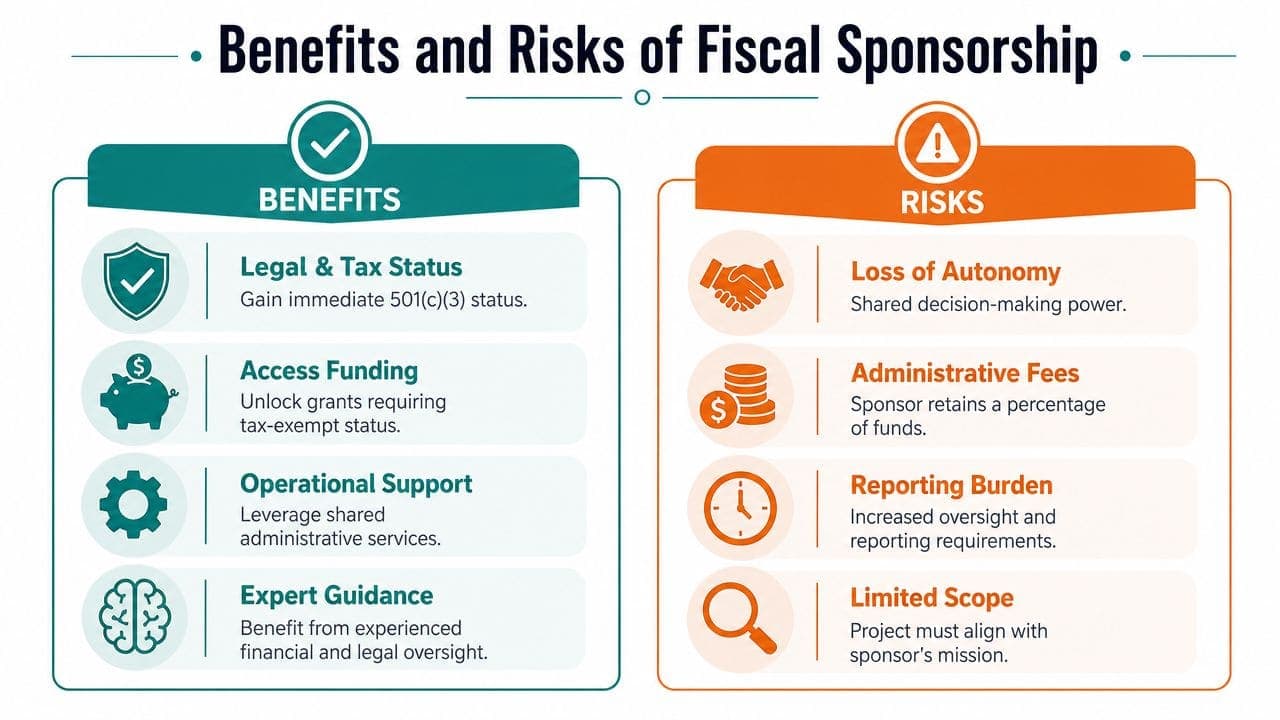
The appeal is obvious. A project can start raising charitable dollars without waiting to build a full nonprofit back office from scratch. A sponsor can expand its mission footprint without launching every new idea as a separate entity.
That's the upside. The trade-off is that fiscal sponsorship is not light administration dressed up in legal language. It's a governance and finance relationship that needs real structure.
What the project gains
For many projects, the biggest benefit is speed. You can accept tax-deductible gifts and approach funders that require a charitable home. You may also gain help with receipting, accounting, payroll, insurance, and grant administration.
That support can save a founder or program leader from becoming an accidental bookkeeper. It also gives donors more confidence that someone other than the project leader is watching the money.
What the project gives up
Autonomy is the first cost. Even in looser arrangements, you won't have complete freedom over charitable funds. If a sponsor is doing its job correctly, it will ask questions, require budgets, review spending, and insist on documentation.
The second cost is economic. Fees matter, but the larger issue is what those fees cover. One explanatory source notes that fees may fall roughly in the 7% to 15% range, with a lower 3% to 6% range in some arrangements, while also stressing that the sponsor must retain legal control and records to avoid becoming a pass-through, as discussed in this fiscal sponsorship pricing and risk discussion.
What the sponsor gains and risks
Sponsors can support aligned work without creating a separate nonprofit every time a strong idea appears. That can be mission-expanding and strategically smart.
But sponsors also inherit real exposure.
- Financial risk means someone on your team must track restricted funds correctly.
- Operational risk means project leaders will expect timely reports and timely disbursements.
- Legal risk means a weak agreement or weak documentation can create trouble quickly.
- Reputational risk means the public usually sees the sponsor's name first when something goes wrong.
Cheap fiscal sponsorship often becomes expensive later. The bill shows up as cleanup, confusion, and staff time.
The arrangement works best when both sides stop pretending it's simple. Good sponsorship is not just a fee for access to a tax ID. It's a managed relationship with fiduciary duties attached.
Navigating Compliance and Financial Oversight
This is the line you can't blur. A fiscal sponsor must exercise discretion and control over sponsored funds for contributions to remain tax-deductible.
That phrase sounds abstract until you live with it. Then it becomes a daily accounting rule, a board governance rule, and a donor communication rule.
The AICPA explains that the sponsor must maintain adequate records and ensure the money is used for activities that further its own exempt purpose. It cannot be a simple pass-through arrangement, as outlined in the AICPA overview of fiscal sponsorships.
What discretion and control means in practice
The sponsor is not just parking money for the project. The sponsor is the organization legally responsible for charitable funds.
That means:
- Funds must be approved for charitable use consistent with the sponsor's exempt purpose.
- Records must be maintained well enough to support oversight.
- Restrictions must be tracked so project money doesn't get mixed with general operating cash.
- Disbursements need review based on the agreement, the budget, and the purpose of the funds.
If your current process is spreadsheets, email approvals, and a shared folder full of PDF invoices, you already know where this starts to break down.
Why generic bookkeeping falls short
Class tracking in a generic accounting system can help you label transactions. It doesn't automatically give you true restricted fund visibility by project, grant, and purpose. It also won't save you when a project leader asks a simple question such as, "How much is available to spend from that grant right now?"
That's why compliance and sane operations are tied together. The legal rule creates the reporting requirement. The reporting requirement creates the need for proper fund accounting.
If you can't show where restricted money came from, what it can be used for, and what remains, you don't have control. You have hope.
If you're reviewing your current setup, this fiscal sponsor compliance resource is a practical next read.
A Practical Checklist for Due Diligence
Most fiscal sponsorship problems begin long before money moves. They begin in early conversations where everyone assumes the other party means the same thing by "support," "oversight," or "independence."
Ask sharper questions early. It saves strain later.
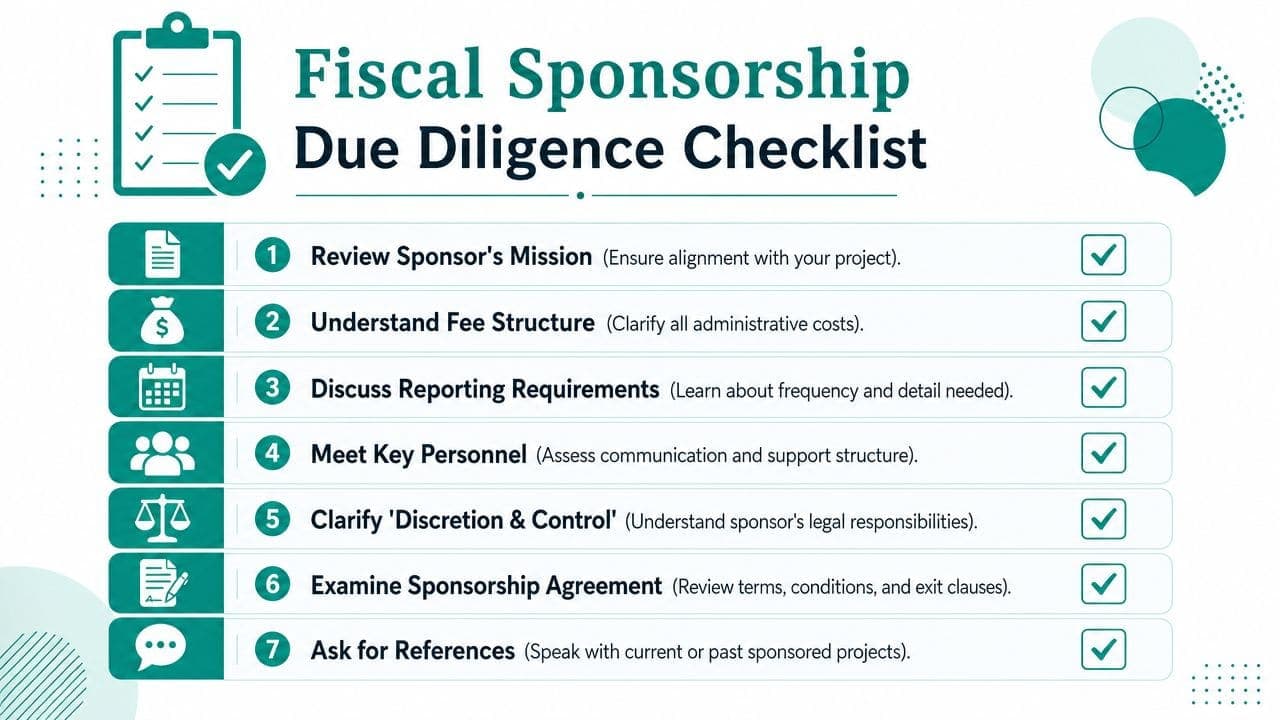
A useful benchmark is pricing. Propel Nonprofits notes that a common market benchmark for fiscal sponsorship is a 5% to 10% administrative fee, compensating the sponsor for fiduciary oversight, separate accounting, donor receipting, and financial controls, in this board guide to fiscal sponsorship.
If you are the project seeking a sponsor
Start with fit, not fees. A sponsor that doesn't understand your work will become hard to work with even if the fee looks attractive.
Ask these questions:
- Mission fit: Does the sponsor clearly see your work as part of its exempt purpose?
- Financial reporting: What reports will you receive, how often, and at what level of detail?
- Cash access: How are reimbursements, vendor payments, and grant disbursements processed?
- Fee structure: What is covered by the core fee, and what triggers extra charges?
- Fund restrictions: How are grants and donor restrictions tracked on the sponsor's books?
- Insurance and risk: What coverage applies to your staff, volunteers, and events?
- Exit terms: If you spin out or move, what happens to restricted funds, records, and intellectual property?
If you are the sponsor considering taking projects on
Turn the questions inward. Capacity is the actual issue.
- Staff time: Who will review budgets, payments, grant terms, and reports?
- Accounting structure: Can your current system track separate funds cleanly by project?
- Board understanding: Does your board know it is accepting fiduciary responsibility, not just giving permission?
- Documentation discipline: Can your team keep agreements, approvals, and restrictions organized?
- Tolerance for complexity: Are you prepared for a project that starts small and becomes grant-heavy?
A sponsorship agreement should answer the awkward questions before anyone feels awkward asking them.
The basic checklist is simple. The discipline is not. If you want a more detailed list to use in live conversations, review this fiscal sponsor compliance checklist.
How to Manage Complex Reporting with Confidence
The hardest part of fiscal sponsorship usually isn't donor cultivation or project vision. It's reporting once the arrangement becomes real.
A sponsor may be tracking several projects, each with its own grants, donor restrictions, spending approvals, and reporting expectations. At that point, generic small-business accounting tools often start showing their limits.
The Council of Nonprofits points to a key operational question as fiscal sponsorship becomes a more common long-term alternative to forming a standalone nonprofit. Can the sponsor support detailed grant drawdowns and project-by-project financials while still meeting its compliance obligations, as discussed in this Council of Nonprofits guide to fiscal sponsorship?
Where common tools help and where they don't
QuickBooks is familiar and widely used. For many nonprofits, it's a reasonable bookkeeping tool. But classes are not the same as true fund accounting, especially when you need to see restricted balances by project and purpose without rebuilding reports every month.
Aplos is stronger on nonprofit accounting structure. That's a meaningful advantage if your main problem is fund tracking.
The challenge for sponsors is that accounting rarely stands alone. The same organization also needs donor records, volunteer tracking, event data, emails, and internal communication in one operational picture. When those systems are split apart, staff spend too much time reconciling information and explaining differences.
What a better reporting setup should do
A sponsor needs software that reflects the legal reality of the project.
Look for these capabilities:
- Project-level fund tracking: Each sponsored project should have clean restricted balances.
- Grant visibility: You should be able to see what has been awarded, spent, and still available.
- Consolidated reporting: Leadership and the board need organization-wide visibility without losing project detail.
- Donor and finance connection: Gifts, restrictions, receipts, and accounting entries should line up.
- Shared access without seat anxiety: Project leads, finance staff, and leadership all need visibility appropriate to their roles.
AlignMint serves as one such option. It combines true fund accounting with donor CRM, volunteer management, events, marketing tools, Minty assistance, and plan-based user allowances (1 on Free, up to 10 on Plus, up to 25 on Pro, and unlimited on Enterprise) in one system. For sponsors managing multiple projects, that matters because the finance record and the donor record don't drift apart, and smaller organizations can start on a free tier if they raise under $100K.
For a practical reporting framework, this article on fiscal sponsor monthly financial reporting goes deeper into what project leaders and sponsors should expect to see every month.
Your Next Step Toward Fiscal Sponsorship
A fiscal sponsor non profit arrangement works when the relationship is clear and the money is clearer. You need an agreement that defines control, responsibility, reporting, fees, and exit terms. Then you need financial systems that can carry out that agreement without turning every month-end into a scramble.
That's the part many leaders underestimate. Sponsorship is often sold as a shortcut. It can be one, but only if the sponsor can track restricted funds, document approvals, and report by project without confusion.
If you're evaluating sponsors, ask harder questions about reporting than about branding. If you're becoming a sponsor, make sure your finance office can support the programs you're promising to take on. Good intentions won't reconcile grant balances.
When the structure is right, fiscal sponsorship can preserve your momentum, protect donor trust, and reduce the administrative drag that keeps strong projects from getting started.
Ready to see how an all-in-one platform can simplify your fiscal sponsorship operations? Explore AlignMint's fund accounting features. Or, if you're just starting and raise under $100K, create your free AlignMint account today. For more insights, read our guides on nonprofit accounting software and fund accounting for nonprofits.
If your organization is weighing fiscal sponsorship, AlignMint is worth a look. We built it for nonprofit teams that need fund accounting, donor management, volunteers, events, marketing, and clear reporting in one place, without per-seat fees complicating access for staff and project leaders.
Ready to see how AlignMint fits your workflow?
Schedule a free walkthrough — we will help you map donors, funds, and migration steps.