

For related tools, see fiscal sponsor software and fund accounting.
Quick Answer: What a Fiscal Sponsor Nonprofit Does
A fiscal sponsor nonprofit takes legal and fiduciary responsibility for charitable funds raised on a project's behalf. It is not simply lending a tax ID. Successful arrangements require clear discretion-and-control workflows, defined fees for real oversight, and exit terms before money starts moving.
You probably know this situation. A strong community idea is ready to move, donors are interested, and the project matters now, but forming a new charity will take time and energy you don't have.
A fiscal sponsor nonprofit can give that work a legal and financial home faster. The hard part is knowing what the arrangement really requires, what it costs the sponsor, and how to avoid a messy ending later.
Your Guide to Fiscal Sponsorship
Most leaders first look at fiscal sponsorship when the usual path feels too slow. You may have a pilot program ready to launch, a coalition effort that needs a fiscal home, or a funder asking for a charitable vehicle before they commit.
A fiscal sponsor nonprofit can solve that problem. Instead of waiting to form a separate 501(c)(3), a project operates under an existing nonprofit's structure and receives the administrative support that makes fundraising and compliance possible.
That sounds simple. It isn't always simple in practice.
What works is treating fiscal sponsorship as an operating model, not a shortcut. The project needs clarity on fundraising, spending authority, reporting, and decision rights. The sponsor needs the staff, systems, and board discipline to manage restricted funds and document charitable use.
Three questions usually tell you whether you're looking at the right arrangement:
- Is speed the main need: If the project needs to start fundraising or accept grants soon, sponsorship can make sense.
- Is the project aligned with the sponsor's mission: If the mission fit is weak, strain shows up quickly in approvals, reporting, and governance.
- Is there a clear plan for operations: Before money arrives, you need agreement on accounting, donor handling, and oversight.
If you're comparing options, AlignMint's fiscal sponsor overview lays out the operational side in plain language.
Practical rule: Fiscal sponsorship works best when both sides want structure, not freedom from structure.
Used well, sponsorship can help a project move earlier and with better controls. Used casually, it creates confusion around authority, reporting, and ownership.
What Fiscal Sponsorship Really Is
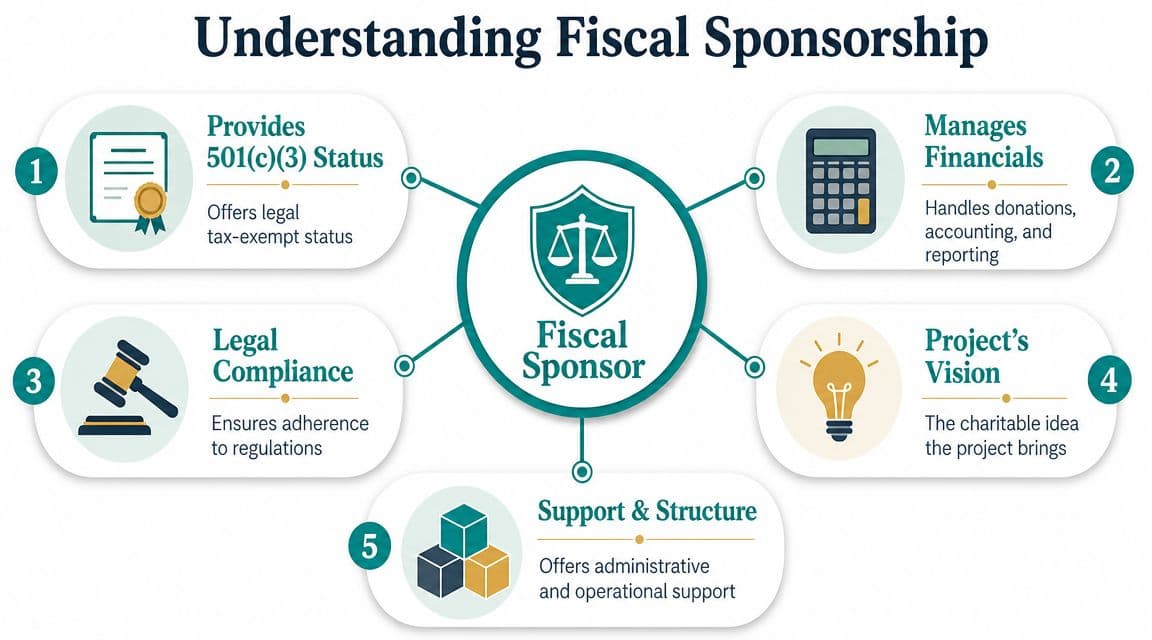
A fiscal sponsor is often described as a nonprofit that helps a project receive tax-deductible donations. That's true, but it doesn't go far enough. The sponsor isn't just lending its tax status. It is taking responsibility for charitable funds and the way those funds are used.
The simplest way to think about it
A useful analogy is a general contractor. The project brings the vision, relationships, and program idea. The sponsor provides the legal structure, financial administration, and compliance framework that allows the project to happen inside an established charitable organization.
That framework carries real obligations. According to the AICPA's overview of fiscal sponsorship, a sponsor must treat sponsored projects as part of its own exempt operations, retain discretion and control over donated funds, maintain records showing charitable use, and report the project's assets and liabilities on its own balance sheet in the relevant structure (AICPA overview of fiscal sponsorship).
Why discretion and control matters
Discretion and control is the phrase that separates a valid sponsorship from a pass-through arrangement.
If a donor gives money for a sponsored project, the sponsor can't act like a mail slot. The sponsor has to decide that the funds will be used for charitable purposes consistent with its exempt mission, keep records that support that decision, and oversee the use of the funds.
That doesn't mean a good sponsor micromanages every program detail. It means the sponsor has legal responsibility for the money. If your project wants unrestricted independence, fiscal sponsorship may not be the right fit.
The sponsor has to be able to show that the project's charitable activity is its own responsibility, not someone else's side account.
What this changes day to day
Once leaders understand that point, several practical realities become easier to accept.
- Donations aren't the project's private account: They are charitable funds under sponsor control, often with donor restrictions attached.
- Records must be complete: The sponsor needs documentation for spending, grants, balances, and charitable purpose.
- Reporting belongs to the sponsor: Financial statements and tax reporting have to reflect the sponsored activity correctly.
- Approvals matter: Spending, hiring, contracting, and grant handling need defined procedures.
This is why weak sponsorship arrangements usually fail. One side thinks the relationship is mostly administrative. The other discovers that real oversight slows down decisions and requires more paperwork than expected.
What good arrangements feel like
A healthy fiscal sponsor nonprofit doesn't disappear into the background. It creates a clear operating lane. Project leaders know what they can approve, what needs sponsor review, how funds are tracked, and what reports will be produced.
That clarity protects everyone. Donors know their gifts are handled within a charitable structure. Projects gain legitimacy and administrative support. Sponsors reduce the risk of acting like a pass-through.
If you're evaluating a sponsorship relationship, start here. Ask whether the sponsor behaves like a responsible charitable operator, not just a host for contributions.
Key Fiscal Sponsorship Models Explained
Not all fiscal sponsorships work the same way. If you skip this distinction, you can end up with the wrong expectations about ownership, staffing, and what happens when the project grows.
The two models most leaders need to understand first are Model A and Model C. In the Johnson Center's analysis of the Fiscal Sponsor Directory, the directory included 380 sponsors, more than two-thirds were established in 2000 or later, and 63% practiced Model C. The same analysis found that 96% charged a percentage-based fee, with almost half falling in the 5% to 10% range (Johnson Center analysis of fiscal sponsorship models).
Model A means the project sits inside the sponsor
Under Model A, often called the direct project model, the sponsored work becomes part of the sponsor's operations. The sponsor typically employs staff tied to the project, owns assets connected to the project, and carries the program as an internal activity.
This model can work well when the sponsor wants deep integration. It also works when a project doesn't need separate corporate identity and is comfortable operating as a program inside a larger organization.
What tends to work well in Model A:
- Shared staffing: HR, payroll, supervision, and policies are easier when everyone sits under one employer.
- Tighter financial control: Expenses, approvals, and reporting often move through standard sponsor systems.
- Mission alignment: This model fits best when the project and sponsor already see themselves as one charitable effort.
What often frustrates project leaders:
- Less autonomy: The sponsor's policies govern hiring, contracts, branding, and operations.
- Asset ownership is clearer, but less flexible: If the project later wants to leave, separation can be more complicated.
- Decision speed depends on the sponsor: If internal approvals are slow, the project feels it quickly.
Model C gives the project more independence
Under Model C, the pre-approved grant relationship, the project remains a separate entity and receives grants from the sponsor after the sponsor accepts charitable contributions intended to support that work.
This is the model many leaders prefer when they want more room to build their own identity or eventually form an independent nonprofit. It usually gives the project more operating independence, but it still requires the sponsor to exercise real judgment over charitable funds.
Fiscal Sponsorship Models At-a-Glance
| Attribute | Model A (Direct Project) | Model C (Pre-Approved Grant) |
|---|---|---|
| Legal position | Project operates as part of the sponsor | Project remains a separate entity receiving grants |
| Staff relationship | Staff are generally tied to the sponsor's employment structure | Project usually manages its own entity-side staffing structure |
| Asset ownership | Sponsor typically owns project-related assets | Ownership depends on entity structure and grant terms |
| Financial control | High sponsor integration into day-to-day operations | Sponsor oversees grants while project keeps more operational room |
| Best fit | Internal program incubation or long-term integration | Projects seeking autonomy or a path to independence |
| Exit path | Can be more involved because operations are integrated | Often cleaner if agreement terms are written well |
For a deeper breakdown of reporting and accounting implications, see this guide to fiscal sponsorship accounting models.
How to choose between them
The wrong question is usually, "Which model is easier?" The better question is, "Which model fits the future we're building?"
If the project expects to remain closely tied to the sponsor, Model A may fit. If the project expects to raise its own support, build separate leadership, and possibly spin out later, Model C often makes more sense.
Choose the model that matches the likely exit, not the most optimistic story about the future.
In practice, misunderstandings usually come from assumptions about ownership. A project leader may assume donor relationships, intellectual property, staff relationships, or reserves will move with them later. A sponsor may assume those items stay where they were built. Those assumptions need to be written down before the first major gift arrives.
A Sponsor's Accounting and Legal Duties
The fastest way to get fiscal sponsorship wrong is to treat it as donation processing with a service fee attached. Once you become the sponsor, your accounting, legal oversight, and internal controls all become more demanding.
That isn't a niche issue anymore. A 2023 field scan found that 100 participating fiscal sponsors collectively stewarded more than $2.6 billion in community investments in the prior year, and 73% offered finance, HR, legal, insurance, and compliance services (Social Impact Commons field scan). That tells you where the field has gone. Sponsors are operating as shared-services hubs, not simple pass-through entities.
Restricted funds change your accounting posture
For most sponsored projects, gifts come in with donor intent tied to a specific project. That means the sponsor has to track those funds with precision and report on them in a way that supports both internal management and external reporting.
If your system can't show project-level balances, inflows, expenses, and restrictions without spreadsheet rescue work, you're exposed. This is why true fund accounting matters. You need a chart of accounts and fund structure that reflect how the money is governed.
Common friction points show up fast:
- Project-level reporting: Program leads want current balances and spending detail.
- Restriction tracking: Finance has to separate what is available from what is committed or limited.
- Grant administration: Drawdowns, reimbursements, and grant reports have to tie back to the books.
- Consolidated reporting: The sponsor still needs organization-wide statements that roll sponsored activity into the proper picture.
Separate handling is a practical safeguard
Propel Nonprofits cites a common benchmark of about 5% to 10% of funds held for the sponsor's administrative share, and notes that best practice is to keep project money in a separate bank account and separate it from operating funds in the financial system (Propel Nonprofits board guide). That share is an administrative allocation of funds the sponsor already holds. Sector guides still call it a fee.
That matters for more than neatness. Separate handling reduces commingling risk and makes reporting, reconciliation, and project exits easier to manage. It also forces better habits around approvals and documentation.
What software usually gets wrong
Many organizations try to manage sponsored projects in general small-business accounting tools. QuickBooks is familiar and useful for many nonprofits, but it wasn't built as true fund accounting software. Its class and location workarounds can help with simple segmentation, yet fiscal sponsorship often demands cleaner treatment of restrictions, project balances, and consolidated nonprofit reporting than a workaround can comfortably support.
Other tools have strengths in adjacent areas. Blackbaud and Neon One are known in fundraising and nonprofit operations. Bloomerang is strong in donor relationship management. The issue isn't that those systems are flawed. It's that fiscal sponsorship usually breaks apart organizations that rely on one tool for donations, another for accounting, and separate spreadsheets for project reporting.
If you're acting as sponsor, you need one place to answer ordinary questions quickly:
- What is Project A's restricted balance right now
- Which grants have been spent down
- What administrative allocation posted, and to which fund
- Which donor receipts and reports have already gone out
For teams comparing systems built for this work, AlignMint's fiscal sponsor accounting page focuses on the accounting side of sponsored project management.
Operational test: If finance needs three exports and a spreadsheet to answer a project balance question, your controls are weaker than they look.
The True Cost of Becoming a Sponsor
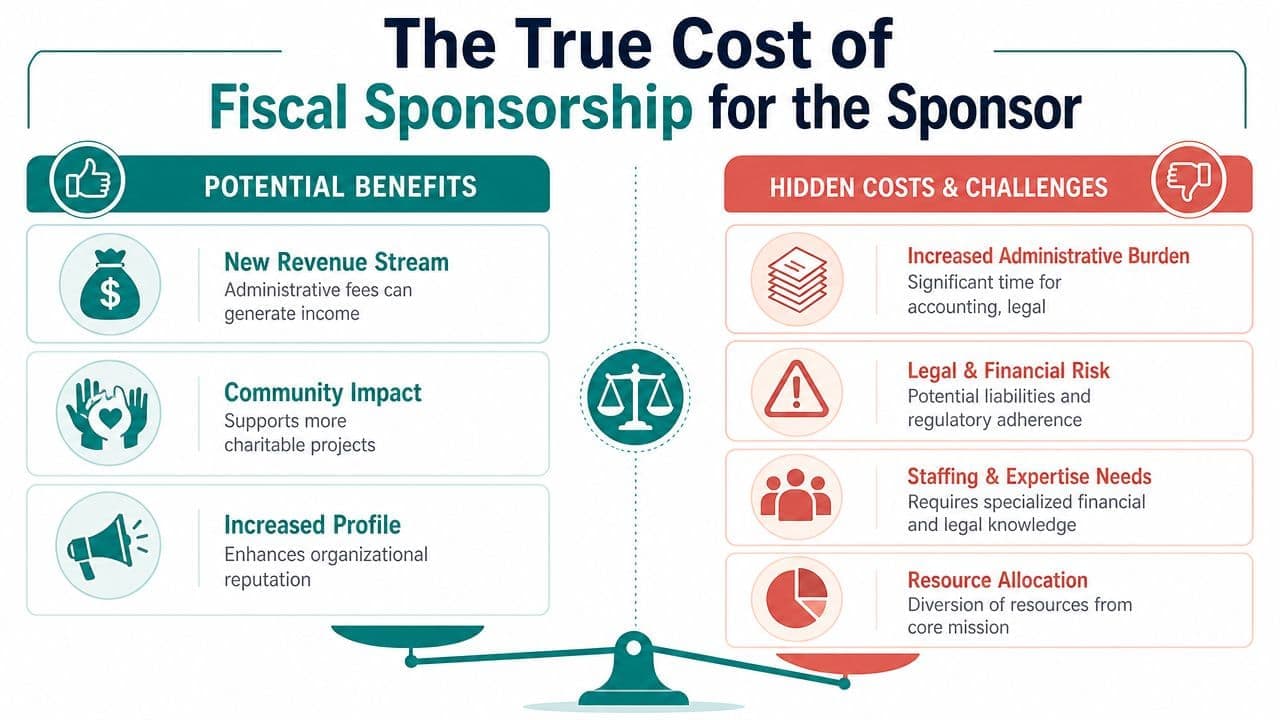
A lot of boards see fiscal sponsorship as mission expansion plus the administrative allocation. Sometimes the allocation covers the work. Sometimes the portfolio is a drain on staff, leadership attention, and risk tolerance that the rate never fully covers.
The useful question is whether the allocation covers the actual work.
The allocation is only part of the picture
Public guidance often mentions sponsor fees. The range is useful, and it is incomplete. The sponsor is taking on governance responsibility, compliance oversight, financial administration, and reputational risk. The amount those guides call a fee is an administrative allocation.
Propel Nonprofits puts the core issue plainly. The question for a potential sponsor is not "What is the fee?" but "What is the true net margin after compliance and risk costs?" because the sponsor must retain "complete discretion and control" over funds (fiscal sponsorship rate considerations).
That question changes the board discussion. You stop looking at the gross allocation and start looking at staff time, review load, insurance implications, finance capacity, and executive oversight.
Hidden costs show up in ordinary work
These are the costs leaders tend to underestimate:
- Review time: Someone has to review contracts, grant terms, restricted gifts, and unusual expenses.
- Finance load: Reconciliations, project statements, fee calculations, and grant reporting take repeated attention.
- Leadership bandwidth: EDs and CFOs get pulled into issues when project leaders and sponsors interpret authority differently.
- Policy strain: Procurement, HR, conflict of interest, and expense approval rules need to be applied across sponsored work.
A weak sponsorship program often starts with a small project that seems manageable. Then another project joins. Then a grant arrives with reporting conditions. Then a staffing question lands in HR. The burden rarely arrives all at once.
Sponsorship can advance your mission. It can also distract your core team if you treat it like administrative side income.
What a prudent board should ask
Before approving a sponsorship program, boards should press on practical issues:
- Do we have finance staff who can support project-level reporting without manual workarounds
- Who approves restricted gifts, contracts, and unusual expenses
- Can we explain our termination process before we sign the first agreement
- Will this strengthen our mission, or just widen our admin surface area
If the answers are fuzzy, the program probably isn't ready. Fiscal sponsorship can be worthwhile. It just doesn't stay lightweight for long.
For a broader look at the finance side, this post on nonprofit accounting best practices is a useful companion.
Choosing a Sponsor and Planning Your Exit
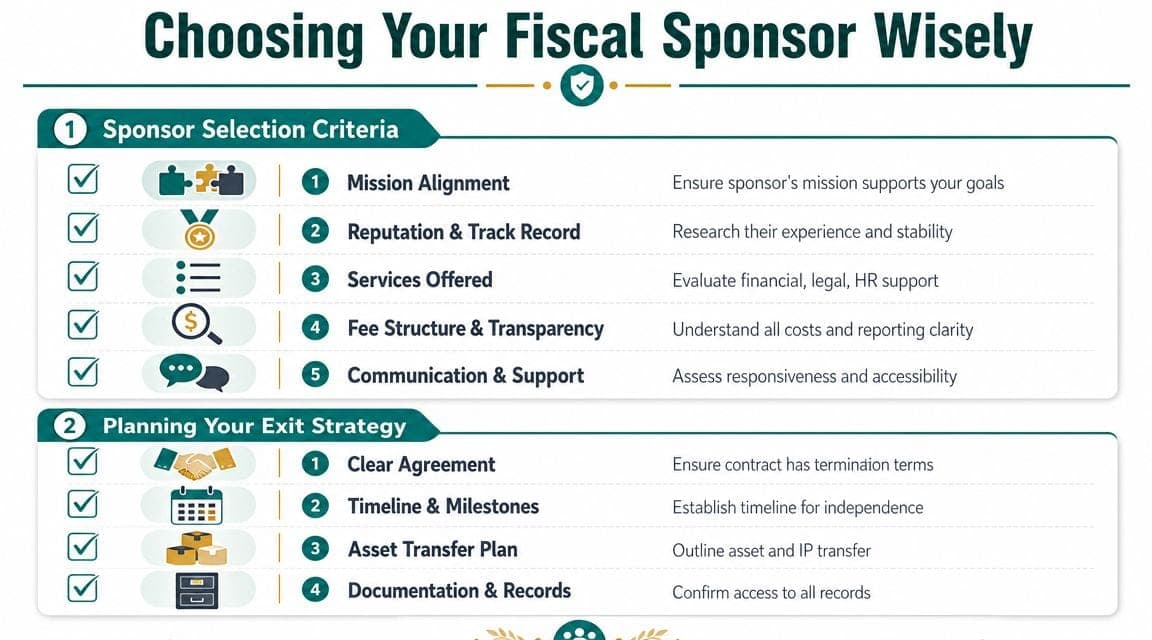
If you're looking for a fiscal sponsor nonprofit, the fee is not the first thing to compare. The first thing to compare is whether this organization can hold your work responsibly without slowing it to a crawl or creating confusion about ownership.
That starts with fit. It ends with the exit clause.
What to check before you sign
A sponsor should be able to explain its process in plain language. If basic questions produce vague answers, expect bigger problems once money and expectations build.
Strong due diligence usually includes these checks:
- Mission fit: The sponsor should be able to state why your project belongs within its exempt purpose.
- Services included: Ask exactly what finance, HR, legal, compliance, donor processing, and reporting support are included.
- Decision rights: Clarify who can hire, sign contracts, approve expenses, speak to funders, and launch appeals.
- Reporting rhythm: Ask how often you'll receive financial statements and what detail they include.
- Peer references: Talk to other sponsored projects, especially ones that have been there long enough to know the rough edges.
If you want a practical shortlist, this guide on how to choose a fiscal sponsor is a good starting point.
The agreement matters more than the pitch
Leaders sometimes get sold by warmth, reputation, or urgency. Then they sign a thin agreement and discover later that everyone meant something different by "support."
The written agreement should make operating expectations concrete. At minimum, it should address services, fees, fundraising rules, ownership questions, financial reporting, records access, approvals, and termination.
The D.C. Bar's guidance is especially useful on the issue many organizations skip. A written fiscal sponsorship agreement should define duration, termination procedures, and what happens to project funds and property when the agreement ends (D.C. Bar guidance on fiscal sponsorship termination).
Your exit plan should exist on day one
Most public advice focuses on starting the relationship. Experienced leaders know the true tension often appears when the relationship ends.
Exit planning should answer questions like these:
- Remaining restricted funds: If your project leaves, how will donor restrictions continue to be honored
- Grant balances: Can grants transfer, or must the sponsor complete or regrant them under specific conditions
- Property and equipment: Who owns items bought with sponsored funds
- Donor records: What access does the project keep to donor history and contact information
- Brand assets and intellectual property: Who controls the name, materials, curriculum, or digital assets
- Record retention: Who holds financial and legal records after termination
A missing exit clause isn't a small drafting issue. It's a sign that no one has tested how this relationship ends under stress.
Red flags worth taking seriously
Some warning signs are easy to dismiss when everyone is enthusiastic. Don't dismiss them.
- The sponsor says control won't be an issue: It will be. The question is whether control is defined clearly.
- The agreement is silent on termination: That usually means future conflict is being postponed, not prevented.
- Financial reporting is described casually: If statements are irregular or hard to interpret, trust erodes quickly.
- Fundraising protocols are vague: Confusion over who can solicit, acknowledge, and steward gifts creates avoidable donor friction.
Projects that plan to become independent should be especially disciplined here. If you think you'll spin out later, build that expectation into the agreement, the recordkeeping, and the financial workflow from the beginning.
A good sponsorship relationship doesn't just help you start. It lets you leave cleanly if the project outgrows the arrangement.
Manage Fiscal Sponsorships with Confidence
The day-to-day challenge in fiscal sponsorship isn't theory. It's coordination. A donation comes in, the right project needs credit, restrictions need to be reflected in the books, the donor record must stay current, and the sponsor needs reporting that stands up to audit and board scrutiny.
That's where disconnected systems create most of the pain. One tool holds accounting, another handles donor records, a third tracks communications, and project staff keep their own spreadsheets because they can't get timely answers any other way.
A better setup brings those moving parts together. If your accounting, donor records, volunteer activity, events, and marketing all live in the same system, your team spends less time reconciling and more time managing the program itself.
For fiscal sponsors, that means a few practical gains:
- Project balances are visible: Finance can answer questions without rebuilding reports by hand.
- Donor records stay connected to gifts: Sponsored projects can communicate with supporters without splitting the source of truth.
- Grant activity is easier to follow: Spending and reporting live closer to the accounting record.
- Team access is simpler to manage: Program staff, finance staff, and leadership can work in one place without per-seat anxiety.
AlignMint is one option built around that model. It combines fund accounting, donor CRM, volunteers, events, marketing, and an AI assistant in one platform, with plan-based user access and a free tier for nonprofits under $100K. For fiscal sponsors, the practical value is that restricted funds, donor activity, communications, and project reporting stay connected instead of being patched together after the fact.
That matters because confidence in sponsorship rarely comes from better intentions. It comes from better visibility, cleaner controls, and agreements that match how your team operates.
If you're sponsoring projects, your systems should make disciplined stewardship easier. If you're seeking a sponsor, ask whether their tools and processes can support the relationship you're counting on.
If you're weighing whether fiscal sponsorship fits your organization, or you're tired of managing sponsored projects across accounting software, spreadsheets, and separate donor tools, take a look at AlignMint. We built it for nonprofit operators who need true fund accounting, connected donor records, built-in marketing, and clear project reporting without adding another stack of systems to manage.
Ready to see how AlignMint fits your workflow?
Schedule a free walkthrough — we will help you map donors, funds, and migration steps.