

For related tools, see fiscal sponsor software and fund accounting.
Fiscal Sponsor for Nonprofit: Your Practical Guide
Quick Answer: Fiscal Sponsor for Nonprofit: Your Practical Guide
A fiscal sponsor for nonprofit projects is an established 501(c)(3) that lets you accept tax-deductible donations and grants without forming your own charity first. Model A integrates your project inside the sponsor; Model C funds a separate project through pre-approved grants. The right fit depends on how much oversight you need, how quickly you must fundraise, and whether the sponsor's fund accounting can track restricted dollars at the project level.
You may already be staring at this problem right now. A promising program needs to raise money, donors want a tax deduction, a foundation asks for 501(c)(3) status, and nobody on your team has time to form a new nonprofit from scratch.
That's where a fiscal sponsor for nonprofit work can make sense. The right arrangement helps you start faster, stay compliant, and avoid building an entire back office before the mission has even found its footing. The wrong arrangement creates confusion, reporting delays, and spreadsheet chaos that follows you for years.
What Is a Fiscal Sponsor Really
A fiscal sponsor is an established nonprofit that gives a project a legal and administrative home so it can accept tax-deductible donations and certain grants without first becoming its own separate charity. If you want the short version, think of it as a respected organization lending its charitable umbrella, while keeping real oversight over the money and the charitable purpose.
That last part matters. This is not a casual pass-through relationship. A real fiscal sponsorship arrangement comes with supervision, controls, and operating rules.
Fiscal sponsorship is no longer a niche workaround for small experiments. A 2023 field scan found that 100 fiscal sponsor organizations collectively stewarded more than $2.6 billion in community investments in the previous year, which shows the model has become a core part of nonprofit infrastructure, not a side practice for a few incubators (Social Impact Commons field scan summary).
Why leaders choose this route
Most executive directors don't choose fiscal sponsorship because it sounds elegant. They choose it because they need to act.
You may need to:
- Launch quickly so donors can give now, not after months of legal setup.
- Test a program before deciding whether it deserves its own corporation and board.
- Reduce administrative burden by relying on a sponsor for finance, HR, legal, insurance, and risk management support.
- Protect early momentum when a founder or small team shouldn't spend its first season buried in filings.
That mix of speed and support is what makes the model attractive.
Practical rule: If your program is ready to serve people but not ready to run payroll, filings, insurance, and audits on its own, fiscal sponsorship may be the wiser first step.
What it looks like in daily operations
In real life, fiscal sponsorship is less romantic than most guides make it sound. Someone still has to approve expenses. Someone still has to track restricted gifts. Someone still has to make sure donor intent matches actual spending.
The sponsor usually provides shared back-office capacity. Your project gets access to systems and oversight that would otherwise take time and money to build. That's why this model works especially well for projects that need to receive charitable gifts quickly but also need stronger administrative discipline from the start.
If you want a plain-language definition to share with your board or project lead, AlignMint's fiscal sponsor glossary entry is a useful reference.
The Common Fiscal Sponsorship Models
The term "fiscal sponsorship" sounds singular. It isn't. Two arrangements can both be called fiscal sponsorship and operate very differently day to day.
That's why smart leaders ask one question early. Which model are we entering?
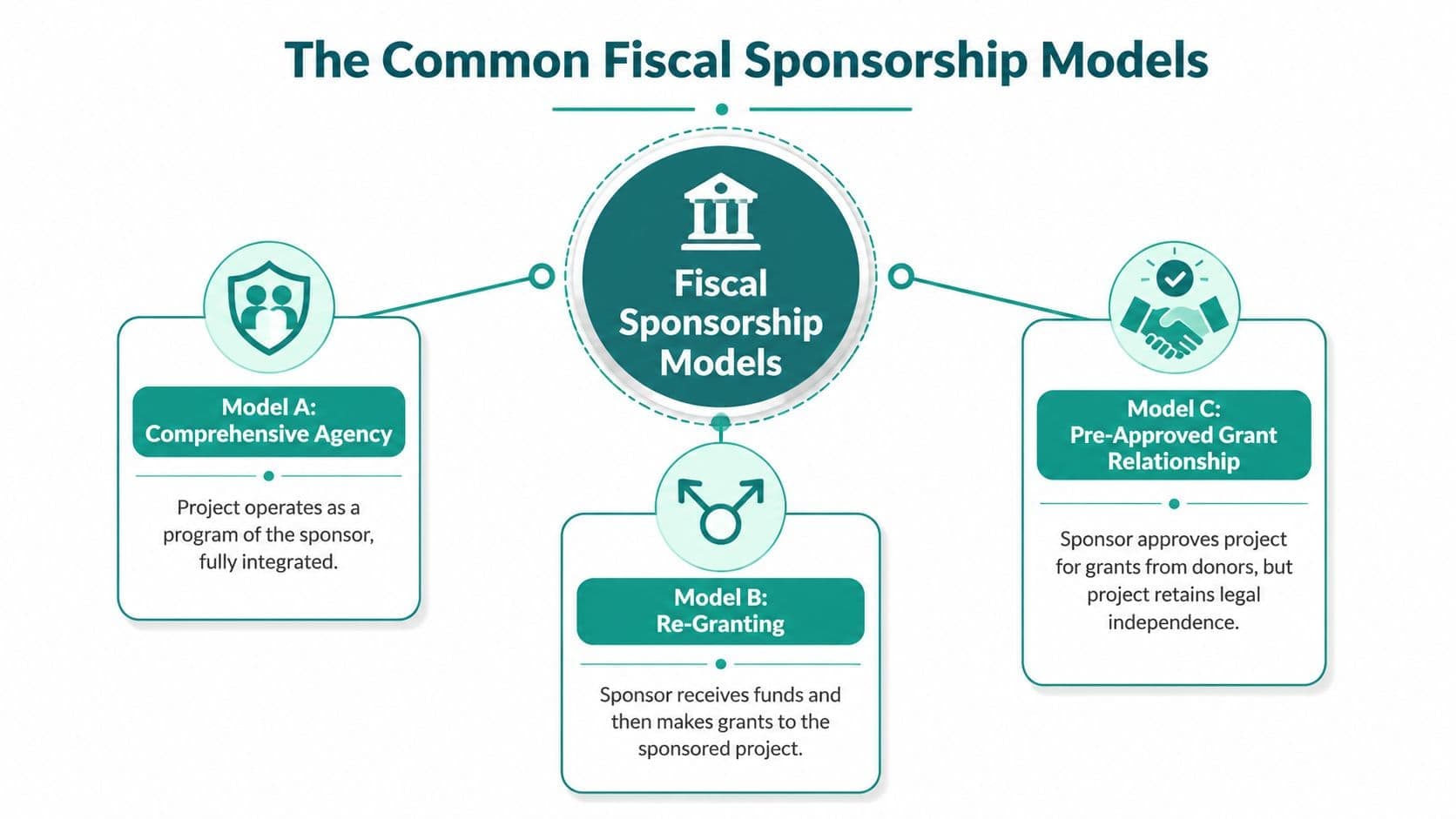
A directory analysis of fiscal sponsors found that 63% practiced Model C and 46% practiced Model A, which tells you both are common enough that you need to understand the distinction before you sign anything (Johnson Center analysis).
Model A means the project lives inside the sponsor
Model A is often called the direct project or full-service agency model. In practical terms, your project operates as part of the sponsor.
The sponsor owns the legal relationship with staff, vendors, contracts, and funds. Your project may have leadership and advisory input, but the sponsor has final authority because the project is one of its programs.
This model works best when you want:
- A closer administrative home with stronger central oversight
- Less independence in exchange for more operational support
- A pilot structure that may later spin out if it proves viable
Model A can be a good fit when a project leader cares more about getting work done than about standing up an independent organization right away.
Model C means the sponsor funds a separate project
Model C is commonly described as a pre-approved grant relationship. Your project remains separate, but the sponsor receives charitable funds and then makes grants in support of the project's charitable purpose.
This usually gives project leaders more room to manage their own operations. But it also increases the need for clean documentation, clear approvals, and careful reporting.
Model C tends to appeal when you want:
| Model | Where the project sits | Who holds more control | Best fit |
|---|---|---|---|
| Model A | Inside the sponsor | Sponsor | Early-stage programs needing heavier administrative support |
| Model C | Outside the sponsor, funded by it | Shared, with sponsor oversight over charitable funds | Projects wanting more independence with continued charitable access |
The mistake I see most often is not choosing the wrong model. It's choosing a model you never fully named, then discovering six months later that you and the sponsor meant different things.
Model choice changes your reporting life
The legal structure affects ordinary work. Who signs contracts. Who hires staff. Who owns project assets. Who can approve spending. Who answers the donor when a restricted grant hasn't moved.
Those details don't belong in fine print. They shape your week.
If you want a practical accounting lens on the differences, AlignMint's guide to fiscal sponsorship accounting models is worth reviewing before legal review begins.
Your Responsibilities and Your Sponsors
A healthy fiscal sponsorship relationship feels clear, not fuzzy. Everyone knows who makes program decisions, who controls money, and who carries legal risk.
Trouble starts when a project assumes, "The sponsor handles that," while the sponsor assumes, "The project should already know that."
Your job as the sponsored project
Your team still carries real responsibility. Even if the sponsor handles accounting and compliance, you are not relieved of discipline.
In most working relationships, your side is expected to manage the mission-facing work. That usually includes program planning, budget awareness, expense documentation, grant narrative updates, and timely communication when plans change.
Your responsibilities often include:
- Program delivery so activities stay aligned with the stated charitable purpose
- Budget management so spending follows approved uses and available balances
- Documentation for reimbursements, vendor payments, and grant-related support
- Reporting to the sponsor on outcomes, timing, and any material change in scope
- Early warning when a grant restriction, staffing issue, or funding delay affects operations
If your project leader treats the sponsor like a bookkeeping service, the relationship usually frays fast.
The sponsor's job is oversight, not mere processing
Under the standard Model C relationship, the sponsor receives and controls the funds and retains discretion to ensure they are used for a charitable purpose. That control is what allows the sponsor to extend its 501(c)(3) status to the project (San Francisco Bar Association memo).
That means the sponsor is doing far more than depositing checks.
A capable sponsor usually handles some mix of the following:
| Sponsor responsibility | What it means in practice |
|---|---|
| Fund control | Donations and grants are received under the sponsor's authority |
| Compliance review | Spending must fit charitable purpose and donor restrictions |
| Financial records | The sponsor maintains official books and reporting |
| Risk management | Insurance, legal exposure, and policy enforcement sit with the sponsor |
| Termination decisions | The sponsor needs a lawful path if a project goes off course |
Shared responsibility works best when it is boring
That may sound odd, but it's true. The best fiscal sponsorships are operationally boring. Reports arrive on time. Restrictions are tracked correctly. Approval paths are clear. Nobody improvises around the edges.
Good sponsorship doesn't run on trust alone. It runs on trust backed by paperwork, process, and clean records.
If you're evaluating how much compliance structure a sponsor should have, AlignMint's fiscal sponsor compliance resource gives a practical sense of what mature oversight should include.
The Fiscal Sponsorship Agreement Checklist
A weak agreement creates strong headaches. If the written terms are vague, every hard moment later becomes a matter of memory, personality, or power.
A solid agreement protects both sides because it removes guesswork before money starts moving.
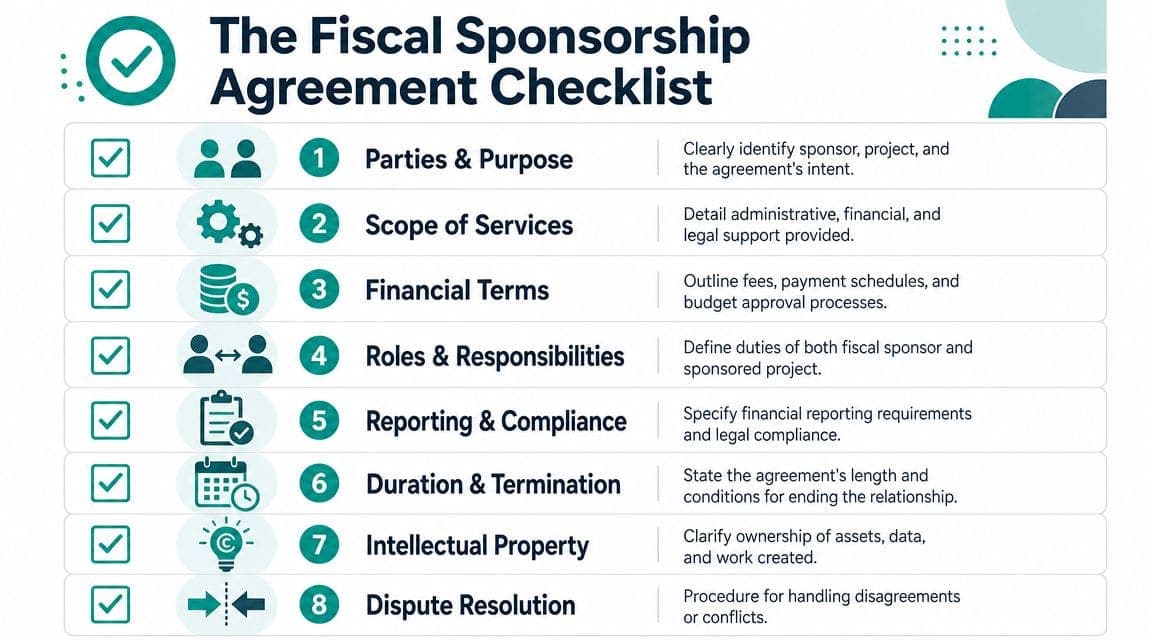
Fiscal sponsorship fees are usually a percentage of funds raised, with a common range of 3% to 15%, and that fee needs to be clearly spelled out in the agreement because it is the trade-off for getting started faster (Good Grants overview of fiscal sponsorship costs).
Terms that should never stay vague
You do not need a perfect contract. You do need a clear one.
Look for these items before anyone signs:
- Parties and purpose so the document states exactly who is involved and what charitable work is covered
- Services included because "back-office support" can mean anything from basic receipting to payroll, grant administration, and HR
- Fee structure including percentage, timing, and whether some services trigger extra charges
- Spending authority so everyone knows who can approve what, and under which budget
- Reporting schedule covering financial reports, narrative reports, and grant compliance deadlines
- Restricted funds handling so donor intent is not lost in general operations
- Intellectual property and data ownership especially if the project later separates
- Exit terms describing what happens to remaining funds, records, assets, and obligations
The exit clause deserves special attention
This is the part leaders skip when everyone feels optimistic. Don't skip it.
Projects change. Some grow into independent nonprofits. Some close. Some need to move to a different sponsor because the fit no longer works. If the agreement is cloudy on exits, ordinary transitions become emotional and expensive.
Ask direct questions:
- Can the project leave?
- What conditions apply to the transfer of remaining charitable funds?
- Who owns donor records, program materials, and work product?
- How are unpaid bills or grant obligations handled?
A sponsorship agreement should answer hard questions while everyone still likes each other.
If you want a practical review companion before sending documents to counsel, this fiscal sponsor compliance checklist is a useful starting point.
Avoiding Spreadsheet Hell with Consolidated Reporting
Here, fiscal sponsorship stops being theory and becomes work.
If you are the sponsored project, you need timely reports that show what money is available. If you are the sponsor, you need to track multiple projects, each with different restrictions, reporting dates, grant terms, and approval paths. That is where many organizations drift into spreadsheet hell.
One public explainer notes that fiscal sponsor fees often fall in the 7% to 15% range because sponsors may be covering significant back-office work such as tax filings and financial management. That matters because the more projects you manage, the more administrative burden piles up unless your systems are built for it (video explainer on fiscal sponsorship costs and sponsor burden).
Where reporting breaks down
The failure usually doesn't begin with bad intent. It begins with ordinary tools stretched too far.
A sponsor starts with spreadsheets and maybe QuickBooks. A project gets a monthly PDF. Then another project comes on. Then another grant with restrictions. Then donor acknowledgments need to match fund coding. Then a board member asks for project-level visibility across the whole portfolio.
Now your finance team is reconciling:
- Bank activity against multiple project balances
- Restricted grants against allowable uses
- Shared expenses across projects
- Donor records in one system and accounting records in another
- Project leader questions that require manual lookup
That is expensive in staff time, and it raises the risk of mistakes no sponsor wants to explain.
Why generic accounting setups struggle
QuickBooks can be useful. So can Aplos. Blackbaud has strengths too, especially for larger organizations with established processes. The issue isn't that these products are bad. The issue is that many sponsors need one place to see accounting, donors, communications, volunteers, and project activity together.
Classes in QuickBooks are not the same thing as true fund accounting. They can help categorize activity, but they don't solve the deeper problem of restricted balances, project-specific visibility, and consolidated oversight across several sponsored initiatives.
Aplos is often appreciated for simplicity. Blackbaud is well known and broad. But when teams stitch accounting, CRM, email, events, and volunteer records across separate tools, they create handoffs that invite errors. That is the part many buying guides skip.
If your team exports from one system, edits in Excel, and re-enters totals somewhere else, you don't have a process. You have a quiet liability.
What better reporting looks like
Better reporting is not flashy. It is clear.
You want a system that shows each project's available balance, separates restricted from unrestricted activity, ties gifts to the right fund, and gives leadership a consolidated view without rebuilding reports by hand each month. You also want project leaders to see what they need without exposing everything to everyone.
That need for clean, consistent reporting isn't unique to nonprofits. These Homebase financial reporting insights offer a helpful reminder that reporting discipline matters most when organizations are managing multiple stakeholders, time-sensitive decisions, and complicated cash movement.
If your current process depends on one finance manager who "knows where everything is," you don't have resilience. You have a single point of failure.
For a more practical monthly rhythm, AlignMint's guide to fiscal sponsor monthly financial reporting is worth keeping nearby.
Common Questions About Fiscal Sponsorship
Even when the structure is sound, a few practical questions usually remain. These are the ones that matter in board conversations, donor meetings, and internal planning sessions.
The questions leaders ask most often
| Question | Answer |
|---|---|
| Is a fiscal sponsor the same as a fiscal agent? | People often use the terms loosely, but they are not always describing the same legal reality. In a true fiscal sponsorship, the sponsor usually has oversight responsibilities and cannot act as a mere pass-through. If someone describes themselves as only processing donations and passing the money along untouched, ask counsel to review that structure carefully. |
| Can a fiscally sponsored project become its own nonprofit later? | Yes, that can happen if the agreement allows for it and the parties plan for transfer of funds, assets, records, and obligations. The transition goes much better when the exit path is addressed early instead of during conflict. |
| Should every new charitable idea start under a sponsor? | No. Some efforts are better launched inside an existing nonprofit as a permanent program. Others should form independently from the start. Fiscal sponsorship makes the most sense when speed, experimentation, or shared administration outweigh the desire for immediate independence. |
| What are the biggest red flags in a sponsor? | Vague financial reporting, unclear fee terms, slow responses on restricted funds, and confusion about who approves spending are all warning signs. If a sponsor can't explain its controls plainly, expect friction later. |
| What should project leaders ask before joining? | Ask how donations are receipted, how often reports are sent, who approves budgets, how grant restrictions are tracked, what insurance exists, and what happens if the relationship ends. The simpler the answers, the better. |
A few judgment calls that matter
Not every problem shows up in the contract. Some show up in behavior.
If a sponsor is consistently late with reports, dismissive about restrictions, or informal about approvals, don't assume that will improve once money increases. It usually gets worse under pressure.
By contrast, a strong sponsor tends to be clear, calm, and a little conservative. That's usually a good sign. You are not looking for charisma. You are looking for disciplined administration that protects the mission.
What to do if you're still deciding
Start with a short internal test.
Ask your team:
- Do we need speed more than independence right now?
- Can we live within someone else's controls for a period of time?
- Are we prepared to report cleanly and regularly?
- Do we know what success would look like in one year or three years?
Those answers usually reveal whether a sponsor is the right fit.
If fundraising is part of your launch plan, your donation process matters too. AlignMint's related guide on creating online giving pages for nonprofits can help you think through the donor experience from day one.
If you're managing sponsored projects, restricted funds, donor records, and monthly reporting across too many disconnected tools, AlignMint is worth a serious look. We built it as an all-in-one platform for nonprofit operations, with true fund accounting, donor management, volunteer tracking, built-in marketing, Minty help, and plan-based user allowances (1 on Free, up to 10 on Plus, up to 25 on Pro, and unlimited on Enterprise). If your organization is under $100K in annual revenue, there's also a free tier, which makes it practical to get organized before spreadsheet chaos becomes your normal.
Ready to see how AlignMint fits your workflow?
Schedule a free walkthrough — we will help you map donors, funds, and migration steps.