


Quick Answer: Boost Fundraising for Charity: A Complete Guide
Plan fundraising for charity from budget reality: goals, donor relationships, channels, compliance, and reporting - without spreadsheet chaos after the campaign. The sections below walk through practical steps, examples, and what to watch for.
For related tools, see AlignMint features. You’re probably juggling three separate conversations right now. One is about money coming in, one is about programs going out, and one is about whether your reports will hold up when the board asks hard questions.
That’s why fundraising for charity can feel harder than it should. The campaigns aren’t the whole job. The core effort is building a system that connects donor relationships, cash flow, restricted funds, volunteers, and impact reporting so your fundraising strengthens the organization.
Build Your Fundraising Plan and Set Clear Goals
Most fundraising trouble starts before the first appeal goes out. The problem isn’t usually effort. It’s that the revenue goal sits in one spreadsheet while the budget, restrictions, and program commitments sit somewhere else.
Start with the budget, not the campaign calendar. If you don’t know what must be unrestricted, what can be restricted, and what timing your cash flow can tolerate, you’ll raise money and still feel behind.

Start with the money you actually need
A practical fundraising plan answers four questions first.
-
What must be paid for no matter what Payroll, occupancy, core administration, insurance, and basic program delivery belong here. This is the part many boards understate because it’s less emotionally appealing than program asks.
-
What funding is flexible Unrestricted support gives you room to operate. If you don’t name that need clearly, you can end up “fully funded” on paper and still short on rent or salaries.
-
What funding is restricted Grants, designated gifts, scholarship funds, mission trips, capital improvements, and sponsored projects all need separate handling. Don’t blend them into a general target.
-
When cash must arrive A year-end pledge is helpful, but it won’t cover a shortfall in April if the cash doesn’t land until December.
Practical rule: Build your fundraising target from your operating reality, not from last year’s campaign hope.
True fund accounting holds significant importance. While QuickBooks classes and spreadsheet tabs can mimic some of this, they don’t give you the same confidence when a donor asks how much remains in a restricted fund or a board member asks whether a grant can legally cover a cost.
Set goals your board can understand
A board-approved fundraising plan should fit on a page. If it takes twenty minutes to explain the logic, it’s too abstract.
Use a simple planning structure like this:
| Planning area | What to define |
|---|---|
| Annual need | Total revenue required to support operations and programs |
| Unrestricted target | What you need for core operations |
| Restricted target | What must be raised for named programs or grants |
| Timing | Which months matter most for cash flow |
| Ownership | Who carries each revenue stream |
Then match the target to real donor behavior. In 2024, individuals drove 66% of all U.S. charitable giving, contributing $392.45 billion, which is why a durable plan for individual donors matters so much for small and mid-sized nonprofits, churches, and schools (fundraising statistics on charitable giving).
That doesn’t mean every group should chase the same tactics. It means your base plan can’t depend mostly on foundations or one event if your real strength is grassroots support.
Separate the plan into three lanes
I’ve found this keeps teams calm and honest.
-
Base revenue lane Annual fund, recurring gifts, church giving, school families, and dependable donor renewals. This keeps the lights on.
-
Growth lane Mid-level and major donor work, sponsorships, expanded giving days, and selected grant opportunities.
-
Special purpose lane Capital, scholarships, emergency response, or fiscal sponsorship projects with clear restrictions and reporting obligations.
If your organization is still formalizing its structure, especially in a new market, it helps to understand the compliance side early. This guide to registering a charity is useful because it ties legal setup to operational readiness, not just paperwork.
A fundraising plan should tell your team what to stop doing, not just what to add.
Build the communications plan at the same time
Many organizations write a development plan first, then scramble to invent messaging later. That’s how appeals become vague and deadlines slip.
Write the message map alongside the budget map. For each funding lane, note the audience, the ask, the proof point, and the follow-up rhythm. If your team needs a starting point, this guide to a marketing plan for nonprofit organizations is a practical companion because it connects campaign planning to actual outreach work.
A good plan reduces stress because everyone can see the same picture. The executive director sees cash timing. Development sees donor priorities. Finance sees restrictions. The board sees why the goal exists in the first place.
Know Your Donors and Manage Relationships
A donor file isn’t just a list of transactions. It’s the memory of your organization.
When donor history lives in email inboxes, spreadsheets, event apps, and one staff member’s head, your team loses context. That’s when good donors get generic asks, major prospects get rushed, and loyal volunteers never hear from development.

Treat donors like people, not segments alone
Segmentation matters, but relationship history matters more. Before you divide donors into buckets, gather the full picture for each person.
You want to know:
-
Giving history First gift, latest gift, recurring status, lapsed patterns, and any restricted preferences.
-
Engagement history Event attendance, volunteer service, school or church connection, campaign responses, and notes from meetings.
-
Communication preference Who answers email, who picks up the phone, who responds to text, and who wants a handwritten note.
-
Decision context Family involvement, employer match habits, board relationships, and whether they support one program or the full mission.
That unified view changes the quality of every ask. It also protects you when staff changes. A relationship shouldn’t disappear because one development director retires.
Why cultivated relationships outperform cold outreach
Most executive directors know this instinctively. The data backs it up. A relationship-focused fundraising pipeline has a 20-40% success rate for cultivated prospects, compared to just 2-5% for cold asks (guidance on avoiding common fundraising mistakes).
That gap matters because many teams still spend too much energy on broad appeals to people they hardly know. Cold outreach has a role, but it shouldn’t carry your revenue plan.
A stronger pattern looks like this:
| Donor stage | What your team should do |
|---|---|
| First gift | Thank quickly, explain impact clearly, invite a second touch |
| Repeat donor | Personalize outreach based on interest and timing |
| Loyal annual giver | Deepen connection with updates, calls, and special involvement |
| Major donor prospect | Move from campaigns to conversations |
| Lapsed donor | Reconnect with context, not guilt |
If your staff can’t see every donation, event, volunteer shift, and note in one record, they’re fundraising half blind.
Watch for the warning signs of siloed data
You don’t need a technology audit to know whether your current setup is helping or hurting. The signs are usually obvious.
-
Duplicate records One donor appears under multiple names, and no one knows which history is correct.
-
Missed acknowledgments Finance posted the gift, but development didn’t know it arrived.
-
Disconnected volunteers A committed volunteer gets treated like a stranger because their service history never reaches the donor file.
-
Weak board follow-up A board member makes an introduction, then the handoff gets lost.
-
Reporting delays You can’t answer a simple question without asking three people for exports.
These are not small inconveniences. They lower trust inside the team and with donors.
Use AI carefully and only where it helps
A lot of nonprofit leaders hear “AI” and assume extra complexity. That skepticism is healthy.
The useful version is simple. You ask plain-language questions about your own data and get a quick answer you can act on. Which donors haven’t been thanked by phone this quarter. Which volunteers also gave last year. Which recurring donors downgraded. That kind of prompt can save time.
At AlignMint, Minty is built for that kind of operational question inside the same system that handles CRM, accounting, volunteers, events, and marketing. That matters more than novelty because the answer is only useful if it reflects your real records.
For retention work, consistency beats flash. This guide to nonprofit donor retention strategies is worth keeping nearby because retention usually improves through small repeatable actions, not heroic campaigns.
Build a discipline your team can maintain
A donor management process should be light enough to survive busy seasons.
Try this weekly rhythm:
-
Monday Review gifts that came in and assign thank-you actions.
-
Midweek Log calls, meeting notes, and follow-up dates while details are fresh.
-
Friday Review top donors, event leads, and anyone who needs a personal touch next week.
Good donor management isn’t about more software. It’s about fewer blind spots.
If your current system only stores names and gifts, it’s not really managing relationships. It’s archiving receipts. For fundraising for charity to become dependable, your team needs one place that remembers the whole relationship and helps you act on it.
Choose Your Fundraising Channels and Tactics
Most organizations don’t have a fundraising problem. They have a prioritization problem.
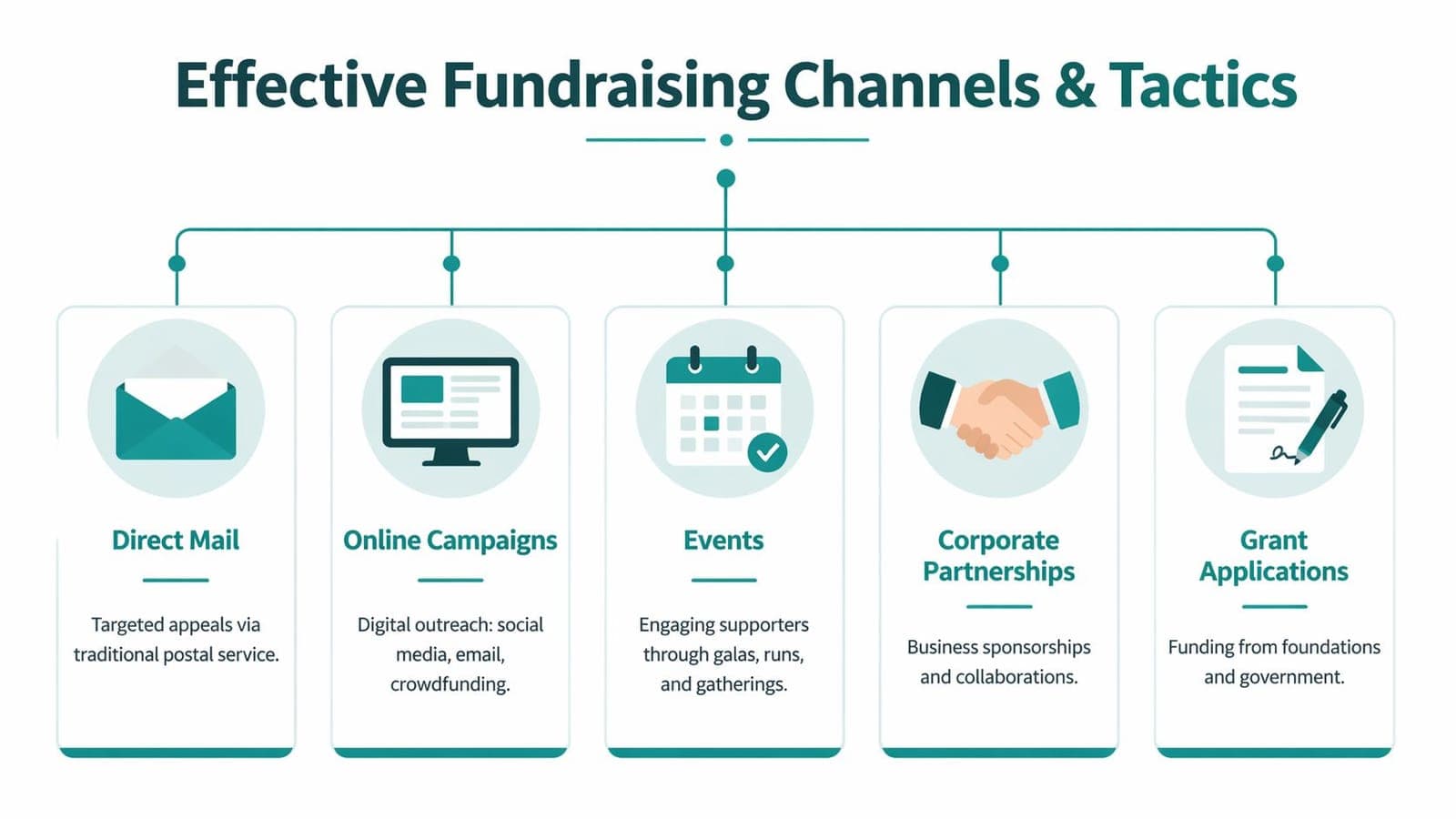
The calendar fills with things that are visible, familiar, or board-friendly. Meanwhile, the channels that build long-term revenue don’t get enough attention. The fix isn’t doing everything. It’s choosing a few channels that match your donor base and managing them inside one operating rhythm.
Online giving should be simple and immediate
Your donation page shouldn’t feel like a side project. It’s a front door.
If someone is ready to give, the page should make three things obvious fast. What the gift supports. Whether the gift is one-time or recurring. Whether the donor can trust the process.
Keep the page branded, short, and tied to a specific need. Add options for recurring gifts, but don’t bury the one-time option. For schools, churches, and multi-program nonprofits, it also helps to let donors select the right fund clearly so finance isn’t fixing coding errors later.
For promotion, one message rarely does enough work on its own. Email, text, social posts, and direct outreach should support the same appeal. If your team needs campaign ideas that can travel well across channels, these social media fundraising ideas can help you shape a cleaner rollout.
If you want a broader communications perspective, this piece on digital marketing for nonprofits is useful because it connects online outreach to real donor action rather than empty visibility.
Events can build community, but they must earn their keep
Events still matter. They’re often the fastest way to gather donors, volunteers, and prospects in one place.
But many nonprofits confuse activity with income. A packed room can still produce weak financial results if sponsorships lag, volunteer coordination is messy, and donor follow-up never happens.
Use events for one of three purposes:
-
Acquisition Bring new people into your circle and capture their information properly.
-
Cultivation Move known supporters closer to deeper giving through conversation and access.
-
Stewardship Thank the people who already carry your mission and strengthen retention.
If an event doesn’t clearly serve one of those jobs, it may be draining staff time without helping your plan. Integrated event tools prove useful. Ticketing, table assignments, donations, promo codes, volunteer shifts, and follow-up should connect back to the same donor and finance records.
An event should produce more than applause. It should produce next steps.
Major gifts deserve a distinct strategy
Small and mid-sized nonprofits often underinvest in major donor work because it feels intimidating or too dependent on one person’s style. That’s a mistake.
In 2025, large nonprofits grew 11.7% while small organizations saw a 6.4% decline. Major gifts made up 84.5% of revenue for large groups and 51.7% for small ones, which points directly to the need for a more focused major donor strategy (analysis of charitable giving trends in 2025).
That doesn’t mean every organization needs a formal major gifts office. It does mean someone should own the process.
A practical major donor track includes:
| Stage | What it looks like |
|---|---|
| Identify | Review donors with strong history and clear mission affinity |
| Qualify | Confirm interest through contact, not assumptions |
| Cultivate | Share access, updates, and thoughtful conversation |
| Ask | Make a clear invitation tied to a real outcome |
| Steward | Report back and plan the next touch |
For churches, this may look like pastoral and lay leader involvement. For schools, it may center on parents, alumni, and scholarship supporters. For fiscal sponsors, it may involve project leaders and donors who care about a defined portfolio rather than one umbrella brand.
Grants and restricted gifts need operational discipline
Grants can be valuable, but they bring obligations that broad donor appeals usually don’t. Restricted gifts can create the same challenge on a smaller scale.
If your development staff celebrates the award while finance opens a manual tracking file, you’ve split the job in two. That split causes trouble later when spending, drawdowns, and reports no longer match.
The healthiest setup connects the fundraising tactic to the accounting method from the start. That means the right fund, the right program coding, and the right reporting path before the first dollar is spent.
Different software products solve parts of this well. Bloomerang is strong in donor engagement. DonorPerfect has long served fundraising teams that want established CRM workflows. Blackbaud products can support larger and more complex institutions. QuickBooks is familiar for general bookkeeping. The gap for many nonprofits is that these tools often require extra systems or workarounds to connect fundraising, true fund accounting, volunteers, and marketing in one place.
Master Your Budget and Financial Compliance
This is the part of fundraising for charity that many leaders dread. Not because it’s impossible, but because too many systems make it harder than it needs to be.
When fundraising and accounting live apart, every gift creates extra cleanup. Staff must decide where it belongs, whether it’s restricted, who got the receipt, whether the bank deposit matches, and how it will appear on reports later.

Learn the distinction that drives everything
The most important financial distinction in nonprofit fundraising is simple.
Unrestricted funds support the organization where needed. Restricted funds must be used the way the donor, grant, or governing document requires.
That sounds basic, but many reporting problems start when teams treat every dollar as available cash. A scholarship gift is not the same as general operating support. A church building fund is not the same as weekly giving. A fiscal sponsor cannot treat project funds like house money.
Once you accept that, your budget becomes easier to read. You stop asking only, “How much did we raise?” and start asking, “How much of what we raised can support this decision?”
Why workarounds create compliance risk
A lot of nonprofits run accounting on business software because it’s familiar. That’s understandable.
The problem is that familiar isn’t always appropriate. If your team is tracking restrictions with class codes, side spreadsheets, and monthly manual corrections, the process depends on memory and vigilance. That’s risky when staff are busy or turnover hits.
In 2025, the IRS flagged 22% more Form 990 inaccuracies in nonprofits with under $500K in revenue, and 45% of those errors were tied to poor fund accounting (discussion of fundraising and compliance gaps).
That should get every executive director’s attention. Smaller organizations aren’t protected by being small. They’re often more exposed because fewer people are checking the numbers.
Finance stress usually isn’t caused by too much information. It’s caused by information living in the wrong places.
Build a month-end process that supports fundraising
Your finance process should help development answer donor questions, not slow it down.
A useful monthly checklist includes:
-
Confirm deposits and gift entry Make sure gifts, fees, and bank activity align before reports go out.
-
Review restricted balances Check whether each fund still has money available and whether spending matched intent.
-
Reconcile pledge and receivable records Know what’s been promised, what’s overdue, and what needs follow-up.
-
Verify receipts and acknowledgments Confirm that every donor got the right documentation.
-
Prepare board-ready statements Present information in a way non-finance leaders can understand.
If your reports don’t help the board distinguish operating health from restricted activity, they’re not doing enough. The board doesn’t need accounting jargon. It needs clarity.
Use budgeting as a management tool, not a compliance chore
A nonprofit budget should answer operational questions in plain English.
| Financial question | What your system should tell you |
|---|---|
| Can we hire | Whether unrestricted support can carry ongoing cost |
| Can we spend this grant | Whether the expense matches the fund and purpose |
| Did this appeal help operations | Whether gifts were coded to unrestricted support |
| Are we behind | Whether cash timing and budget timing still align |
This is especially important for fiscal sponsors, schools, and churches with many designated funds. If each program or project requires separate oversight, finance can’t stay accurate through manual patches alone.
If your team still builds the whole picture by hand, this nonprofit budget template in Excel can help you organize the basics before you move to a more integrated process.
Good compliance work is not about producing prettier reports. It protects the mission. It lets you say yes to the right opportunities, no to risky ones, and answer donor and board questions without a week of reconstruction.
Measure Your Success and Show Your Impact
A fundraising total is only the first line of the story. Donors want to know what changed because they gave.
That’s why measurement has to connect three things. Money in. Money used. Results produced. If any one of those is missing, your reporting feels incomplete.
Move beyond dollars raised
Many organizations stop at campaign totals because those numbers are easiest to pull. But campaign totals alone won’t tell you whether your fundraising is healthy.
A better review includes questions like these:
- Are donors staying with you
- Are repeat donors giving in the same way, growing, or fading
- Did a campaign bring in flexible support or only restricted money
- Which programs can show outcomes tied to funding
- Can your team explain the difference between activity and impact
A simple dashboard is helpful. It doesn’t need to impress anyone. It needs to help your staff and board make decisions.
Donors rarely need more adjectives. They need clearer proof.
Show impact in a way people can trust
The strongest impact reporting is concrete and disciplined. It connects donor support to mission results without overstating certainty.
That matters because 70% of donors prefer organizations that can demonstrate their impact with clear metrics, while only 25% of nonprofits under $1M have the right tools for this, which contributes to higher donor churn (discussion of impact reporting gaps for nonprofits).
If your reports rely on anecdotes alone, some donors will stay emotionally engaged, but others will drift. They want to know you can track what happened, not just describe good intentions.
A simple board or donor reporting format might include:
| What to report | Why it matters |
|---|---|
| Funds raised by purpose | Shows whether revenue matched need |
| Funds spent by program or fund | Shows stewardship and compliance |
| Output measures | Shows what activity occurred |
| Outcome measures | Shows what changed for participants |
| Donor trends | Shows whether support is durable |
Keep the reporting burden realistic
Not every organization needs a full impact department. But every organization needs a repeatable method.
Pick a short list of measures that your team can gather reliably. Then report them consistently. Schools may track scholarships awarded and student participation. Churches may track benevolence support, ministries served, or family engagement. Fiscal sponsors may track project-level spending and deliverables by sponsored entity.
The annual report is still one of the best places to bring this together. If you need a structure, this annual report template for nonprofits can help you turn scattered program notes into a coherent story.
When impact reporting is disciplined, fundraising gets easier. Donors see competence. Staff see progress. Boards see mission and money in the same frame.
Your Fundraising Implementation Checklist and CTA
A practical fundraising system starts to show up on ordinary Tuesdays. The gift comes in. It gets coded to the right fund. The donor gets thanked on time. Finance can reconcile it without chasing development for context. That is the standard to build toward.
Use this checklist to set the next 60 to 90 days of work. Keep the scope tight enough that your team can finish it.
A workable checklist
-
Review your fund structure Confirm which gifts are unrestricted, restricted, grant-based, or project-based, and document how each one should be recorded and reported.
-
Rewrite your annual goal Tie the target to budget reality, cash needs, and program commitments, not just campaign hopes.
-
Pull your top donor list Identify who needs a personal conversation, a stewardship update, or a direct ask this month.
-
Choose one source of truth Decide where donor notes, giving history, tasks, and pledge status will live so staff and volunteers are not working from competing records.
-
Fix your donation path Make sure your giving page is clear, branded, mobile-friendly, and mapped to the correct funds or campaigns.
-
Schedule a monthly revenue review Put development and finance in the same meeting to review gifts received, restrictions, acknowledgments, reconciliation issues, and next actions.
-
Assign owners Give each step a name beside it. Plans stall when every task belongs to the whole team.
-
Set a short reporting rhythm Choose a few mission and revenue indicators you can update consistently for leadership, board members, and major donors.
Many nonprofit leaders are right to be skeptical of software. I have seen teams buy a new tool and still keep the same spreadsheet workarounds because nobody clarified process, ownership, or fund rules first. The better test is simple. Can the system help your staff record gifts accurately, follow up reliably, and see how fundraising decisions affect cash flow and restricted funds?
If the answer is no, fix the workflow before you buy anything else. If the answer is almost, you are usually close. A few disciplined changes in process, data standards, and review cadence often do more for fundraising stability than another campaign idea.
Frequently Asked Questions About Fundraising Systems
Here are the questions I hear most from executive directors who are rightly cautious.
| Question | Answer |
|---|---|
| Do we really need an all-in-one system | Not always. But if your team keeps re-entering gifts, reconciling donor records by hand, or fixing restricted fund errors in spreadsheets, one connected system usually reduces risk and saves time. |
| We already use QuickBooks. Isn’t that enough | QuickBooks is familiar and many nonprofits use it well for general bookkeeping. The limitation is that it wasn’t built as true nonprofit fund accounting with donor management, volunteers, events, and marketing in one place. |
| Will switching systems disrupt fundraising | Any change requires planning. The key is to move in phases. Clean donor records first, define funds second, then move forms, campaigns, and reports in an orderly sequence. |
| What about churches, schools, and fiscal sponsors | They often need more structure, not less. Designated funds, scholarships, ministries, grants, and sponsored projects create reporting needs that basic business tools don’t handle well. |
| Is software the answer to donor retention | No. Relationships retain donors. Software only helps when it supports consistent follow-up, accurate records, and clear reporting. |
| We’re small. Should we wait | Usually not. Small organizations benefit most from clean habits early because they have less staff capacity to repair bad data and compliance problems later. |
The point isn’t to buy more technology. It’s to remove avoidable friction from the jobs you already have to do.
If you want one place to manage accounting, donor records, volunteers, events, marketing, and reporting, take a look at AlignMint. We built it for nonprofit leaders who need clearer numbers, fewer workarounds, and a system that supports fundraising without creating more admin.
Frequently Asked Questions
Ready to try AlignMint with your nonprofit?
Start free — set up donor tools, giving pages, and Minty. Upgrade when you need accounting.