For related tools, see Alignmint features.
Nonprofit Success: Master Volunteer Management
Quick Answer: Nonprofit Success: Master Volunteer Management
Volunteer management is the discipline of recruiting, preparing, scheduling, supporting, and retaining volunteers with clear roles and reliable records. Strong programs protect service quality, reduce staff rescue work, and connect volunteer engagement to donor relationships.
Your volunteer list is probably sitting in three places right now. A spreadsheet someone updates when they remember, an inbox full of scheduling threads, and a few staff members who "just know" who always shows up.
That can work for a while. Then one staff person leaves, a key event gets short-handed, or your board asks what the volunteer program is contributing to mission delivery and fundraising.
A strong volunteer management practice fixes that. It gives you a clear way to recruit, prepare, schedule, support, and retain volunteers without treating them like free labor or your staff like air traffic controllers. Done well, it protects program quality, steadies operations, and strengthens the relationships that often lead to giving.
From Well-Meaning Chaos to Mission-Critical Asset
Most nonprofit leaders didn't set out to build a messy volunteer program. It usually happens because the work grows faster than the process.
A church starts with a handful of dependable helpers. A food pantry adds Saturday distribution. A school expands events and family engagement. Before long, you've got sign-up sheets, text chains, background check reminders on sticky notes, and one heroic staff member holding the whole thing together by memory.
The problem isn't effort. The problem is that goodwill doesn't scale.
When volunteer coordination stays informal, your team pays for it in quiet ways. Staff spend hours chasing replies. Volunteers arrive unsure of their role. Strong people drift away because nobody followed up after their first few shifts. Donor and volunteer records sit in separate systems, so your development team misses the obvious fact that some of your most committed volunteers are also likely to become your most loyal givers.
Volunteers don't become a strategic asset by showing up. They become one when your organization gives them structure, clarity, and a reason to stay.
That's why I've come to see volunteer management as an operating discipline, not a side task. It belongs in the same conversation as staffing, budgeting, and donor stewardship.
If your current setup feels patched together, you're not behind. You're normal. But you do need a better framework than spreadsheets and crossed fingers. A good place to start is this guide to volunteer management best practices, especially if your team wants simple improvements before making any tool changes.
Why Volunteer Management Is Now a Strategic Priority
The pressure on volunteer programs isn't theoretical anymore. It's operational.
Formal volunteering in the United States fell from 30% in 2019 to 23.2% in 2021, a drop of over 23%. In response, nearly half of nonprofit CEOs report that recruiting enough volunteers is a "big problem," making retention and efficient management central to program continuity, according to the National Council of Nonprofits.

That changes the conversation. Volunteer management isn't about making things nicer for your coordinator. It's about whether your programs can keep running with consistency when volunteer supply is tighter and staff are already stretched.
Retention matters as much as recruitment
Many organizations still respond to volunteer shortages by pushing harder on recruitment. Recruitment matters, of course. But if your process is disorganized, new names won't solve the deeper issue.
A volunteer who has a confusing first shift, gets poor communication, or feels underused often doesn't come back. Then your team starts over. Again. That cycle drains staff time and weakens service delivery.
A better approach asks harder questions:
- Are roles clear enough that people know what success looks like?
- Are schedules realistic for the actual lives volunteers lead?
- Does someone follow up after the first experience?
- Can staff quickly see who is active, skilled, and ready for more responsibility?
Those aren't administrative details. They're continuity controls.
Volunteer operations affect financial stability
This is the part many boards miss. A well-run volunteer program doesn't just help you fill shifts. It protects your budget.
When volunteers are matched well, supervised properly, and retained over time, staff spend less energy on rescue work. Programs become more predictable. Events are less likely to run short. Reporting gets easier because participation and hours are documented rather than reconstructed after the fact.
There's also a fundraising connection. Volunteers see your mission up close. They know your staff. They often become advocates, referrers, and donors over time. If your organization keeps volunteer information in one silo and donor information in another, you lose that full picture.
Board-level takeaway: Volunteer management belongs in strategic planning because it affects service capacity, staff workload, supporter loyalty, and revenue potential.
The old view no longer works
The old view treated volunteers as free help. That framing was always incomplete, and now it's risky.
Volunteers require recruiting, screening, communication, supervision, and recognition. If those functions are weak, your mission pays the price in inconsistency and burnout. If they're strong, volunteers increase reach, deepen community trust, and give your organization more resilience in a labor-constrained environment.
That's why the leaders I trust don't ask, "How do we get more volunteers?" They ask, "How do we run a volunteer program people want to stay in?"
The Core Processes of a Strong Volunteer Program
Good volunteer management starts long before a person's first shift. It begins with a simple idea. Treat the volunteer relationship with the same care you'd give any role that affects clients, programs, or reputation.
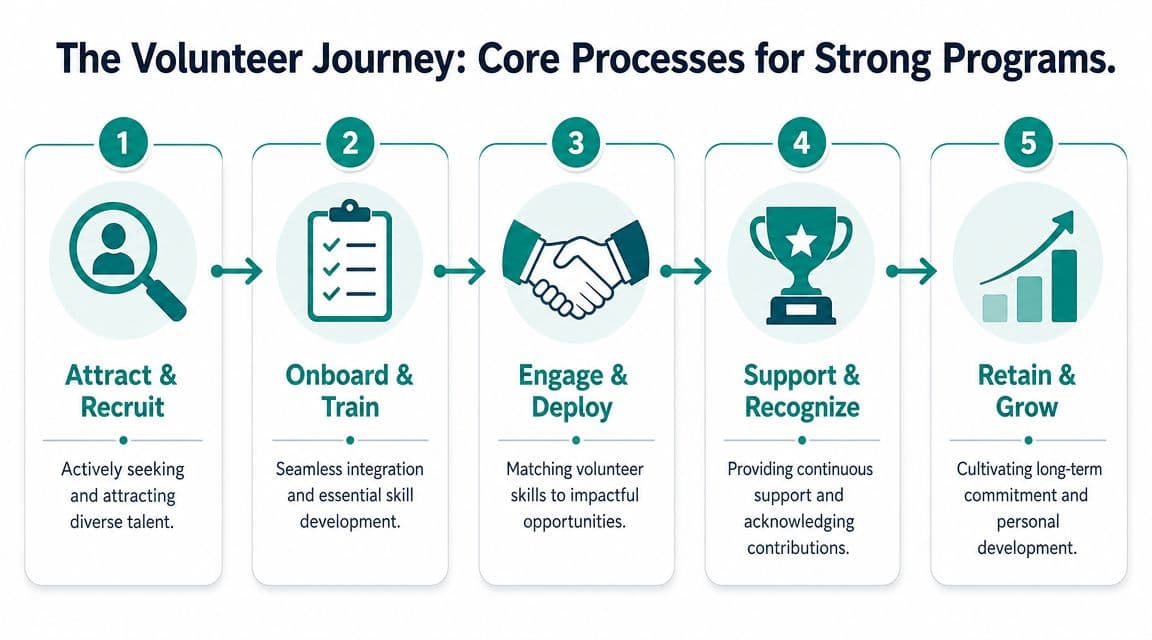
Start with clear roles, not vague invitations
"Come help sometime" feels friendly, but it creates confusion. People are more likely to commit when they understand the task, time expectation, and purpose.
Write role descriptions in plain English. Say what the person will do, who they report to, what skills help, and what kind of schedule the role requires. If a role includes client contact, money handling, driving, or work with children, spell that out.
This also helps you recruit the right people instead of any available people.
Screen and match with care
Many organizations rush at this stage because they need help quickly. That usually backfires.
The Urban Institute's research on volunteer management practices highlights written policies, screening and matching, training, recognition, and regular information collection as core practices. The practical lesson is simple. Effective volunteer programs require tangible resources for screening, matching, supervision, and tracking. If you skip these steps, your staff usually ends up spending more time fixing preventable problems later.
A few essential elements matter here:
- Check fit before placement: Not every willing person is right for every role.
- Use written policies: Consistency protects both staff and volunteers.
- Document key information: Availability, skills, restrictions, and preferences should live in one place.
Welcome people well and train for the real job
A volunteer's first experience often determines whether you'll ever see them again.
That doesn't require a fancy orientation. It requires clarity. Show them how your mission connects to the role. Explain the rules that matter. Introduce the person they can ask for help. Give them enough training to feel useful, not lost.
For organizations trying to make that first experience more thoughtful, some ideas from employee welcome practices can be adapted well for volunteer settings. This roundup of best employee onboarding kit ideas is useful, not because volunteers need corporate swag, but because it shows how small touches can reduce uncertainty and help people feel expected.
If you collect applications digitally, keep the form simple and role-specific. A tool like Alignmint's volunteer application workflow shows the kind of structure that helps staff gather the right information without creating extra paper handling.
Practical rule: If a new volunteer needs to ask three people where to go, what to do, and who's in charge, your process needs work.
Schedule simply and communicate consistently
You don't need a complicated system to improve scheduling. You need one source of truth.
Volunteers should know where to find their shift, what to bring, who to contact, and what happens if they can't attend. Staff should be able to see who is confirmed, who cancels often, and which roles are consistently hard to fill.
The strongest programs usually keep communication predictable. A reminder before the shift. A thank-you after. A clear update when plans change. Silence creates no-shows. Last-minute scrambling creates burnout.
Support people after the first shift
Some organizations do a decent job welcoming volunteers and then disappear. That's where retention starts to slip.
Strong programs check in. They notice when someone hasn't signed up in a while. They ask whether the role still fits. They move a volunteer to a better assignment when needed instead of assuming the person lost interest.
A simple support rhythm helps:
- First-shift follow-up: Ask what worked and what felt unclear.
- Regular supervisor contact: Keep communication human, not just transactional.
- Role adjustments: Move people toward the work they enjoy and do well.
- Recognition tied to contribution: Thank people specifically, not generically.
Recognition should be specific
"Thanks for all you do" is kind, but it fades fast. Specific recognition sticks.
Tell volunteers what their effort made possible. Mention the event they staffed, the families they served, the records they entered, or the students they supported. That helps people connect time spent with mission impact.
Recognition also doesn't have to be public. Some volunteers love a spotlight. Others prefer a quiet note from a staff member they respect. The point is to notice contribution in a way that feels genuine.
Measuring What Matters in Your Volunteer Program
If your volunteer program is hard to describe in a board meeting, it's usually because the data lives in too many places.
That's why measurement matters. Not to make the work feel corporate, but to help you answer basic leadership questions. Are we retaining people? Are we filling critical roles? Where are staff spending extra time? Which programs depend most on volunteer labor?
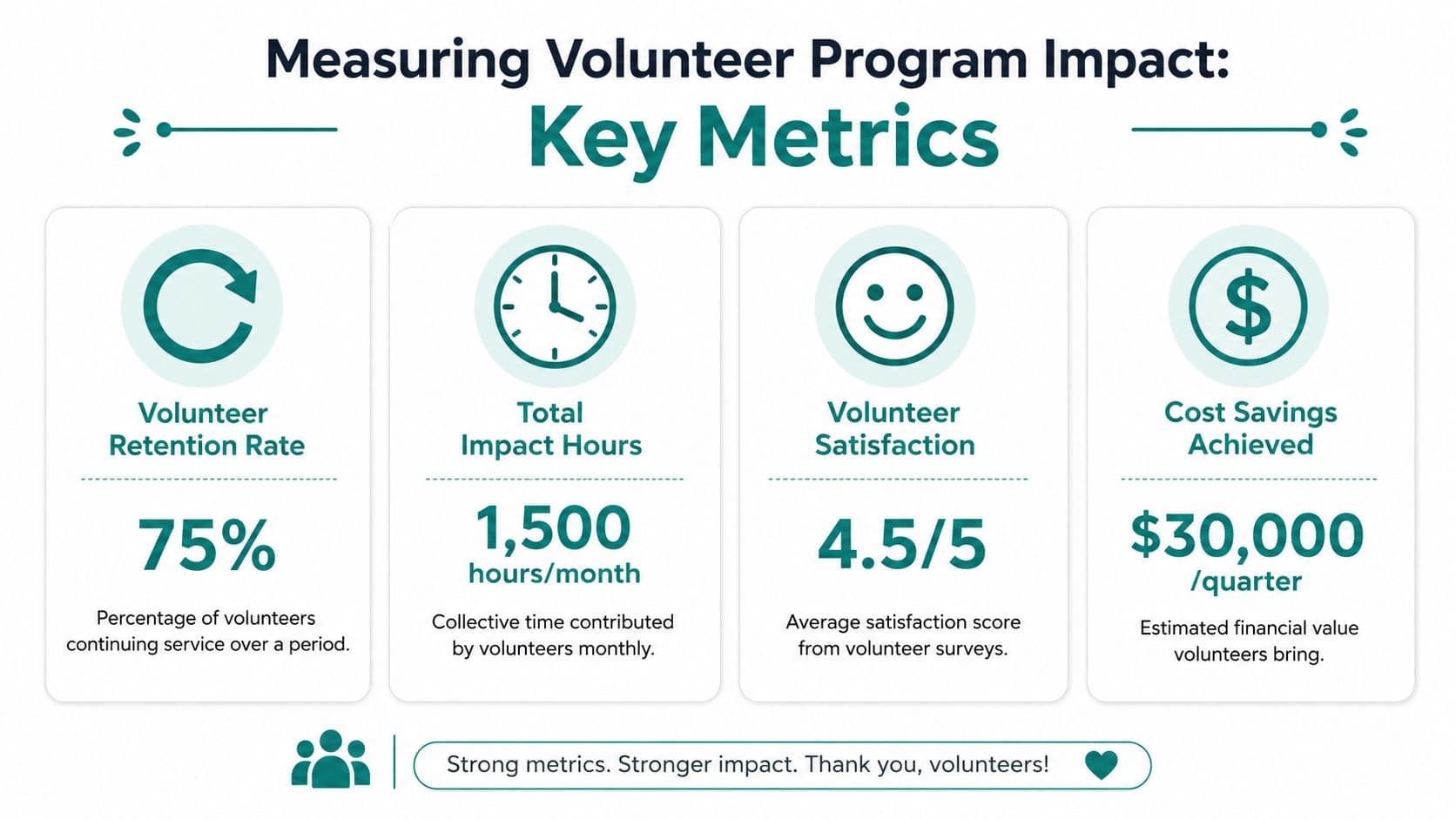
Track a short list first
Modern volunteer management is now treated as a measurable function. Guidance summarized by Kindful frames it around metrics such as retention rate, total volunteer hours, no-show rate, and average engagement time, and notes that 75.7 million people, or 28.3% of the U.S. population aged 16 and up, volunteered through an organization in the research it cites. That scale is one reason strong data habits matter so much. You can review that framing in Kindful's overview of volunteer management metrics and practice.
You don't need a dashboard full of vanity numbers. Start with a few measures that help you manage:
- Retention rate: Are volunteers returning over time?
- Total hours: Where is volunteer effort concentrated?
- No-show pattern: Which roles or locations need better confirmation?
- Average engagement time: Are people staying involved briefly or building a longer relationship?
These metrics tell a story about stability, not just activity.
Use data to make staffing decisions
A volunteer report becomes useful when it changes what your team does next.
If one program logs many hours but low retention, you may have a supervisor issue or a role mismatch. If another fills every shift easily, study why. The answer might be schedule flexibility, stronger training, or a clearer sense of purpose.
A clear hours report also helps with grant reporting and board communication. Instead of estimating effort after the fact, your team can show documented participation by program, event, or time period. This kind of volunteer hours report is the difference between scrambling for numbers and having them ready when needed.
The goal isn't to prove your volunteers are busy. It's to show that your volunteer program is dependable, well-managed, and tied to mission outcomes.
Don't force financial math you can't defend
Many leaders want one clean number for the "value" of volunteer time. I understand the temptation. Boards and funders like tidy summaries.
Still, be careful. If you don't have a method your finance team can explain confidently, don't overstate it. It's often stronger to report documented hours, retention, roles filled, and program coverage than to present a dollar figure that obscures the actual picture.
The better financial insight often comes from operational evidence. Fewer staffing gaps. Better event execution. More consistent program delivery. Cleaner reporting. Those are real management gains, and they're easier to defend.
Staying Compliant and Reducing Risk
Some parts of volunteer management are about warmth and retention. This part is about duty of care.
If volunteers work with children, vulnerable adults, money, transportation, client data, or public representation of your organization, informal processes aren't enough. You need written expectations, documented screening, and a record of what training was provided.
Written policies protect everyone
A policy manual doesn't need to be long to be useful. It does need to answer the questions that create confusion and risk.
Include role boundaries, attendance expectations, conduct standards, confidentiality, safety steps, and who handles concerns. Staff should know when a volunteer issue stays at the supervisor level and when it needs executive review.
This doesn't make your culture colder. It makes your standards visible.
Background checks are a management decision, not a clerical task
Not every role carries the same level of risk, so your screening should fit the assignment. A front-desk greeter may not need the same review as a youth mentor or driver.
The key is consistency. Decide which roles require checks, references, interviews, or extra supervision. Then apply those standards the same way each time. If your team is sorting that out, this practical guide on how to run volunteer background checks is a useful place to start.
For leaders thinking through broader people-policy questions, this article on managing HR legal landscape offers a helpful reminder that risk usually grows in the gap between informal habits and documented practice.
A volunteer who feels safe, informed, and well-supervised is more likely to stay. A program with unclear boundaries invites both turnover and trouble.
Documentation matters when memories fail
Most compliance problems don't start with bad intent. They start with missing records.
A volunteer says they never received a policy. A supervisor assumes someone else handled training. A parent asks whether screening was completed. If the answer depends on memory, your organization is exposed.
Keep records of applications, role assignments, screening results where appropriate, signed acknowledgments, training completion, and incident notes. That discipline protects your mission as much as it protects your reputation.
Choosing the Right Tools for Your Team
Most executive directors I know don't want another software pitch. They want fewer moving parts, less duplicate entry, and clearer answers when staff ask basic questions.
That's why the core issue isn't whether you need "software." It's whether your current patchwork is costing more in staff time, missed follow-up, and disconnected data than you realize.
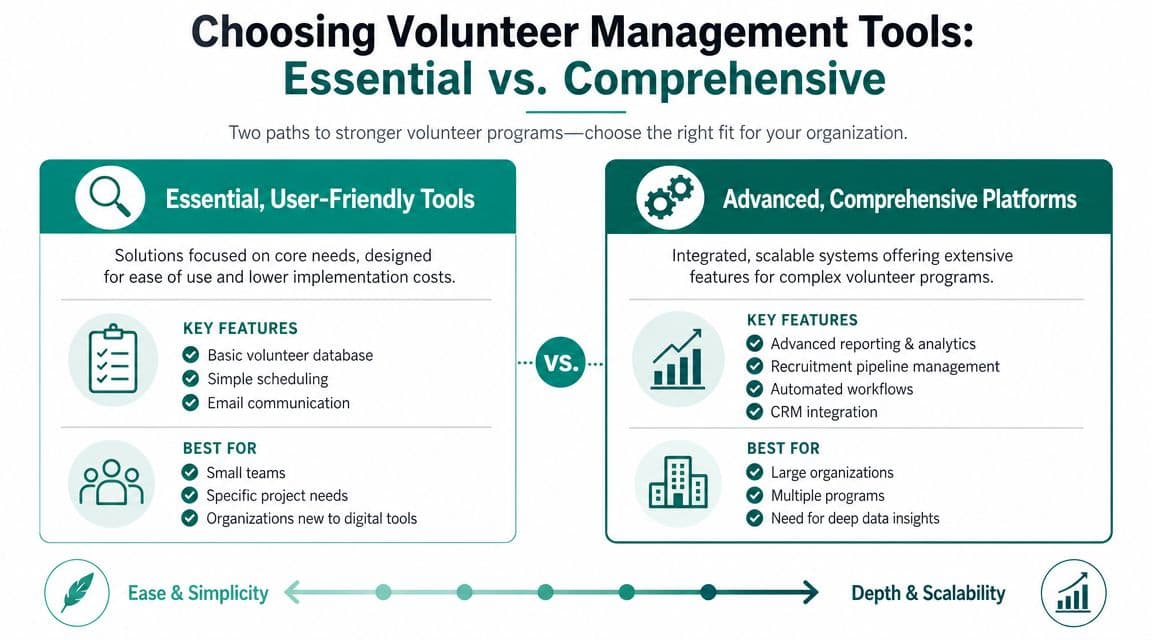
What point solutions do well
Point tools can be perfectly reasonable. If you run a small, straightforward program, a scheduling app plus email may cover your immediate needs.
Products like VolunteerHub and Better Impact are known in this category, and they can help teams organize volunteer assignments and communication more effectively than spreadsheets alone. For a program with one main use case, that may be enough.
The trade-off shows up later. Volunteer data sits apart from donor records, event participation, accounting, and staff communications. Someone has to reconcile the pieces by hand.
Independent guidance on volunteer management software makes this point well. These systems work best when they serve as a centralized data layer, capturing recruitment, skills, availability, assignments, hours, and communications in one record so staff can automate coordination and reporting instead of re-entering the same information in multiple places.
What to look for before you buy anything
Whether you choose a simple tool or a broader platform, look for operational basics first.
| Need | Why it matters |
|---|---|
| Skills and availability tracking | Helps staff match people to real needs instead of generic openings |
| Self-service hour logging | Reduces staff chasing paperwork after events or shifts |
| Role-based communication | Lets your team contact the right group without mass email confusion |
| Reporting by program | Supports grant reporting, board reporting, and staffing review |
| Shared record across teams | Prevents volunteer, fundraising, and finance information from splitting apart |
You should also ask implementation questions early. Who will own setup. What old data needs to move. Which staff need training. What process problems are being carried into the new system.
Integration is where the real value appears
A university-backed analysis from Arizona State University argues that nonprofits should break down silos between volunteer and donor management because volunteers are potential donors, and better participation data can improve both the volunteer experience and giving. That perspective is worth reading in ASU's piece on smarter volunteer and donor management.
An integrated platform earns its keep when volunteer activity, donor records, communications, events, and accounting connect, allowing your team to see the full supporter relationship.
We built Alignmint's volunteer management features with that operational reality in mind. It sits inside the same platform as donor management, events, marketing, and true fund accounting, so you can track volunteer hours, skills, availability, and background checks without splitting the record across separate systems. For smaller nonprofits, the free tier for organizations under $100K and unlimited users also remove two barriers that often keep good process stuck in spreadsheets.
If you're comparing options, that's the practical divide. A point solution may solve scheduling. An integrated system can also connect volunteer activity to fundraising follow-up, program reporting, and financial oversight.
Your Next Step Toward a Thriving Volunteer Program
A stable volunteer program doesn't come from working harder at the same patchwork process. It comes from treating volunteer management as part of how your organization runs.
That means clear roles, careful screening, consistent training, useful reporting, and tools that don't trap your data in separate places. It also means seeing volunteers for what they are. Not free labor, but people whose experience affects mission delivery, staff capacity, and long-term financial health.
If your current approach feels fragile, start small. Tighten one process. Document one policy. Clean up one reporting habit. Then decide whether your tools still fit the program you're trying to lead.
If you want to bring volunteer coordination, donor records, marketing, events, and true fund accounting into one place, take a look at Alignmint. We built it for nonprofit leaders who need clear operations without juggling five systems, and a demo is a practical way to see whether it fits your team.
Ready for One Clearer Nonprofit System
If you want accounting, donors, volunteers, events, marketing, and reporting in one place, Alignmint was built for that kind of day-to-day nonprofit work.
Ready to see how Alignmint works for your nonprofit?
Schedule a free walkthrough - we'll set everything up for you.