

For related tools, see the fiscal sponsor fee calculator, fiscal sponsor software, and fund accounting.
Quick Answer: Fiscal Sponsor Organizations
Fiscal sponsor organizations are existing nonprofits that provide legal, financial, and administrative infrastructure for projects that are not yet, or may never become, separate 501(c)(3)s. The best fit depends on mission alignment, the sponsorship model (A, B, or C), fee structure, and whether the sponsor's accounting systems support restricted funds at the project level.
You may be staring at a promising new program, a donor ready to give, and a practical problem. The need is real, but the legal and financial structure behind it isn't in place yet.
That's where fiscal sponsor organizations come in. Done well, they let you raise tax-deductible funds quickly, stay compliant, and avoid building a full nonprofit back office before the mission has proven itself.
What Are Fiscal Sponsor Organizations Really
A project is ready to launch. A foundation wants to fund it this quarter. The team can run the program, but no one has a clean answer to a donor's first accounting question: who receives the grant, books the revenue, and signs the grant report?
A fiscal sponsor solves that operational problem by placing the project under an existing 501(c)(3) structure. The sponsor receives charitable funds, holds legal and fiduciary responsibility, and runs the administrative systems behind the project, from payment processing and restricted fund tracking to payroll, contracts, insurance, and reporting.
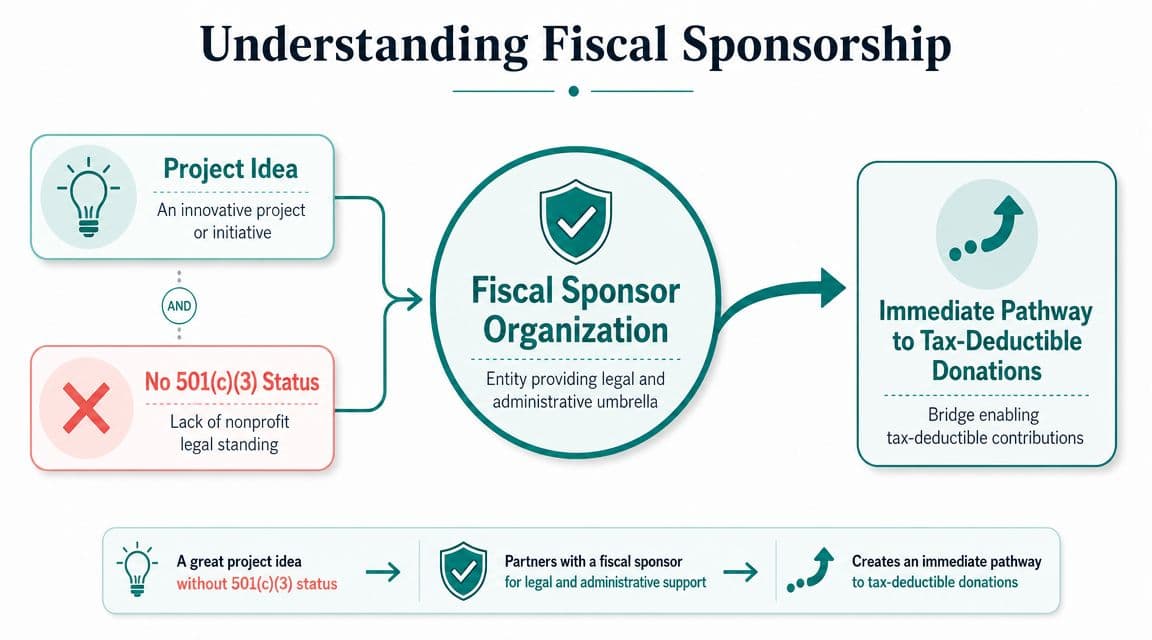
From an operations standpoint, that distinction matters. A sponsor is not just lending out a tax ID. It is taking on real compliance duties and real financial risk, which means the quality of its accounting, approvals, internal controls, and recordkeeping will shape the project's day-to-day experience.
If you want a plain-language definition, AlignMint's fiscal sponsor glossary entry is a useful starting point.
Why leaders choose this route
Speed is part of the appeal, but it is not the whole story.
Fiscal sponsorship is often the right fit when the project needs to start before a standalone nonprofit would be practical, or when the project may never need its own corporation, board, audit relationship, and finance stack. I have seen strong programs stall for months over setup tasks that had nothing to do with community impact. Banking, chart of accounts design, donation acknowledgments, grant coding, payroll setup, and filing calendars all take time, and early-stage teams rarely budget for that well.
A capable sponsor gives projects access to shared infrastructure that would be expensive to build alone. That can include finance, HR, legal review, insurance coverage, grant administration, and policies for spending approvals and documentation. In practice, the benefit is not just reduced overhead. It is cleaner execution. Donors get receipts. Restricted funds are tracked correctly. Reports go out on time. Staff know who approves what.
The trade-off is control. Projects usually give up some independence in exchange for that support, and they need to be clear-eyed about it from the start.
Why this is no longer a niche arrangement
Fiscal sponsorship now operates at meaningful scale across the nonprofit field. A 2023 field scan by Social Impact Commons describes sponsors stewarding billions in charitable and community investments while expanding shared infrastructure and capacity-building.
For operational leaders, the takeaway is straightforward. Treat fiscal sponsorship as a serious organizational model with legal, accounting, and reporting consequences. If the sponsor closes the books late, project managers will not trust their balances. If grant restrictions are tracked poorly, spending decisions become risky. If reporting lives in spreadsheets and email threads, both the sponsor and the project will spend too much time reconciling basic facts.
Strong arrangements are boring in the best way. Roles are documented. Money is coded correctly. Approvals are clear. Donors, auditors, and project leads can all see who is responsible for what.
Weak arrangements tend to fail in predictable places first: cash flow confusion, delayed reimbursements, missing backup, unclear ownership of staff and contracts, and year-end reporting surprises. Those are not side issues. They are the operating reality of fiscal sponsorship.
The Different Models of Fiscal Sponsorship
Not all fiscal sponsorship arrangements feel the same on the ground. The legal label matters because it changes who employs staff, who owns the work product, who holds the risk, and how much independence the project keeps.
Model A
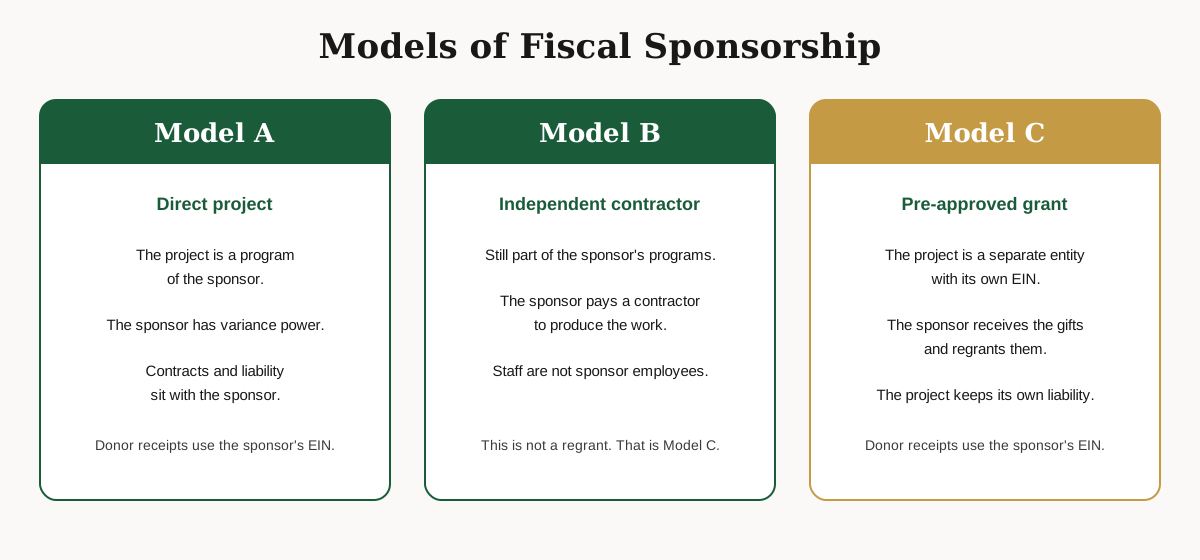
In a Model A arrangement, the project sits inside the sponsor as one of the sponsor's own programs. The sponsor is the legal entity, has variance power, and donor receipts use the sponsor's EIN. Staff are usually employees of the sponsor. Contracts and liability sit with the sponsor.
This model can work well when the project is mission-aligned, the sponsor wants close oversight, and the project doesn't need a separate identity yet. It is usually the simplest model for governance because there is less ambiguity about who is in charge.
The trade-off is independence. If your team wants to shape its own strategy, branding, staffing structure, or future spin-out path, Model A can feel restrictive.
Model B
Model B is the independent contractor project. The work is still part of the sponsor's programs. The sponsor receives the charitable gifts, then engages an independent contractor to produce the result and pays that contractor from those funds. The contractor accounts for its own income and expenses. Paid staff are not employees of the sponsor.
This is not a regrant. The pre-approved grant to a separate entity is Model C.
Model C
Model C is the pre-approved grant. The project is a separate entity and has its own EIN. The sponsor still receives the gifts and regrants them. Donor receipts still use the sponsor's EIN. The project keeps its own principal and its own liability.
In the Johnson Center's discussion of the field, over two-thirds of listed fiscal sponsors were established in 2000 or later in a directory containing 380 sponsors, and the most common arrangement is the Model C preapproved grant relationship, as noted in the Johnson Center overview.
If you want a deeper accounting view of how these structures differ, AlignMint has a helpful piece on fiscal sponsorship accounting models.
Model choice is really a control choice. Ask who hires people, who signs contracts, who owns the donor relationship, and who can say no to spending.
A practical comparison
| Model | What it feels like day to day | Main strength | Main risk |
|---|---|---|---|
| Model A | The project is a program of the sponsor | Clear oversight. Contracts and liability sit with the sponsor | Limited independence |
| Model B | The sponsor pays an independent contractor to do the work | The project stays in the sponsor's programs without sponsor employment | Easy to mistake for a regrant |
| Model C | The sponsor receives the gifts and regrants them to a separate entity | The project keeps its own principal and liability. Donor receipts still use the sponsor's EIN | Confusion if the agreement never names the letter |
AlignMint records Not set, Model A, or Model C on an operational fund. Model B is not a fund setting. Model C stays on the sponsor's ledger.
What works is choosing the model that matches your actual operating intent. If you want independence, choose a structure that supports it. If you want the sponsor to run the administrative side tightly, admit that upfront.
What doesn't work is calling everything "fiscal sponsorship" and assuming the details will sort themselves out later. They won't.
Key Responsibilities for Sponsors and Projects
A healthy sponsorship arrangement runs on divided responsibility, not fuzzy goodwill. Both sides need to know what they own, what they approve, and what they report.
The sponsor's responsibilities
The sponsor is not just holding money. The sponsor is taking on legal, accounting, and compliance duties that carry real consequences.
According to the Connecticut Conservation and Development guidance, a fiscal sponsor is not a pass-through and must provide core back-office functions such as legal and compliance, accounting, charitable fund administration, and HR. The agreement should also define the sponsor's control over funds and reporting requirements, as outlined in this fiscal sponsor compliance guidance. For a practical review process, this fiscal sponsor compliance checklist is worth keeping handy.
That means the sponsor should be able to answer basic operating questions without scrambling. Who approves contracts. How restricted gifts are tracked. How payroll is handled. How donor receipts are issued. What happens if a budget changes midyear.
Your responsibilities as the project
Project leaders sometimes hear "the sponsor handles administration" and assume that means they can focus only on programming. That's too loose.
Your team still owns execution. You run the program, manage day-to-day spending against the approved budget, submit reports on time, explain variances, and flag issues before they become compliance problems.
A practical division often looks like this:
- Program delivery: Your team runs services, events, campaigns, or field work.
- Budget discipline: You monitor spending and ask before making major changes.
- Documentation: You provide invoices, contracts, grant reports, and program updates.
- Communication: You keep the sponsor informed when staffing, funding, or risk changes.
What fails first: not accounting. Communication. Most sponsorship strain starts when one side assumes the other already knows what's happening.
What the agreement should settle early
Good agreements remove guesswork. Weak agreements create tension later, usually when money is tight or a donor asks questions.
The document should settle at least these points:
- Control over funds: The sponsor's approval authority cannot be vague.
- Reporting cadence: Monthly, quarterly, or grant-specific reports should be named.
- Budget changes: Material shifts should require documented approval.
- Use of name and brand: Donors need consistent language about who is receiving funds.
- Exit terms: Everyone should know what happens if the project leaves.
What works is a sponsor that acts like an operating partner. What doesn't work is a sponsor that behaves like a mailbox and a project that behaves like an independent nonprofit with no reporting duties.
Fund Accounting and Reporting for Sponsors
For many fiscal sponsor organizations, the accounting structure determines whether confidence is built or lost. If the accounting structure is weak, everything else starts to wobble. Donor restrictions get harder to track, project balances become debatable, and finance staff spend their days reconciling spreadsheets that never quite agree.
Why the accounting treatment matters
Under IRS-aligned practice, a valid fiscal sponsorship arrangement requires the sponsor to retain discretion and control over contributed funds. In accounting terms, the sponsored project is recorded as one of the sponsor's own activities, with the project's revenues and expenses appearing on the sponsor's financial statements, typically as donor-restricted net assets when funds are restricted, according to the AICPA overview of fiscal sponsorships.
That single point changes everything operationally. If the project's activity sits on the sponsor's books, the sponsor needs a system that can separate each project cleanly while still rolling everything into entity-wide reporting.
This is why generic small-business accounting software often creates friction for sponsors. Tools built for a single business entity can track categories, classes, or locations, but fiscal sponsorship needs more than labels. It needs real fund structure, restriction tracking, approval logic, and reporting by project, grant, and purpose.
Why spreadsheets and class tracking break down
Spreadsheets can work for a short window. They stop working when staff change, grants overlap, or a donor asks for a restriction-specific report that has to match the general ledger.
QuickBooks is a capable general accounting tool and many nonprofits know it well. But for sponsors managing multiple sponsored projects, class tracking often becomes a workaround rather than a governing structure. The finance team ends up building shadow systems outside the ledger just to answer ordinary questions.
Common pain points show up quickly:
- Restricted balances drift: A spreadsheet says one number, the books say another.
- Project reporting slows down: Staff wait for finance to rebuild reports manually.
- Approvals become opaque: No one can easily see which spending line was authorized.
- Year-end gets messy: Consolidated reporting takes too much cleanup.
If you want a deeper primer on nonprofit-specific accounting structure, this guide to fund accounting for nonprofits is a practical companion.
Finance reality: If your project directors need a custom spreadsheet to understand their balances, your system isn't giving them usable visibility.
What better reporting looks like
A sponsor's reporting system should answer three questions without drama. What money came in. What restrictions apply. What remains available by project and purpose.
That applies internally and externally. Project leaders need readable statements. Executive staff need consolidated visibility. Auditors and board members need a clean trail. If your team wants a straightforward refresher on statement structure, even outside a nonprofit-specific context, this UK financial statement guide gives a useful overview of how core statements fit together.
The best setup isn't flashy. It's disciplined. Every gift lands in the right place. Every expense maps correctly. Every project leader can see what they're allowed to spend without calling finance three times a week.
How to Choose the Right Fiscal Sponsor
A project can look well matched on paper and still become a daily operational headache. I have seen teams choose a sponsor because the mission fit felt right, then spend the next year chasing approvals, correcting gift records, and waiting on reports they assumed were standard.
That is why sponsor selection should be treated as an operating decision, not just a legal or fundraising one. The right sponsor can keep finance, compliance, and donor administration quiet and predictable. The wrong one creates friction in basic tasks like hiring, paying vendors, closing grants, and telling project leaders what they can spend.
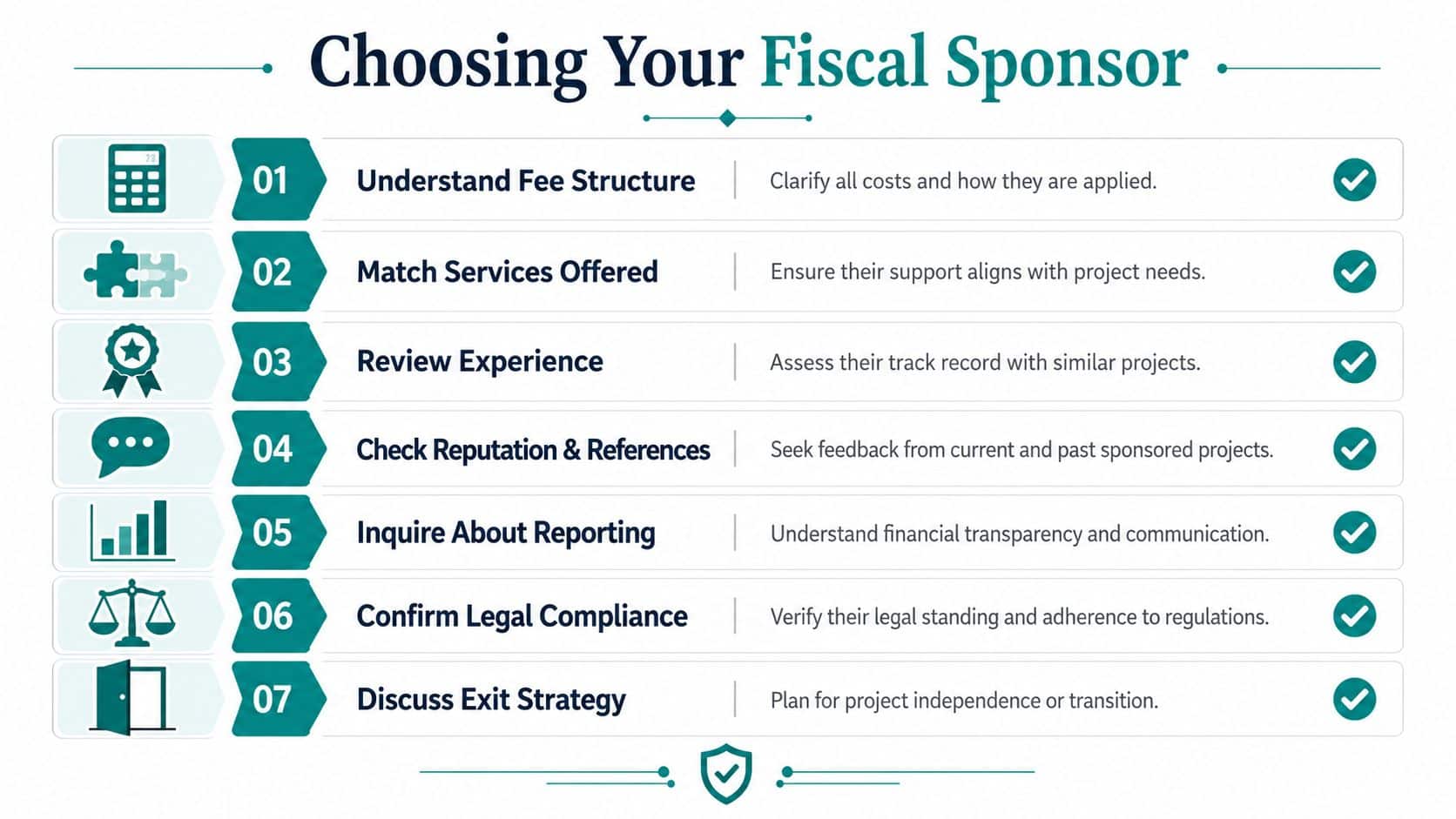
Questions worth asking in the first meeting
Start with the points that affect day-to-day operations.
- How do you approve spending? Ask who has authority, what thresholds trigger extra review, and how long routine approvals usually take.
- What reporting will we receive? Request sample project statements and a real reporting calendar.
- Which services are included? Accounting, gift processing, HR support, contract review, payroll, and compliance are often priced and staffed differently.
- How do you track restricted gifts? The answer should explain both policy and bookkeeping.
- What does exit look like? A mature sponsor can explain transfers, closeout timing, and record retention without hesitation.
Clear answers matter. If staff cannot explain their process clearly, the process is usually harder than it needs to be.
Questions that reveal operational maturity
Many sponsors sound strong in principle. The true test is whether their systems hold up under normal nonprofit pressure: a late grant revision, a donor correction, a new employee, a reimbursement question, or a board request that lands with short notice.
Ask about workflow, controls, and visibility.
| Ask this | Listen for |
|---|---|
| What software do you use for accounting and donor records? | Whether finance and fundraising stay aligned or require manual reconciliation |
| Can project leaders view their own balances? | Direct access to current information, not emailed snapshots |
| How are donor acknowledgments handled? | Clear responsibility for receipting, coding, and follow-up |
| Who handles contracts and HR questions? | Named staff roles and response expectations |
| How often do projects meet with finance staff? | A regular service cadence, not ad hoc problem-solving |
A sponsor with disciplined operations can show the workflow, the forms, and the reports. They do not need to sell the process with vague language.
If you want a practical benchmark for evaluating platform readiness, this guide to fiscal sponsorship software can help you compare what sponsors should be able to support operationally.
Ask for evidence. Sample reports, approval paths, intake forms, and the sponsorship agreement will tell you far more than a polished overview call.
What to notice beyond the checklist
Pay attention to how the sponsor describes the relationship with projects. Strong sponsors respect project leadership and speak plainly about oversight, internal controls, and legal responsibility. They are neither controlling for its own sake nor so hands-off that no one knows who owns the risk.
Also look at response discipline. Do they answer follow-up questions directly? Do finance and program staff give the same answer? Can they explain how a restricted gift, payroll change, or contract request moves through the organization? Those details usually predict the quality of the partnership better than mission language alone.
The right fit feels steady. You can see where the guardrails are, who makes decisions, and how information flows. That clarity is what lets a project spend less time interpreting the sponsor and more time running the program.
Keeping Sponsor Operations in One Place
Once a sponsor manages multiple projects, software stops being an IT issue and becomes a governance issue. If data sits in separate tools, staff start doing manual transfers between accounting, donor records, volunteer activity, event registration, and email communications.
That's where errors creep in. A donor is thanked from one system but posted incorrectly in another. A project report shows a balance that finance has already adjusted. A program lead asks a simple question and waits days because no one has one place to look.
What unified systems fix
The practical gain from an all-in-one platform is less duplicate entry and fewer shadow records. Accounting, CRM, volunteer records, event activity, and marketing live together, so your team isn't stitching together the story of a project from five exports.
For fiscal sponsors, that matters in three ways:
- Project visibility: Project leaders can see their own financial and donor activity without asking finance for every report.
- Communication control: Donor outreach, updates, and campaign activity can connect to the same records used for gift tracking.
- Staff access: Unlimited-user models are often easier for sponsors because you can include finance staff, program staff, and project leaders without rationing seats.
Blackbaud has broad nonprofit functionality and many large organizations rely on it. Aplos is accessible and familiar to smaller teams. The gap many sponsors run into is fragmentation. Some systems handle accounting better than communications. Others handle fundraising but still require extra tools for volunteer management or project-facing access.
One option in this category is AlignMint. It combines fund accounting, CRM, volunteer management, events, marketing tools, and its Minty assistant in one platform, with plan-based user allowances (1 on Free, up to 10 on Plus, up to 25 on Pro, and unlimited on Enterprise) and a free tier for nonprofits under $100K. If you want a closer look at software built for this use case, this fiscal sponsorship software guide lays out the considerations well.
What to look for before you switch
Don't buy software based on a dashboard demo alone. Ask how the system handles restricted funds, project-level access, consolidated reporting, donor acknowledgments, and communication history.
Also ask one boring question that saves a lot of pain later. What can staff stop doing manually if you adopt this system? If the answer isn't clear, the tool may be adding another layer rather than simplifying operations.
A Smarter Way to Manage Your Mission
Fiscal sponsorship works best when the legal structure, financial controls, and daily operating tools all support each other. If any one of those pieces is weak, staff spend too much time translating, correcting, and chasing information.
You need a system that treats projects, restrictions, donor records, and communications as connected parts of the same job. That's especially true if you're supporting multiple sponsored projects and want leaders to have visibility without losing control.
We built our approach around that reality. For sponsors and sponsored projects alike, the goal is simple. Clear books, clear reporting, clear accountability, and less administrative drag on the mission.
If you're weighing software for fiscal sponsor organizations, AlignMint is built to handle true fund accounting, donor management, volunteers, events, marketing, and project visibility in one place. You can explore how it fits your workflow, especially if you need consolidated reporting and project-level clarity without adding more disconnected tools.
Ready to see how AlignMint fits your workflow?
Schedule a free walkthrough — we will help you map donors, funds, and migration steps.