

Form 990-EZ Guide for Small Nonprofits (2026)
You're probably looking at a stack of bank statements, grant letters, and payroll reports, knowing the filing deadline is closer than your calendar admits. That's the form 990 ez problem for most small nonprofits, not the form itself, but the year of scattered data behind it.
If your books are tidy, the return feels manageable. If they're not, you end up rebuilding the year line by line, and that's where mistakes, delays, and stress usually start.
Quick Answer: Form 990-EZ Filing Requirements
Form 990-EZ generally applies when an exempt organization has gross receipts under $200,000 and total assets under $500,000, subject to IRS exceptions. It is due by the 15th day of the fifth month after the tax year ends, and current Form 990-EZ returns must be filed electronically.
A clean finance trail makes filing easier, so start with fund accounting. For related reading, compare nonprofit tax filing requirements with Form 990 filing software.
The Filing-Morning Reality Most Guides Skip
The worst 990-EZ mornings start before coffee. Someone asks for the revenue total, the program descriptions, and the compensation list, and nobody can answer from memory.
That scramble usually means the books were never kept in a way that matched the return. You're not just filing a tax form, you're proving that your records can tell one clean story.
Practical rule: If your ledger can't separate restricted gifts, program costs, and payroll by activity, filing season will feel like an audit rehearsal.
A better setup changes the whole experience. Instead of pulling numbers from three systems and a spreadsheet, you already have the trail in your accounting records, donor history, and program notes.
That matters whether you file on your own or work with a CPA. It also matters if you're comparing workflow options, including workforce compliance with PEO, because payroll and reporting data still have to land cleanly somewhere.
If you want the broader filing picture, our guide on nonprofit tax filing requirements helps you see where 990-EZ fits beside other annual obligations.
The calmer path is simple. Keep the books 990-EZ-ready during the year, and filing stops feeling like a rescue mission.
What Form 990-EZ Is and Who Should File It
Form 990-EZ is the IRS's shorter annual information return for smaller tax-exempt organizations. It sits between the postcard filing and the full Form 990, and the IRS treats it as a distinct reporting class in its own records, not just a shorter version of the long form.
The filing test is mechanical. Under the current IRS instructions, Form 990-EZ generally applies when an organization has gross receipts under $200,000 and total assets under $500,000. Exceptions apply, so confirm the rule for your organization before filing. The IRS also requires current Form 990-EZ returns to be filed electronically.
What those two numbers really mean
Gross receipts are broader than donations. They usually include program fees, event income, and other receipts that flow through the organization. If you only watch contribution income, you can miss the point where the form choice changes.
Total assets are broader than cash too. They can include savings, equipment, and other balances the organization holds at year-end. A board that thinks only in terms of the checking account can underestimate how quickly the asset test matters.
Practical rule: If either your receipts or your assets is close to the ceiling, start preparing for the full Form 990 before year-end closes.
Churches are a notable exception. An independent nonprofit filing guide notes that churches are generally not required to file Form 990 at all nonprofit filing exception overview. That exception matters because many leaders assume every exempt organization files one of the 990-series returns, and that is not always true.
For a small organization, the filing decision can change from one year to the next. Growth in grants, reserve savings, or equipment purchases can push you past the EZ line, so budget planning should include that possibility. The cleanest way to avoid a year-end scramble is to keep receipts, asset balances, and program records organized all year, not after the books close.
If you want a broader view of how annual filings fit together, our guide on nonprofit tax filing requirements explains where 990-EZ sits beside other obligations.
If you are comparing workflow options, including workforce compliance with PEO, payroll and reporting data still have to land cleanly somewhere. The same is true for organizations looking at a discussion of form 990 filing software options, because software only helps when the underlying records are already organized well enough to trust.
| 990 Family Return Comparison at a Glance | Form | Eligibility | Reporting Detail | Best For |
|---|---|---|---|---|
| 990 Family Return Comparison at a Glance | 990-N | Very small organizations | Minimal | Very small groups with limited receipts |
| 990 Family Return Comparison at a Glance | 990-EZ | Under the IRS thresholds | Moderate detail | Small and mid-sized nonprofits |
| 990 Family Return Comparison at a Glance | 990 | Above the EZ thresholds | Full detail and more schedules | Larger or more complex organizations |
For a smaller nonprofit, the key question is not just which form to file. It is whether the year's numbers are being tracked in a way that makes the answer obvious before filing season starts.
Reading the Form Without Falling Asleep
A 990-EZ can look intimidating the first time you open it. Once you know what each block is asking, it reads less like a mystery and more like a checklist of whether your books can support the story you are telling.
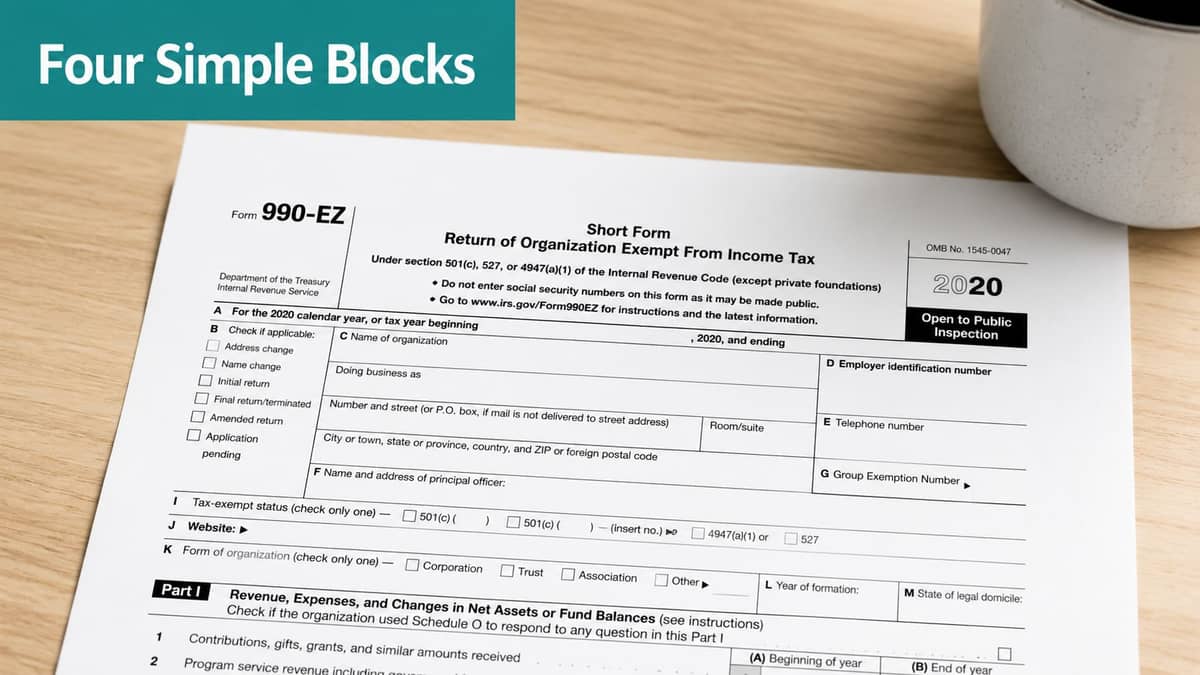
Identity and program service details
The form starts with the organization's primary exempt purpose, then asks for narrative descriptions of its three largest program services, the number of people benefited, and compensation details for the five highest-compensated employees above $100,000 IRS Form 990-EZ. If you want a plain-English refresher on the filing itself, the Form 990 glossary entry is a useful companion. The IRS is looking for more than a mission statement here. It wants to see that the programs, the numbers, and the exemption line up.
A simple tutoring program makes that easier to picture. If your nonprofit provides tutoring, the form wants the type of tutoring, who received it, and roughly how many people benefited. Vague language like “community outreach” rarely gives a reviewer enough to work with, especially if your internal records do not separate programs cleanly.
Money, balance sheet, and compliance
The financial section asks whether your totals reconcile to the books. That includes revenue, expenses, and net assets, along with the balance sheet items that should connect back to the prior year's ending figures.
The compliance questions usually trip people up because they force a yes or no answer on items that are easy to overlook during the year. They cover new activities, unrelated business income, and insider transactions, so a “yes” answer often needs a short explanation and clean backup.
If you answer a question too quickly, that is usually where the filing gets messy later.
Clean filings start long before tax time. The records need to separate money by purpose as transactions happen, not after the year closes. When accounting data, donor history, and program records sit in different places, the return becomes a reconstruction project instead of a report.
That is why the form feels simpler than the long return but still demands discipline. Filing is not hard because the questions are obscure, it is hard because the year has to be organized before anyone starts filling in boxes.
Where 990-EZ, 990-N, and 990 Differ
A lot of confusion starts when people treat the 990 family like one form with three labels. The forms are related, but they are not interchangeable, and the right choice changes as the organization grows.
The practical split
990-N is the postcard for the smallest organizations. It asks for very little, so it does not give much room to describe programs or explain finances.
990-EZ sits in the middle. It asks for real program descriptions, financial totals, and compliance answers, while still being lighter than the full Form 990.
Full Form 990 is the next level up. It adds more schedules, more governance detail, and a bigger compensation conversation.
A fictional youth-mentoring nonprofit shows the progression clearly. At $80,000 in receipts, it may still fit the postcard route. As it grows past the EZ thresholds, the reporting burden increases, and the board needs to plan for that switch before year-end.
The better habit is to watch the trend, not just the current year. If receipts are rising, or assets are building, assume the next filing may be different and keep the books ready for that possibility all year.
| Form | Eligibility | Reporting Detail | Best For |
|---|---|---|---|
| 990-N | Smallest organizations | Minimal | Very small nonprofits with limited financial activity |
| 990-EZ | Under the IRS thresholds | Moderate | Small and mid-sized nonprofits with more activity |
| 990 | Above the EZ thresholds | Extensive | Larger organizations with more complexity |
That choice is easier to make when the books stay organized throughout the year, because the filing starts to reflect day-to-day recordkeeping instead of a last-minute cleanup. A fund-accounting-native system helps keep program activity, restricted money, and general operations in separate lanes, so the return is built from clean categories instead of a scramble at tax time. For teams comparing tools, browse nonprofit accounting options can help you compare approaches without assuming every group needs the same setup.
Filing Methods, Deadlines, and Penalties That Matter
The filing method is straightforward now. For tax years ending July 31, 2021 and later, Form 990-EZ must be filed electronically IRS e-file guidance.
That rule changes the practical rhythm of filing. You're no longer preparing a paper package for the mail, you're making sure your data is ready for an electronic submission.
What gets missed most often
The deadline depends on your year-end, and many boards forget to build the filing date into the annual calendar early enough. The common mistake isn't ignorance, it's waiting until the books are closed before anyone starts gathering the attachments and answers.
Late filing can trigger a penalty, and it's easier to avoid than to fix. If you miss, the IRS may accept a reasonable-cause explanation, but you'll need documentation that shows why the filing was late and what you did to correct it.
A separate state filing can also sit on the same timeline. That's the part many executive directors miss, because the federal return gets all the attention and the state notice lands in a different inbox.
File early enough that your CPA or preparer has time to ask follow-up questions. That's where clean filings usually happen.
If you use software to prepare the return, the best ones shorten the back-and-forth by pulling the right numbers from the books automatically. That doesn't remove judgment, but it does reduce the number of manual steps.
The safest habit is boring and effective. Put the filing date on the board calendar, set an internal deadline ahead of it, and keep the records ready before anyone asks for them.
Seven Common Reporting Traps and How to Avoid Them
Most 990-EZ mistakes come from the same small group of problems. They're usually bookkeeping issues first, tax issues second.
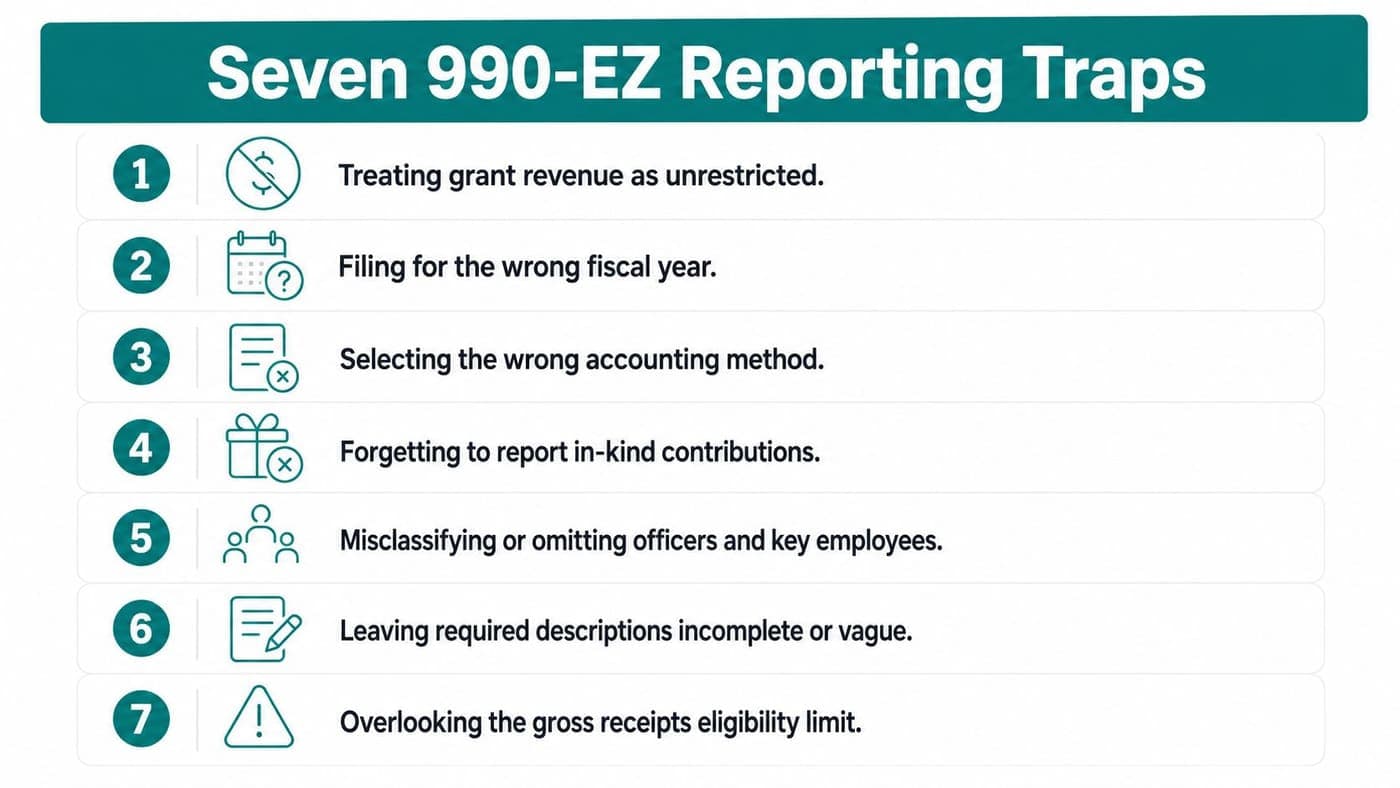
The traps that show up again and again
-
Treating gross receipts like donations only. Gross receipts are broader than contribution income, so program fees and event receipts can't disappear into the wrong bucket. The fix is to classify revenue as it comes in, not during filing season.
-
Skipping the public charity questions. The form still asks for public charity status information for many filers. The fix is to keep your determination letter and status records with your annual files.
-
Letting totals drift away from the books. If your return doesn't match your accounting records, the IRS and your board will both notice. The fix is to reconcile monthly and compare the draft return to your financial statements before filing.
-
Missing compensation that crosses the reporting line. The 2025 form asks for the five highest-compensated employees above $100,000 IRS Form 990-EZ. The fix is to review payroll and contractor records together before you finalize the return.
-
Leaving Schedule N unanswered when a major disposition happened. If a nonprofit has a liquidation, dissolution, termination, or significant disposition of net assets, it must answer “Yes” and complete the applicable parts of Schedule N IRS instructions. The fix is to flag major restructurings as soon as they happen.
-
Using expense allocations without a clear method. Functional expense reporting needs a defensible allocation trail. The fix is to document the basis for payroll and overhead splits during the year.
-
Filing late because nobody set a reminder. This is the most ordinary mistake and often the easiest to prevent. The fix is a simple internal deadline that lands before the IRS deadline.
The pattern is simple. Every trap starts as a data hygiene problem, then becomes a filing problem later.
How a Native Fund Accounting Platform Changes the Filing
A true fund accounting system changes the process before tax season starts. Instead of reconstructing the year from bank statements, you're posting transactions into the right restriction, program, and grant categories as they happen.
That matters because the form depends on the same underlying detail your board, donors, and grantors care about. If restricted gifts land in the right fund, and payroll is coded by program from the start, the return stops being a separate project.
What changes in practice
Revenue shows up where it belongs. Grant drawdowns, donor gifts, and event income can be tracked in the same system without forcing the chart of accounts to pretend every dollar is the same.
Expense allocation gets easier too. The same data trail that supports the financial statements also supports the narrative and functional expense reporting the IRS expects.
I've seen many teams try to patch this with general accounting software, spreadsheets, and last-minute reviews. That can work for a while, but the handoffs create gaps, especially when more than one person edits the same numbers.
One option built for this is AlignMint, which combines accounting, donor management, volunteers, events, and marketing in one place, and includes Minty for questions about your actual books. If you're comparing structures for your books, its form 990 builder is worth reviewing because it reflects how filing data is shaped from the accounting side.
The trend line explains why this matters. NCCS data show that e-filed Form 990-EZ returns increased from 15,470 in 2009 to 205,532 in 2022, a rise of about 1,229%, with 198,731 e-file returns in 2023 also recorded in the series NCCS e-file data. That volume says a lot of nonprofits are still doing this work every year, and many are doing it under time pressure.
Your 990-EZ Year-Round Checklist and Next Steps
The easiest filing is the one your books already support. If you keep the year organized, May feels normal instead of urgent.
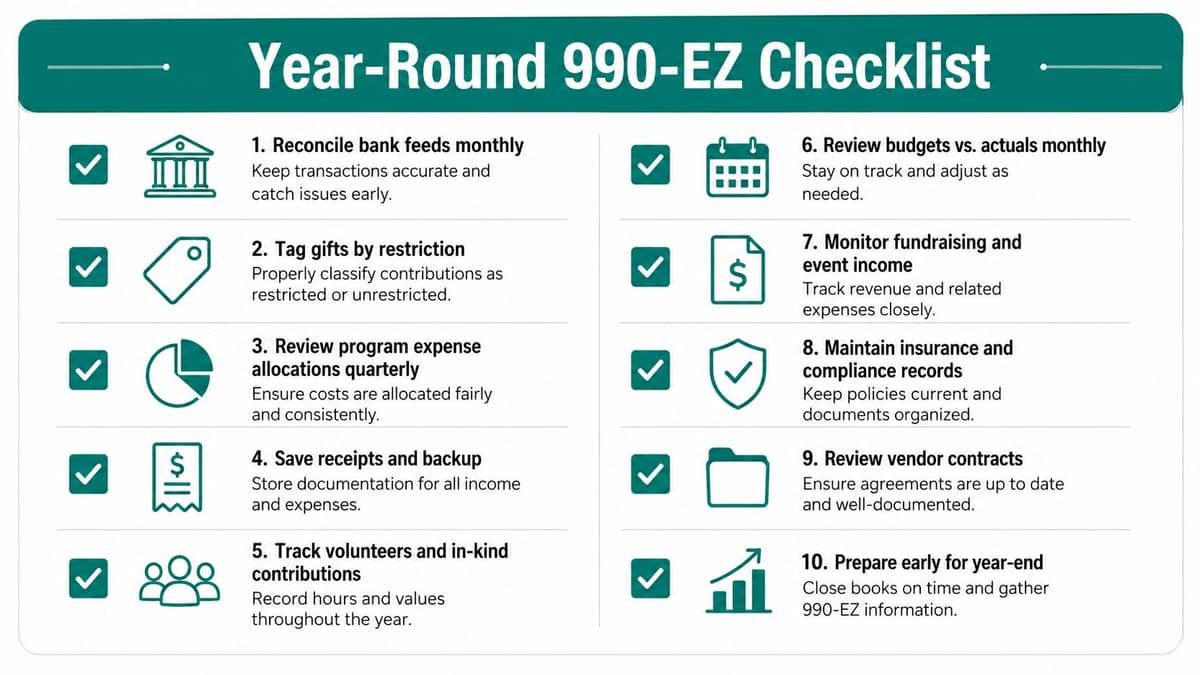
A simple habit list
- Reconcile bank feeds monthly so errors don't pile up.
- Tag gifts by restriction when received so donor intent stays clear.
- Allocate payroll by program before year-end arrives.
- Track in-kind contributions with notes so the file isn't rebuilt later.
- Review public charity status annually so you know what the return needs.
- Run a quarterly mini preview from the books.
- Check for major asset changes that could trigger Schedule N.
- File electronically through an authorized provider.
- Set your internal deadline two weeks early.
- Store the prior three years of returns with governing documents.
That checklist is what keeps the form manageable. It also keeps the board from treating filing season like a surprise.
QuickBooks is familiar, and Volgistics is strong for volunteer scheduling. Those tools do their jobs, but they don't always keep accounting and program data in one place.
If you want a calmer May, start with the books, not the form. Our Form 990 checklist can help you compare what you already have against what the return asks for.
If your nonprofit wants 990-EZ reporting to feel routine instead of frantic, keep the books, fund records, and filing checklist aligned throughout the year.
Ready to try AlignMint with your nonprofit?
Start free — set up donor tools, giving pages, and Minty. Upgrade when you need accounting.