

For related tools, see AlignMint features.
Grants for Nonprofit Organization: 2026 Funding Guide
Quick Answer: Grants for Nonprofit Organization: 2026 Funding Guide
Grants for nonprofit organization leaders should be evaluated for mission fit, capacity fit, and reporting fit before staff write the proposal. A grant that your team cannot track, spend correctly, or report cleanly can cost more than it helps.
You're probably feeling this already. A board member asks about new revenue, a program need can't wait, and someone says, "Have we looked at grants lately?" Then the substantive work begins. Research, deadlines, budgets, restrictions, reports, and the quiet worry that winning the grant may create a second job for your team.
This guide is for that reality. It covers grants for nonprofit organization leaders from the first search to the final report, with special attention to the part most articles skip: how to manage grants well after the award letter arrives.
Getting Started with Grant Funding
Most executive directors don't chase grants because they enjoy paperwork. They chase grants because a program needs funding, a staff role needs support, or a capital need won't fit inside annual giving alone. Grants can open doors that individual gifts sometimes can't, especially when a funder wants to back a defined project, an expansion, or a new service model.
That instinct is sound. Grants now account for 19% of all charitable giving, the median grant award is $35,000, and the number of grant-making foundations has grown from 47,000 to 84,000 over the last 15 years, according to these nonprofit grant statistics compiled by Double the Donation. That matters because grants aren't an occasional side opportunity anymore. They're a regular part of nonprofit finance.
If you're just beginning, start with a hard look at readiness. Not mission readiness. Operational readiness. Can your team describe the program clearly, build a budget the finance committee trusts, and report back without hunting through old emails and spreadsheets? A quick financial readiness check for nonprofit grant work can save you from applying too early.
Practical rule: Don't apply for a grant just because the opportunity exists. Apply when the program, budget, and reporting process can all survive the award.
A lot of organizations underestimate that last part. They think the challenge is getting noticed. Often, the primary challenge is staying organized long enough to build a repeatable grant track record.
What usually works early
- A narrow first target: Start with one program area you can explain cleanly.
- A simple grant file: Keep one place for deadlines, attachments, budgets, and contacts.
- Board discipline: Make sure leadership agrees on what funding is worth pursuing.
What usually doesn't
- Chasing every listing: Volume feels productive. It rarely is.
- Writing from scratch each time: That burns staff time and creates inconsistent answers.
- Treating grants like "extra money": Restricted funding has rules attached, even when the application looked simple.
Understanding the Different Types of Grants
Not all grants ask the same thing from your team. Some mainly test fit. Others test patience, controls, and reporting discipline. If you don't separate those realities early, you can spend months pursuing the wrong kind of funder.
The main categories
Private foundations remain the most frequently cited source of grant awards, with community foundations and corporations also playing major roles, as noted in this grant funding overview. In day-to-day practice, that means most nonprofits should build a mixed strategy rather than relying on one lane.
Government grants deserve their own category because the stakes are often higher. About 30% of U.S. nonprofits receive government grants, totaling over $303 billion annually, and for more than 35,000 nonprofits, government grants supply over 50% of total revenue, according to Candid's analysis of nonprofits that rely on government grants. If you work in health, education, or social services, this isn't edge-case funding. It can become core revenue.
Corporate grants are different. They may align with a company's giving priorities, local presence, or staff engagement goals. Community foundations often know the local environment well and can be practical entry points for organizations with a place-based mission.
Grant types at a glance
| Grant Type | Typical Funder | Primary Motivation | Common Reporting Level |
|---|---|---|---|
| Foundation grant | Private or family foundation | Mission alignment and program impact | Moderate, often narrative plus financial |
| Community foundation grant | Place-based foundation | Local community benefit | Moderate, with local outcome focus |
| Corporate grant | Company or corporate foundation | Community presence, values alignment, employee engagement | Light to moderate, sometimes brand-sensitive |
| Government grant | Federal, state, or local agency | Public policy goals and service delivery | High, with stricter financial and compliance demands |
Government money can strengthen an organization for years. It can also expose weak internal controls within months.
How to choose where to spend time
A foundation grant may be more forgiving if your systems are still developing. A government grant may be worth the effort if your team already has clean program records, finance support, and a tolerance for detail. Corporate grants can be attractive, but some are smaller, more local, or tied to very specific community footprints.
Use three filters before you commit:
- Mission fit: Does the funder support work you already do well?
- Capacity fit: Can your current staff handle the paperwork after award?
- Reporting fit: Can finance and programs produce what the grant will require?
The wrong grant isn't just a lost application. It can become a costly distraction.
Where to Find the Right Grant Opportunities
The problem usually isn't a shortage of listings. It's too many listings with too little context. A busy executive director can lose hours looking at grants that were never realistic for the organization's size, geography, or staffing model.

The smartest search starts with fit, not abundance. The grant market is increasingly fragmented, with many funders prioritizing local impact. Opportunities are often county-specific or aimed at smaller organizations, including some limited to budgets under $350,000, which means the primary question is often not "where are the grants?" but "which grants are realistic for our capacity?" That pattern is reflected in these statewide opportunity listings and observations on localized grant funding.
Look for realistic, not interesting
A grant can sound perfect on the first read and still be a poor target. The warning signs are usually practical:
- Geography restrictions: The program serves your mission, but not your region.
- Invited applicants: The listing is public, but the process is relationship-driven.
- Capacity mismatch: The reporting burden is too heavy for your current staff.
- Grant size mismatch: The award won't justify the effort required to apply and manage it.
If you need a current stream of opportunities, AlignMint's nonprofit grants resources page is one place to organize what you're tracking alongside your operations.
Research the funder before you draft anything
Good prospecting goes beyond the mission statement. Look at what the funder has supported before. Review the kinds of projects they back, the level of grant they tend to award, and whether they repeatedly support organizations like yours.
That doesn't require fancy software. It requires consistency. Keep notes on:
- Past grantees: Are they similar in size or sophistication?
- Program type: Do they fund direct service, capital, planning, or capacity-building?
- Geographic pattern: Local, regional, statewide, or national?
- Decision process: Open application, rolling review, or relationship-first?
A strong pipeline is usually short. It contains opportunities you can actually execute, not every grant that mentions your cause.
Many leaders also overlook local signals. Community foundations, regional family funds, and issue-specific local grantmakers may offer a better path than a large national competition. Smaller opportunities can still matter, especially when they fit your staff time and reporting ability.
Writing a Compelling Grant Proposal
A moving story can get a reviewer's attention. It usually won't carry the full proposal. Funders increasingly want proof that you understand the need, can execute the plan, and can account for the money afterward.
That's why evidence beats adjectives. Funders increasingly expect evidence-backed proposals, and nonprofits improve their fit by using a funder's historic grant sizes and project types to shape the request, budget, and outcomes, as described in Pebble Impact's guidance on nonprofit grant types and proposal fit. If a funder mostly supports project grants in a certain range, don't submit a broad operating-style narrative with a mismatched budget.
Build the case in this order
Start with the problem, but define it in plain terms. What is happening, for whom, and why does your organization have a credible response? Then move to the program design. Reviewers need to see that your activities connect logically to your expected outcomes.
A proposal usually gets stronger when these pieces line up:
- Need statement: Specific, current, and grounded in the community you serve.
- Program plan: Clear activities, ownership, and timeline.
- Outcomes: Measurable changes you can track.
- Budget: A request that matches the project and the funder's typical pattern.
For budget planning, a grant proposal budget template for nonprofits can help your finance and program staff work from the same structure.
What reviewers often notice first
Reviewers can spot strain quickly. They notice when the outcomes are too ambitious, the budget categories feel pasted in, or the narrative describes a program your team doesn't seem ready to run. They also notice when an organization tries to reshape itself around the grant instead of presenting stable, board-approved work.
A useful test: If your program director and finance lead would describe the proposal differently, the draft isn't ready.
What improves proposals in practice
- Consistent language: The same program should sound the same in the narrative, budget, and attachment set.
- Measured promises: Commit to what you can document, not what sounds impressive.
- Historical fit: Ask for the kind of support the funder already gives.
- Operational honesty: If the project requires staffing, data collection, or partnerships, say so clearly.
What usually weakens a proposal is overstatement. Words like "transformational" are easy to type. Reviewers care more about whether your plan is credible and your numbers make sense.
Budgeting and Managing Restricted Funds
The practical realities of grants often emerge. Winning the award feels like success. Then the restrictions appear in practice. Separate spending rules. Match requirements. Drawdowns. Program deadlines that don't line up neatly with the fiscal year. Narrative reports due at the same time finance is closing the month.
Most online guidance still focuses on finding grants. But many nonprofits struggle most after the award, especially with drawdowns, matching requirements, and reporting across multiple restrictive awards, as highlighted in NerdWallet's roundup of nonprofit grant realities. That's the part that affects sleep.
Restricted funds are not a spreadsheet problem
A common mistake is treating restricted grants as something you can patch together with classes, tags, tabs, and month-end workarounds. QuickBooks has strengths for general bookkeeping. Many nonprofits already know it well. But class tracking is not the same as true fund accounting, especially when you need a live view of what remains available inside a specific restriction.
That difference matters when someone asks, "Can we spend this now?" If the answer depends on a spreadsheet maintained by one person, you have risk.
A cleaner setup includes:
- Grant-specific tracking: Revenue, expenses, and balances tied to the actual award.
- Program alignment: Spending connected to the activity the grant supports.
- Restriction visibility: Clear distinction between what is awarded, spent, committed, and still available.
- Document retention: Agreements, amendments, and reports stored where staff can find them.
For a deeper look at the mechanics, this guide to grant revenue and restricted funds covers the accounting side in plain language.
What to set up on day one
As soon as the award is accepted, build the operating structure. Don't wait for the first reimbursement request or board question.
Create a simple kickoff checklist:
- Read the agreement carefully: Identify restrictions, match terms, allowable costs, and reporting dates.
- Assign owners: One person for program delivery, one for finance, one for submission control.
- Load the budget into your accounting structure: Don't rely on the proposal PDF as your working budget.
- Set a reporting calendar: Include drafts, review dates, and submission deadlines.
- Decide how staff time and shared costs will be documented: This gets messy fast if you improvise.
The easiest grant to mismanage is the one that looked simple when you applied.
Where software can help and where it can't
No system fixes weak internal discipline. But the right system does reduce avoidable mistakes. If you're evaluating tools, compare them on practical outcomes. Can they track restricted funds natively? Can program and finance teams see the same grant status? Can you pull reports without rebuilding the data each month?
Products like QuickBooks, Bloomerang, and Salesforce each have strengths in their own areas. Some organizations piece together several systems and make it work. If you want accounting, donor records, volunteers, events, marketing, and grant-related fund tracking in one place, AlignMint is one option. It includes true fund accounting rather than class-based workarounds, a built-in marketing suite, plan-based user allowances (1 on Free, up to 10 on Plus, up to 25 on Pro, and unlimited on Enterprise), and a free tier for nonprofits under $100K in revenue.
The main point is simpler than the product list. Grants put pressure on your back office. If the process depends on memory and heroics, the problem will show up during reporting.
Staying Compliant with Post-Award Reporting
Compliance sounds administrative, but it's really about trust. A funder gave your organization money for a stated purpose. Reporting proves that your team followed through, tracked the money correctly, and noticed problems early enough to address them.
The reporting rhythm that keeps teams out of trouble
The healthiest reporting process starts before spending begins. Read the agreement, mark every due date, and decide who owns each input. Program staff usually hold activity details. Finance holds expenditures and balances. Someone needs to combine both into one accurate submission.
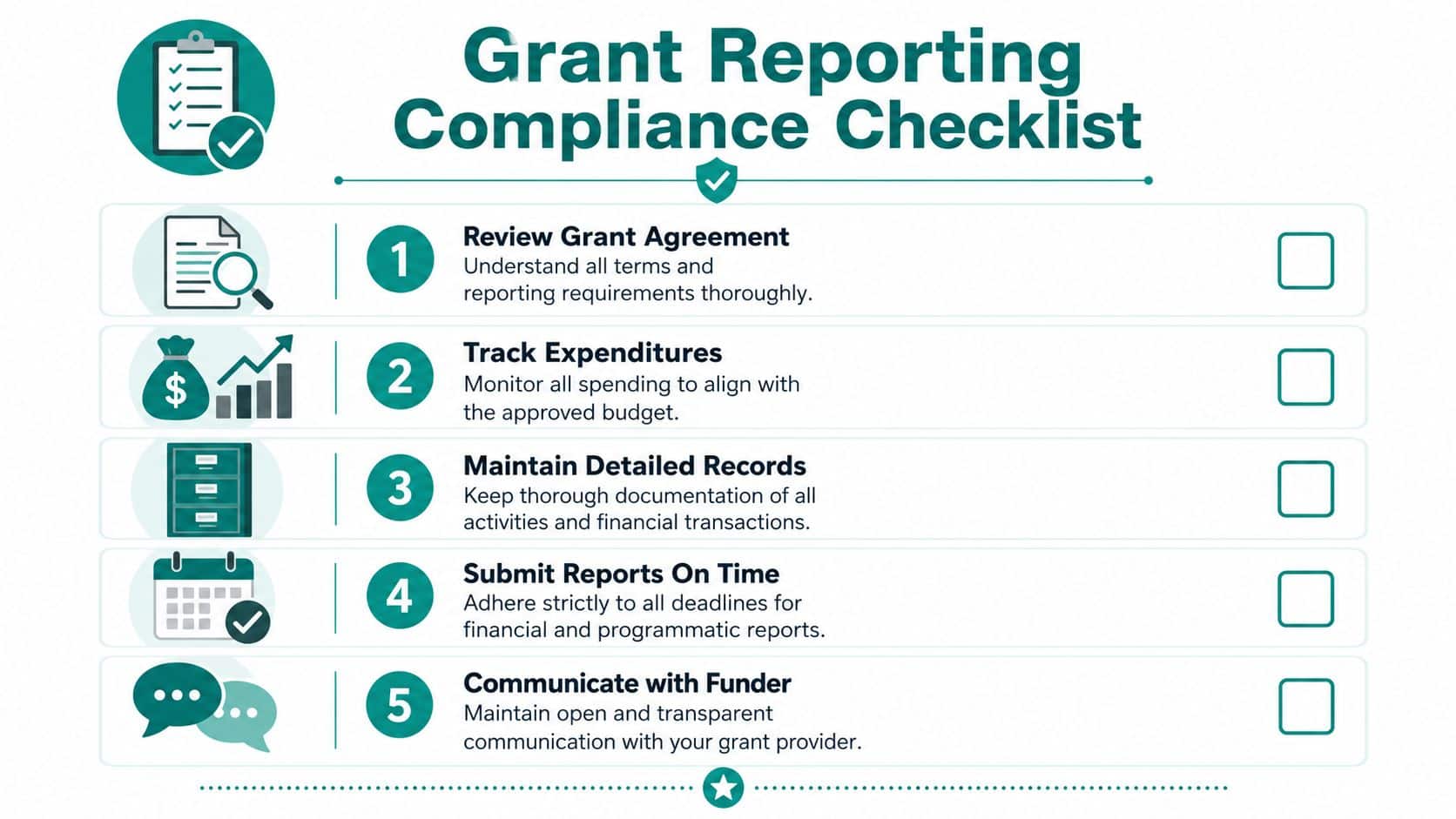
A dependable routine often looks like this:
- Review the grant agreement
- Track expenditures against the approved budget
- Maintain support for activities and transactions
- Prepare reports before the deadline week
- Communicate with the funder when something changes
What belongs in your reporting file
You want one working file or system for each grant. Not a scavenger hunt.
Keep these items together:
- Award document and amendments
- Approved budget and any revisions
- Submission schedule
- Financial detail by grant
- Program notes and outcome records
- Copies of submitted reports and funder correspondence
Late reporting is often a systems failure, not a staff failure.
If your compliance process still lives across inboxes, a desktop folder, and one finance spreadsheet, the risk isn't only lateness. It's inconsistency. Different staff members may be working from different versions of the same grant.
When funders need to hear from you early
Most funders would rather hear about a problem before the deadline than after it. If spending is behind, a staffing issue changes delivery, or a budget line needs adjustment, communicate early and clearly. Don't wait and hope the variance disappears.
This matters internally too. Program leaders, finance staff, and executive leadership need shared visibility. A useful related read is this article on nonprofit compliance systems and internal accountability. It pairs well with this guide because grant compliance is usually strongest when it sits inside a broader compliance habit.
You also don't want reporting knowledge trapped with one employee. Teams change. Cross-training protects the organization and makes transitions far less painful.
Bringing It All Together for Grant Success
Grant success rarely comes from one excellent application. It comes from a connected operating habit. You find opportunities that fit your mission and capacity. You write proposals that match what the funder supports. Then you manage the award with discipline, track restrictions clearly, and report without scrambling.
That lifecycle matters more than any single tactic. Good grant work is steady, not flashy. It depends on clear budgets, organized records, shared visibility across staff, and honest choices about which opportunities are worth pursuing.
For some organizations, grants are one revenue stream among many. For others, they are central to the mission. Either way, the organizations that handle grants well usually have the same trait. Their programs, finance, donor records, communications, and internal coordination don't live in separate silos.
If your work also involves sponsored projects or faith-based operations, these related guides on fiscal sponsorship and church accounting are worth reading next.
If you want a simpler way to manage grants, donor records, restricted funds, volunteers, events, and reporting in one system, take a look at AlignMint. We built it for nonprofit leaders who need practical control, not another patchwork of tools.
Ready to try AlignMint with your nonprofit?
Start free — set up donor tools, giving pages, and Minty. Upgrade when you need accounting.