

For related tools, see AlignMint features.
Mastering Nonprofit Grants: Your Essential Guide
Quick Answer: Mastering Nonprofit Grants: Your Essential Guide
Nonprofit grants are funding agreements with expectations attached. Strong teams screen opportunities for mission fit, build realistic budgets before applying, track restrictions by fund after award, and keep reporting deadlines visible from day one.
You may be living this already. A grant comes in, everyone celebrates, and then your team starts building side spreadsheets to track restrictions, deadlines, and reports because the main system can't keep up.
That's where nonprofit grants stop feeling strategic and start feeling fragile. The good news is that the full grant lifecycle can be managed with far less confusion when you treat grant work as an operating process, not just a writing exercise.
Understanding Nonprofit Grants and Funders
Nonprofit grants matter, but they're easy to misread. Many boards treat grants as the main path to growth, even though grants sit inside a much larger fundraising picture.
In 2023, Americans gave $557.16 billion to charity, and foundations contributed $103.53 billion of that total, equal to 18.6% of all giving according to these charitable giving figures. The same source shows that religion received 27%, human services 14%, and education 13% of charitable dollars. That tells you something important. Foundation support is significant, but it isn't the whole funding market.
The main grant types
A simple way to explain nonprofit grants to staff and board members is to compare them to different kinds of mission investment.
| Grant type | What it usually funds | What it means operationally |
|---|---|---|
| Operating support | General mission work | Gives you room to cover real overhead, staffing, and core services |
| Program or project grants | A defined service, initiative, or population | Requires tight tracking against a specific purpose |
| Capital grants | Buildings, equipment, major upgrades | Usually involves a longer planning cycle and clearer purchase documentation |
Operating support is the most flexible. Program grants are the most common source of confusion because the award letter may sound simple while the spending rules are not. Capital grants often look straightforward until procurement, approvals, and reporting start piling up.
If you need a clean definition to share internally, AlignMint's grant glossary entry is a useful plain-language reference.
Practical rule: A grant is never just money. It's money with expectations.
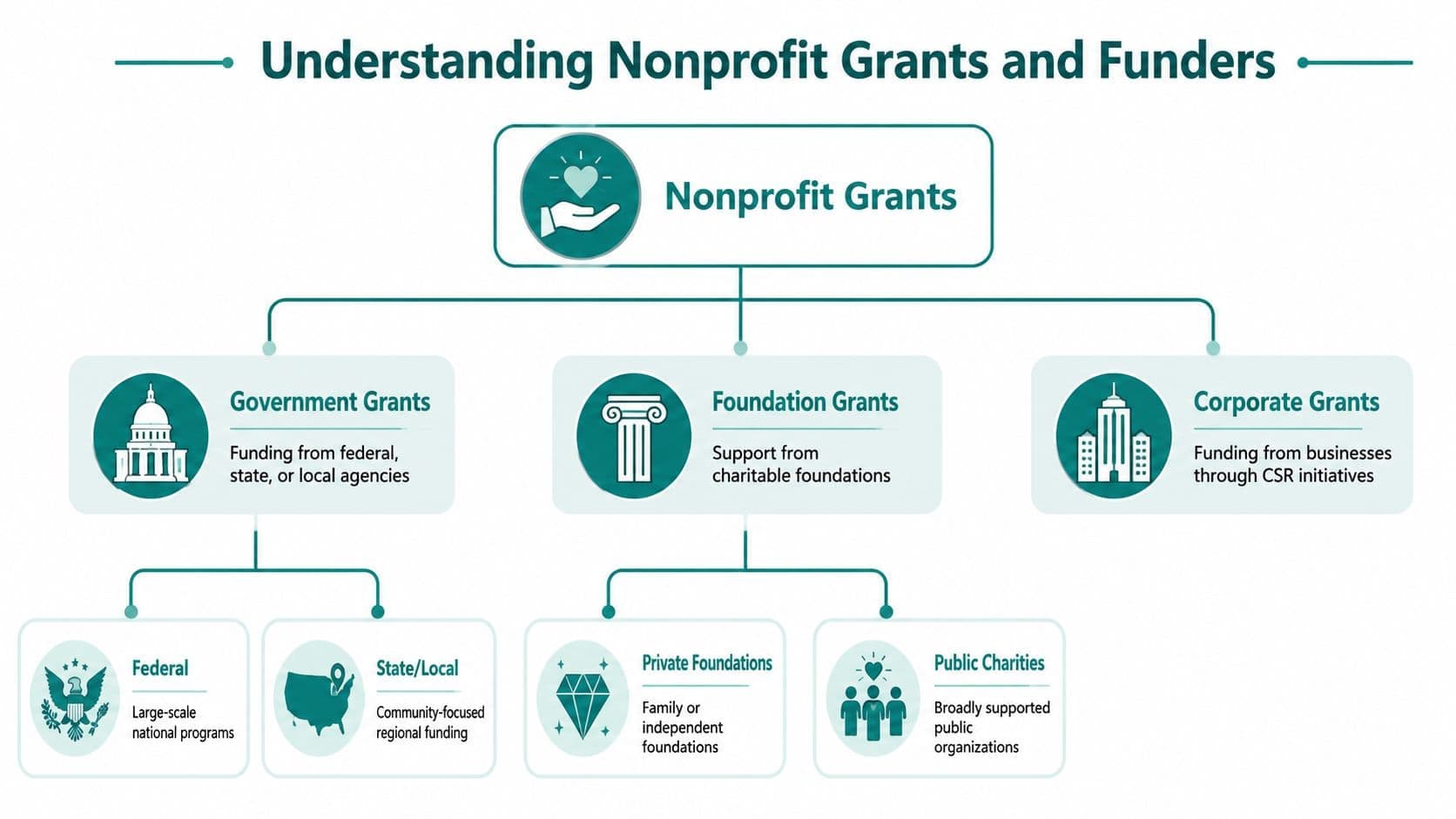
The main funder categories
The label on the check matters because each funder type thinks differently.
Foundations usually want mission fit, a credible plan, and evidence that your organization can carry out the project. Private foundations may have narrow interests. Public charities and community foundations often focus more on local need and community alignment.
Corporations often connect giving to community presence, employee engagement, or brand priorities. That doesn't mean the support is shallow. It means your proposal needs to show why your work matters in the places they care about.
Government funders tend to require the most formal compliance. Federal opportunities often demand more documentation, while state and local grants may be more rooted in practical service delivery and local relationships.
What realistic expectations look like
A healthy grant strategy starts with honest positioning.
- Don't treat grants as your only revenue plan. Foundation money is a major channel, but it is not the majority of giving.
- Don't assume every grant is worth pursuing. Some opportunities cost more staff time than they return in useful support.
- Do match the ask to your capacity. A tightly run smaller grant can help more than a large award your systems can't manage.
The organizations that handle nonprofit grants well usually do one thing better than everyone else. They understand the funder, the restriction, and the reporting burden before they apply.
How to Find the Right Grant Opportunities
Most wasted grant effort starts before the writing. It starts with chasing the wrong prospects.
Small and first-time nonprofits often have a better shot with community foundations, local market grants, and smaller foundations with narrow eligibility, as described by the New Hampshire Charitable Foundation grant guidance. That's why a smaller pool of geographically or mission-specific funders is often a higher-yield path than broad national competitions.
Where strong prospects usually come from
The best grant list is rarely the longest one. It's the one your team can work.
Start with these places:
- Community foundations: They often know local needs well and may support organizations that are too small to stand out nationally.
- Corporate giving in your service area: If a company has employees, customers, or facilities nearby, your local work may be relevant.
- Family and independent foundations: These funders can be highly specific. That's a strength if your mission fits.
- Referral paths: Board members, major donors, and peer nonprofits often know which funders are active in your area.
A practical shortlist beats a giant spreadsheet of remote possibilities every time.
What to screen before you invest time
A grant can look perfect until you read the details. Before assigning staff hours, check these questions:
- Is the geography right? Many grants are tied to a city, region, or service area.
- Is the mission match direct? "Broad alignment" usually isn't enough.
- Can your team handle the reporting? A modest award with heavy compliance can drain your capacity.
- Is there a relationship path? Some funders prefer a letter of inquiry or a warm introduction.
- Does the funding fit your actual need? Money for equipment doesn't solve a staffing problem.
The right grant isn't the one with the biggest name. It's the one your organization can win, manage, and report on without strain.
If you want a starting point for active opportunities, this roundup of available grants for nonprofits can help you spot categories worth pursuing.
Keep prospecting organized
Many executive directors get stuck. The search itself becomes another pile of notes.
You don't need a fancy grants department to stay organized. You need one place to track:
- Who the funder is
- What they care about
- Who knows them
- When the deadline hits
- What was submitted
- When follow-up is due
A donor CRM can handle much of this if your team uses it consistently. The benefit isn't technology for its own sake. The benefit is that your future self can find the conversation history, the contact person, and the past proposal without digging through inboxes.
Writing an Application That Funders Trust
A persuasive grant application does more than describe need. It proves that your organization can turn money into results without losing control of the details.
Funders pay attention to the narrative, but trust often rises or falls with the budget. If the numbers are vague, the proposal feels risky, even when the mission is compelling.

Start with the gap, not the wish list
Funders value applications that quantify the current gap and show how the investment will improve service delivery rather than just replacing tools, according to Power Consulting's guidance on nonprofit technology grants. That principle extends beyond technology. A strong application shows what is missing now, why it matters, and what will change if the grant is funded.
That means your narrative should answer three questions clearly:
- What problem is limiting your work right now
- Why your current setup can't solve it alone
- What specific change the grant will make
Weak proposals ask for support because something would be helpful. Strong proposals ask because a defined gap is holding back service.
Your budget is part of the argument
Many nonprofits still treat the budget as a form to complete after the grant narrative is finished. That's backwards.
A grant budget tells the funder whether your team understands the project. If you request software, training, contracted support, or direct program costs, each line should connect to an outcome. If the line item exists only because "we need it," the case is thin.
Here's a simple comparison:
| Weak budget logic | Strong budget logic |
|---|---|
| Replace outdated tools | Improve service delivery in a defined area |
| Add staff time | Support a specific program activity with clear responsibility |
| General admin costs | Steward restricted funds and document eligible spending |
| Miscellaneous expenses | Named costs tied to a deliverable or timeline |
A clean grant budget template helps teams think this through before they upload anything.
A budget should read like operations, not hope.
Why accounting structure matters before submission
Executive directors often experience a moment when the ground shifts. You can write a sound proposal, but if your accounting setup can't support the budget categories you promised, the application becomes harder to defend later.
That's one reason true fund accounting matters early. If your general ledger is messy, your budget narrative will usually be messy too. Staff then spend hours rebuilding numbers for one application at a time, which creates inconsistencies across proposals.
Applications become more credible when the finance side and the program side are speaking the same language. The funder doesn't need to see your chart of accounts. They do need to feel that your organization knows exactly how the money will be tracked and used.
Managing Restricted Funds Without Spreadsheets
It is 4:30 p.m. on the day before a grant report is due. Finance has one balance. The program director has another. Payroll was split in a spreadsheet no one updated after the last staffing change, and now someone is asking a basic question you should be able to answer in minutes. How much of this restricted grant is left?
That is where grant administration breaks down for a lot of nonprofits. The accounting system holds the official books, but the working truth lives in side files, inboxes, and staff memory. By the time leadership reviews the numbers, the team is reconciling versions instead of managing the award.
Why spreadsheets take over
Spreadsheets usually fill a structural gap. Many accounting tools can record transactions well enough, but they do not always handle restrictions, grant periods, budget categories, and program views in a way that matches how nonprofit teams operate.
QuickBooks is a common example. It can serve an organization reasonably well for basic bookkeeping. But many teams end up using classes, tags, and manual exports to imitate grant tracking. That works for a while. It also creates extra checking, extra training, and extra room for mistakes.
The warning signs are familiar:
- No one can see the current grant balance without a manual reconciliation
- Expense eligibility depends on staff memory or a separate tracker
- Payroll allocations need to be rebuilt each month
- Program staff and finance staff pull different reports for the same grant
- Funder reporting starts with exporting data into a custom spreadsheet
If your process depends on someone saying, "I have the latest version," you do not have reliable grant control.
What true fund accounting changes
A better setup records the restriction inside the financial structure itself. Revenue, expenses, and balances are tied to the correct fund from the start, so the team is not rebuilding grant status after the fact.
That changes day-to-day operations in practical ways. Finance can see what has been awarded, received, spent, and remaining. Program leaders can check whether a cost fits the grant before it gets charged. Executive directors get a cleaner answer during board meetings and budget reviews.
This matters most when funding is tight and reimbursement timing is unpredictable. In that environment, one miscoded expense does more than create cleanup work. It can distort available balance, delay reporting, and create preventable conversations with the funder.
Operational reality: Manual grant tracking increases the odds that restricted money gets charged late, coded incorrectly, or reported inconsistently.
What a workable setup looks like
A grant management workflow has to support the full lifecycle, not just bookkeeping after the award comes in. Restricted funds need to stay connected to the approved budget, the spending rules, and the reporting requirements all the way through closeout.
| Need | What the system should do |
|---|---|
| Restricted fund tracking | Show current balances by grant without off-book reconciliation |
| Expense coding | Let staff code transactions to the correct fund and program at entry |
| Drawdown visibility | Separate awarded, received, spent, and remaining amounts |
| Reporting | Produce grant-ready financials without exporting into custom spreadsheets |
| Team access | Let program and finance staff see what they need without seat limits driving behavior |
Integrated systems help because they reduce handoffs between departments. For example, restricted fund tracking in AlignMint is built around native fund accounting rather than class-based workarounds. Aplos is another system many nonprofits know, especially for accounting-focused setups. Some organizations still pair QuickBooks with a separate donor CRM and additional tracking files. The trade-off is usually more duplicate entry, more reconciliations, and less confidence in the numbers halfway through a grant period.
Control is the issue
Software matters, but control matters more.
When grants live across spreadsheets, inboxes, and disconnected reports, staff spend time proving the numbers instead of using them. Audit prep gets harder. Budget-to-actual reviews take longer. Program managers lose confidence because they cannot see, in one place, what remains available and what has already been committed.
The goal is straightforward. Your team should be able to answer three questions without rebuilding the file first: What was awarded, what has been spent, and what is still restricted but available. If your current process cannot do that cleanly, the problem is not effort. It is the system design.
Mastering Grant Reporting and Funder Relations
Grant reporting feels painful when the data trail is messy. When the structure is sound, reporting becomes one of the easiest ways to strengthen funder trust.
Funders want to see the impact of their investment, and strong reports use measurable KPIs like cost-effectiveness, participant completion rates, and attendance figures to demonstrate accountability and mission success, according to Casebook's discussion of data in nonprofit funding.
What a useful grant report includes
Most reports combine three elements.
Financial reporting shows what you spent and whether those expenses matched the approved purpose. If your accounting system can produce grant-specific statements directly, this part becomes much easier.
Outcome reporting shows what changed. Within this process, attendance, completion, and other program measures matter. The point is not to drown the funder in metrics. The point is to show that your team can connect spending to results.
Narrative reporting explains what happened on the ground. Good narrative updates don't sound polished for the sake of polish. They explain progress, obstacles, and adjustments in plain language.
Send the report your program officer can understand in one sitting. Clarity builds more confidence than volume.
Reporting is also relationship work
Many executive directors treat reporting as the final administrative task attached to an award. That leaves a lot of value on the table.
A timely, accurate report tells the funder three things:
- Your organization pays attention
- Your team can manage restricted support responsibly
- Renewal conversations will be easier than they were the first time
That's especially true when you name what changed because of the grant, not just what activities occurred. A funder wants to know whether the investment mattered.
Drawdowns and cash timing need active management
Some grants reimburse after spending instead of paying upfront. That creates cash pressure even when the award is solid.
The operational question is simple. Can your team document eligible costs fast enough to request funds without delay?
That's why grant reporting and cash management belong together. If finance is waiting on program notes, and program staff is waiting on finance coding, reimbursement slows down. An executive director then ends up solving a workflow problem with working capital.
The stronger approach is to build reporting habits monthly, not at the deadline. When teams review restricted spending and progress updates as they go, the formal report becomes a summary rather than a scramble.
An Integrated Workflow for Grant Management
The cleanest grant operations look boring from the outside. That's a compliment.
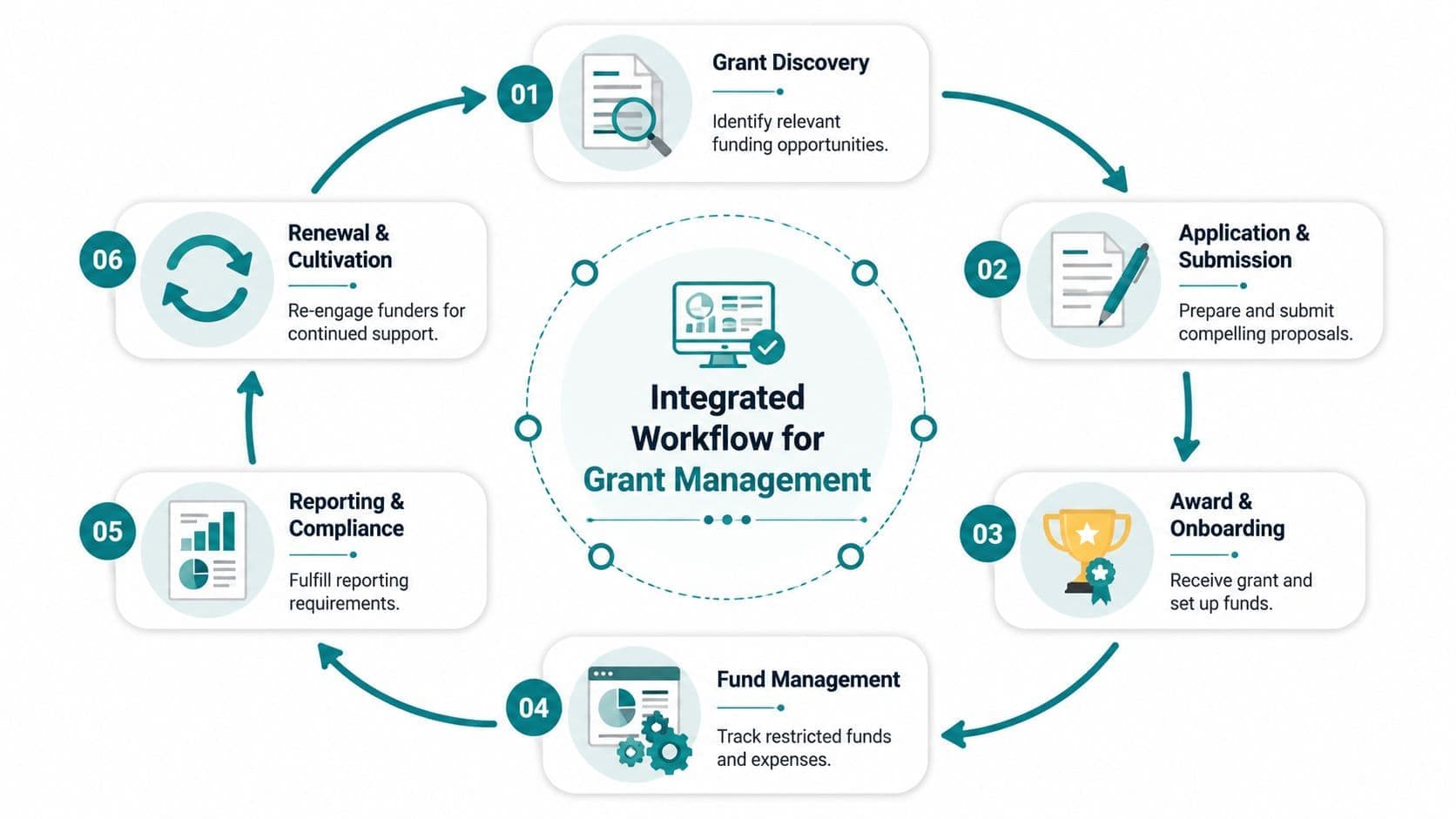
Prospecting, applications, fund setup, reporting, and renewal all run through one connected workflow. Staff don't re-enter the same information in multiple systems, and leaders don't wait for someone to stitch together a story from scattered records.
What integration changes day to day
When grant work is unified, each part supports the next:
- Prospecting stays organized in your CRM, with notes, deadlines, and relationship history attached to the funder.
- Application budgets start cleaner because finance data already reflects your real program structure.
- Awards get set up correctly with restrictions, reporting dates, and responsible staff assigned early.
- Expenses post to the right place without rebuilding reports later.
- Funder updates come together faster because financial and program data already live in the same environment.
- Renewal work gets easier because your history is intact.
That's the operational advantage of an all-in-one model. The benefit isn't convenience alone. It's fewer chances for error.
How this compares with pieced-together tools
Many nonprofits build a grant stack over time. They might keep accounting in QuickBooks or Aplos, donor activity in another CRM, email in a separate marketing tool, and volunteer records somewhere else. Each tool may be fine on its own.
The trouble starts when a grant touches several departments. Then staff has to reconcile finance, donor history, volunteer participation, events, and communications by hand.
A connected setup reduces that friction. It also helps when executive directors want answers in plain language instead of custom report requests. An AI assistant such as Minty can help surface grant-related information from your real data without forcing staff to export files first.
For nonprofits that want one system for accounting, CRM, volunteers, events, team communication, online giving pages, and marketing, this guide to grant tracking software for nonprofits is a practical place to compare approaches.
What to look for if you're evaluating systems
Keep the shortlist simple.
- True fund accounting: Not class workarounds. You need native restricted fund handling.
- Shared data across teams: Finance, development, and programs should not be looking at separate records.
- Built-in marketing and donor tools: Grants don't replace donor work. Your systems should reflect that.
- Plan-based user allowances (1 on Free, up to 10 on Plus, up to 25 on Pro, and unlimited on Enterprise): Seat limits often push staff back into side spreadsheets and shadow systems.
- A workable price path: Smaller nonprofits need room to start without buying software they can't yet support.
If your organization is under $100K in annual revenue, a free tier can make the decision easier. That matters for smaller teams that need structure before they can justify another monthly bill.
If you're tired of managing nonprofit grants through spreadsheets, side notes, and disconnected software, take a look at AlignMint. We built it for nonprofits that need true fund accounting, donor and volunteer tools, built-in marketing, Minty, and plan-based user allowances (1 on Free, up to 10 on Plus, up to 25 on Pro, and unlimited on Enterprise) in one place, with a free tier for smaller organizations that need a practical starting point.
Ready to try AlignMint with your nonprofit?
Start free — set up donor tools, giving pages, and Minty. Upgrade when you need accounting.