

Your finance report says you're fine. Your bank balance says you're nervous. That tension often comes from restricted gifts that look healthy on paper but can't cover payroll, rent, or the surprise repair sitting on your desk today.
Restricted fund accounting solves that problem when you set it up clearly. If you understand what's restricted, what's merely delayed, and what can be spent, you can protect donor trust, avoid compliance trouble, and make calmer decisions with your board.
For the operating system behind that clarity, see fund accounting. It is the feature layer that keeps restricted balances, releases, and reports connected.
Understanding Key Concepts
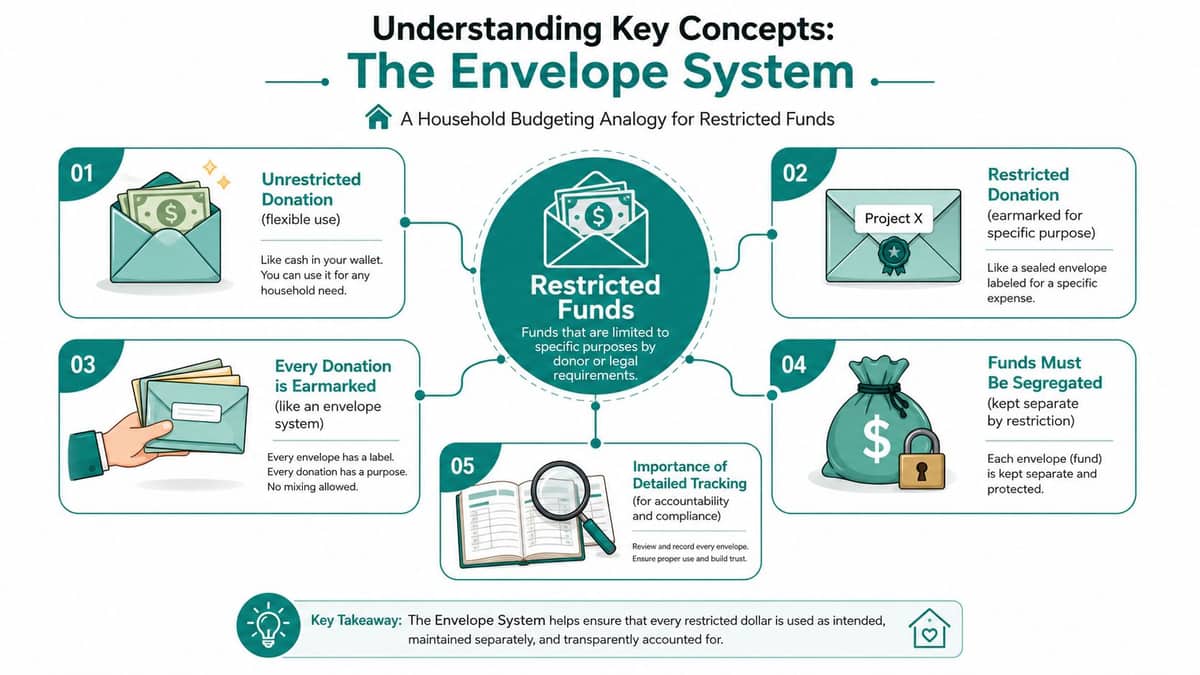
A simple way to understand restricted fund accounting is to think about household envelopes. One envelope holds grocery money. Another holds vacation savings. A third covers school fees. You may have all the cash in one drawer, but each envelope still has a job.
Nonprofit money works the same way. Some gifts are unrestricted, which means you can use them for general operations and mission needs. Some are restricted, which means the donor has set a purpose or time limit, so that money must stay tied to that instruction.
The envelope idea in daily nonprofit life
If a donor gives for youth tutoring, that gift belongs in the “youth tutoring” envelope. If another donor gives without strings, that gift goes in the flexible envelope. You can't borrow from the tutoring envelope to cover office rent unless the donor agrees.
That's why good tracking matters. Fund accounting traces every single cent from donor intent to actual use, tying each dollar to its stated purpose, as explained in this overview of fund accounting and donor intent.
Practical rule: If a board member asks, “Can we spend this today?” your answer should come from donor intent, not from the bank balance.
What readers often confuse
Many executive directors assume “we have the cash” means “we can spend the cash.” That's the first trap. A restricted gift can sit in your account and still be off-limits for general use.
The second trap is thinking restrictions live only in the accounting office. They don't. Development, programs, finance, and even volunteers handling event proceeds need the same understanding, or the wrong expense gets charged to the wrong fund.
A helpful starting point is a plain-language guide to tracking restricted funds. If your team also thinks carefully about how donor gifts are framed at the point of giving, examples from Ecuadane can help spark better donor communication around purpose-driven support.
Legal and Accounting Distinctions
The rules matter because donor intent isn't just a courtesy. It affects your financial statements, your audit trail, and the decisions your board makes from those reports.
Under GAAP, contributed income must be reported in exactly two categories: with donor restrictions and without donor restrictions, replacing the older three-category model. That requirement is described in this summary of restricted fund presentation under GAAP. For many leaders, that single shift clears up a lot of old terminology that still floats around board rooms.
What that means on your statements
You're no longer trying to sort gifts into “temporary” and “permanent” labels for basic statement presentation. You're answering a simpler question. Does the donor restriction still apply, or doesn't it.
That sounds easier than it is. The accuracy lives in your chart of accounts, your fund list, and your supporting schedules. If those are sloppy, your statement categories will be sloppy too.
If your accounting system treats restricted gifts like a tag or class instead of a real fund structure, your reports may look neat while your compliance remains shaky.
UK charity rules make the distinction visible
The UK makes this separation especially clear. Charities must present unrestricted and restricted funds separately in annual accounts under the Statement of Financial Activities, ensuring transparent donor compliance, as explained in guidance on fund accounting for charities.
That rule is useful even if you're not in the UK. It forces the right habit. A healthy-looking total can hide the fact that much of the money is spoken for.
Where misclassification starts
A common example is a grant letter that says “for the after-school program.” That sounds like a restriction. Another says funds are available only if you complete a milestone or overcome a barrier. That may be a condition instead. Those are not the same thing.
When your team blurs those lines, revenue gets recorded in the wrong period or in the wrong category. A practical refresher on fund accounting for nonprofits can help your leadership team see how legal presentation and day-to-day bookkeeping fit together.
Journal Entries and Examples
Most confusion disappears once you see the flow. In plain terms, you usually record the gift when it's received or confirmed, then move it out of restriction when the donor's purpose or time requirement has been met.
Under FASB ASC 958-605, revenue recognition for unconditional donor-restricted contributions happens immediately when the gift is received, not later when you spend it, as outlined in this explanation of restricted contribution recognition. That's the accounting rule. It's also where the liquidity trap begins, because the statement can improve before spendable cash does.
A simple way to think about the entries
First, record the gift in the restricted category. Later, when you've met the restriction, record the release. The cash may have come in earlier, but the release happens when the purpose or time requirement is satisfied.
Here's a plain sample table you can adapt.
Sample Journal Entries for Restricted Funds
| Transaction | Debit Account | Credit Account |
|---|---|---|
| Receive a donor-restricted gift in cash | Cash | Contribution revenue with donor restrictions |
| Record an unconditional restricted pledge | Contributions receivable | Contribution revenue with donor restrictions |
| Spend money on the restricted program expense | Program expense | Cash or accounts payable |
| Release funds after the restriction is met | Net assets with donor restrictions | Net assets without donor restrictions |
This is the part many boards never see. The expense entry and the release entry are related, but they aren't the same entry. Spending money does not automatically reclassify net assets unless your process is set up to do that.
A common boardroom example
Your school receives a gift for library upgrades. The money arrives this spring. Under the accounting rule above, you recognize the restricted revenue now. If the library work happens later, the funds remain in the restricted category until that purpose is fulfilled.
The board may see stronger revenue today and still face a tight operating month. That isn't a contradiction. It's how timing works in restricted fund accounting.
If your team handles many grants, this guide to grant revenue and restricted funds can help you align gift setup, spending, and release timing more carefully.
Reporting and Compliance Requirements
Annual reporting gets easier when your file is built month by month, not in a rush at year-end. Restricted gifts need a paper trail that connects donor language, accounting entries, spending records, and the final reports you share outside the organization.
In the United Kingdom, charities must present unrestricted and restricted funds separately in annual accounts under the Statement of Financial Activities, ensuring transparent donor compliance, according to this charity fund accounting guide. Even outside the UK, that principle is useful. Clear separation makes your year-end reporting easier to defend.
The reporting rhythm that keeps you out of trouble
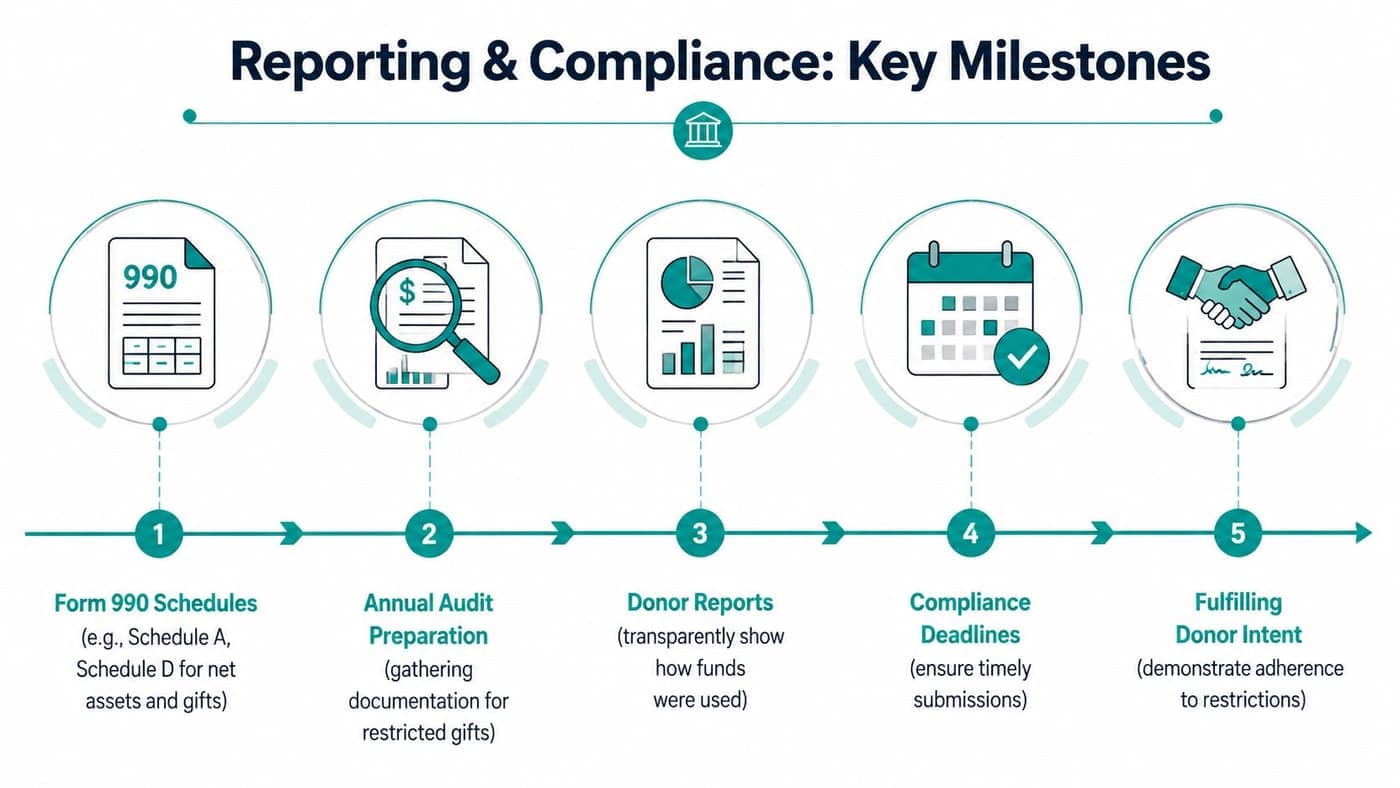
A steady compliance cycle usually looks like this:
- Capture donor terms early in the gift record or grant file.
- Post transactions to the correct fund during the month, not later.
- Match spending to restrictions before preparing donor or board reports.
- Prepare year-end support for net assets, releases, and grant activity.
- Check external filings against your ledger and donor schedules.
For U.S. nonprofits, that same discipline supports Form 990 preparation. In Canada, the restricted fund method also requires tracking tables and return disclosures for restricted balances and activity, but the larger lesson is universal: if you can't show the movement of each fund, reporting becomes guesswork.
What your auditor will want quickly
Keep these items easy to pull:
- Gift documentation with donor purpose and timing language
- Fund activity reports showing opening balance, additions, spending, and closing balance
- Release support tying expenses or time passage to the reclassification
- Board-ready summaries that explain why cash and net assets may tell different stories
For a practical reference on restricted gift utilization, it helps to standardize how your team documents releases before the audit request list arrives.
Reconciliation and Internal Control Best Practices
Good controls protect your mission first. They keep one rushed coding error from becoming a donor issue, an audit adjustment, or a painful board conversation three months later.
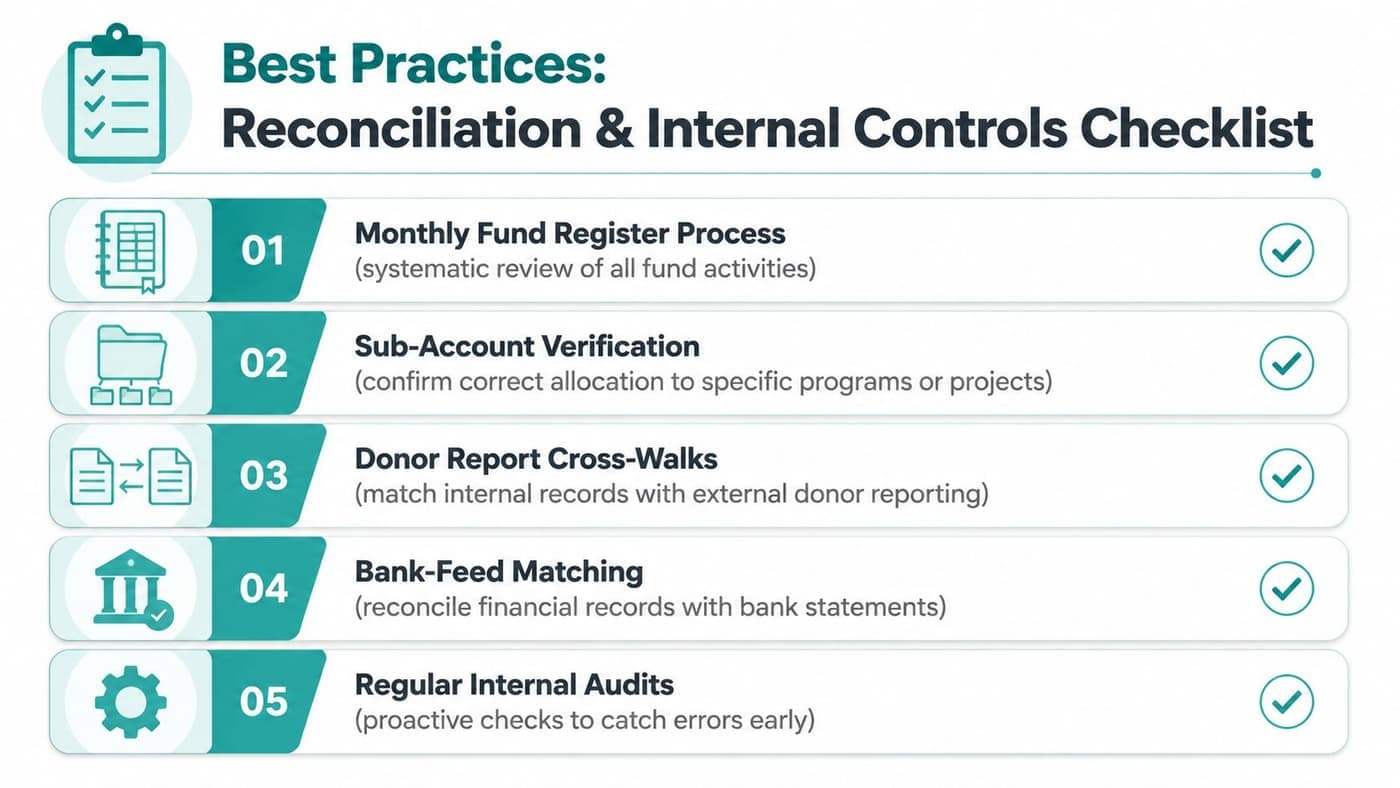
You need a formal fund accounting policy, a restricted fund register with donor details, gift purpose, and spending timelines, and monthly reconciliation procedures that verify activity against donor reports and the general ledger, as outlined in this guidance on nonprofit fund accounting controls. Those steps sound basic. They also prevent most avoidable mistakes.
A monthly control routine that works
Try this simple checklist at month-end:
- Review every active restricted fund against the donor agreement.
- Compare ledger activity to donor-facing reports before anyone sends updates.
- Check unreleased balances and ask whether the restriction has been met.
- Confirm bank activity ties to posted gifts, grant receipts, and disbursements.
- Store support in one place so finance, development, and leadership use the same record.
Quarterly checks for leadership
Once a quarter, step back from transaction review and ask broader questions.
- Are any restricted balances sitting too long because releases weren't posted?
- Did any team code expenses to the wrong program because the fund list is confusing?
- Is cash getting tight even while net assets look healthy?
- Do fiscal sponsorship, church, or school programs need separate reporting views for board oversight?
Clean restricted fund records don't just satisfy auditors. They help you see whether your apparent surplus is actually spendable.
If you want a practical operating model, this article on restricted funds tracking shows how teams can keep finance and development aligned without extra spreadsheets.
Common Mistakes and Troubleshooting
The most dangerous errors in restricted fund accounting usually start with a reasonable assumption. “It's a grant, so it must be revenue.” “We spent the money, so the restriction must be released.” “The donor said it was for students, so that's enough detail.”
Those shortcuts create trouble because the accounting answer depends on the exact donor language and your exact entries. Audits frequently reveal nonprofits misclassifying conditional contributions as restricted revenue because they confuse purpose restrictions with conditions that must be met before recognition, as noted in this discussion of conditional versus restricted contributions.
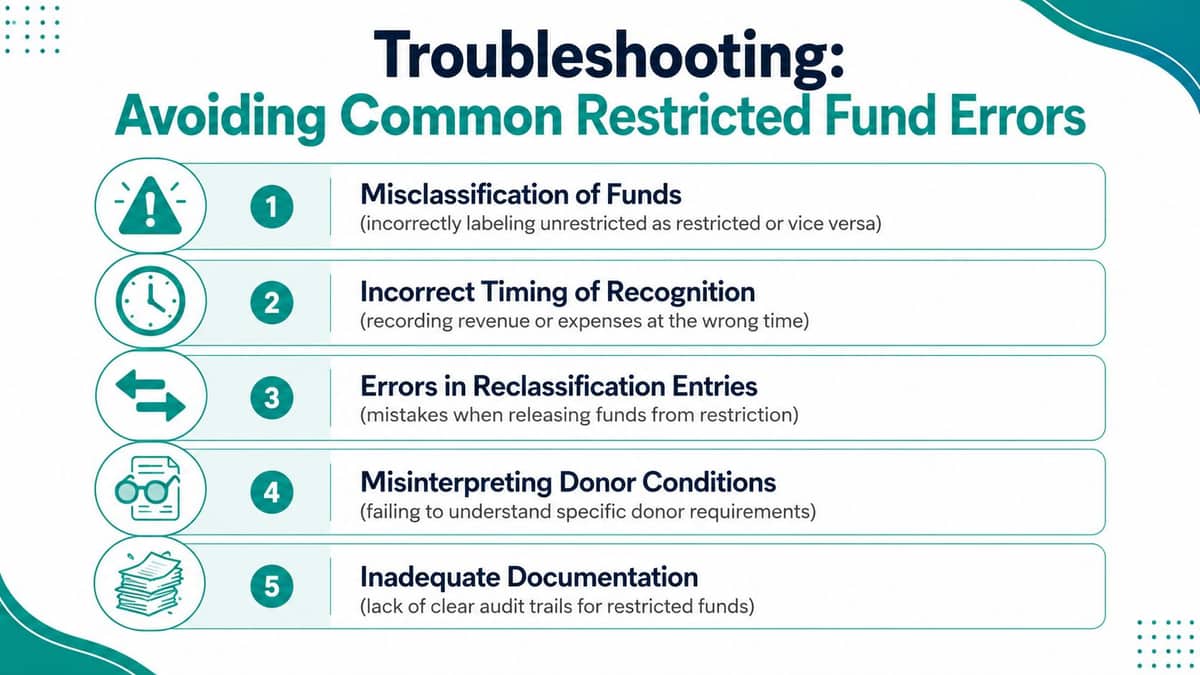
Five errors worth watching
- Calling every donor instruction a restriction. Some grants include a real barrier. If the donor obligation depends on that barrier, treat it carefully before recording revenue.
- Recording the gift correctly, then stopping there. Teams often miss the later release entry, so restricted balances stay inflated.
- Charging broad admin costs to a narrow grant. If the agreement doesn't allow it, the expense doesn't belong there.
- Relying on memory instead of documentation. Staff turnover makes this especially risky.
- Confusing available cash with available operating cash. Restricted money can sit in the bank and still be unavailable for general needs.
Quick fixes when something looks off
Start with the donor letter or grant agreement. Then trace three things: the original entry, the related expense, and the release or remaining balance. Most problems become visible when you line those up.
“For the youth program” points to a purpose restriction. “If you recruit students” may point to a condition. That wording changes the accounting result.
If your reports show strong net assets while payroll feels strained, don't assume the books are wrong. Check whether delayed releases, staged funding, or tightly earmarked cash are masking a liquidity gap.
Software Automation for Restricted Funds
The biggest benefit of software isn't speed. It's confidence. When your system ties donor intent, accounting, reporting, and communication together, you spend less time reconciling and more time making decisions you trust.
That matters most when your organization has grants, events, volunteer activity, church or school programs, or a fiscal sponsorship structure that creates multiple reporting layers. Manual spreadsheets can track some of this for a while. They struggle when gifts, acknowledgments, restrictions, expenses, and donor updates all need to stay in sync.
What to look for in a real system
A useful platform should help you do these jobs in one place:
- Track true funds, not just tags so each restricted balance has its own reporting logic
- Connect donor records to accounting entries so development and finance see the same gift story
- Handle online giving pages and marketing without exporting donor data into separate tools
- Support volunteer management and team communication because operations rarely live in finance alone
- Offer AI help carefully so staff can ask plain-language questions without digging through reports
If you're comparing products, it's fair to say QuickBooks is familiar and widely used, and many nonprofits already know it. The gap is that classes don't equal true fund accounting. NetSuite offers broad accounting depth, but many smaller organizations find the setup heavier than they want. Aplos serves faith-based and nonprofit users well in several areas. The key question is whether the structure matches the way you report restricted balances, grants, and releases.
One option is AlignMint, which combines accounting, CRM, volunteers, events, marketing, online giving pages, team communication, and Minty in one platform. It also offers true fund accounting, clear user access by plan, and a free tier for nonprofits under $100K. For executive directors who are tired of stitching systems together, that combination can reduce handoffs between finance, fundraising, and programs.
Automation should fix the liquidity blind spot
The hidden problem most articles skip is timing. You can recognize restricted revenue before the cash is free for operations, or before all restriction releases have been posted. That creates a management issue, not just an accounting one.
A better system should show restricted balances clearly, surface unreleased amounts, and help you compare bank cash to available operating cash. If you're thinking broadly about process improvement, this practical article on how firms boost growth through accounting automation is a useful outside perspective on why automation matters beyond bookkeeping alone.
Conclusion and Call to Action
Restricted fund accounting isn't only about debits, credits, and audit files. It's about knowing which money is available, which money is spoken for, and how to prove that your organization honored donor intent.
If you keep three ideas in view, most decisions get clearer. Separate restricted and unrestricted activity carefully. Post releases when restrictions are met. Watch for liquidity gaps when reported strength and spendable cash don't match.
That discipline helps every kind of nonprofit, especially grant-funded groups, fiscal sponsors, churches, and schools with many moving parts. When your system, policy, and monthly controls work together, restricted gifts stop being a source of anxiety and become a source of confidence.
If you want a simpler way to manage restricted funds, donor records, volunteers, events, marketing, and reporting in one place, take a look at AlignMint. You can start with the free tier if your nonprofit raises under $100K, test how true fund accounting works in daily practice, and see whether one connected system would reduce the load your team is carrying today.
Ready to try AlignMint with your nonprofit?
Start free — set up donor tools, giving pages, and Minty. Upgrade when you need accounting.