

You've found a cause worth supporting, and someone has offered the first gift before your paperwork is ready. Starting a foundation means building the financial records alongside the legal entity, not catching up after grants begin. You'll need a clear sequence for choosing your structure, establishing oversight, and keeping every charitable dollar accountable.
Quick Answer: Starting a Foundation
Starting a foundation means choosing a private foundation or public charity, forming the entity in order, and keeping fund records before the first gift. Structure decides your filings, payout rules, and what the books must explain.
Start with fund accounting and how to start a nonprofit. For the exemption application, see the Form 1023 checklist.
Choosing Between a Private and Public Foundation
Will your organization be a private foundation or a public charity? That decision shapes your funding model, board responsibilities, annual reporting, and administrative budget.
The word foundation doesn't settle your tax classification. A founder-led grantmaker and a publicly supported organization running community programs can need very different operating arrangements.
Private foundation and public charity compared
| Feature | Private foundation | Public charity |
|---|---|---|
| Typical funder | One family, individual, or company | Many donors and public support |
| Public support test | Not required | Must establish the applicable public charity classification and satisfy its requirements |
| Annual information return | Generally Form 990-PF | Form 990, Form 990-EZ, or Form 990-N, subject to eligibility and exceptions |
| Annual payout rule | Minimum-distribution rules apply, with calculation details your adviser should confirm | No equivalent private-foundation payout requirement |
| Excise tax on net investment income | Private-foundation excise-tax rules apply, subject to exceptions | Private-foundation investment-income excise tax generally doesn't apply |
| Donor deduction limit for cash gifts | Confirm the applicable limit against the donor's income and foundation classification | Confirm the applicable limit against the donor's income and charity classification |
| Best fit | Founder-led giving backed by dedicated assets | Ongoing programs funded by public gifts |
Match the structure to your actual work
Your first distinction is between operating programs and awarding grants. The IRS private-foundation statistics guidance distinguishes operating foundations, which generally conduct charitable activities, from nonoperating foundations, which primarily make grants.
Nonoperating foundations represent the majority of private foundations. The same IRS guidance describes annual Form 990-PF reporting covering distributions, administrative expenses, income, balance-sheet information, and excise-tax liability.
That means your structure determines what your accounting records must explain. A bank statement alone won't establish why a payment advanced your charitable purpose.
Use these questions to test your initial choice:
- Publicly funded programs: Will you deliver services and depend on continuing gifts from a broad donor base?
- Dedicated charitable assets: Will a family or company provide assets that support ongoing grantmaking?
- Administrative capacity: Who will maintain records, prepare filings, and explain financial decisions to the board?
Our 501(c)(3) glossary can help you separate charitable exemption from foundation classification before discussing the options with your adviser.
Practical rule: Write down your intended activities, funding sources, and proposed classification before anyone prepares the exemption application.
If you're testing a charitable project rather than building a permanent institution, discuss fiscal sponsorship before creating another legal entity. Clarify who controls donations, approves spending, maintains records, and accepts reporting responsibility under that arrangement.
How to Start a Foundation Step by Step
A controlled filing sequence prevents expensive rewriting. Your legal documents, state registrations, tax application, and financial setup should describe the same organization.
The IRS guidance on applying for tax-exempt status identifies formation, organizing documents, state requirements, and an EIN as prerequisites. It also explains the 27-month filing window, which can generally preserve exemption back to formation when you file on time.
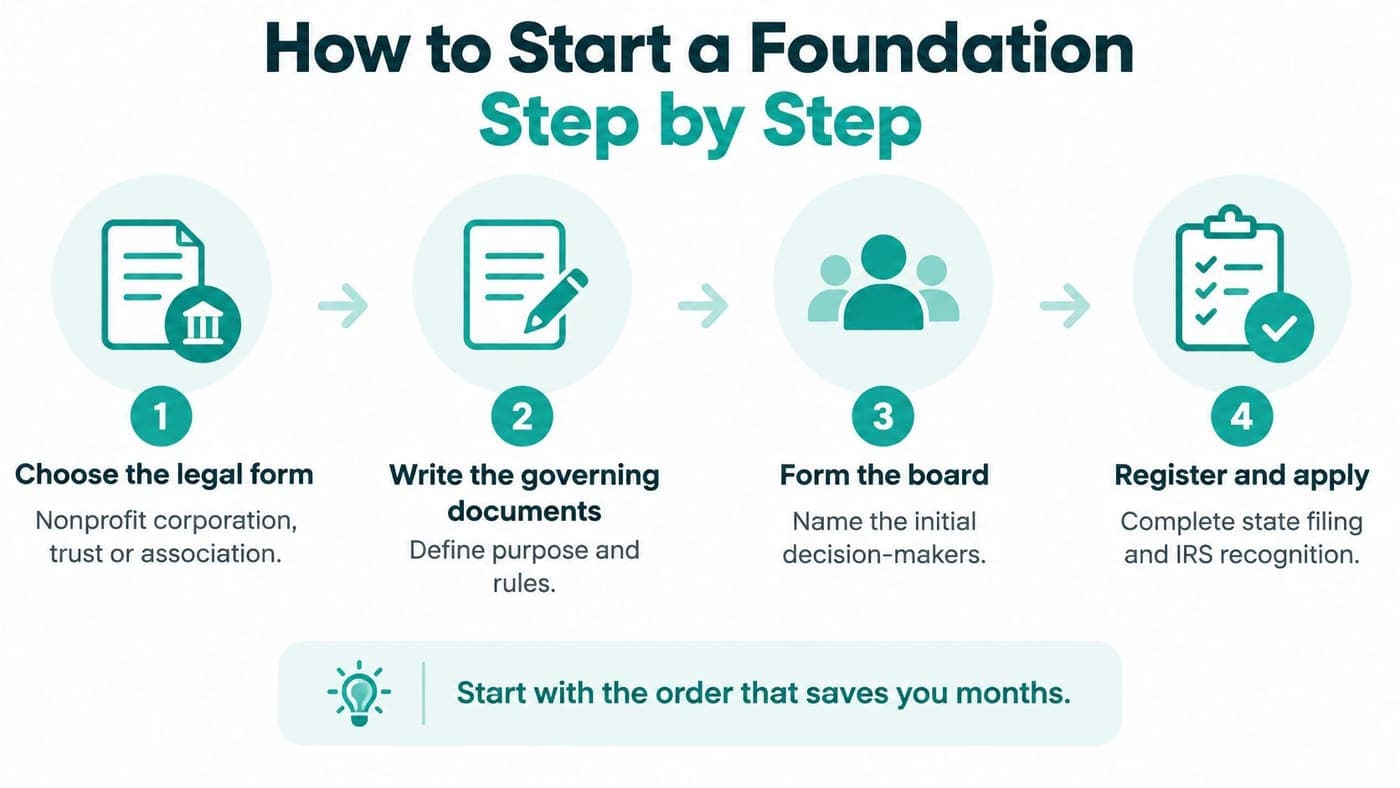
Complete the formation work in order
-
Choose your legal form.
A nonprofit corporation, trust, or association needs governing documents suited to its structure. Don't select a familiar business form because you've used it elsewhere.Ask your attorney to explain the practical differences in governance, amendment procedures, and continuing administration before deciding.
-
Write a specific charitable purpose.
Describe what the organization will accomplish and whom it will serve. Broad aspirations won't replace appropriate organizing language.Include dissolution provisions directing remaining assets toward qualifying charitable purposes. Have counsel check consistency between those provisions and the rest of your documents.
-
Complete your state formation filing.
File the appropriate documents and retain the state's acceptance or incorporation certificate. Keep the final accepted version, not just an unsigned draft.Use the organization's legal name consistently across banking, contracts, applications, and donor communications.
-
Determine charitable-registration obligations.
Check your state charity regulator's requirements before requesting donations. Formation approval and permission to solicit contributions are separate questions.Online giving can introduce additional registration questions. Identify where you'll actively fundraise rather than assuming your home-state filing covers every campaign.
-
Obtain your Employer Identification Number.
Apply for the organization's EIN and retain the confirmation with your permanent records. An EIN identifies the entity; it isn't an exemption approval. -
Establish board authority.
Seat the initial board and approve bylaws, financial authority, and a conflict-of-interest policy. Record these decisions before directors begin signing agreements.Assign responsibility for keeping the official document file current. Shared responsibility without a named owner usually creates missing records.
-
Choose and submit the exemption application.
File Form 1023 or, when eligible, Form 1023-EZ electronically through Pay.gov. Complete and retain the eligibility worksheet before choosing the shorter application.Our Form 1023 checklist helps organize the documents and decisions your application needs.
-
Calendar the exemption deadline and interim filings.
Record the formation date and applicable filing window immediately. Required annual returns can remain due while your determination application is pending.
Budget for preparation, not just filing
Key fees and deadlines for exemption
| Item | Amount or timing | Note |
|---|---|---|
| Form 1023 user fee | Current IRS user fee shown during filing | Standard application for eligible organizations |
| Form 1023-EZ user fee | Current IRS streamlined-application fee | Eligibility worksheet must support this route |
| Exemption filing window | IRS formation-based application window | Timely filing can preserve exemption back to formation |
| Late exemption filing | Generally effective from the filing date | Earlier activity may fall outside recognized exemption |
| Form 990-PF due date | Determine from the foundation's tax year and current instructions | Assign preparation and review owners |
| Form 990-N | Check eligibility and the applicable annual filing deadline | Electronic e-postcard for eligible small public charities |
| Form 990-EZ | Check current filing thresholds and annual deadline | Short-form return for eligible organizations |
Separate government fees from legal drafting, accounting setup, and ongoing administration in your startup budget. Request written scopes that distinguish formation work from annual support; neither timing nor total cost is universal.
Acceptance of a filing isn't the end of administration. Separate ongoing state obligations from the formation paperwork you just finished.
Bylaws, Board and Conflict-of-Interest Policy
Good governance gives donors confidence that someone can question the founder. Your board needs documented authority, usable procedures, and enough information to decline an inappropriate transaction.
The IRS tax-exemption application guidance connects exemption administration with eligible structures, application requirements, and continuing tax questions. Your governance records should also demonstrate that actual spending matches your charitable purposes.
Write rules your board can follow
Bylaws should establish board composition, election procedures, terms, officer responsibilities, meeting arrangements, quorum, and amendment procedures. Any dissolution language should agree with the organizing documents rather than introduce competing directions.
Use examples to identify questions, not to assume another corporation's provisions suit your foundation.
Our bylaws generator can help organize an initial draft for legal review. The board should understand each provision before approving it.
Pair the bylaws with a written conflict-of-interest policy. Require directors and officers to disclose financial relationships, update disclosures regularly, and step away from decisions involving their interests.
- Identify the relationship: Record who benefits and how they're connected to the foundation.
- Separate the decision: Have disinterested directors evaluate the proposal without pressure from the interested person.
- Preserve the evidence: Record disclosures, recusals, documents considered, and the final decision in the minutes.
Don't confuse approval with permission
Say the founder's spouse offers office space at market rent. Comparable prices and a documented vote don't, by themselves, make that transaction permissible.
Private-foundation self-dealing rules require specialist review when transactions involve insiders. Have counsel determine whether the arrangement is prohibited or fits an applicable exception before anyone signs.
A unanimous board vote cannot turn a prohibited transaction into an acceptable one.
At the first board meeting, approve the conflict policy, bank accounts and signing authority, and the grant or program calendar. Store the approved minutes with the documents they authorize.
Use a shared board folder and a named records owner for team communication. Important approvals shouldn't exist only in personal email accounts or informal text messages.
Funding Your Foundation and Its Payout Math
Build a giving plan you can sustain, not a miniature version of a large institution. Your starting assets must support charitable distributions and the administration needed to manage them responsibly.
For tax year 2022, the IRS foundation report found foundations with at least $100 million in assets represented 1.5% of returns, yet controlled 68.3% of total assets. That concentration makes aggregate sector wealth a poor guide to a new foundation's operating budget.
Choose funding you can plan around
Your funding route determines how confidently the board can make future commitments.
- Founding gift: Dedicated assets provide a starting base, but the board must decide what remains invested and available.
- Continuing family or company gifts: Regular contributions can support a grant cycle, provided the budget distinguishes promises from received funds.
- Planned gift: A future estate contribution may establish long-term capacity, but it doesn't pay today's obligations.
An endowment needs clear spending and investment policies. Record whether limits arise from donor instructions, governing documents, or the board's own decisions.
Calculate distributions before approving grants
Ask your foundation CPA to prepare the applicable distribution calculation rather than applying a percentage to today's bank balance. Asset valuation, timing, qualifying expenses, adjustments, and prior distributions can affect the final obligation.
Keep the calculation separate from your grant wishlist. The legal minimum and the amount your board can responsibly distribute answer different questions.
Your payout worksheet should show the calculation base, required adjustments, qualifying distributions already made, and the remaining obligation. Your cash forecast should then show when those payments can clear.
Investment-income excise tax belongs in a separate calculation. Don't calculate it on the founding gift itself or assume the investment statement contains every relevant adjustment.
Have your preparer document the taxable investment-income base, applicable rate, payment timing, and any exceptions. Reserve the resulting amount before treating the remaining cash as available for grants.
Budget discipline: A distribution requirement is a compliance obligation, not evidence that every proposed grant is affordable.
Approve a grantmaking policy covering the annual budget, award range, application cycle, recipient review, and payment conditions. Include a review trigger when investment results weaken or expected contributions don't arrive.
Before making the first award, answer one practical question: What must remain invested or reserved to protect future commitments? A written answer helps directors explain why a worthwhile application might still need to wait.
Accounting and Compliance From the First Gift
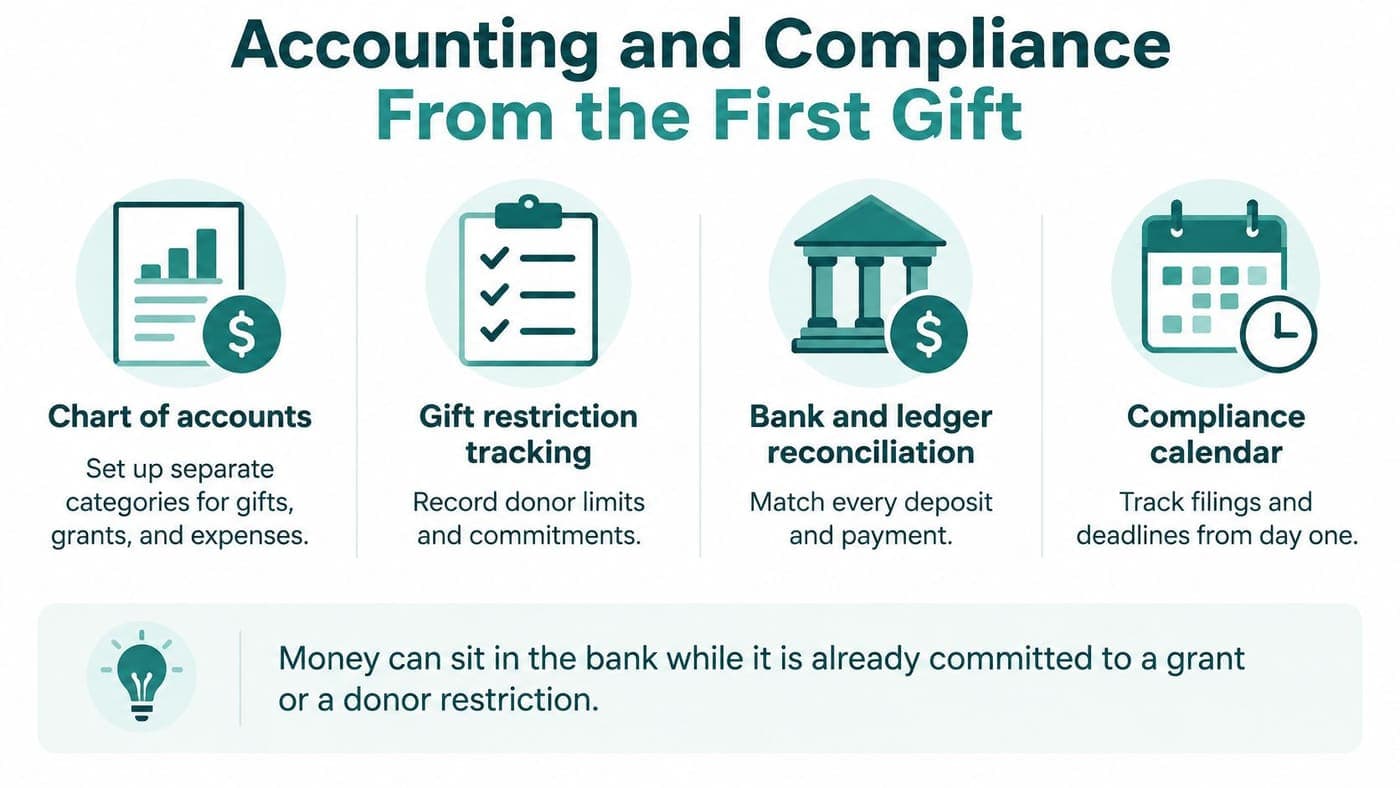
Your bank balance can include money you're not free to spend. A restricted gift, approved grant commitment, or unpaid bill can make apparently available cash misleading.
The IRS ongoing-compliance guidance for private foundations describes continuing filing, disclosure, substantiation, prohibited-transaction, and excise-tax responsibilities. Financial control belongs in formation because those responsibilities don't begin with your first audit question.
Build records around purpose and responsibility
Start with a chart of accounts that distinguishes income, expenses, assets, and liabilities. Add fund and program tracking so you can explain both what happened and which purpose it served.
Next, create a donor-restriction register. Record the original gift document, permitted uses, applicable end date, reporting duty, responsible person, and remaining balance.
Maintain a grant calendar covering applications, decisions, agreements, payments, and recipient reports. An approved award should remain visible even when payment isn't due immediately.
Then establish a monthly close with bank reconciliation and review of outstanding transactions. Finish with a retention policy covering receipts, gift correspondence, grant agreements, board minutes, and filed returns.
Prepare reporting from the underlying transactions
Public-charity expense reporting requires more than broad bookkeeping categories. The IRS Form 990 separates Part IX expenses into program services, management and general, and fundraising.
Record those classifications during bookkeeping rather than reconstructing everyone's time and purpose during return preparation. Your annual reporting file should also retain the explanations supporting significant allocations.
Keep contribution receipts and fundraising costs separate. The Form 990 instructions require gross contributions collected in the organization's name and related fundraising expenses to be reported separately.
A campaign's net deposit isn't enough evidence. Preserve the gross gifts, processing or fundraiser charges, refunds, and settlement details needed to reconcile the transaction.
Use our Form 990 checklist to assign supporting schedules and documents to named owners. Ask your preparer to identify any additional returns arising from your activities.
Choose software by the reports it can prove
QuickBooks is a capable general ledger, and classes can tag transactions by activity. A class label alone, however, doesn't establish a complete restriction-management process.
Before choosing software, test whether it can report restricted balances, commitments, releases, and supporting transactions without manual reconstruction. True fund accounting should preserve purpose through the entire reporting process, not merely attach a label.
Church building gifts, school scholarships, and fiscally sponsored projects each need clear purpose-level records. Volunteer hours should remain identifiable operational records rather than being confused with cash donations.
Copy this monthly routine into your calendar:
- Reconcile cash: Match bank and payment-processor activity to recorded transactions.
- Review restrictions: Check spending against gift terms and update remaining balances.
- Check commitments: Compare approved grants and unpaid bills with available cash.
- Inspect documentation: Resolve missing receipts, agreements, and approval records.
- Brief the board: Share exceptions, upcoming obligations, and decisions needing attention.
Costly Mistakes New Foundations Make
Paying foundation bills personally creates cleanup work before you've established reliable books. Without receipts, approvals, and a clear reimbursement trail, directors can struggle to explain whose obligation was paid.
The deeper problem isn't untidy paperwork. It's making commitments without evidence that the foundation had authority, available funds, and a charitable reason.
Common foundation mistakes and their fixes
| Mistake | What It Costs | Fix |
|---|---|---|
| Paying foundation bills from a personal account | Commingled money, possible self-dealing questions, and potentially an unplanned excise tax | Open a separate bank account; document receipts and obtain appropriate review before reimbursement. Use the controls under Accounting and Compliance From the First Gift. |
| Board signs documents without reading them | Decisions a donor or regulator can challenge | Circulate materials beforehand and record questions in minutes. Follow the governance procedures under Bylaws, Board and Conflict-of-Interest Policy. |
| Launching grants before policy is approved | Grants that cannot be justified during an audit | Approve grant criteria and conflict procedures before awards. Use Funding Your Foundation and Its Payout Math to establish spending authority. |
| Building the first budget on expected gifts | Commitments the foundation cannot cover | Separate received gifts from documented pledges; don't treat either as interchangeable cash. Apply the funding controls under Funding Your Foundation and Its Payout Math. |
| Leaving the annual return to the last month | Rushed filings and missing supporting records | Assign an owner and preparation milestones when establishing the filing calendar under How to Start a Foundation Step by Step. |
Watch for decisions that look harmless
A well-intentioned exception can create a precedent nobody approved. Paying a recipient early, changing a grant purpose by email, or accepting a verbal restriction can leave the official records incomplete.
Require the person proposing an exception to explain the change, identify the approving authority, and attach supporting documents. That's more useful than discovering the explanation during year-end preparation.
Keep these habits simple enough to maintain:
- Maintain a decision log: Summarize significant board decisions, the responsible person, supporting documents, and follow-up needed.
- Review received funding quarterly: Compare the budget with actual gifts and separately documented commitments before approving additional spending.
A clean checklist won't compensate for an unsupported decision. Your records need to explain the judgment behind the transaction, not merely show that someone checked a box.
Confirm Your Structure Before You File
The best next step is a written classification decision, not another application draft. Give your attorney or CPA a concise description of your activities, funding sources, proposed governance, and intended grantmaking.
Finish the decisions that prevent rework
- Confirm the classification. Obtain written advice on private-foundation or public-charity status, including the consequences for your intended activities.
- Assign the filing calendar. Record the formation-based exemption deadline and name the person responsible for tracking it.
- Establish purpose-based accounting. Decide how your books will identify restrictions, commitments, and reporting responsibilities before accepting gifts.
Keep those decisions together with your organizing documents. A future director or preparer should be able to understand the organization without relying on the founder's memory.
For day-to-day administration, we bring fund accounting, donor management, volunteers, events, and marketing into one operating record. Our online giving pages connect gifts with donors and purposes, while built-in marketing supports email, text, and campaign follow-up.
Our Minty AI assistant can help identify donor, fund, event, and volunteer signals within your team's permissions. That can support review and communication, but it doesn't replace board judgment or professional tax advice.
We offer a free setup call to walk through fund accounting, donations, and reporting against your plan. AlignMint is free for nonprofits with up to $100K in annual donations, with no credit card required; the Free plan includes one user.
Your decision this week is specific: confirm your structure in writing before filing anything. Software should support that decision, not distract you from making it.
We offer a free setup call focused on your foundation's fund accounting, donations, and reporting needs before gifts begin arriving. Visit AlignMint to discuss your plan and establish records that support your charitable purpose from the start.
Ready to try AlignMint with your nonprofit?
Start free — set up donor tools, giving pages, and Minty. Upgrade when you need accounting.