

Your statement shows a healthy surplus, yet your operating account feels thin before payroll. That gap confuses many directors, and it usually comes from restricted money. This guide walks you through each line so you can tell what's truly available.
Quick Answer: Not for Profit Income Statements
A not for profit income statement, usually a statement of activities, lists revenue, expenses, and the change in net assets. A surplus can still include restricted money you cannot spend on general bills.
Start with fund accounting and the statement of activities. For restricted balances, see restricted funds.
The Line Items on a Nonprofit Income Statement
You open the bank app and see one number that looks reassuring. Your board packet shows another number that tells a different story. Both can be right, because they answer different questions.
A not for profit income statement is usually called a statement of activities. It lists revenue first, then expenses, then the change in net assets. You get a clear picture of mission activity before you judge cash.
The Two Columns That Control Spending
Every revenue line lands in one of two classes for reporting. One class is net assets without donor restrictions. The other is net assets with donor restrictions.
A gift with no strings sits in the first class. A grant limited to a youth program sits in the second. Your board can read flexibility, not just totals, from that split.
| Line item | Without donor restrictions | With donor restrictions |
|---|---|---|
| Individual and corporate gifts | Yes, when no purpose or time limit applies | Yes, when the donor limits use or timing |
| Grants | Yes, when the grant has no purpose or time limit | Yes, for most purpose-specific or time-limited grants |
| Program service revenue | Yes, such as fees for services | Rarely |
| Investment income | Yes, unless a donor restricts it | Yes, when the donor restricts it |
| Special event revenue, net of direct costs | Yes, for most events | Only when tied to a restricted purpose |
| Net assets released from restrictions | Added when the purpose or condition is met | Subtracted when the purpose or condition is met |
| Change in net assets | Total for this class | Total for this class |
Read the release line as money moving between labeled envelopes. You spend restricted funds on their stated purpose this month. The amount leaves the restricted class and joins unrestricted revenue.
That movement doesn't create new cash for your organization. It only shows a promise has now been fulfilled properly. Your statement stays honest about what's still owed to donors.
A clean chart of accounts makes this sorting far easier. Our nonprofit chart of accounts template gives you account names that match these lines. You'll spend less time renaming accounts at year end.
Card gifts and event payments also need careful posting daily. Connect each receipt to the right revenue line. That habit keeps online giving from blurring your classes.
Pull last year's statement before you read any further today. Tag each revenue line with its class using a pen. You'll see your real operating picture much faster that way.
How It Differs From a For-Profit Profit and Loss Statement
A business surplus belongs to owners who can take it. Your surplus stays with the mission for future service. That single difference shapes every line on your statement.
Your report is commonly presented as a statement of activities. The National Council of Nonprofits sector overview notes FASB Statements No. 116 and 117 formalized the structure. They became effective for large organizations for fiscal years beginning after December 15, 1994.
Statement No. 117 set three core external statements for nonprofits. They are financial position, activities, and cash flows reports. Funders expect that layout because it allows fair comparisons.
| Element | For-profit profit and loss | Nonprofit statement of activities |
|---|---|---|
| Top line | Sales of goods or services | Contributions, grants, program fees, investment income |
| Bottom line | Net income belonging to owners | Change in net assets that stays with the mission |
| Equity | Retained earnings | Net assets without and with donor restrictions |
| Expense grouping | Mostly by nature, such as wages and rent | By function, plus natural detail |
| Volunteer time | Not reported | Generally not reported as revenue or expense |
Revenue tells the first story difference between the formats. A store sells products, while you receive gifts and grants. Some of your revenue arrives with limits attached by donors.
Equity tells the second story in plain language for boards. A company shows retained earnings in one pooled balance. You show two classes so readers see donor limits clearly.
Expenses and Volunteer Time
Expenses also group differently in the two report formats. Businesses sort mainly by nature, like wages and rent. You sort by function and keep natural detail underneath.
Volunteer time generally appears in neither revenue nor expenses. You can describe volunteer impact in notes and annual reports. You don't inflate revenue just because generous people helped.
QuickBooks handles simple books well for many very small groups. Aplos and Blackbaud serve many nonprofits with fund accounting built in. Whichever tool you use, auditors still expect nonprofit presentation.
Set your current profit and loss beside this table today. List each row you can't yet answer with confidence. That short list shows your next cleanup work clearly.
Why Restricted Dollars Change What You Can Spend
A surplus doesn't always mean you have spare cash. A grant can lift March results while funding summer work. You can't pay spring rent with money promised for July.
Picture a bake sale jar with labeled coins inside. Coins marked for the library roof still count toward the total. You still can't buy flour with those labeled coins.
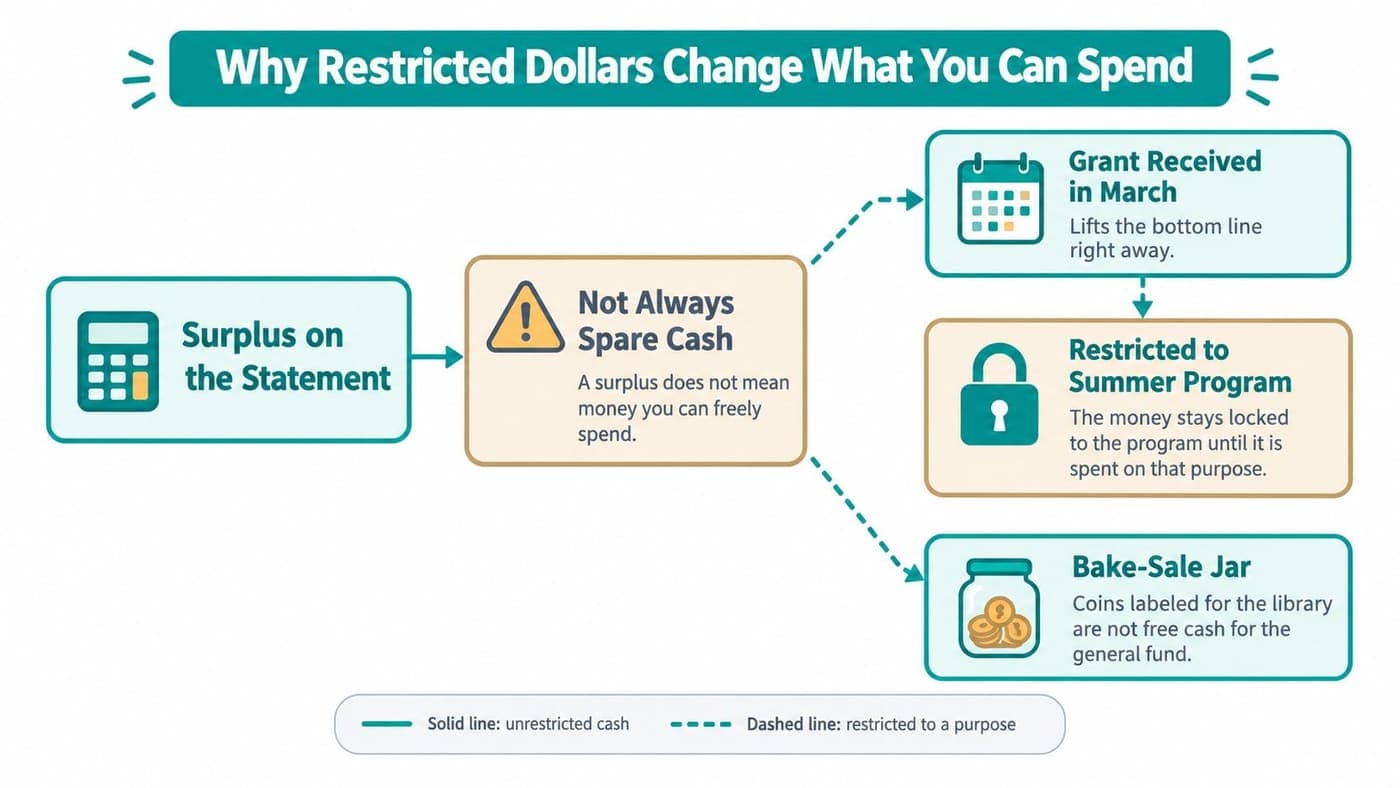
Your total cash breaks into pieces with different rules attached. Some cash is restricted, and some cash isn't collected yet. Only the remaining piece is truly available for general bills.
Board designated reserves need special care in board talks. They stay in the without restrictions class for reporting. They aren't spare cash unless your board votes otherwise.
A positive change in net assets does not prove unrestricted cash is available.
Liquidity notes belong right beside your statement every time. FASB ASU 2016-14 requires qualitative and quantitative disclosure about financial assets available within one year. That note answers how you'll meet general spending needs.
Say you hold a restricted grant and a board reserve. You also wait on pledges that donors haven't paid. Your statement can show income while payroll cash stays tight.
Our restricted funds guidance shows how to track each balance by purpose. You'll answer donor questions without hunting through old spreadsheets. That clarity protects trust when a funder asks for proof.
For each restricted balance, check two facts this week. Confirm the condition is met and cash is banked. Don't release funds until both answers are clearly yes.
How Expenses Split by Function
A single expense total hides how you served your mission. Funders want to see program, office, and fundraising effort separately. Your board needs that split to judge priorities wisely.
Program services cover work that directly serves your mission. Management and general covers governance, finance, human resources, and audit. Fundraising covers the full cost of raising contributions.
The IRS Form 990 requires 501(c)(3) and 501(c)(4) organizations to complete Part IX functional columns. It requires expenses connected with raising contributions in the fundraising column. That includes printing, postage, mailing list rental, and professional fundraiser costs.
| Expense | Program services | Management and general | Fundraising |
|---|---|---|---|
| Program staff salary | Share of time spent on program work | Share spent on program oversight and admin | Share spent on donor appeals or events |
| Executive director salary | Share tied to program leadership | Share spent on governance, finance, and HR | Share spent on donor meetings and galas |
| Rent and utilities | Share of space used by program work | Share used by admin staff | Share used by fundraising staff |
| Appeal letter printing and postage | None, unless the letter carries program content | None | All of it |
| Donor database and accounting software | Share used for program tracking | Share used for finance and governance | Share used for donor records and campaigns |
| Professional fundraiser fees | None | None | All of it |
| Annual audit fees | None | All of it | None |
Your salary rows deserve the closest look each month. A program manager may teach, supervise, and attend donor events. Each activity belongs in a different functional column.
Rent works the same way across your shared office. Program rooms support mission work, while finance desks support management. Fundraising staff space belongs in the fundraising column.
Choosing a Basis You Can Defend
Pick one clear measure for each shared cost type. Use staff time logs for salaries across your programs. Use square footage for rent and user counts for software.
Apply your chosen basis the same way every month. Consistency matters more than hunting for a perfect formula. Auditors and grant reviewers look for steady, documented methods.
Your ledger can keep natural detail under each function. Salaries, rent, and supplies still show what you bought. The functional view then shows why you bought it.
Cash movement adds another layer when you review results. Operating, investing, and financing activity differ. That context helps when cash and expenses don't move together.
Some appeals also carry genuine program education for readers. Document your split and keep a copy of the piece. Don't guess at year end from fading memory.
Our functional expenses guidance walks through common allocations step by step. You'll close each month with fewer judgment calls lingering. That steadiness makes Form 990 work much calmer.
Pick one shared cost before you close this month. Write down its allocation basis in one short sentence. File that note where your successor can find it.
A Worked Example From One Year of Operations
A small food pantry director plans her year with care. She wants the pantry statement to guide weekly buying. Her numbers show how restricted grants shape real choices.
The pantry raises $200,000 in unrestricted individual gifts yearly. It also earns $30,000 from a special event, net of costs. A foundation gives $90,000 restricted to fresh produce purchases.
During the year, staff spend $60,000 on qualifying produce. That spending releases $60,000 from restriction during the period. The remaining $30,000 stays limited to future produce buying.
Without donor restrictions, revenue totals $290,000 for the year. That's gifts plus event revenue plus the released amount. Expenses also total $290,000, so unrestricted change is zero.
| Line | Without donor restrictions | With donor restrictions |
|---|---|---|
| Individual gifts | $200,000 | $0 |
| Special event revenue, net of direct costs | $30,000 | $0 |
| Grant received | $0 | $90,000 |
| Released from restriction | $60,000 | -$60,000 |
| Total revenue | $290,000 | $30,000 |
| Total expenses | $290,000 | $0 |
| Change in net assets | $0 | $30,000 |
Total expenses split three ways across the pantry functions. Program services cost $230,000, including the $60,000 produce purchases. Management and general cost $40,000, and fundraising costs $20,000.
The bottom line looks positive at $30,000 overall. Yet the director has no extra unrestricted money available. Every remaining dollar is locked to fresh produce purchases.
This pattern is common across small and midsize organizations. Purpose-specific grants often make up a large share of funding. Your pantry example is therefore ordinary, not unusual.
The Pantry Monthly Close
- Tag on arrival: Assign each gift and grant its class daily.
- Post to fund: Charge produce invoices against the grant fund.
- Release with proof: Record releases only when conditions are met.
- Allocate shared costs: Split payroll and rent by written basis.
- Match three places: Confirm statement, bank, and grant file agree.
More detailed coding doesn't always create better accountability alone. Poorly designed codes can hide shared costs behind false precision. Keep your fund list short enough for staff to use.
Rebuild this example with your own numbers this week. Use your largest grant and your latest monthly expenses. You'll quickly see which dollars you can actually spend.
Where Each Figure Goes on Form 990 and Grant Reports
Form 990 is where your statement meets public view. Donors, funders, and board members read that filing online. Your figures must match across every document you sign.
The IRS Form 990 form reports revenue in Part VIII by type. Its columns separate total, related, unrelated, and excluded revenue. Categories include contributions, program service revenue, and investment income.
Part IX then reports your statement of functional expenses. It requires program, management and general, and fundraising columns. Total expenses in Part I must agree with Part IX.
Revenue less expenses gives the change in net assets. That figure should match your statement of activities exactly. If it doesn't, stop and find the difference first.
Grant Reports and Audit Files
Most funders ask for budget versus actual by line. They also want each grant's remaining restricted balance shown. Proof of release matters when conditions have been met.
A common mismatch causes painful year end cleanup work. A grant report may group expenses differently than Part IX. Map each grant category to your ledger from day one.
Your auditor tests the same totals across every report. Gift receipts support revenue lines with amounts and dates. Clean donor records make that testing faster and cheaper.
Our Form 990 Builder guidance helps you prepare filing data from connected records. You'll check totals before your preparer starts asking questions. That early review saves rushed corrections near deadlines.
Before you sign any filing, compare the three parts. Check Part VIII, Part IX, and statement totals line by line. Ask a second person to confirm the match.
Check Your Statement Before the Next Board Meeting
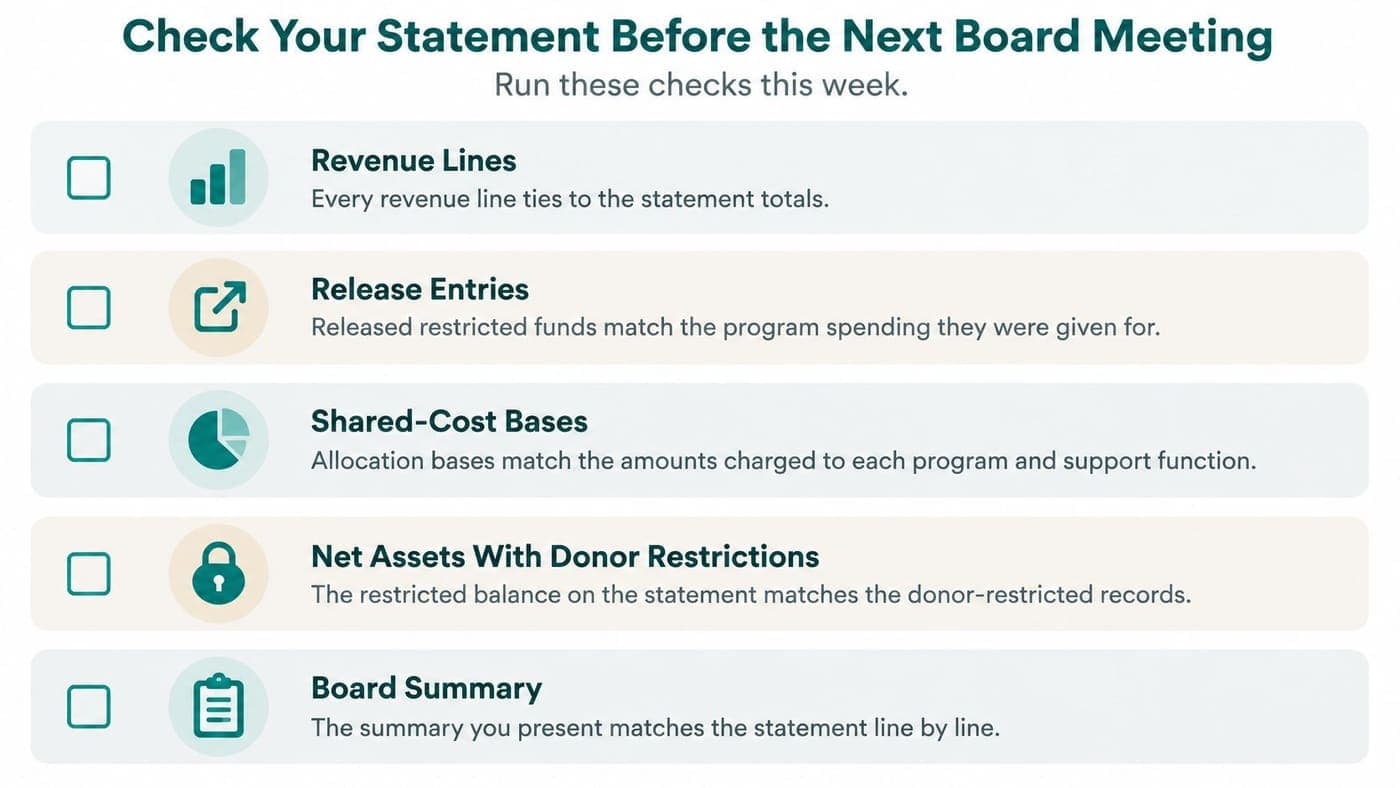
You can run a useful review before the next meeting. It takes focus, not new technical skill or long hours. These checks catch the errors boards notice most often.
- Revenue agreement: Revenue lines, releases, and shared cost bases agree.
- Release proof: Every release matches a condition met.
- Restricted match: Each restricted balance matches grant file and bank.
- Filing match: Part I, VIII, IX, and statement totals align.
- Plain words: Change in net assets is explained for directors.
We built our system to keep dollars tied to purpose. It can run standard and by-fund income statements for reports. Our board reporting health check helps you review your packet first.
Explore fund accounting in AlignMint when you're comparing your options. Read our guides on fund accounting for nonprofits and nonprofit accounting software for context. Choose the shared ledger or fund system that fits best.
If your statement and bank balance keep telling different stories, we can help you sort restricted and unrestricted dollars with confidence. Visit AlignMint to see how standard and by-fund statements could make your next board meeting calmer.
Ready to try AlignMint with your nonprofit?
Start free — set up donor tools, giving pages, and Minty. Upgrade when you need accounting.