

Your bank balance can look comfortable while your operating cash is dangerously thin. That's the daily risk with restricted funds for nonprofits, and it catches good leaders off guard. This guide shows you how to read donor intent, record releases correctly, and know what's truly spendable before you approve the next bill.
Quick Answer: Restricted Funds
Restricted funds are donor-limited dollars that can sit in the bank while operating costs still need unrestricted cash. Record the purpose, and release the balance only when that purpose is met.
Start with fund accounting and restricted vs unrestricted funds. For the written rule, see how to draft a restricted funds policy.
The Bank Balance That Could Get You in Trouble
You're in a board meeting and the checking account looks healthy. Your program director asks for new laptops, and nobody objects at first. Then your finance chair pauses and asks how much of that cash is actually yours to spend.
That pause is the whole issue with restricted funds for nonprofits. Cash in the bank and cash available for payroll aren't the same thing. Some of those dollars already belong to a purpose a donor named.
The Question Behind the Question
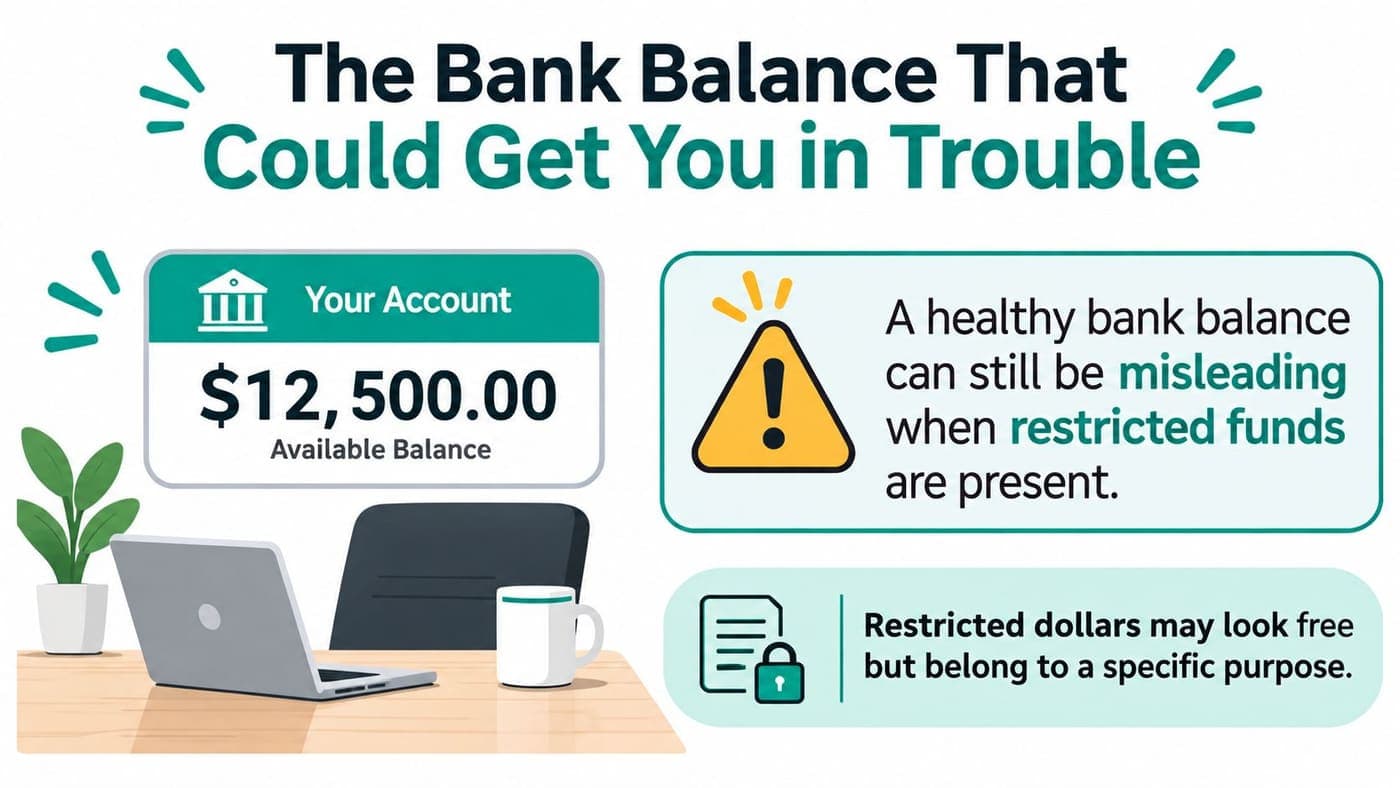
Your board isn't really asking about laptops. They're asking whether you can cover rent, salaries, and insurance next month. A strong total balance can hide a weak unrestricted position.
That gap is common across the sector. The 2025 Nonprofit Finance Fund survey report found 75% of nonprofits struggled to raise unrestricted dollars, with 46% calling it a major challenge. So restricted gifts can pile up while general costs go uncovered.
Restricted dollars may look free but belong to a specific purpose. Your job is knowing the difference before you commit.
What You'll Walk Away With
You'll get four practical things from this guide. First, a plain definition you can repeat to your board. Second, a way to read donor intent before posting anything.
- Clear entries: You'll see what happens when money arrives and when it's released.
- A reporting rhythm: You'll get a monthly habit that keeps audits calm.
- A liquidity lens: You'll learn to separate total cash from spendable cash.
None of this needs a big finance team. It needs a steady routine you can run each week. Once that routine exists, restricted money stops feeling like a trap and starts feeling like proof donors trust you.
What Restricted Funds Actually Are
A restricted fund is a gift with instructions attached. The donor tells you how, when, or whether you may spend it. When you accept the gift, you accept those instructions too.
Unrestricted dollars work differently. Your board decides where they go, based on need. They pay for rent, bookkeeping, and the unglamorous costs that keep programs running.
The Two Buckets on Your Statements
U.S. accounting standards sort every dollar into two classes. They're called net assets with donor restrictions and net assets without donor restrictions. You'll see those exact labels on your financial statements.
The IRS builds the same split into Form 990. The IRS Form 990 instructions require both classes in Part X, reconciling to total liabilities and net assets. Your return, your books, and your statements all need to tell the same story.
| Type of money | Who sets the use | Can your board change it |
|---|---|---|
| Donor restricted | The donor or grantmaker | No, not on its own |
| Board designated | Your board | Yes, by board action |
| Unrestricted | Your organization | Yes, as needs change |
A Picture That Helps Boards
Think of your mission as a shelter you're building. Restricted money is labeled for one roof, one wall, or one window. Unrestricted money keeps the whole building standing and the lights on.
That picture also clears up a common mix-up. When your board sets money aside for a reserve, that's a designation, not a restriction. The IRS instructions note that board designations don't create donor restrictions, so that money stays unrestricted.
Practical rule: If the donor didn't limit it, don't call it restricted. The label changes what you're allowed to do.
Why does the wording matter so much. Because a donor restriction carries legal weight beyond your office. Honoring it protects donor trust, your audit, and your board's decisions about what you can afford.
Reading Donor Intent Before You Touch the Books
Most restricted fund mistakes happen before anyone opens the accounting software. They happen when a gift arrives and nobody pins down what the donor meant. Interpretation, not data entry, is where you're most exposed.
Your first job is reading the agreement, letter, or appeal language closely. What did the donor say, in writing? Your accounting should follow that answer, not the other way around.
The Three Flavors You'll See
Purpose restrictions limit money to a named use. A gift for summer camp scholarships pays for scholarships, not general staffing. If the wording is broad, you'll need to decide what reasonably fits.
Time restrictions limit when money may be used. A multi-year program grant may release as each period passes. Endowment restrictions go further, holding the original gift while earnings may be spendable.
- Original gift: Check what the donor said about the principal itself.
- Earnings: Interest, dividends, and gains may carry separate instructions.
- Applicable law: State law can limit endowment components even without explicit wording.
FASB expects each endowment component to be judged on its own instructions. The FASB ASU 2016-14 update frames donor restrictions as limits met through time passing or actions you take. A component is unrestricted unless donor instructions or law say otherwise.
When the Words Are Fuzzy
A phrase like "support youth programs" sounds clear until bills arrive. Does it cover program staff, technology, evaluation, or shared occupancy. What happens if money remains when the project ends.
Write down your reading of ambiguous language, and who approved it. That note is gold at audit time.
California offers a useful warning here. A 2026 California Attorney General letter, discussed alongside FASB Statement No. 116, notes donations must be used consistently with donor restrictions. Under common law, restrictions can follow the assets themselves.
Your acknowledgment letter is part of this paper trail. Naming the purpose back to the donor confirms you understood each other. Our donation acknowledgment letter template helps you capture that wording while the gift is fresh.
The Accounting Entries Behind Restricted Dollars
The entries themselves are simpler than many expect. Money arrives, you record it in the right class, then you move it when conditions are met. The discipline is doing each step in order, every time.
When a restricted gift arrives, cash goes up. At the same time, revenue lands in net assets with donor restrictions. The money is real, but it isn't available for general spending yet.

Receiving, Spending, and Releasing
Say a program grant arrives and you spend it over several months. Each month, you record the program expenses as you normally would. Then you record a release for the qualifying amount spent.
The release moves money from restricted to unrestricted net assets. It isn't new revenue, and it isn't new cash. The ASC 958 guidance summary describes this as a reclassification once time passes or purpose is fulfilled.
- At receipt: Record cash and restricted contribution revenue.
- At spending: Record the expense against the program.
- At release: Move the matching amount between net asset classes.
- At close: Reconcile what's left by fund and restriction type.
One shortcut needs care. If a restricted gift is fulfilled in the same reporting period, you may present it as unrestricted support. That only works if you've adopted that policy, apply it consistently, and disclose it.
Two Traps That Aren't Revenue at All
Sometimes money passing through your hands isn't yours. If a donor names an unaffiliated beneficiary and you agree to act for them, that's generally a liability. The guidance on recording contributions held for others explains why control, not custody, drives the answer.
Conditional gifts are the second trap. If a measurable barrier stands between you and the money, it may sit as a liability until met. Sorting this out is easier with a clean structure, and our nonprofit chart of accounts template gives you accounts that match these distinctions.
Before you post: Ask who controls spending decisions, and whether the donor can redirect the funds. Document the answer with the agreement.
Tracking and Reporting Restricted Balances in Real Time
Here's a claim worth testing in your own office. Your tracking habit matters more than any single software feature. A year-end scramble almost always produces guesses dressed up as numbers.
Real-time tracking means every restricted gift lives in a subledger from day one. That record links the agreement, eligible expenses, restriction status, and release date. Supporting invoices sit right alongside, not in someone's email.

A Monthly Close You Can Actually Keep
Start with opening restricted balances by fund. Add new restricted receipts and any investment returns. Subtract releases, then confirm the closing balance matches your records.
- Capture donor intent: File the agreement the day the gift arrives.
- Tag restriction type: Mark purpose, time, or endowment at intake.
- Update the subledger: Post receipts, expenses, and releases promptly.
- Monitor available balance: Check what's spendable before approving costs.
- Reconcile regularly: Tie each fund to your books every month.
That rhythm gives your finance committee a short, honest summary. They see what came in, what was released, and what remains committed. Nobody has to reconstruct decisions from memory months later.
Watching Your Unrestricted Floor
The report your board needs most shows unrestricted cash on its own. Set a floor that protects payroll and core bills. When unrestricted cash dips near that floor, you act early, not in a panic.
Forecasting releases helps too. If you know when restricted purposes will be fulfilled, you can predict future flexibility. A balance sheet by fund view makes that picture visible without exporting spreadsheets.
A positive bank balance isn't spendable cash until you've set restricted obligations aside. Show your board both numbers, every time.
Automation earns its keep for small teams. When tagging happens at intake, monthly reporting becomes review instead of archaeology. Your auditor gets clean records, and you get your evenings back.
Where Common Tools Fall Short for Restricted Reporting
Plenty of good tools handle parts of this work well. The honest question is where each one strains. Your size, grant mix, and staffing decide which strain matters most.
QuickBooks is familiar, and many bookkeepers know it cold. That familiarity is a genuine strength for small teams. The gap is that classes and locations tag transactions, but they don't enforce true fund balances.
Three Familiar Names, Three Different Gaps
Aplos offers approachable fund accounting that small nonprofits and churches appreciate. Getting started feels manageable, even without an accounting background. As reporting needs grow, some directors find the work still feels manual.
Blackbaud Financial Edge brings real depth for larger institutions. Its reporting suits complex organizations with dedicated finance staff. For most small and mid-sized nonprofits, price and learning curve are the barriers.
| Tool | Strength worth crediting | Where directors feel friction |
|---|---|---|
| QuickBooks | Familiar to many bookkeepers | Classes don't enforce fund balances |
| Aplos | Approachable fund accounting | Reporting can feel manual at scale |
| Blackbaud Financial Edge | Depth for larger institutions | Cost and learning curve |
What Purpose-Built Fund Accounting Changes
We built our fund accounting features around native restricted balances, not workarounds. AlignMint combines accounting, donor CRM, volunteers, events, and marketing in one place. Minty, our AI assistant, answers questions against your real numbers.
There's no per-seat pricing, so your treasurer and program staff can all log in. Organizations raising under $100K yearly can start on our free tier. That's a calm way to test whether native fund accounting fits your habits.
Buy for the workflow you'll actually run weekly. Fancy features you skip don't protect donor intent.
How Real Organizations Live With Restricted Money
Abstract rules land better when you see them in familiar settings. Three common situations show how the same habits play out differently. Each one rewards the team that documents early.
A small church receives a capital campaign gift for roof repairs. The money sits in the bank while bids come in slowly. Without clear tagging, that balance tempts everyone during a tight month for utilities.
Three Settings, One Discipline
The church keeps the gift tagged to the roof project from intake. Board reports show it separately from operating cash. When the roofer's invoice arrives, the release entry follows the payment naturally.
A fiscal sponsor faces a trickier question. It administers grants for several community projects under its umbrella. The beneficiary-control test decides whether passed-through money is revenue or a liability.
- Church campaign: Tag at intake, release against the contractor's invoice.
- Fiscal sponsorship: Classify control before posting anything at all.
- Education grant: Watch timing, since reimbursement follows your spending.
That third case strains cash flow the most. An education nonprofit spends first, then waits for grant reimbursement. Tracking the receivable matters as much as tracking the restriction, and our grants receivable guidance walks through that timing.
Document at intake, tag in the subledger, reclassify at release, reconcile monthly. Four habits, repeated calmly, cover nearly every scenario.
Notice what these stories share. None of the organizations needed a large finance department. They needed agreement about where intent gets recorded, and someone checking balances before approving expenses.
Volunteer-heavy programs add one more wrinkle worth naming. Tracking who does what, and when, supports both grant reports and clean operations. Clear records protect everyone's time, including yours.
Putting It All Together and Your Next Step
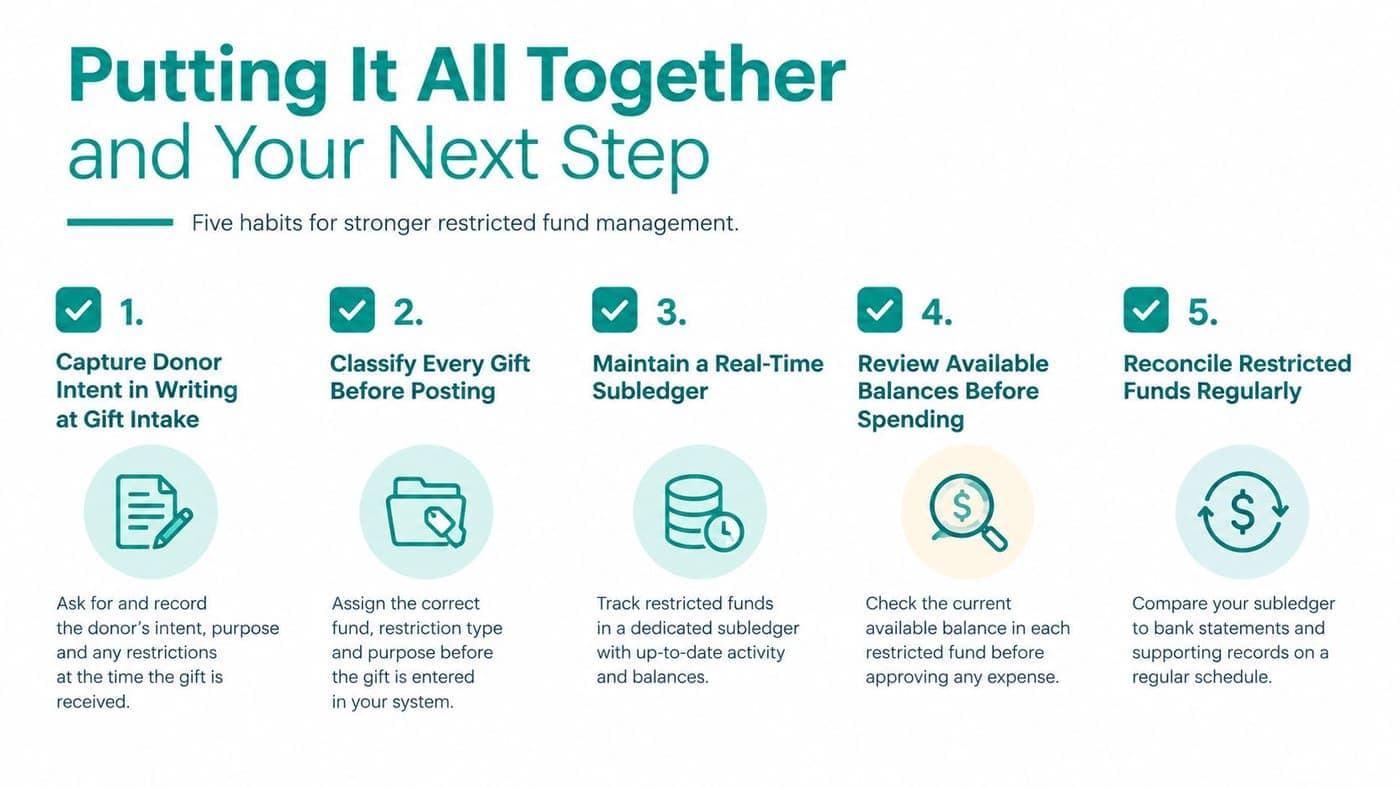
Restricted funds stop being stressful when they become routine. Five habits carry most of the weight for small teams. None require new staff, and each one pays off at audit time.
You're really building one connected chain of evidence. Donor intent leads to classification, classification leads to tracking, and tracking leads to honest board conversations. Break any link, and you're reconstructing history later.
Your Monday Morning Checklist
Print this list and run it with your bookkeeper next week. It takes one focused hour to see where you stand. Then fix the weakest link first, not everything at once.
- Capture intent in writing: File every agreement at gift intake.
- Classify before posting: Decide restriction, condition, or liability first.
- Keep a live subledger: Link agreements, invoices, and release dates.
- Check before spending: Review available balances before approving costs.
- Reconcile monthly: Tie opening balances to closing balances by fund.
Don't forget the donor side of the paper trail. For a single contribution of $250 or more, donors generally need written acknowledgment before claiming a deduction. The IRS substantiation and disclosure requirements spell out what that acknowledgment must state, including whether goods or services were provided.
Turning Discipline Into a Board Story
Your board doesn't need accounting lectures. They need one honest sentence about liquidity each month. Tell them total cash, restricted commitments, and what's available for operations.
Healthy assets with weak liquidity is a sentence boards understand. Say it early, while you still have options.
When that conversation becomes normal, fundraising strategy improves too. You can ask donors, politely and in writing, about broadening overly narrow restrictions. Many would rather see their gift work than sit stranded.
Start with the checklist, then look closely at your tools. If tagging still lives in side spreadsheets, that's your signal. The right system makes these five habits feel ordinary, which is exactly the point.
We built AlignMint so restricted balances, donor records, and Form 990 ready reports live in one calm workspace your whole team can use without per-seat fees. If your bank balance and your spendable cash never seem to match, visit AlignMint and see how native fund accounting and Minty make that answer clear in minutes.
Ready to try AlignMint with your nonprofit?
Start free — set up donor tools, giving pages, and Minty. Upgrade when you need accounting.