

You're reviewing a draft Form 990 close to filing, and a familiar vendor name suddenly looks connected to a board member's family. The question isn't only whether Schedule L applies. It's whether your organization can show how it reached its answer.
Form 990 Schedule L is easier to handle when you start with the people and relationships behind transactions, then check the return's trigger questions. Here's a practical way to identify who may be covered, understand what must be reported, and keep a defensible record, including when your answer is no.
Quick Answer: Form 990 Schedule L
Form 990 Schedule L discloses certain transactions with interested persons, including excess-benefit deals, loans, grants, and business deals. File it when the return's trigger questions say yes, and keep a record when the answer is no.
Start with fund accounting and Form 990 reporting. For the filing calendar, see what a late Form 990 costs.
Why Schedule L Catches So Many Nonprofits Off Guard
A vendor linked to a board member's cousin appears in the payables list. Someone remembers a small loan from an officer. Your tax preparer asks whether either relationship belongs on Schedule L, and the filing deadline is near.
That moment is stressful because the accounting records may show who got paid without showing how that person relates to the organization. A familiar business name can look ordinary until someone connects it to a director, an officer, or a family member.

Form 990 Schedule L is the IRS disclosure schedule for certain financial relationships between a tax-exempt organization and interested persons, including disqualified persons under Internal Revenue Code section 4958. It covers four defined areas: excess-benefit transactions, loans, grants or assistance, and business transactions involving interested persons. It's a targeted governance disclosure, not an attachment every nonprofit files automatically. The current IRS Schedule L instructions describe the schedule's scope and filing triggers.
The schedule generally comes into play when specific answers on Form 990 Part IV are “Yes.” Form 990-EZ filers can also have a Schedule L requirement through questions in Part V. So the practical starting point isn't guessing from the organization's size or scanning every transaction indiscriminately. It's checking the relevant questions and then making sure the underlying facts support the answers.
A confident “no” also needs a process behind it. You need a reasonable way to identify insiders and related parties, search your records for relevant transactions, and preserve the reasoning that supports your conclusion. That's the less visible work, but it's often what turns filing-season guesswork into a repeatable governance practice.
The goal for your own team is straightforward: know who could be covered, check the right transactions, and keep a clear record of what you found.
What Schedule L Covers and What It Leaves Out
Schedule L reports specified transactions between an organization and certain interested persons. It doesn't calculate tax, and it doesn't capture every transaction involving a person connected to your nonprofit. Its four parts define the ground it covers.
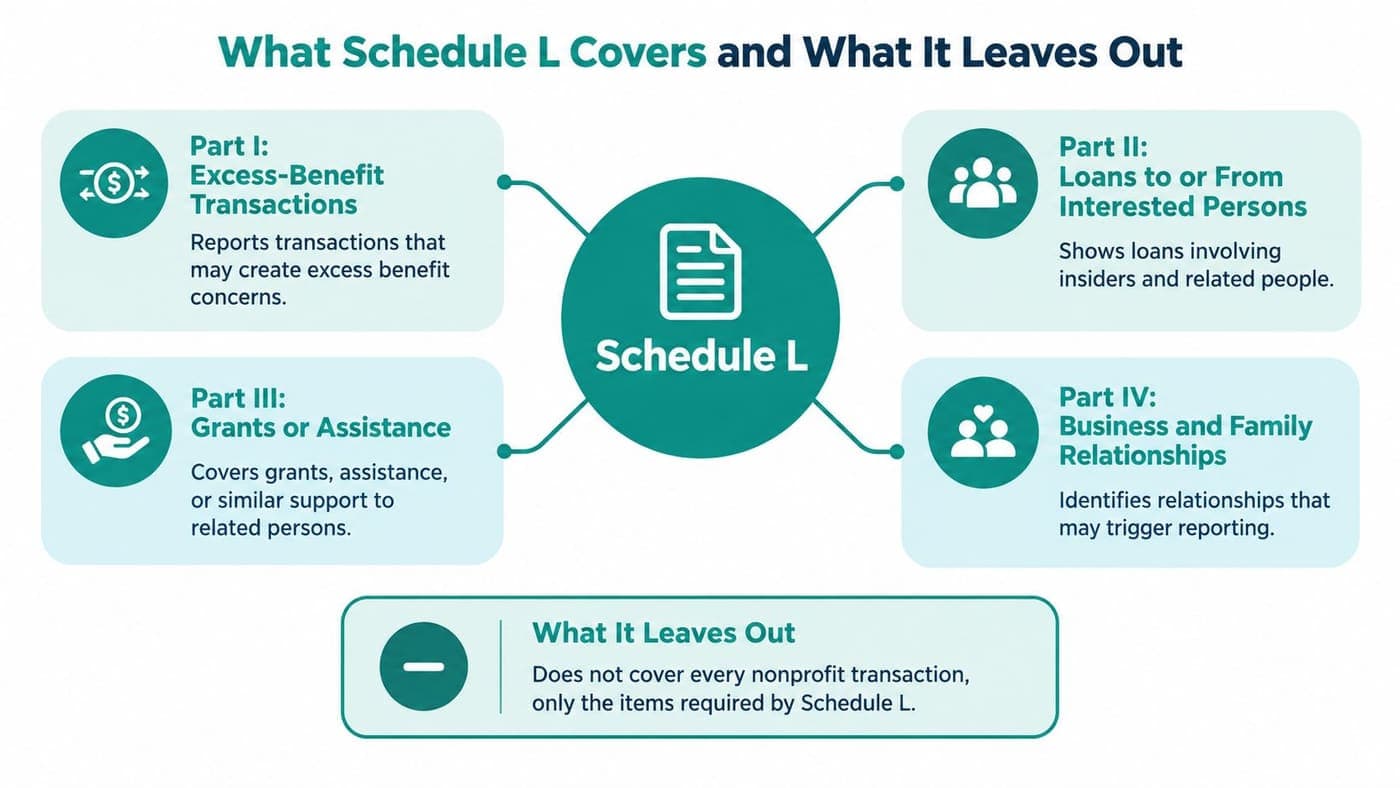
Part I covers excess-benefit transactions. Part II covers loans to or from interested persons. Part III covers grants or assistance benefiting interested persons. Part IV covers business transactions involving interested persons. The categories are distinct, so one relationship or payment shouldn't be casually assigned to whichever part seems easiest.
For Form 990 filers, the related trigger questions appear in Part IV: lines 25a and 25b concern excess-benefit transactions, line 26 concerns loans, line 27 concerns grants or assistance, and lines 28a through 28c concern business transactions. Form 990-EZ filers may have a Schedule L attachment requirement through Part V questions 38a or 40b. The Form 990 materials describing the schedule's scope reinforce that these are specific triggers, not a universal disclosure rule.
Start with the return's trigger questions. Then determine whether the transactions and relationships support each answer.
That order helps prevent two common errors: attaching Schedule L without a qualifying trigger, or missing an attachment because no one connected a transaction to the return question. If you're reviewing the core return alongside the schedule, this plain-language explanation of Form 990 can help you keep the forms' separate jobs clear.
"Interested person" is not another name for any vendor, grantee, or lender. The relationship matters, and the relevant categories are defined by the instructions. That's why Schedule L starts with careful identification and classification, not a blanket sweep of every payment made by the organization.
The Four Transaction Types and Their Thresholds
The threshold rules are where a reasonable-sounding shortcut can lead you astray. For Parts I, II, and III, the IRS instructions generally require reporting covered transactions regardless of amount. A small amount isn't a reason to omit a transaction if it belongs in one of those parts. The IRS instructions for Schedule L explain the reporting rules and loan treatment.
Part IV works differently. Business transactions have individual and aggregate reporting thresholds, so you need to gather and group relevant activity before deciding whether a transaction must be reported. Don't borrow Part IV's threshold approach for the other parts.
| Schedule L Part | Transaction Type | Form 990 Trigger | Threshold Applies |
|---|---|---|---|
| Part I | Excess-benefit transactions | Part IV, lines 25a or 25b | No dollar threshold for covered transactions |
| Part II | Loans to or from interested persons | Part IV, line 26 | No dollar threshold; outstanding loans are reported separately |
| Part III | Grants or assistance benefiting interested persons | Part IV, line 27 | No dollar threshold for covered transactions |
| Part IV | Business transactions involving interested persons | Part IV, lines 28a through 28c | Individual and aggregate thresholds apply |
Loans need particular attention at year-end. Report each covered loan separately when it remains outstanding at the end of the organization's tax year, regardless of amount. That means your review should include the year-end balance sheet and loan records, not just the expense ledger or transactions above an internal materiality cutoff.
A useful procedure combines the related-party list with transaction data. For Part II, reconcile loans to the balance-sheet and loan-related disclosures, then retain support for the relationship classification, original principal amount, board approval, and default status. These records help explain what the balance represents and why you treated the person as related.
This is also why a general-ledger review needs context. A ledger can tell you which account holds a payment or balance, but it may not identify the person behind a legal entity or the relationship that makes a transaction relevant. A guide to general-ledger structure and records can support that bookkeeping review without replacing the relationship analysis.
When transactions involve a family member or a person managing someone else's affairs, accurate identification matters beyond tax filing.
How to Identify Interested Persons Before You File
The hardest question may not be how much was paid. It may be whether the payee is connected to someone the organization should consider. A vendor's legal name won't necessarily reveal that a director's family member controls the business or that an officer is affiliated with the entity.
IRS guidance addresses transactions with disqualified persons under section 4958 and generally includes family members and affiliated entities. It also raises the question of how hard the organization must look for information in Parts III and IV. That makes reasonable inquiry part of the compliance work, not an optional extra. The IRS discussion of Form 990 Part VI and Schedule L transactions provides useful context for that inquiry.
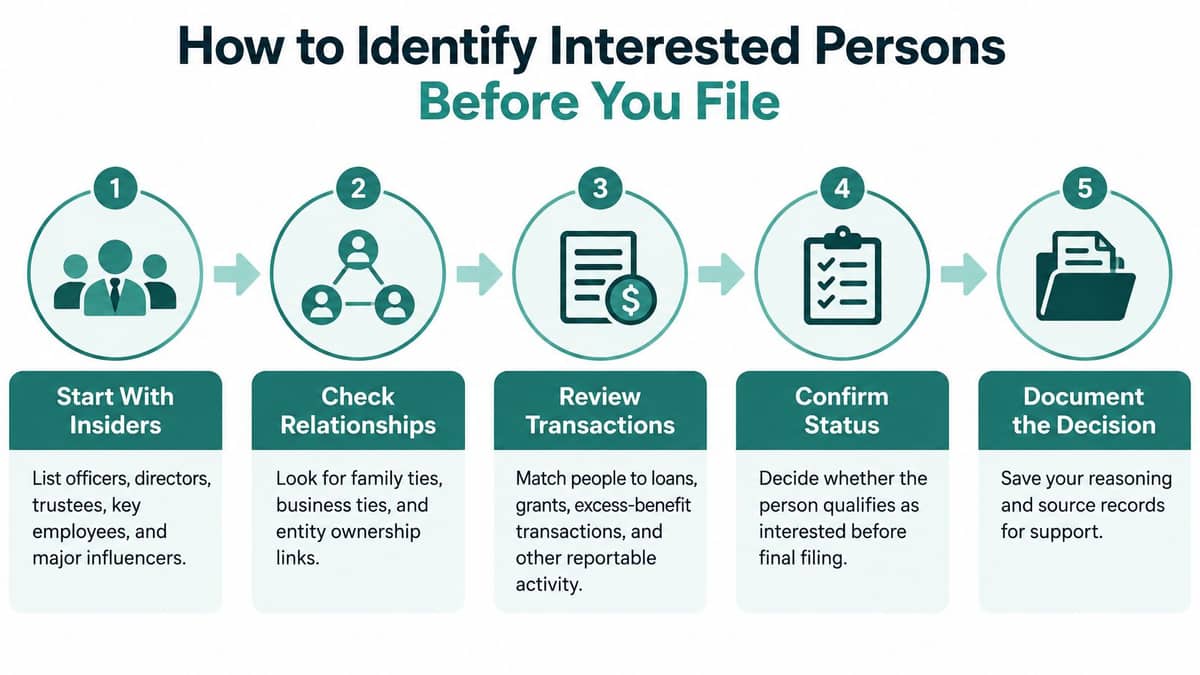
A workable process begins with the people closest to the organization. Ask officers, directors, trustees, and key employees to disclose relevant family and business relationships, then compare those disclosures against the vendor, grantee, and lender records. Keep the questions and answers, rather than relying on someone's memory during filing season.
Build the review around records you can explain:
- Collect disclosures: Keep annual questionnaires and conflict-of-interest forms with the organization's governance records.
- Match names: Compare disclosed people and affiliated entities against vendor, grantee, and lender records.
- Review activity: Search for loans, grants or assistance, possible excess benefits, and business transactions.
- Record decisions: Note why a person or entity was classified as interested, or why a relationship wasn't treated as covered.
- Retain approval evidence: Preserve relevant board approvals and minutes alongside the transaction support.
A “no Schedule L” conclusion can require more documentation than a straightforward filing. You need to show not only that you found no reportable transaction, but also how you looked for interested persons and evaluated what you found. That's especially important when relationships are indirect or records span different programs and entities.
Use a vendor record that connects the legal name to a disclosed relationship, then preserve the review behind any final classification. A resource on vendor records and CRM practices can help you think through how to organize those records. For organizations operating across jurisdictions or through fiscal sponsorships, make sure your inquiry considers affiliations and structures that may not appear in a domestic vendor list.
Choosing Tools That Track Related-Party Data
Your records don't need to be complicated, but they do need to connect names, relationships, and transactions. A spreadsheet can be a practical starting point if someone maintains it carefully. Its weakness is that it depends on consistent updates and manual matching when people or payment records change.
Generic accounting software, including QuickBooks, can help you record and categorize financial activity. But a ledger organized around vendor legal names or accounting classes may not, by itself, show that several payees are connected to one interested person. You still need a separate process to identify relationships and aggregate activity across funds and programs.
An all-in-one nonprofit platform can bring accounting, donor management, volunteers, events, and marketing into one working environment. For Schedule L preparation, the useful capability is tagging vendors, grantees, lenders, officers, directors, key employees, and related parties at the entity level, then reviewing their payments and balances across programs and funds. That can make it easier to spot when one person's activity appears in grants, payroll, reimbursements, and vendor payments.
Tools don't replace the organization's judgment about whether a relationship or transaction is covered. Before choosing one, ask whether it can preserve the underlying records, support review by person and relationship, and make it clear how the information reaches the person preparing the return.
AlignMint is one option in this category. It combines true fund accounting, with restricted funds, grants, and programs modeled natively, with a donor-centered CRM that connects giving and finance records. Its marketing suite, volunteer management, event tools, and Minty AI assistant sit alongside those functions, and its free tier for nonprofits raising up to $100K per year may suit organizations watching costs. Those are workflow features, not a substitute for verifying Schedule L decisions with your preparer and the current instructions.
The right choice depends on how your organization works today. A spreadsheet may be enough when records are simple and someone owns the process. If you're already reconciling several systems, compare how well each option connects identity, transactions, and approvals before paying for new software.
How Schedule L Shapes Your Governance Disclosures
A related-party review doesn't stop when you've decided what to enter on Schedule L. The information can also matter when the organization answers governance questions elsewhere on Form 990, including whether governing-body members are independent for Part VI, line 1b. The IRS identifies Schedule L information as relevant to that independence determination. The 2025 Form 990 instructions address this connection.
That relationship matters because a transaction can raise a governance question even when the organization's records show it as an ordinary payment. If a board member's business receives payment, for example, the organization needs enough information to assess and document the relationship, not just record the expense.
Governance and tax reporting draw on the same relationship records.
Your review should also include controlled or disregarded entities connected to the organization. Certain transactions involving interested persons through a disregarded entity may be reportable, including transactions involving an employee of that entity who qualifies as a key employee of the organization as a whole. Looking only at direct payments from the filing organization can leave part of the picture out.
For practical board oversight, keep transaction review and board documentation connected. Minutes can help show how the board handled a disclosed relationship, while supporting records can explain the organization's treatment in its return. This guide to board meetings and records offers a related perspective on organizing that work.
A clean process helps the board answer two connected questions: what happened, and how did the organization oversee it? That clarity supports a more coherent governance record for the organization's preparer, board members, and other readers of its filing.
Your Pre-Filing Checklist for Schedule L
Before filing, work from the Form 990 questions outward. That keeps the review tied to the actual triggers and gives your preparer a clearer record than a last-minute search through payment descriptions.
- Check the triggers: Review the relevant Part IV questions on Form 990, or the applicable Part V questions on Form 990-EZ.
- Confirm relationships: Compare current questionnaires and conflict disclosures with vendor, grantee, lender, and entity records.
- Group activity: Aggregate transactions by person and relationship before applying Part IV thresholds.
- Reconcile loans: Match Part II information to year-end balances and other loan-related disclosures.
- Keep support: Document board approval, default status, relationship classification, and original principal amount where relevant.
- Record a negative answer: Save the inquiry steps, source records, and reasoning that support a decision not to attach Schedule L.
If the current process turns into a spreadsheet scramble, start by identifying which records you can connect and which still need manual matching. AlignMint's Form 990 reporting tools can help organize accounting data, restricted balances, grant drawdowns, and functional expense information for review. For a separate filing-season reference, use this Form 990 checklist alongside your preparer's current instructions.
Before the next filing season, assign responsibility for relationship questionnaires, transaction matching, and final review. A named owner and a saved audit trail make it easier for you and your preparer to understand what was checked and why.
If you want to see whether a connected finance and relationship-tracking workflow would help your Schedule L review, visit AlignMint. You can compare its fund accounting and Form 990 reporting tools with the process your organization uses now, then decide whether it fits your needs.
Ready to try AlignMint with your nonprofit?
Start free — set up donor tools, giving pages, and Minty. Upgrade when you need accounting.