

Good nonprofit grant accounting lets you prove, award by award, what you received, what you spent, and what remains. That proof matters more when more than 60% of grantseekers say non-government funders allow 25% or less for indirect costs.
You didn't take this job to rebuild spreadsheets on Friday afternoons. You took it to serve your community well and steward other people's money carefully. Our goal here is simple and practical. We'll show you the decisions that keep grant money clean, calm, and ready for any funder or auditor who asks.
Quick Answer: Nonprofit Grant Accounting
Nonprofit grant accounting tracks each award from receipt through spending and the remaining balance. Restricted and conditional grants follow different timing rules, so cash in the bank is not the same as money you can spend.
Start with fund accounting and what grant accounting covers. For the tracker, see grant tracking software.
The Friday Afternoon Grant Report Problem
It's 3:40 on a Friday and a program officer emails you. She wants a budget-versus-actual report for one award, due Monday morning. Your bank balance looks fine, but that's not what she's asking for.
Your bookkeeper opens the spreadsheet she built last spring. Your program lead opens a different version with newer numbers. Nobody can say, with real confidence, how much of that grant is left.
Where the Panic Really Starts
The problem usually isn't carelessness or effort. It's the gap between general bookkeeping and specialized grant work. Bookkeeping tells you money moved. Grant accounting tells you whether that movement followed this funder's rules, budget, and timeline.
You start asking questions no one wrote down. Who approved moving money between budget lines last month. Was that salary charge split across two awards, or just one. Did the amendment extend the spending window, or only the report date.
Cash in the bank is not the same as money you're free to spend.
That sentence explains most grant stress I've seen. A healthy balance can hide restricted dollars that belong to specific work. It can also hide a grant you've nearly spent while another sits untouched.
What Calm Looks Like Instead
Calm doesn't require a finance degree or a bigger staff. It requires one record per award that your whole team trusts. That record holds the budget, the rules, the deadlines, and every charge tied to the award.
When that record exists, Monday's report becomes a printout, not a rescue mission. You answer the funder quickly and move on with your week. You also make spending decisions during the grant, not apologies after it ends.
We've cleaned up enough messy ledgers to know the pattern. The organizations that struggle aren't less dedicated than yours. They asked a general tool, and a tired spreadsheet, to do a specialized job for far too long.
Fund Accounting and Why Restricted Money Has Its Own Lane
You gain clarity the moment each dollar gets a labeled home. That's fund accounting in plain English. Think of envelopes on your desk, each marked with a purpose a donor or funder chose.
One envelope pays your rent and everyday bills. Another pays only for the after-school program a foundation funded. A third holds building money you can't touch for payroll, no matter how tight the month feels.
The Three Envelopes You'll Use Most
Your unrestricted envelope carries money with no donor strings attached. Your board can set some aside for a roof repair, but the board can also change its mind. That flexibility is exactly why unrestricted money keeps organizations alive.
Your restricted envelope carries money bound by a donor's written purpose or timing. Our plain-language guide to a restricted fund explains how that promise should appear in your records. You spend from that envelope only when the cost matches the promise.
Some money stays restricted forever, like an endowment gift. You protect the original gift and spend only what it earns. Mixing that money into operations isn't a bookkeeping error. It's a broken promise with legal weight behind it.
Practical rule: If you can't name the envelope, don't record the expense yet.
Releases and Real Balances
When you spend restricted money exactly as promised, you record a release from restriction. The money moves, on paper, from restricted to unrestricted net assets. Your net assets with donor restrictions balance then drops by that amount, which is healthy and expected.
Here's a small example that plays out everywhere. A funder gives you money for summer meals, and you buy food in June. Recording the release in June shows your board the promise was kept, while waiting until December makes your restricted balance look falsely large.
General ledgers and class tracking often push this work into side spreadsheets. The balance then lives in someone's memory instead of your books. That's how good people accidentally spend the same restricted dollar twice.
True fund accounting keeps each envelope self-balancing inside one system. You see real balances by fund, program, and grant whenever you ask. Your board stops guessing what's available, and you stop fearing that question at meetings.
Conditional Grants Versus Restricted Grants and Why Timing Matters
You protect your audit when you answer two separate questions correctly. First, is this grant conditional. Second, is it restricted. Those words sound similar, but they control entirely different timing decisions in your books.
A contribution is conditional when the agreement contains both a barrier you must overcome and a right of return or release, as explained in the FASB guidance on conditional contributions. Until you clear that barrier, cash received generally sits as a refundable advance, not revenue. Recording it as income too early overstates what you've earned.
Two Grants, Two Very Different Answers
Consider a government reimbursement award first. You spend money on qualifying costs, document them, and then request payment. You generally recognize revenue as those eligible costs are incurred, often with a receivable until cash arrives.
Now consider a foundation check that arrives on day one. The agreement requires a specific milestone and allows repayment if you miss it. That clawback makes the grant conditional, so the cash waits as a liability until you meet the milestone with evidence.
Contrast both with a simpler grant for a named program. The funder sets no barrier and no repayment right tied to performance. You recognize that unconditional gift when received or promised, then hold it in restricted net assets until you spend it as directed.
Matching requirements deserve the same careful reading. A grant with a matching requirement is conditional when you must first raise or spend the match, according to The CPA Journal discussion of not-for-profit accounting misconceptions. Once you satisfy that condition, you record the receivable and contribution revenue under the award terms.
A restriction tells you how to spend money. A condition tells you whether you've earned it yet.
Fields Your System Needs
Your grant record should never force these into one checkbox. Keep separate fields for conditions, restrictions, qualifying expenses, matches, milestones, and releases. Our guide to revenue recognition walks through how those fields should drive each entry.
Read the agreement and its referenced documents, not just the award label. Funders use words like grant and restricted loosely in cover letters. Your auditor will read the signed terms, so your schedule should quote the barrier and clawback language directly from those pages.
Federal Grant Rules That Change How You Code Expenses
A charge can look reasonable on a program budget and still fail an audit if it does not benefit the award or follow its terms. Under 2 CFR Part 200, total award cost means allowable direct costs plus allocable indirect costs, less applicable credits. As executive director, make sure each expense is both permitted by the award and supported by records your team can produce later.
Costs must be necessary and reasonable for the work, and your organization must apply its own policies consistently across federal and nonfederal activity. If you would not approve a purchase with unrestricted funds, pause before charging it to a federal award. A quick review before approval is easier than defending the charge during an audit.
Direct Costs, Indirect Costs, and Consistency
Direct costs serve a specific award, such as a counselor hired only for that program. Indirect costs support the organization as a whole, including accounting, facilities, executive oversight, and depreciation. Use a documented cost allocation method to divide shared expenses in a way you can explain and defend.
Auditors look for consistent treatment. Do not code a cost as direct on one award and indirect on another without a written reason. Apply the same method each month, and retain labor distribution support close to when the work took place.
If you lack a negotiated rate, you may elect a de minimis rate of up to 15% of modified total direct costs where permitted under the same 2 CFR Part 200 cost principles. Write down your chosen base and apply it consistently. If your team cannot explain the calculation, do not use the rate without fixing the documentation first.
Why One Rate Never Fits Every Award
The GAO review of federal grant requirements says federal recipients and subrecipients must meet data, record, and reporting requirements set by the awarding agency, federal law, or both. Some programs also cap administrative costs, including a 5% limit for certain HHS substance-abuse block grants and a 6% limit for some Serve America Act education programs, as described in that review. Check each award before approving costs. A charge allowed under one grant may be capped or disallowed under another.
Keep a short allocation memo on file. Name the indirect pool, the base, and the person who reviews charges each month. For staff working across awards, maintain time records as the work happens. Reconstructed timesheets months later rarely satisfy an auditor.
Choosing a System for Grant Tracking and Reporting
You save the most time when your system matches your actual work. That work is entering an award, spending against it, and reporting without rebuilding numbers. Judge every option by those three tasks, not by a polished sales demonstration.
QuickBooks Online deserves honest credit here. It's familiar, widely supported by bookkeepers, and strong for everyday bills and banking. Many small nonprofits start there for good reasons, and classes or tags can track programs at a basic level.
The gap appears with restricted balances and grant conditions. Classes weren't built as self-balancing funds with their own net asset balances. So your team rebuilds restricted balances, releases, and funder reports in spreadsheets, month after month, hoping formulas survived the last edit.
Three Approaches, Judged by Daily Work
- Ledger plus spreadsheets: Costs little at first, but every report depends on one person's file.
- QuickBooks with classes: Handles general accounting well, while grant restrictions still need outside tracking.
- True fund accounting platform: Holds funds, grants, donors, and programs natively in one record set.
A purpose-built system should show award-level coding at entry, not cleanup. It should connect a donor's gift record to the fund it supports. It should track drawdowns, partial payments, and outstanding grant balances without a side schedule you maintain by hand.
What We Built for This Exact Gap
We built our platform as one home for accounting, donor records, volunteers, events, and marketing. Grants Receivable records award amounts, dates, restrictions, report due dates, partial payments, and write-offs. Our Minty AI assistant answers questions about your real data, so you ask what's left on an award instead of exporting three reports.
You also get plan-based access with no per-seat fees, which matters when program staff need visibility. Your board treasurer, bookkeeper, and program lead can all see the same numbers. Nobody waits for the one person who holds the spreadsheet password.
For readers comparing regional business tools beyond the nonprofit world, Accounting Software for UAE from Smart Classic Business Hub offers useful context. Your needs differ, though, because donor restrictions and Form 990 reporting drive your chart of accounts. Ask any vendor one question. Show me, right now, what's left in each restricted grant, then produce that funder's report without exporting anything.
Five Internal Controls That Keep Grant Money Clean
Controls sound bureaucratic until you see them as habits. Good habits protect your staff as much as your money. They prove that honest people followed a clear process, even when a busy month produced a mistake.
The Five Habits Worth Starting This Week
- Build an award schedule: Record each grant's terms, budget, deadlines, and barriers before spending begins.
- Code consistently: Tie every transaction to a fund, program, and award using one shared chart.
- Set approval thresholds: Require written approval before drawdowns and larger grant purchases move forward.
- Reconcile monthly: Match ledger activity to funder reports and bank records while memories stay fresh.
- Keep one award folder: Store the agreement, amendments, invoices, and correspondence together for every grant.
Start with the award schedule if you do nothing else. One page per grant prevents most coding arguments later. Our documentation on the audit log shows how a system can preserve who changed what, and when.
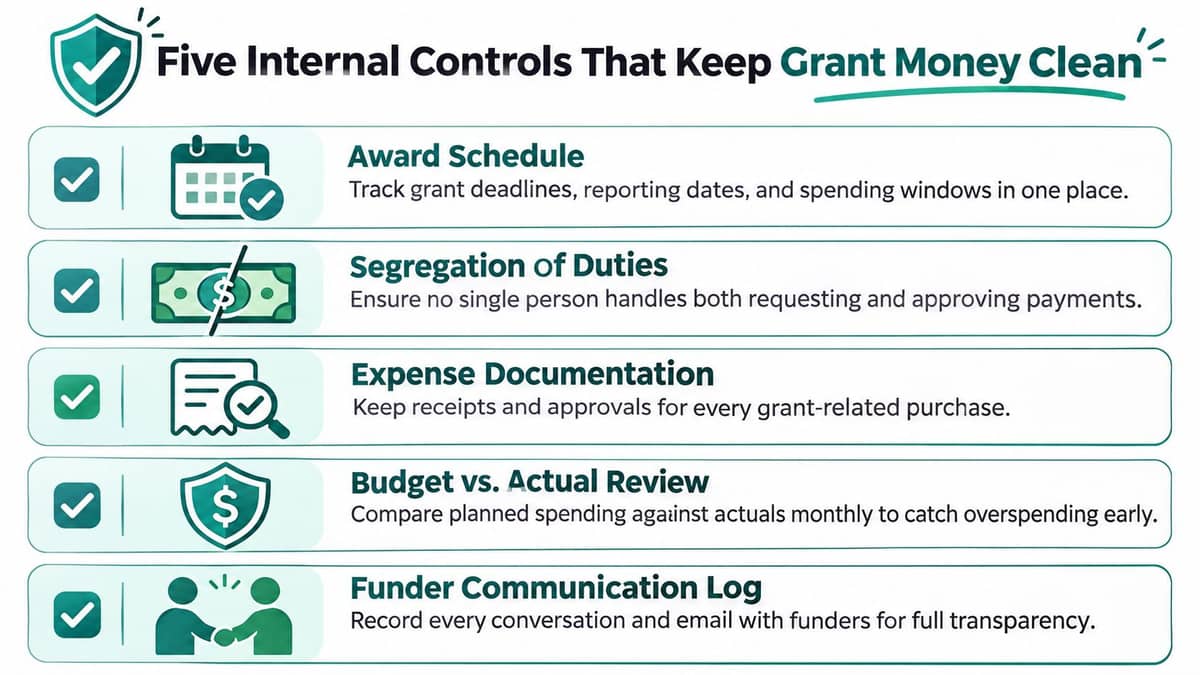
Split duties where your small team realistically can. The person requesting a payment shouldn't be the only person approving it. When staffing makes that hard, a board treasurer review adds a second set of eyes without new payroll.
Reporting burden is shifting unevenly across the sector right now. In the Nonprofit Finance Fund survey, 29% said grant reporting had become more onerous while 30% said it had become easier, according to the Nonprofit Finance Fund 2025 survey results. Your funders will keep asking differently, so your internal source of truth must stay steady.
Monthly discipline: Reconcile while the month is still warm, not at year end.
None of this requires new software to begin. Print the checklist, assign an owner, and review it at every month-end close. Clean grant books come from small habits repeated, not heroic effort once a year.
From Award Records to Form 990 and Funder Reports
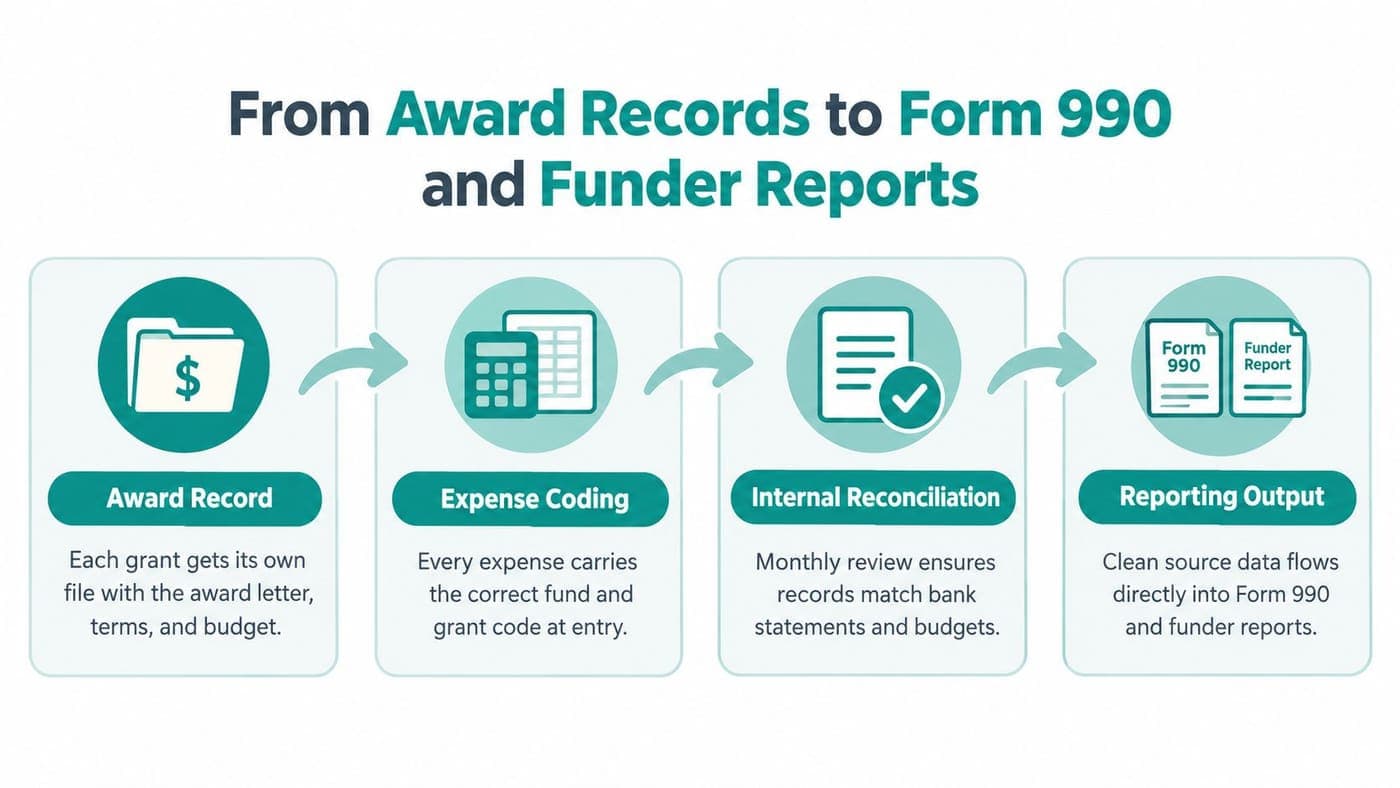
Everything clicks when good records at the source feed every report. You enter an award once, code each expense once, and reuse that work all year. Your funder report, board packet, audit schedule, and tax return then tell the same story.
Follow one grant from setup to closeout. You record the award, its restrictions, budget lines, and report dates on day one. Staff time, supplies, and contractor invoices carry that award code as they're entered, not during a year-end cleanup.
An amendment arrives midyear and shifts money between budget lines. You log the change, keep the signed document, and keep the original budget visible. Your next funder report shows both versions clearly, so nobody wonders which numbers governed which months.
Where Those Records Land on Form 990
Public reporting makes this discipline worth it. Organizations generally file the full Form 990 at $200,000 in gross receipts or $500,000 in total assets, and more than 80,000 organizations reported government grants on a full Form 990 in each year from 2021 through 2023, according to the Urban Institute analysis of nonprofits and government grants. Government grant revenue, program expenses, and grants you pass to others all appear where donors and regulators can read them.
Our Form 990 builder guidance shows how coded grant data feeds those lines directly. Your Statement of Functional Expenses also grows from the same coding. Program, management, and fundraising totals stop being a year-end allocation exercise you dread.
Seeing the Subsidy Nobody Budgets For
Clean records also reveal a harder leadership question. The 2025 State of Grantseeking Report found 44% of respondents faced increased indirect costs in 2024, while more than 60% said non-government funders allowed 25% or less, according to the 2025 State of Grantseeking findings on indirect costs. It also found 38.7% faced a limit of 10% or less and 25.9% were unsure what funders would cover, in those same findings.
A grant can be fully compliant and still drain unrestricted money. Your system should show unrecovered overhead by award, in plain view. That evidence helps you negotiate, decline a harmful award, or ask your board to approve the subsidy with open eyes.
A Simple Path Forward for Your Grant Books
You don't need to fix everything before your next deadline. You need a short sequence you will finish. Start where the next funder question will land, then work backward into your records with steady, small steps.
Begin by listing every active award on one schedule. Add each budget, restriction, condition, deadline, and remaining balance you can verify today. Mark the balances you can't verify, because those become your cleanup list for the next two weeks.
Your First Month, in Plain Steps
Reconcile one grant fully before touching the rest. Trace every charge to an invoice, timesheet, or allocation note you can file. That single finished grant becomes your template, your training example, and your proof that the system works.
Then fix your coding at the point of entry. Require a fund, program, and award on every grant transaction starting now. Future months stay clean while you repair older ones, and your team stops creating new cleanup work daily.
This same discipline serves our church, school, and fiscal sponsorship communities. Sponsors need project-level ledgers that keep each sponsored project's money distinct from operating funds. Churches need clean separation between charitable income and any unrelated business activity they track.
The Question to Ask Every Vendor
Bring one test to every software conversation you have. Ask the vendor to show each restricted grant's remaining balance right now. Then ask for a funder report and a functional expense statement from that same data, without a spreadsheet appearing anywhere.
If the answer involves exporting and rebuilding, you'll keep paying in staff time. If fund accounting lives inside the system, your reports flow from daily work. Your donor records, online giving pages, volunteer hours, and team messages can also share that same foundation instead of living in disconnected tools.
We're nonprofit directors who built the tool we kept wishing for. We'd rather earn your trust with clean reports than win you with promises. Start with one grant, one schedule, and one month of disciplined coding, and your next Friday afternoon will feel very different.
We offer true fund accounting with grant tracking, donor management, volunteers, events, and marketing in one place, free for nonprofits raising under $100K a year. If you want restricted balances and funder reports you can pull in a few clicks, visit AlignMint and see your grant books handled the way they should be.
Ready to try AlignMint with your nonprofit?
Start free — set up donor tools, giving pages, and Minty. Upgrade when you need accounting.