

You open the mail after breakfast and find an IRS notice addressed to your nonprofit. The amount looks alarming, but you don't know whether it is final, whether the calculation is correct, or whether the organization can request relief.
The Form 990 late filing penalty is usually a daily accrual, not a one-time fine. Once you identify the governing rate, deadline, cap, and reasonable-cause evidence, you can stop the uncertainty and choose the right response.
Quick Answer: Late Form 990 Penalties
A late Form 990 can bring a daily IRS penalty, and three consecutive missed filings can revoke exemption automatically. Confirm the year, the deadline, and whether the return was complete before you respond.
Start with fund accounting and Form 990 extensions. For the filing itself, see nonprofit tax filing requirements.
When the IRS Notice Arrives and What It Means
An IRS notice lands under a stack of board packets. The nonprofit filed late, but the director cannot tell whether the amount reflects the full exposure, a partial assessment, or a figure the organization can challenge.
Treat the notice as a daily accrual problem that can be paused. Do not pay before checking the dates, and do not set the letter aside. Each day may add to the balance while your team gathers records and prepares an abatement request.
Reconcile the notice with the filed return and filing history. Confirm the tax year, original due date, approved extension, IRS acceptance date, and whether the filing was complete. The deadline generally falls on the 15th day of the fifth month after the accounting period closes. For a calendar-year organization, that generally means May 15. Use the Form 990 glossary entry to ensure board members and program leaders are discussing the correct filing.
First response: Establish the dates and file status before debating the amount.
Build an evidence file at the same time. Include the notice, e-filing confirmation, extension approval, correspondence, board or staff records showing who handled the filing, and documentation of any event that prevented timely submission. The stronger the timeline, the clearer the case for reducing or removing the assessment.
If financial records are disorganized, address that weakness before choosing a response. A practical salary calculator can help estimate staffing costs when you assess whether bookkeeping or tax preparation needs dedicated support. It does not replace review of the IRS notice or the underlying return.
By the end of the review, decide whether to pay, request abatement, correct an incomplete filing, or have a nonprofit tax professional respond. Your immediate objective is a dated reconciliation of what the IRS expected, what the organization submitted, and which evidence supports relief.
How the IRS Calculates the Daily Penalty
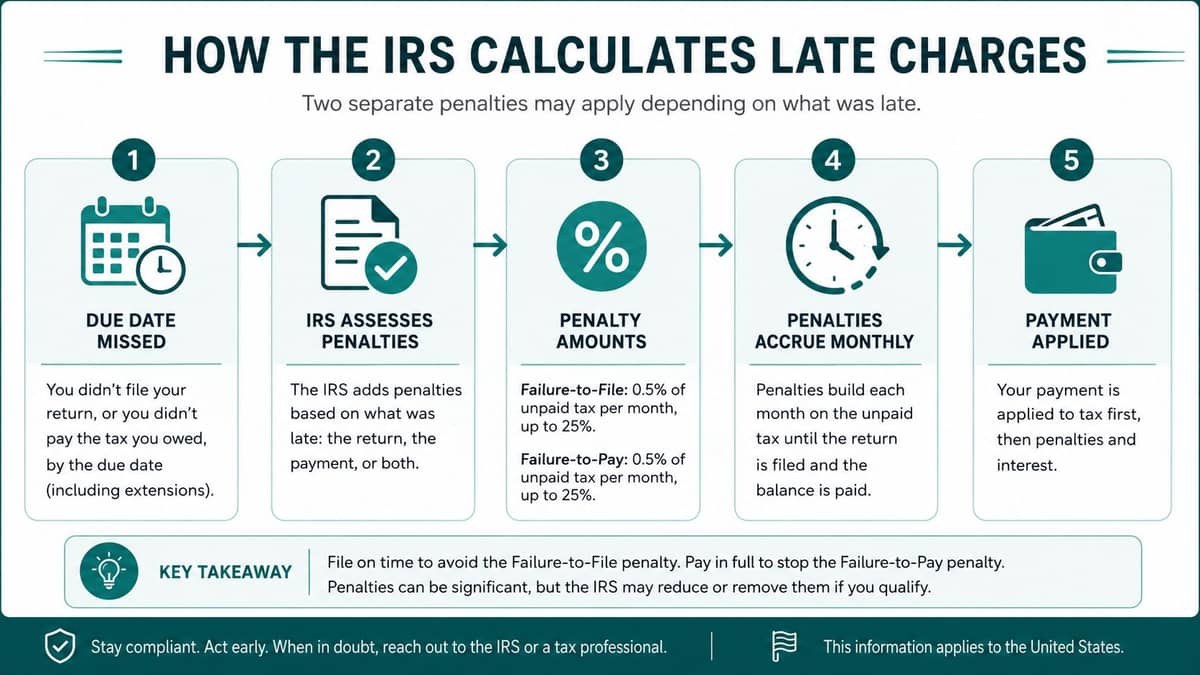
A Form 990 penalty grows with each late day. The IRS applies a daily rate based on your organization's gross receipts for the relevant tax year, then limits the result with a statutory cap. Filing promptly can pause the accrual while you prepare an abatement request.
For tax years covered by the current general schedule:
- Lower-receipts organizations: If gross receipts are below $1,208,500, the rate is $20 per day. The maximum is the lesser of $12,000 or 5% of gross receipts. The IRS late-filing guidance provides these figures.
- Higher-receipts organizations: If gross receipts exceed $1,208,500, the rate is $120 per day, with a maximum penalty of $60,000. The 2025 Form 990 instructions describe the higher tier.
The 2025 Form 990 instructions also state a separate standard rate of $25 per day, capped at the lesser of $13,000 or 5% of gross receipts. Organizations exceeding $1,309,500 in annual gross receipts use $130 per day and a $65,000 cap under that schedule. Match the instructions to the tax year on the notice. Do not combine an older threshold with a newer rate.
The calculation in plain language
Use this sequence:
- Identify the tax year and applicable instructions.
- Confirm gross receipts for that year.
- Count the days after the valid filing deadline.
- Multiply the late days by the applicable daily rate.
- Apply the dollar cap and, where applicable, the 5% receipts cap.
Under the general schedule, an organization below the threshold that is 90 days late starts with 90 multiplied by $20, or $1,800. If its receipts were $200,000, the 5% ceiling would be $10,000, so the initial calculation remains below that limit.
Use the Form 990 checklist to organize deadlines, receipts, schedules, and acceptance records before responding. Those records support both the calculation and any request to reduce or remove the assessment. The practical priority is to file or correct the return quickly, then document the specific facts that justify relief.
Three Real-Style Penalty Scenarios
The penalty is a daily accrual, so the practical goal is to stop the clock and document why the assessment should be reduced or removed. Gross receipts determine the applicable tier, while the filing date determines how long the balance grows.
| Organization Profile | Gross Receipts | Daily Rate | Cap Rule | Penalty at 90 Late Days |
|---|---|---|---|---|
| Small faith-based nonprofit | $200,000 | $20 | Lesser of $12,000 or 5% of receipts | $1,800 |
| Mid-sized community organization | $900,000 | $20 | Lesser of $12,000 or 5% of receipts | $9,000 |
| Larger association | $1,300,000 | $25 | Lesser of $15,000 or 5% of receipts | $2,250 |
These examples assume a complete return, the applicable receipt tier, and 90 late days. The small nonprofit's $1,800 assessment remains below its $10,000 receipts-based ceiling. To support relief, keep the filing acceptance record, the reason for delay, and evidence showing when the organization corrected the problem.
The $900,000 organization reaches $9,000 after 90 days. Its 5% ceiling is $45,000, while the stated dollar cap is $12,000. If the return remains unfiled, the daily accrual continues until the lower applicable limit is reached. A reasonable-cause request should connect each day of delay to specific facts, corrective action, and supporting records.
The $1,300,000 organization produces a different result at the $25 tier: 90 days creates a $2,250 assessment. The useful evidence is equally specific, including the completed return, acceptance confirmation, internal deadline records, and documentation explaining the failure that caused the late filing.
Stop treating the penalty as an abstract board liability. Show the board the rate, late days, cap, and evidence supporting any abatement request.
Practical rule: Calculate exposure from your organization's receipts and filing dates, then assemble the evidence needed to pause accrual and request relief.
A current nonprofit operating budget template can help the finance committee place the potential assessment into cash planning. Record it as a defined liability with its calculation and supporting documents, not as an unexplained administrative expense.
Extensions, Incomplete Returns, and the Deadline Trap
An extension changes the deadline. It doesn't erase the filing obligation or create a permanent shield from penalties.
For penalty purposes, calculate the original due date, add any valid approved extension, and treat the resulting date as the deadline. Days after that date count toward the daily accrual. The IRS guidance specifically states that an approved extension moves the deadline but doesn't eliminate the underlying obligation.
A second mistake is assuming that an electronically submitted return is safe merely because the system received something. The IRS instructions state that an incomplete return can also create daily penalty exposure. A draft-quality submission with missing required information may not protect the organization.
Keep these records together
- Extension evidence: Retain the approved extension and the tax period it covers.
- Acceptance evidence: Save the electronic acceptance confirmation, submission date, and return copy.
- Completion evidence: Keep the final return, schedules, attachments, and internal review notes.
- Deadline record: Record the fiscal year close, original due date, extended due date, and actual acceptance date.
Your finance committee should review the return for completeness before submission, not after an IRS notice arrives. The Form 990 builder can support an organized preparation process, but a responsible officer still needs to review the finished return.
The safest operational rule is simple: file a complete return as soon as possible, preserve proof of acceptance, and never treat an extension as permission to stop monitoring the calendar.
Reasonable Cause Abatement and How to Request It
Reasonable cause is the main relief route when an organization can show that it exercised ordinary business care and prudence but couldn't file on time. The IRS decides these requests case by case, so a general apology or claim that the organization was busy isn't enough.
Begin with the return itself. If it hasn't been filed, complete and submit it promptly while gathering the abatement file. A late return continues to create an avoidable problem, and the IRS materials recognize that penalties may relate to lateness, incompleteness, or both.
Build the evidence file before calling
Your written statement should be signed under penalties of perjury by an appropriate person. It should identify the organization, tax period, filing deadline, actual filing date, circumstances causing the delay, and the steps taken to meet the obligation.
Support the explanation with dated records such as:
- Personnel records: Documented illness, death, or unavoidable absence involving a key employee or volunteer treasurer.
- Disaster records: Evidence of fire, flood, other disaster, or loss of access to essential records.
- Adviser correspondence: Emails showing timely instructions, missing information, or a professional preparer's system outage.
- Governance records: Board minutes showing leadership transitions, emergency decisions, or assigned responsibility.
- Control changes: A dated remediation plan assigning ownership, review, reminders, and backup responsibility.
Explain why an extension wasn't requested, if that applies. Then explain what your organization changed so the same failure is less likely to recur. The strongest file connects the cause, the timeline, the supporting document, and the corrective action without exaggeration.
The IRS's penalty abatement guide offers additional context for organizing a request. Use it as background, then follow the response instructions printed on your IRS notice.
Strong abatement file: The reviewer should understand what happened, when it happened, why ordinary care wasn't enough, and what you changed afterward.
Don't claim that relief is guaranteed. Do present the facts clearly, attach credible evidence, and address every late or incomplete period named by the IRS.
The Three-Year Rule Most Nonprofits Underestimate
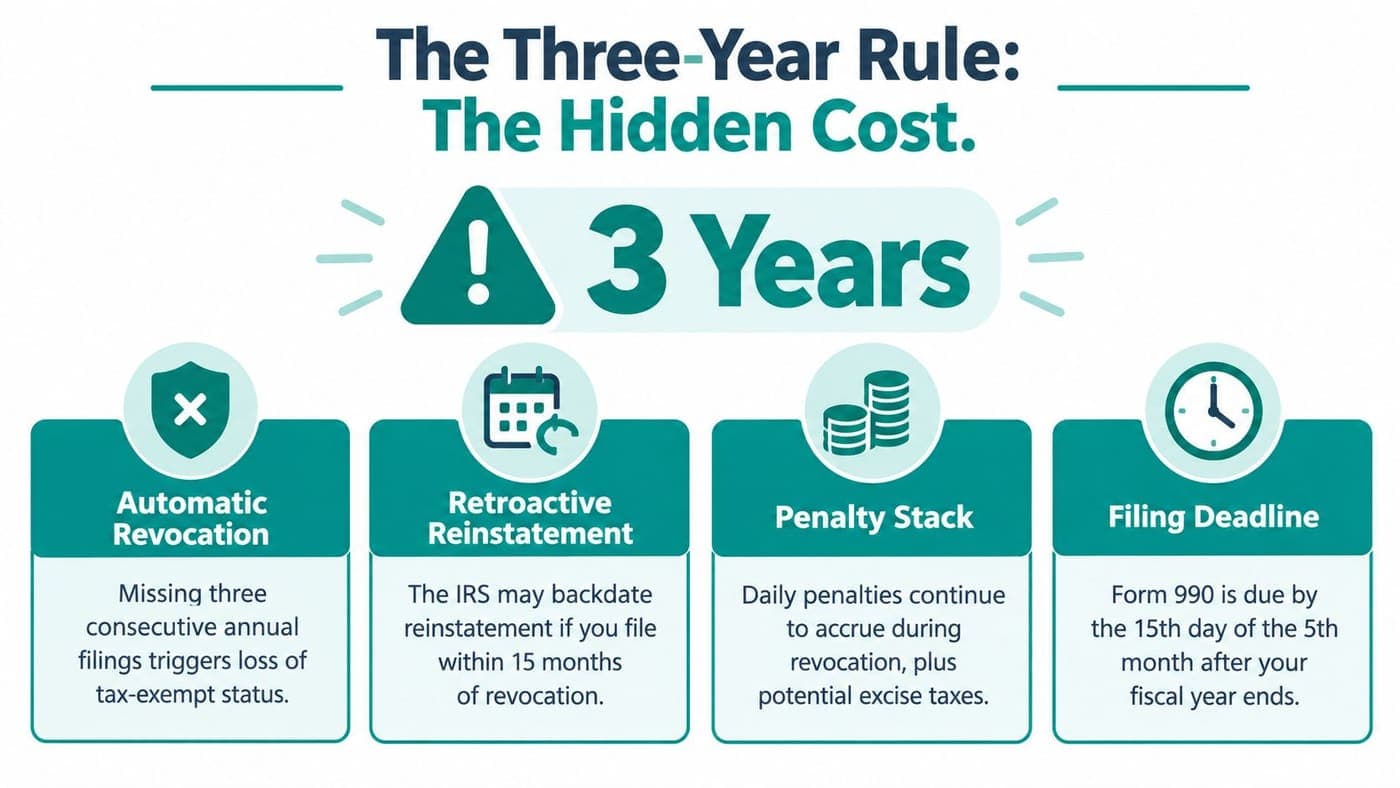
The daily penalty gets attention because it arrives as a dollar amount. The more serious compliance consequence is automatic revocation of federal tax-exempt status after three consecutive missed annual filings.
The rule applies to organizations required to file Form 990, Form 990-EZ, Form 990-PF, or Form 990-N. Missing a Form 990-N e-Postcard generally doesn't create a monetary late-filing penalty for that notice itself, but the missed notice still counts toward the three-year rule.
Revocation becomes effective on the filing due date of the third missed year. The organization can then face questions from donors, grantmakers, state regulators, and banking partners because its federal exempt status no longer appears current.
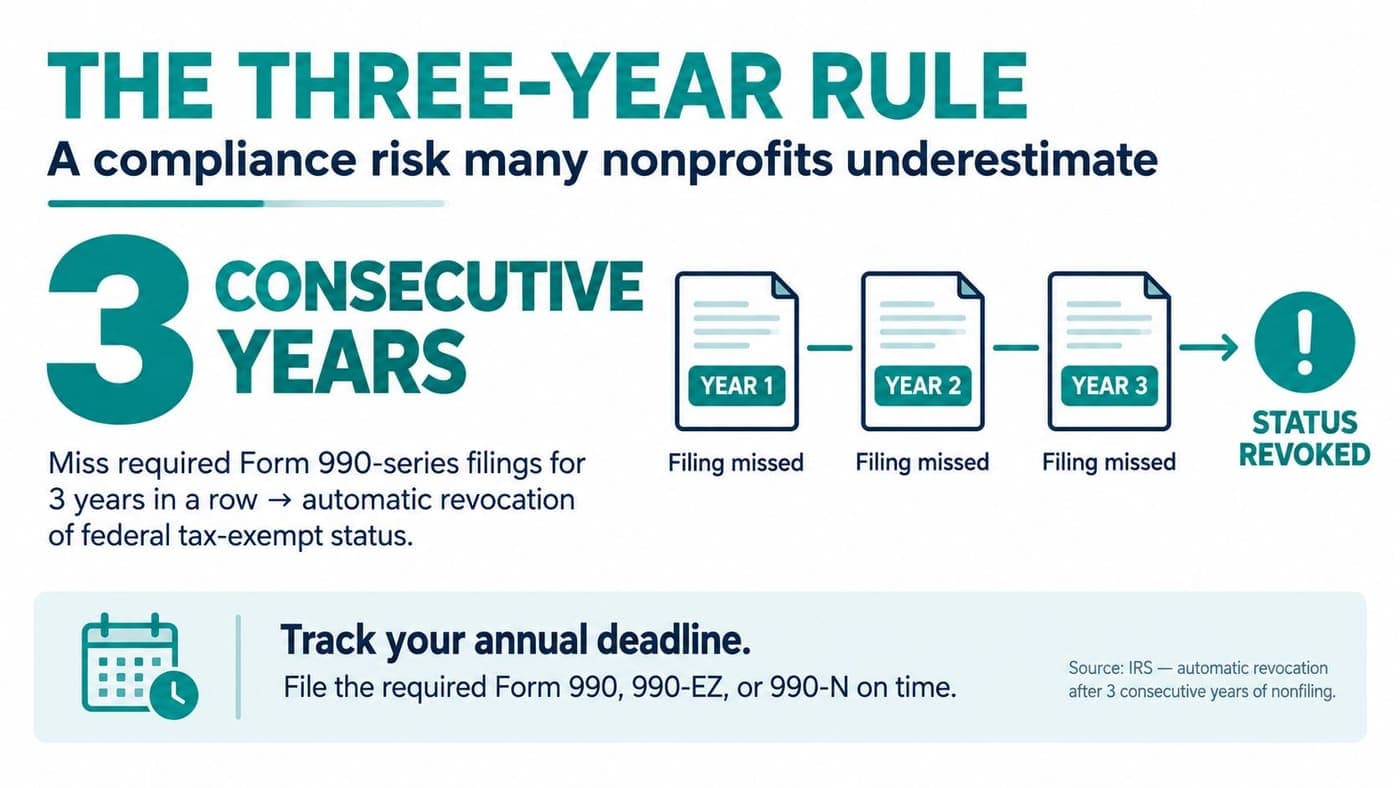
The IRS explanation of the three-year filing rule confirms that the requirement applies across the Form 990 series and the e-Postcard. That distinction matters for small organizations that assume no monetary penalty means no meaningful consequence.
Treat a missed filing as an immediate board-level issue. Check the organization's filing history, determine whether any year was filed under the wrong form, and obtain tax advice quickly if revocation may already have occurred.
The best time to fix a one-year lapse is when you discover it. Waiting for a second missed year turns a manageable administrative problem into a status-reinstatement problem.
Your Action Plan and How to Stay Form 990 Ready
If you have an IRS notice, assign one person to own the response and give the board chair a dated status update. Don't let responsibility remain shared by everyone and owned by nobody.
What to do in the first seven days
Confirm the tax period, original due date, valid extension, actual filing date, acceptance status, gross receipts, daily rate, and cap. Request a complete copy of the filed return from the preparer or internal records, then identify any missing schedules or information.
File the return immediately if it remains outstanding. Filing doesn't prevent you from requesting abatement, but leaving the return unfiled preserves the underlying compliance problem.
Gather the evidence for reasonable cause. Ask the treasurer, executive director, preparer, and board secretary for dated records rather than general recollections.
What to complete within 30 days
Prepare a factual written statement signed under penalties of perjury. Attach the timeline, medical or disaster documentation when relevant, professional-adviser correspondence, system outage records, board minutes, and corrective-control plan.
Use the notice's response address and instructions. Keep a complete copy of everything submitted, including delivery or transmission evidence.
If the organization has not received a notice but is behind, file now and create a board calendar for the next deadline. The IRS general rule places the deadline on the 15th day of the fifth month after the accounting period closes, so the calendar should include preparation, board review, and acceptance verification.
What to establish before the next deadline
Reconcile bank records, donor records, restricted fund balances, grants, payroll, and program expenses monthly. Keep one authoritative record for restricted funds so finance staff don't rebuild the numbers during Form 990 preparation.
The right operating system should connect fund accounting, donor management, volunteer management, events, marketing, and team communication rather than forcing staff to reconcile separate exports. AlignMint is one option that provides true fund accounting, donor-tied gift records, bank-feed reconciliation, Form 990 support, a built-in marketing suite, Minty AI assistance, and plan-based access without per-seat fees. It also offers a free tier for nonprofits under $100K, subject to its current terms.
For broader organizational planning, clarify whether your structure is better suited to a charitable or membership-oriented model by reviewing this guide to choosing between 501c3 and 501c6. Structure affects governance and reporting decisions, so don't treat the filing form as an isolated administrative task.
Use the financial readiness health check to identify gaps in reconciliations, ownership, restricted-fund reporting, and year-end preparation.
By 90 days, your board should have a written compliance owner, backup owner, annual filing calendar, document-retention practice, and review checkpoint. That system is more valuable than a last-minute reminder because it keeps the return complete before the deadline arrives.
AlignMint brings accounting, CRM, volunteers, events, marketing, and Form 990 readiness into one nonprofit operations platform, with true fund accounting and a free tier for organizations under $100K. Visit AlignMint to see whether it can give your team a clearer filing process and fewer manual gaps before the next deadline.
Ready to try AlignMint with your nonprofit?
Start free — set up donor tools, giving pages, and Minty. Upgrade when you need accounting.