

A restricted funds policy is a written procedure that classifies, tracks, and releases donor-restricted money according to FASB standards and donor agreements. Under FASB ASU 2016-14, nonprofit net assets moved from three categories to two, net assets with donor restrictions and net assets without donor restrictions.
You're about to walk into a board meeting with grant reports, donor letters, and a spreadsheet that may not agree with your accounting records. Your policy should remove that uncertainty by connecting every gift to its source document, permitted use, spending evidence, and release event.
This guide explains how to draft that policy in practical terms, including what to do when a restriction no longer makes sense, how to separate donor restrictions from board designations, and how to speak plainly with donors about fund usage.
Quick Answer: Restricted Funds Policy
A restricted funds policy states how you classify, spend, release, and document donor-restricted money. Board approval and a close checklist keep the written rule tied to the ledger.
Start with fund accounting and restricted vs unrestricted funds. For the ledger, see restricted fund accounting.
Understanding Why Your Current Approach Is Creating Risk
The panic usually starts an hour before the finance committee meeting. A board member asks how much remains in the capital campaign, and your finance spreadsheet shows one balance while the general ledger shows another. Then someone asks whether program staff charged shared payroll to the grant, and nobody can immediately produce the allocation basis.
You may recognize this pattern. Your organization accepted a significant gift for a named project, recorded the money in a general account, and added a QuickBooks class to identify related transactions. That workaround can appear adequate until you need to explain which expenses qualified, when the restriction was satisfied, and why the remaining balance changed.

A class can label activity, but it doesn't necessarily establish a complete fund record. Your team still needs the original gift language, the permitted purpose, the time period, qualifying expenditures, and evidence showing when the restriction ended.
Why spreadsheets create a dangerous gap
Accounting standards require more than showing cash in the bank. Contributions without donor-imposed restrictions increase net assets without donor restrictions, while gifts subject to purpose or time limits belong in net assets with donor restrictions. Once the purpose is fulfilled or the required time passes, the amount is reclassified as net assets released from restrictions. FASB ASU 2016-14 explains this presentation framework.
That means your accounting process must track three separate questions:
- What was promised: Which donor, grantmaker, appeal, or agreement created the restriction?
- What was spent: Did each expense satisfy the exact purpose, timing, and geographic limits?
- What was released: What evidence proves the restriction ended?
A policy turns these questions into assigned responsibilities. It tells development staff what language requires review, finance staff how to code receipts, program leaders what documentation to retain, and the board what reports to expect.
Practical rule: If nobody can identify the source document and release event, the fund isn't ready for confident board reporting.
Start with a written restricted funds procedure that your staff can follow without reconstructing decisions from email threads. Your board deserves understandable reports, donors deserve confidence, and you deserve fewer surprises during audit preparation.
Classifying Funding Through the Six-Test Sequence
A defensible policy uses the same classification sequence for every material award. The sequence prevents your team from calling a grant conditional on the grounds that it includes a budget, and it stops staff from treating an internal project label as a donor restriction.
Under FASB ASU 2018-08, a substantive barrier alone doesn't create conditional treatment. The agreement must include both a barrier and a funder's right of return or release. The restricted fund glossary offers useful plain-language definitions, but your policy should require documented judgment for each award.
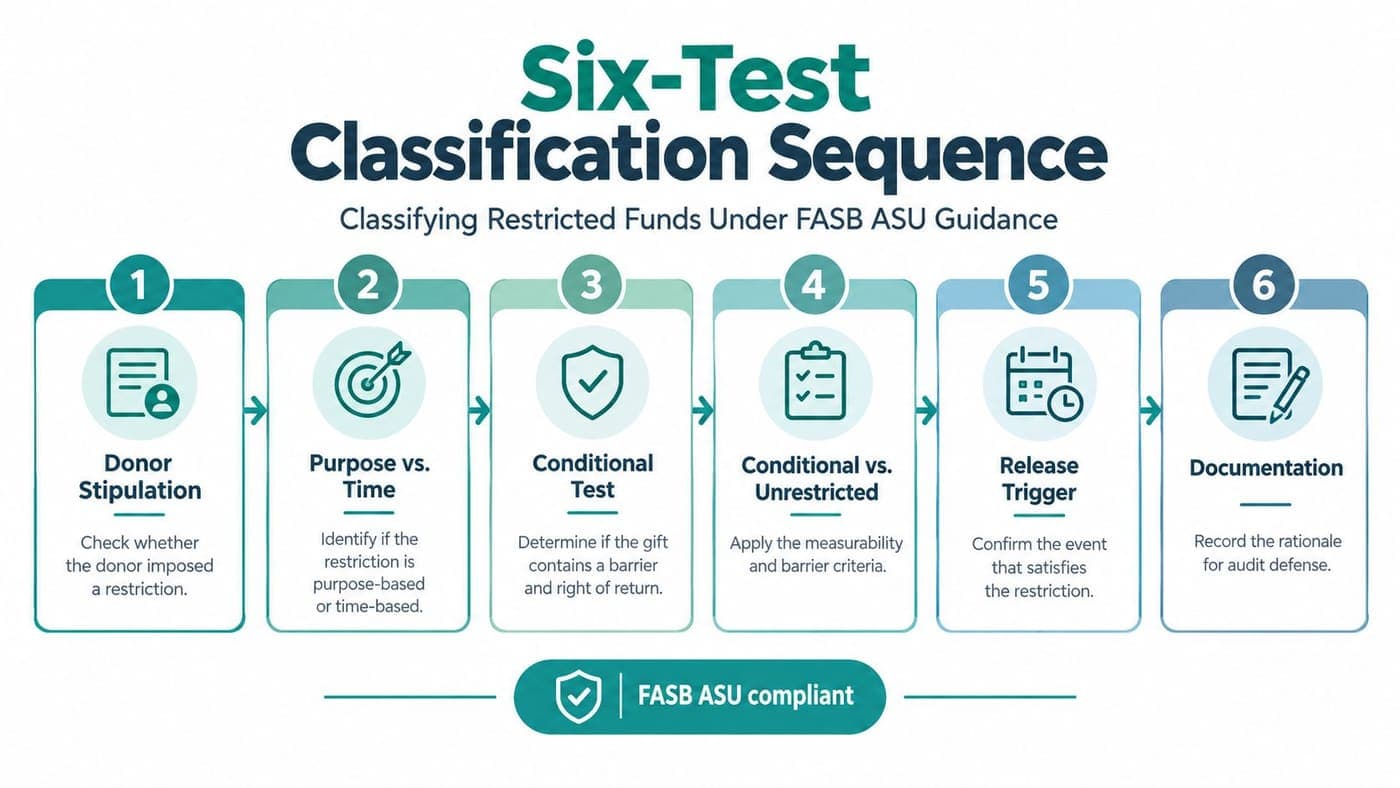
Use these six tests in order:
- Identify the provider and instrument. Obtain the executed grant, pledge, appeal, gift letter, or other authoritative document. A conversation or internal budget isn't enough to establish the accounting conclusion.
- Determine the transaction type. Decide whether the arrangement is an exchange transaction or a contribution. Consider what the funder receives and whether your organization provides commensurate value.
- Test for a substantive barrier. Look for meaningful performance requirements, such as a measurable service, milestone, or specified action. Routine reporting alone may not establish a barrier.
- Check for return or release rights. Ask whether the funder can demand repayment or cancel its obligation when your organization fails the required condition.
- Record conditional support correctly. If both a substantive barrier and a right of return or release exist, treat the receipt as conditional, typically as a liability or unrecognized contribution until the barrier is overcome.
- Classify unconditional support. If the contribution is unconditional, determine whether purpose or time restrictions require classification as net assets with donor restrictions.
| Test Step | Question to Ask | Classification Outcome |
|---|---|---|
| Provider and instrument | Who supplied the resource, and what document governs it? | Establishes the evidence base |
| Transaction type | Is this an exchange or a contribution? | Determines the accounting pathway |
| Substantive barrier | Must your organization complete a meaningful condition? | May indicate conditional treatment |
| Return or release right | Can the funder reclaim funds or cancel its promise? | Required alongside a barrier for conditional treatment |
| Purpose or time restriction | Does the gift limit use or timing? | May create net assets with donor restrictions |
| Release event | What proves the condition or restriction ended? | Supports recognition or reclassification |
For example, a grant budget may identify staffing categories without making the award conditional. Your memo should distinguish a spending plan from a substantive barrier, then explain the conclusion in language a reviewer can follow.
Distinguishing Donor Restrictions from Internal Designations
This boundary causes trouble because both categories may have separate codes, separate reports, and strong emotional importance. The accounting and governance consequences differ, however.
A donor restriction comes from the donor's terms, the grant agreement, or language your organization used when soliciting the gift. It binds the organization until the stated purpose or time condition is satisfied. An internal designation usually comes from board action, such as setting aside unrestricted money for a future building project or operating reserve. The board can generally change that designation through another board action.
| Situation | Likely classification | Question your policy should answer |
|---|---|---|
| A grant names a program and requires eligible spending | Donor-restricted fund | Which costs qualify, and who approves them? |
| The board sets aside operating cash for payroll continuity | Board-designated unrestricted fund | Can the board revise the designation? |
| A campaign asks donors to fund a named shelter expansion | Potential donor restriction | Did the appeal create a promise your organization must honor? |
| A donor writes “for future growth” without further detail | Requires documented interpretation | Did the organization accept that designation? |
| A shared software bill supports restricted and unrestricted programs | Allocation across funds | What reasonable basis supports the split? |
Your fundraising copy matters. A campaign page that promises money will build a particular facility may create obligations even when no separate contract follows. Before publication, development and finance should review appeals, donation forms, acknowledgments, and receipt language together.
Cash pressure makes the distinction harder. A board-designated operating reserve may be available for payroll if the board changes or removes the designation according to its governance process. Donor-restricted building money isn't available merely because payroll feels more urgent. Your policy should require a written decision before anyone moves money between funds.
Shared overhead deserves the same care. If a grant permits indirect costs, document the approved rate or allocation method. If the agreement doesn't support the charge, management intention can't make the expense allowable. For organizations needing outside support, nonprofit grant compliance help can provide another perspective while your board and counsel retain responsibility for the final policy.
Your chart of accounts should preserve these distinctions instead of hiding them in informal labels. A documented purpose manager can help connect fundraising language, fund setup, approvals, and reporting decisions.
Building Controls That Prevent Common Failures
A restricted funds policy works only when someone can apply it at month-end. The most useful control is a restriction register that gives each fund one authoritative record.
Include the source document, permitted purpose, geographic or program scope, start and end dates, reporting milestones, approved indirect-cost rules, responsible owner, current balance, and release evidence. Avoid combining unrelated donor purposes under one general project code, even when the programs look similar.
Four tests for every close
Finance should document four tests before issuing internal or external reports:
| Test Number | Control Action | Documentation Required |
|---|---|---|
| One | Trace additions to bank receipts and donor or grant records | Deposit detail, gift record, and executed instrument |
| Two | Compare expenditures with exact restriction language and approved budgets | Transaction listing, invoices, approvals, and allocation support |
| Three | Recalculate releases when purpose or time conditions are met | Release memo and evidence of satisfaction |
| Four | Investigate aged or negative balances, unspent awards, and transfers | Exception log, corrective action, and approval |
The first test catches gifts that never reached the correct fund. The second identifies expenses that look reasonable operationally but don't meet the donor's terms. The third stops management from releasing money because a program leader says the work is “basically done.” The fourth brings old unresolved decisions to the surface before financial statements are finalized.
Control principle: Release funds because evidence shows the restriction was satisfied, not because the operating budget needs relief.
Your policy should also state whether the organization elects simultaneous reporting for donor-restricted contributions whose restrictions are satisfied in the same reporting period. FASB permits this approach, but the organization must apply it consistently, include related investment gains and income as required, and disclose the accounting policy. BDO's nonprofit accounting guidance summarizes that election and its reporting considerations.
Responsibilities should extend beyond finance. Development owns accurate solicitation language, program leaders confirm allowable activity, and managers approve allocations. If your team needs administrative support, delegating expense report tasks can help organize submissions, but finance must still review the restrictions and approve the accounting treatment.
A fund-accounting system can reduce spreadsheet bridges when it keeps fund balances, transactions, releases, and statements connected. AlignMint's fund accounting feature is one example of a platform designed to model restricted funds natively rather than relying on QuickBooks classes alone.
Handling Imprecise Restrictions When Original Purposes Fail
The hardest conversation begins when a restricted purpose no longer works. Perhaps the program closed, a grant milestone became impossible, the donor died, or the balance is too small to administer sensibly. Many leaders assume they can redirect the money because the replacement purpose serves the same mission. That assumption can create a legal problem.
Management generally can't repurpose a genuine restricted gift unilaterally. Depending on the jurisdiction and circumstances, the organization may need donor consent, attorney-general notice, or court approval. Ohio law, for example, permits notice-based modification only for funds valued below $250,000 and more than 10 years old, with other statutory conditions potentially applying. Ohio Attorney General guidance explains why organizations need a formal process rather than an informal journal entry.
A decision path for impaired restrictions
Your policy should name the people responsible for each stage:
- Identify the problem. The fund owner reports that the purpose, milestone, timing, or administrative burden has become impracticable.
- Preserve the evidence. Finance freezes discretionary spending and gathers the gift instrument, appeal language, reports, correspondence, and current balance.
- Assess the legal route. The executive director, finance committee, and counsel determine whether donor contact, attorney-general notice, or court approval applies.
- Contact the donor or funder. Explain the original commitment, the operational obstacle, and the proposed alternative without implying that approval is automatic.
- Select a related replacement purpose. Document why the new purpose remains faithful to the charitable intent.
- Record the resolution. Retain approvals, notices, consent, amended agreements, and the accounting entry together.
A flexible-purpose clause can prevent future difficulty. When accepting a gift, ask whether the agreement can permit a closely related use if the original program ends or becomes impracticable. That conversation may protect donor intent more effectively than adding another fund code after the problem appears.
Your staff can use a restricted gift utilization process to document requests, approvals, and supporting evidence. The tool doesn't replace counsel, but a consistent record helps your board make decisions responsibly.
Drafting, Approving, and Implementing Your Policy
Write the policy so a new finance manager can apply it without relying on institutional memory. Begin with purpose, scope, definitions, authority, classification rules, tracking requirements, release procedures, exception handling, and reporting responsibilities.
A practical policy statement might say:
“The organization will review each material funding arrangement using a documented classification sequence. Finance will maintain a fund-level record linking receipts, allowable expenditures, releases, and source documents. Staff may not repurpose donor-restricted resources without documented authority, required consent, and legal review.”
Then add procedures for gift acceptance, solicitation review, chart-of-accounts setup, expense approval, month-end reconciliation, donor reporting, and impracticable restrictions. Include the treatment of endowments and investment decisions, because UPMIFA connects prudent management with spending and investment governance. The IRS also emphasizes that charities generally must retain control over donated funds while honoring genuine donor-imposed restrictions. IRS guidance on charitable contributions provides useful context for that balance.
Move from paper to practice
- Draft with the right people: Include the executive director, finance lead, development representative, program owner, and counsel when needed.
- Approve formally: Present the policy to the finance committee and board, then record the approval in minutes.
- Train by scenario: Walk staff through a named grant, a board-designated reserve, a shared expense, and an impracticable purpose.
- Configure the system: Create fund codes, owners, approval paths, release documentation, and recurring reconciliation reports.
- Review routinely: Ask the board to monitor restricted balances separately from unrestricted reserves.
Fiscal sponsorship requires particular clarity. The sponsor records contribution income and expenditures in its own financial records, reports them on its IRS Form 990, and acts as fiduciary for contributions benefiting the sponsored project. The National Council of Nonprofits' fiscal sponsorship guidance explains why the sponsor must honor restrictions and maintain appropriate financial controls.
AlignMint combines true fund accounting with donor management, volunteer records, events, marketing, and team communication. Its free tier is available to nonprofits under $100K, and it offers plan-based access without per-seat fees, while organizations should compare those features with their existing controls and reporting needs.
A good policy won't make every judgment easy. It will make decisions visible, repeatable, and defensible, which is what your board, donors, auditors, and staff need.
If restricted funds are still spread across spreadsheets and QuickBooks classes, AlignMint can connect fund accounting, donor records, approvals, and reporting in one nonprofit platform. Visit AlignMint to review the free tier for organizations under $100K and decide whether its native fund structure fits your policy and reporting needs.
Ready to try AlignMint with your nonprofit?
Start free — set up donor tools, giving pages, and Minty. Upgrade when you need accounting.