

Your bank balance looks reassuring, but a program manager wants spending approval before tomorrow's meeting, and you're not sure what's available. Grant accounting for nonprofit leaders starts with separating money you hold from money you can spend. A clear award record, a disciplined monthly review, and a deadline calendar make that distinction easier to defend.
Quick Answer: Grant Accounting for Restricted Funds
Grant accounting for a nonprofit separates money you hold from money you can spend on each restricted award. Review the fund, the drawdown, and the remaining balance before the next request.
Start with fund accounting and what grant accounting is. For the award file, see nonprofit grant accounting.
Restriction Types That Shape Every Grant Ledger
You can make safer spending decisions when you treat restricted cash as money already spoken for. The bank tells you where money sits, not which promises you've made about its use.
Say your account shows $80,000, but $30,000 belongs to a literacy program under a hypothetical award agreement. That money might also carry a two-year spending window or a matching requirement before you can recognize revenue.
A useful grant ledger sorts transactions by the agreement attached to them, rather than their bank account alone. Separate bank accounts may help administration, but they don't replace records showing restrictions, expenses, liabilities, and remaining balances.
Separate spending restrictions from conditions
Purpose restrictions identify the program, population, or project the donor intends to support. A literacy award shouldn't absorb another program's expenses just because both programs serve the same neighborhood.
Time restrictions determine when resources become available for use. Read the agreement carefully because a donor's time restriction and an award's allowable spending period aren't necessarily identical.
Conditions answer a different question: has your organization become entitled to the contribution? A substantive barrier, together with a funder's right of return or release, requires separate tracking.
For federal awards, the Congressional Research Service explanation of Uniform Guidance identifies 2 CFR Part 200 as the framework containing applicable cost principles.
Restriction types and what the ledger must record
| Restriction type | Typical example | What the ledger must track | Report that shows it |
|---|---|---|---|
| Purpose restricted | Grant for a literacy program | Separate fund balance with expenses coded to that program | Fund balance by program |
| Time restricted | Hypothetical two-year grant paid in advance | Period of availability with spending recorded by period | Budget vs. actual by grant period |
| Conditional | Hypothetical grant requiring a 1:1 match | Barrier, deliverables, match received, and release events | Conditional award tracker and release log |
| Federal cost reimbursement | Federal award governed by 2 CFR 200 | Allowable direct and indirect costs and drawdown history | Drawdown reconciliation and expenditure report |
| Unrestricted | General operating gift | Available for charitable operations unless the board designates it | Unrestricted balance on the statement of financial position |
These categories can overlap within the same agreement, so don't force every award into only one box. A conditional literacy grant may also contain purpose restrictions and a defined spending period.
Practical rule: A board designation isn't a donor restriction, and a spending restriction isn't automatically a revenue condition.
Pull your largest open grant and identify every applicable row. Then note which supporting records your team couldn't produce promptly.
How to Set Up Each Grant as Its Own Fund
You'll spend less time reconstructing reports when each award has a consistent record from the beginning. Your setup should connect the agreement, approved budget, transaction coding, and reporting dates before spending starts.
The federal grants-management overview explains the government-wide framework connecting financial administration with cost-reporting requirements. In practical terms, your accountant should be able to follow an expense from its receipt through its reimbursement request.
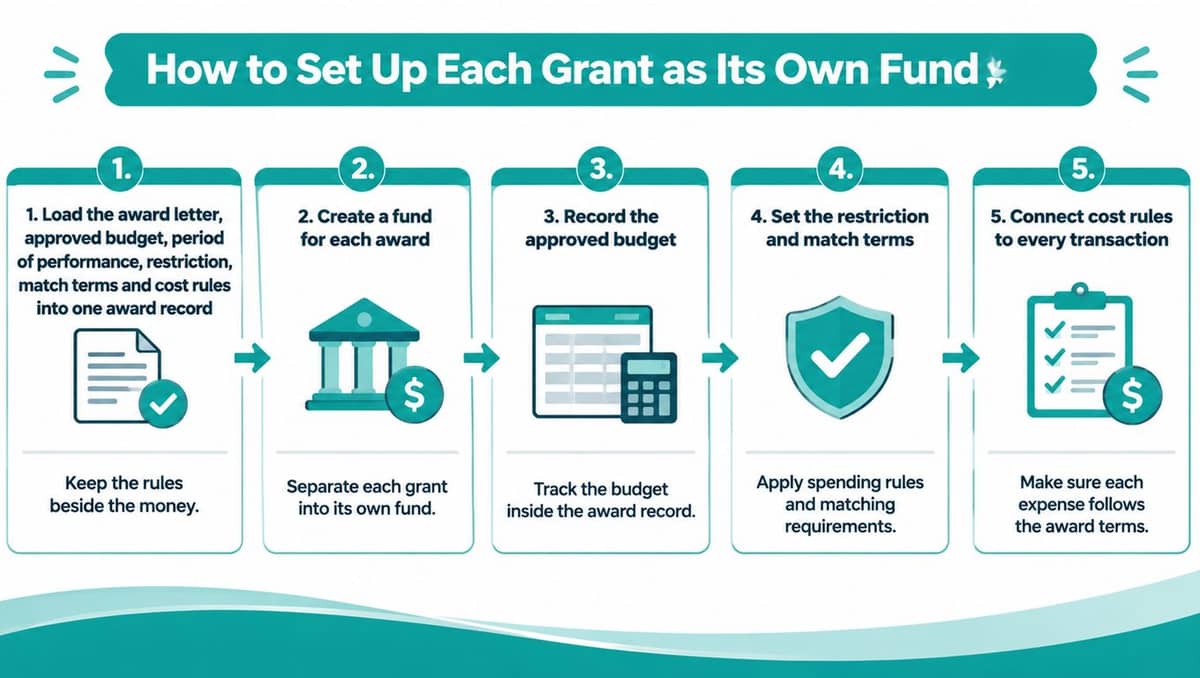
Build the record before entering transactions
-
Keep the agreement beside the money. Load the award letter, approved budget, performance period, restrictions, match terms, and cost rules into one award record. Coding from memory is the common slip, especially when the funder renews an award with different terms.
-
Give the award a distinct fund. Record its restriction type, start date, end date, and responsible program lead so staff can identify its boundaries. Don't leave expired funds open for routine posting without a review process for legitimate adjustments.
-
Map the approved budget to expense accounts. Connect personnel, travel, supplies, and indirect costs to the accounts your bookkeeper uses. A single broad program-expense account hides line-item overruns, so document any budget category combining several accounts.
-
Assign the fund when entering the transaction. Require a fund code on each gift, invoice, and payroll allocation before posting it. Waiting until month-end leaves program managers making decisions from incomplete balances and creates avoidable recoding work.
-
Document the indirect-cost treatment. Record the approved rate, applicable base, exclusions, and any decision to waive recovery in the award file. Copying another grant's rate without checking its terms can produce an unsupported charge even when the arithmetic is correct.
-
Test the complete posting path. Enter a real transaction and confirm the expense account, fund assignment, supporting document, and resulting balance. Then check its treatment in the bank reconciliation rather than assuming a correct-looking report proves correct posting.
Know what a clean setup produces
You should finish with one award record, one approved budget, and a traceable fund balance for each award. Together, the fund-level cash records should reconcile to the bank after accounting for outstanding items.
Don't expect every fund balance to equal cash held for that award. Receivables, unpaid invoices, and refundable advances can make those amounts different for legitimate reasons.
QuickBooks Online offers familiar bookkeeping tools, and class tracking can suit a small, straightforward grant portfolio. However, a class is a transaction label, not automatically a separately balanced fund with identified assets and liabilities.
True fund accounting makes those award-level balances easier to inspect without rebuilding them in spreadsheets. Whatever system you choose, test the reports using an actual award rather than a polished demonstration.
When a Grant Counts as Revenue, Not Just Cash
You can avoid overstating your results by reviewing conditions before recording a grant as contribution revenue. A signed award letter and a bank deposit don't settle that question by themselves.
Say a hypothetical $150,000 grant arrives in March, with entitlement contingent on raising matching funds by June. If the agreement includes a substantive matching barrier and a repayment right, the deposit generally begins as a liability.
FASB ASC 958-605 identifies both a barrier and a right of return or release as core indicators of conditionality.
Check entitlement before classification
Before the barrier is overcome, cash received generally appears as a refundable advance, rather than contribution revenue. An unpaid conditional promise generally remains unrecognized until the organization becomes entitled to it.
After entitlement becomes unconditional, recognize the contribution and assess any remaining purpose or time restrictions. Revenue recognition and release from donor restrictions are separate decisions, even when they occur together.
Conditional and unconditional awards compared
| Criterion | Conditional award | Unconditional award |
|---|---|---|
| Barrier to overcome | Substantive milestone, match, or performance requirement | No substantive barrier |
| Funder right to reclaim or cancel | Yes, if the barrier is missed | No condition-based return or release right |
| Cash received before terms are met | Recorded as refundable advance or liability | Recorded as contribution revenue, subject to applicable recognition rules |
| When revenue is recognized | Once the barrier is overcome | When the promise becomes unconditional |
| Net asset classification | Based on purpose or time restrictions after recognition | Based on purpose or time restrictions at recognition |
A routine reporting requirement doesn't automatically create a substantive barrier. Read what the funder requires, why it matters to entitlement, and what happens if you don't satisfy it.
Keep evidence of each release
Staged milestones may support partial recognition when the agreement establishes separately satisfied conditions. Don't release an entire advance just because the program completed an early deliverable.
If funds must be returned, identify whether you're settling an existing advance liability or correcting previously recognized activity. Have your accountant document the treatment instead of posting an unexplained negative donation.
Record the event that establishes entitlement, not just the date someone remembered to update the spreadsheet.
Keep a release log beside the award record, with the date, amount, supporting evidence, and reviewer. Use your grants receivable records to distinguish outstanding promises from recognized receivables and received payments.
For unclear agreements, obtain a written accounting review before reporting revenue. A short decision memo is more useful than conflicting explanations during the audit.
Monthly Drawdowns and Budget vs. Actual Checks
You can catch cash shortages earlier by reviewing reimbursement activity separately from revenue and bank balances. An award may have recognized revenue while your organization still waits for payment.
For paid-cost reimbursement requests, claim only eligible costs already paid and documented under the award's terms. Federal advance-payment arrangements follow different rules, so don't treat every drawdown as a reimbursement.
Your grant drawdown procedure should identify the payment method before anyone prepares a request. Drawing before payment is a problem under paid-cost reimbursement terms, not a universal description of every federal payment arrangement.
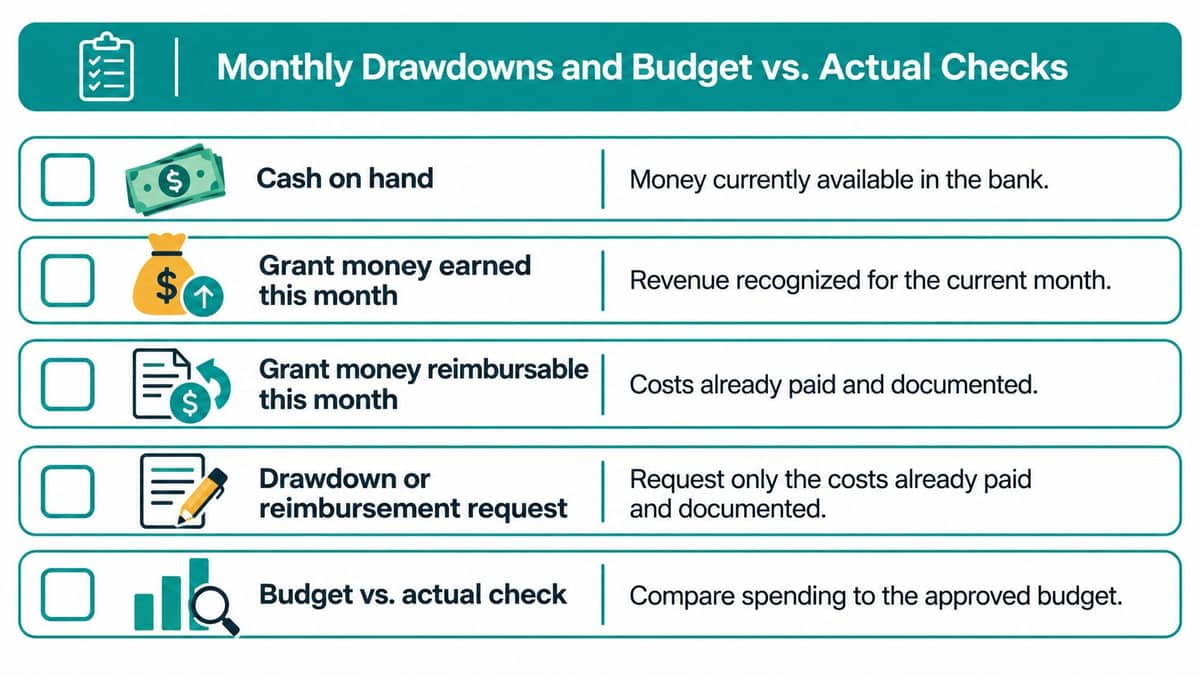
Run the monthly review before submitting requests
-
Reconcile fund records to the ledger and bank. Confirm fund-level cash allocations reconcile collectively to the bank reconciliation. This prevents treating the entire bank balance as available to whichever program asks first.
-
Compare spending by budget line and grant period. Review whether payroll, supplies, or travel are running ahead of the delivery schedule. A favorable total can conceal an overspent category requiring funder approval.
-
Match each request to eligible posted costs. Verify source documents, payment status where required, and the period covered by the request. This prevents unsupported reimbursement claims and duplicate submissions.
-
Check cumulative requests against the award. Include previous payments, pending claims, amendments, and the performance end date in your review. Otherwise, separate requests can appear reasonable while collectively exceeding available authorization.
-
Compare the remaining balance with remaining work. Ask the program lead what commitments and activities still need funding. An apparently comfortable balance may already be committed to payroll or an outstanding purchase.
-
Resolve questionable charges before reporting. Review unusual vendors, missing allocation support, and expenses posted outside the approved period. Don't move a disallowed cost to another restricted award without establishing that award's eligibility.
-
Send a short variance summary. Give the program lead and board treasurer the cause, proposed action, and person responsible. This prevents unresolved differences from becoming familiar numbers nobody investigates.
Keep explanations short enough to use
A useful variance note names the cause rather than repeating the report. For example, explain that a delayed workshop shifted travel spending while staff costs continued.
A healthy month ends with reconciled funds, supported payment requests, and an explanation for each material difference. Your program lead should know both what remains budgeted and what remains spendable.
Funder and Board Reports That Hold Up
You'll answer funder questions faster when every submitted figure comes from a reconciled by-fund statement. A polished narrative can't compensate for totals your team can't trace.
Most organizations need interim progress and financial reports, a year-end by-fund statement, and a board packet. Each serves a different audience, but none should require a separate version of the underlying books.
Prepare one reporting package with traceable totals
-
Pull the period-end by-fund statement. Show opening balances, recognized contributions, expenses, releases or adjustments, and closing balances, with receipts identified separately where needed. Confusing cash received with revenue makes the report difficult to reconcile.
-
Support every closing balance. Tie relevant cash activity to bank records and reconcile receivables, advances, liabilities, and drawdown history. Comparing only the ending bank balance overlooks amounts still owed or awaiting reimbursement.
-
Explain budget differences line by line. Apply the award's approved variance threshold and identify any required budget amendment. Don't assume an internal transfer between categories is permitted because total spending remains unchanged.
-
Check the board's restricted total. Reconcile donor-restricted net assets to the supporting funds, while separating conditional advances and unrestricted board designations. Adding every grant-related balance together can misstate what the organization owns.
-
Obtain director and treasurer review. Ask both reviewers to confirm the reporting period, explanations, supporting schedules, and unresolved issues. Signing a cover sheet without reviewing the reconciliation provides little protection against an incorrect submission.
Use a consistent income statement by fund so program staff and trustees recognize the same categories each period. Keep the submitted report and its supporting version together.
Check the period before checking the presentation
A common mistake is reporting expenses by invoice date instead of when the organization incurred the cost. Under accrual accounting, that can move activity between grant periods and distort the funder's comparison.
Before submission: Select an expense near period-end and trace the service date, posting date, and reporting treatment.
The IRS overview of tax-exempt organization reporting connects contribution and grant classifications with public financial reporting. Form 990's net-asset presentation also needs to agree with the supporting accounting records and audit file.
Keep a reconciliation for any reporting-basis differences rather than forcing unlike reports to match without explanation.
Indirect Costs and Cost Allocation Across Grants
Restricted grant dollars are already spoken for, so shared costs need a paying plan before the award is accepted. Rent, finance payroll, software, insurance, and development time all support programs, but every funder decides how much of that support it will cover.
Start with a cost pool, meaning a defined group of shared expenses. Then choose an allocation base that reasonably reflects how each program benefits, while respecting the award's allowable-cost rules. The gap often hides inside ordinary bookkeeping until a drawdown request, funder report, or audit shows that the organization financed part of the grant itself.
Match the allocation to actual benefit
Allocation bases for shared costs
| Cost pool | Allocation base | Example | Record to keep |
|---|---|---|---|
| Program staff payroll | Time records | Hypothetical coordinator spends three of five days on grant A | Signed timesheets by pay period |
| Rent and occupancy | Floor space used by the program | Hypothetical program uses one of four comparable rooms | Floor plan and monthly allocation entry |
| Software and technology | Number of users or licenses | Hypothetical grant staff use three of twelve licenses | License list by user |
| Finance and development staff | Estimated time share, where permitted | Allocate documented finance effort; review fundraising separately for allowability | Monthly time estimate approved by the director |
| Insurance | Share of total program expenses | Hypothetical grant A represents 25% of program expenses | Policy allocation schedule |
These examples illustrate allocation methods, not automatic permission to charge an award. Development and fundraising expenses need particular care because an allocation formula does not make an otherwise unallowable expense allowable.
Your cost-allocation method should explain the pool, base, exclusions, approval, and frequency of review. For payroll, use documentation meeting the award's requirements rather than assuming an informal estimate is sufficient.
Distinguish recovery from full cost
Federal awards and other funders set their own indirect-cost limits. Some allow a negotiated rate or a simplified election, while others cap recovery below what shared services cost.
A permitted rate still may not cover the actual supporting cost of the grant. If the total award remains fixed, greater indirect recovery leaves less room for direct program spending.
Post monthly allocation entries with a worksheet identifying the source expenses and calculation. Check that the same expense was not charged directly and also recovered through an indirect pool.
Give the board a short schedule showing actual shared cost, allowable recovery, recovered amount, and unfunded balance. That final balance represents an operating subsidy your organization must finance elsewhere.
Waiving recovery can be reasonable when the board understands the benefit and identifies unrestricted funding to cover it. Document the decision rather than allowing an accidental subsidy to appear only at year-end.
Before approving an allocation, ask whether you could show the supporting timesheet, floor plan, or license list. If you cannot explain the path from expense to grant, revise the method before charging it.
Closeout and Subaward Deadlines That Catch Nonprofits
A fully spent grant isn't necessarily a closed grant. Every restricted dollar was spoken for the day it arrived, and closeout is where you prove each one went where the funder intended. Your organization may still owe invoices, await subrecipient reports, or need to return an unused advance.
The federal closeout and record-retention rules establish the following general deadlines and requirements, subject to applicable exceptions and award terms.
Closeout deadlines and record rules
| Deadline or rule | Applies to | Timing | What to do |
|---|---|---|---|
| Final report to funder | Recipient | Within 120 days after the performance period ends | Confirm final draws and liabilities before this date |
| Subaward report to pass-through entity | Subrecipient | Generally within 90 days after the period ends | Collect subrecipient reports before closing your award |
| Record retention | Recipient | Generally three years after submission of the final financial report | Keep award files, timesheets, and receipts together; check exceptions |
| Administrative closeout costs | Recipient | May be allowable through the final-report deadline | Track eligible final-reporting staff time and applicable indirect costs |
| Returned or deobligated funds | Recipient | Document when the funder confirms the action | Record the return or adjustment and reconcile the remaining balance |
Put unresolved items on one calendar
A closeout calendar works like a pre-flight checklist: nothing leaves the ground until every line is checked off. Give each award its own list showing the performance end date, the final-report deadline, and any subrecipient reporting dates. Assign an owner to every open item, because a general reminder to finish the grant is how deadlines slip.
List obligations already incurred but not yet paid, and record appropriate accruals under your accounting method. The reporting window exists for paperwork, not for continued program spending beyond the performance period.
Reconcile the final reimbursement calculation against all advances and previous claims. The answer lands in one of two places: the funder owes your organization money, or your organization must return a balance.
Administrative closeout work needs its own documentation and allowability review. Staff preparing final reports should charge that time to closeout rather than letting routine program charges continue after activities end.
Close the subaward file before the parent award
Confirm each subrecipient's final financial report and resolve differences before finalizing your consolidated submission. Incomplete subaward reporting makes a ledger-only review insufficient, because your own numbers can balance while a subrecipient's file is still open.
Fiscal sponsors should confirm who receives funds, files reports, and retains records across sponsored projects. The National Council of Nonprofits fiscal-sponsorship guidance emphasizes documenting the sponsor's responsibilities for receiving, reporting, and acknowledging charitable donations.
Keep returned funds, deobligations, final approvals, and retained balances in the closeout file. Close the fund at zero, or retain a documented amount with an explanation your accountant has reviewed.
Your Single Audit preparation records should preserve the same transaction trail. Pull every award ending inside the upcoming 120-day planning window and assign closeout owners now, before the final-report rush compresses the work into a week.
Bring Your Grant List to a Setup Call
A setup call becomes far more useful when your records expose the questions your team faces. Restricted dollars are already spoken for, so the goal is to see where timing rules, indirect cost gaps, and closeout deadlines sit inside your own books. Gather these items first:
- Your largest open grant: Bring its award letter and approved budget, including amendments and spending restrictions.
- Your latest payment request: Include the drawdown or reimbursement submission and the supporting expenses.
- Your conditional-award release log: Bring milestone evidence, approvals, and any unresolved recognition questions.
Judge the demonstration by the records
Ask to follow a real gift through its fund assignment, accounting treatment, and final by-fund report. A feature checklist will not show whether a balance is easy to explain at audit time; your own award letter will. The fund accounting and Form 990 reporting resources on our nonprofit operations website offer useful background before the call.
On a free setup call, the team walks through fund accounting, donations, and reporting on your plan. AlignMint's fund accounting keeps restricted and unrestricted dollars tied to their purpose from gift through report, with a full chart of accounts and standards-ready reporting.
AlignMint is free for nonprofits with up to $100K in annual donations, and no credit card is required. The Free plan covers donor records, giving pages, and fundraising drafts for one user; accounting starts on Plus. The Plus plan adds fund accounting, bank feeds, financial reports, and volunteer and event management. Donation pages keep each gift connected to its donor, campaign, and intended purpose, so a restriction follows the gift into the ledger instead of living in a side spreadsheet.
Minty, the AI assistant, answers questions from your live records while respecting the permissions your team already uses. Whether you run a nonprofit, a church, a school, or a fiscal sponsorship, the test stays the same: can your team explain each restricted balance without reconstructing it?
Bring your real grant list to a free setup call. Visit AlignMint to book it, and we can walk through the path from gift to report using your own awards.
Frequently Asked Questions
Each restricted award: what you received, what you may spend, and what remains. Cash in the bank can include money that is already spoken for.
Accounting starts on Plus, which includes fund accounting, bank feeds, and financial reports. Free is for nonprofits with up to $100K in annual donations, one user, and no credit card. Fund management for up to five funds starts on Pro.
Ready to try AlignMint with your nonprofit?
Start free — set up donor tools, giving pages, and Minty. Upgrade when you need accounting.