

You opened the award letter between meetings, and relief came first. Then you saw the reporting dates, the spending limits, and a payment schedule that doesn't match payroll. This guide treats the grant funding process as a multi-year obligation, so you can judge what to accept and how to run it after the yes.
Quick Answer: Grant Funding Process
The grant funding process runs from finding a fit through the proposal, award setup, reporting, and closeout. Accept a grant only when the true cost, the reports, and the cash timing all fit.
Start with fund accounting and what a grantor expects. For the books after the award, see nonprofit grant accounting.
The Seven Stages of the Grant Funding Process
A program director pins the award letter to the board and then stops. The letter names an amount, a period, and a stack of conditions. The spending, the reports, and the cash timing are still ahead.
Treat the grant funding process as a controlled lifecycle, not one submission. Grants.gov describes that lifecycle as pre-award work, application and review, award, then implementation, reporting, and closeout. Skip a stage and the later stages inherit the mess.
| Stage | What happens | Record you keep |
|---|---|---|
| 1. Identify funders | Find funders whose priorities match your program | Shortlist with deadlines and request amounts |
| 2. Qualify your fit | Check eligibility, match requirements, and staff capacity | Written go or no-go note |
| 3. Write the proposal | Draft the narrative around the funder's priorities and outcomes | Proposal version history and reusable sections |
| 4. Build the budget | Cost each activity as direct and indirect, then approve it | Finance-approved budget with indirect cost treatment |
| 5. Submit and wait | Send before the deadline, then track review and decision | Submission confirmation and reviewer feedback |
| 6. Accept and set up the award | Review award terms, open the restricted fund, load the budget | Notice of Award on file with the fund budget loaded |
| 7. Manage, report, and close out | Draw funds, report on time, reconcile, and retain records | Final reports and closeout confirmation |
What the notice locks in
The Notice of Award is the control baseline. Approved scope, budget, milestones, and terms govern every later charge and every report. Program staff cannot add a new activity because it sounds useful. Finance cannot move money across categories because a line looks tight.
The cost of skipping shows up in two familiar ways. Restricted money gets charged to the wrong purpose. Or staff report outputs with no financial evidence beside them. A reviewer, an auditor, or your own board will ask for both.
The habit that holds the stages
Keep one grant record for each award. Link the opportunity, the proposal, the executed award, the restricted budget, the drawdowns, the deliverables, and the correspondence. That single file is what you open when a question arrives two years later.
Finding Funders and Deciding Where You Fit
Plan for a mix of outcomes, not a single win. Nonprofits surveyed by Funding Centre submitted an average of 19 grant applications in 2024 and had a mean success rate of 35%, in figures Funding Centre published in 2025. Nineteen tries means most of the work is choosing, not celebrating.

Search in a few steady places, not everywhere at once.
- Federal listings: Start with Grants.gov, and use a searchable grant list when you want eligibility, budgets, and deadlines in one pass.
- State and local portals: Counties and state agencies post smaller awards with tighter geography rules.
- Community foundations and corporate pages: Read the stated priorities before you draft a word.
- People who already give: A current donor sometimes knows a funder you have not met.
Questions you can answer today
Score fit before you write. Ask whether the mission matches the funder's stated priorities. Ask whether geography and population rules include you. Ask whether a match is required and whether you can document every dollar. Ask whether the deadline is real for your staff, and who will write and later report.
A church food pantry with three staff can face a $40,000 county grant and a $15,000 foundation grant in the same month. The county award needs a match the pantry cannot document and reports the three people cannot carry. The foundation award is smaller, eligibility is clear, and reporting is lighter. The smaller grant is the better yes.
A poor-fit grant costs more in reporting time than it brings in.
Chasing every deadline trains your team to write fast and think later. A written go or no-go note takes twenty minutes. It saves a month.
Writing a Proposal a Reviewer Can Score
Reviewers score how well your plan fits their criteria. They do not score how much you care. The proposal is a map a stranger must follow when you are not in the room.
Draft backward from the guidelines and the scoring rubric. Mirror their words where they fit. Do not paste their sentences into yours.
Questions the reviewer is asking
What problem, here? Open with a statement of need that uses local facts you can stand behind. A national statistic does not tell them about your town.
What will you do? Name the activities, who does them, and when. A food pantry might plan to serve 1,200 households in a year and raise fresh-produce distribution by 15 percent. Each output needs a named measure, such as household sign-in counts and pounds logged at intake.
How will you know it worked? Outcomes need a method, not a hope. Say who collects the number, how often, and where it lives.
Can this organization carry it? Capacity is staff time, a bookkeeper, and a backup if someone leaves. Name the person, not a department title that does not exist.
What happens when the grant ends? Sustainability is the next funding source, a smaller program, or a clear stop. Silence reads as a surprise deficit.
Two mistakes that sink an otherwise solid draft
A generic mission statement pasted into every application tells the reviewer you did not read the guidelines. Outcomes with no measurement method tell them you cannot report later.
Keep a small library of tested paragraphs, including sections you can shape in a grant drafting workspace. Edit each paragraph for the funder in front of you. Sending the same page unchanged is how a strong story starts to sound borrowed.
Budgeting for the True Cost of a Grant
Start with the gap, not the award amount. A $50,000 program budget with a 15 percent indirect cap yields $7,500 for overhead. If rent, accounting, and insurance truly run at 25 percent, that share is $12,500. The $5,000 difference comes from unrestricted money you already needed for something else.
That gap is common, not a personal failure. A 2025 California Little Hoover Commission survey found that roughly two-thirds of nonprofit respondents faced burdensome reporting, 60% said grants did not adequately cover indirect costs, and nearly 60% found applications complex, often because the same facts went into several systems, as the Commission's survey summary records.
| Budget category | What it covers | How funders usually treat it |
|---|---|---|
| Personnel | Salaries and benefits for staff time on the program | Allowed when staff time is tracked and documented |
| Direct program costs | Supplies, materials, and travel tied to the program | Usually allowed with a clear link to activities |
| Indirect costs | Rent, accounting, insurance, and administrative share | Often capped, sometimes around 10 to 15 percent, or negotiated |
| Match or cost share | Your required contribution from other sources | Must be documented, with the source of each dollar tracked |
| Evaluation and reporting | Data systems, outcome tracking, and audit preparation | Often allowed when budgeted from the start |
| Unallowable costs | Certain entertainment, alcohol, and fundraising costs | Paid from unrestricted funds, never from the grant |
Build the request after the true cost
Add staff hours, the overhead share, and any match before you pick the ask. A grant budget worksheet keeps direct lines, indirect treatment, and match sources in one place your bookkeeper can approve.
Volunteer hours can count as match only when the funder allows it and you log them. Donor gifts counted as match must be unrestricted, or already allowed for this purpose. Guessing the source is how a match fails at audit.
Winning the grant can weaken the organization when overhead and reporting labor are not recovered.
The check before you send
Ask one question. Does this grant still work if the indirect rate is capped below your true rate? If the answer is no, shrink the program or decline. Do not hope the board will cover a hole you already see.
Submitting and Waiting for a Decision
"Apply, follow up, and wait patiently" assumes the funder will answer on time and explain a no. Many do not. In a 2025 Nonprofit Finance Fund survey, 48% of respondents said grants had become smaller and 30% said the wait for a decision had lengthened. A separate 2025 declined-applicant survey found that only 47% of applicants who asked for feedback received it, according to Nonprofit Finance Fund's 2025 survey results.
A short send list
- Register early. Portal accounts fail on deadline day, not on a quiet Tuesday.
- Submit at least two days ahead. A late file is a declined file, whatever the story.
- Save the confirmation. Screenshot and email both belong in the grant record.
- Keep a PDF of exactly what you sent. Portals change. Your copy should not.
Four outcomes and a move for each
On-time award. Read the terms before anyone celebrates in public. Then set the award up, which is the next stage, not a victory lap.
Delayed decision. Do not hire or start the work. Keep a cash runway of at least three months of committed program costs. A late yes is still a no until the money or a written commitment arrives.
Partial award. Rebudget, cut scope, and tell the funder in writing what you will no longer do. Spending the original plan on a smaller check creates the deficit you were trying to avoid.
Silent decline. Request feedback inside the funder's stated window. You may not get it. That is not a reason to invent a story about why they passed.
A rejected proposal is a draft, not a verdict on your mission.
Turn the narrative into reusable pieces. Keep the local need, the activities, and the measures. Rewrite the fit for the next funder's priorities. Do not claim alignment you have not checked.
Managing Award Funds, Reports and Closeout
Money in the bank can still be spoken for. An approved grant is a multi-year financial job, not a single deposit. UK Research and Innovation notes that an award's full value is booked in the year it is made, while payments spread across a life that can run several years, in the record summarized by the UK Public Accounts Committee. Your books have to live with that split.
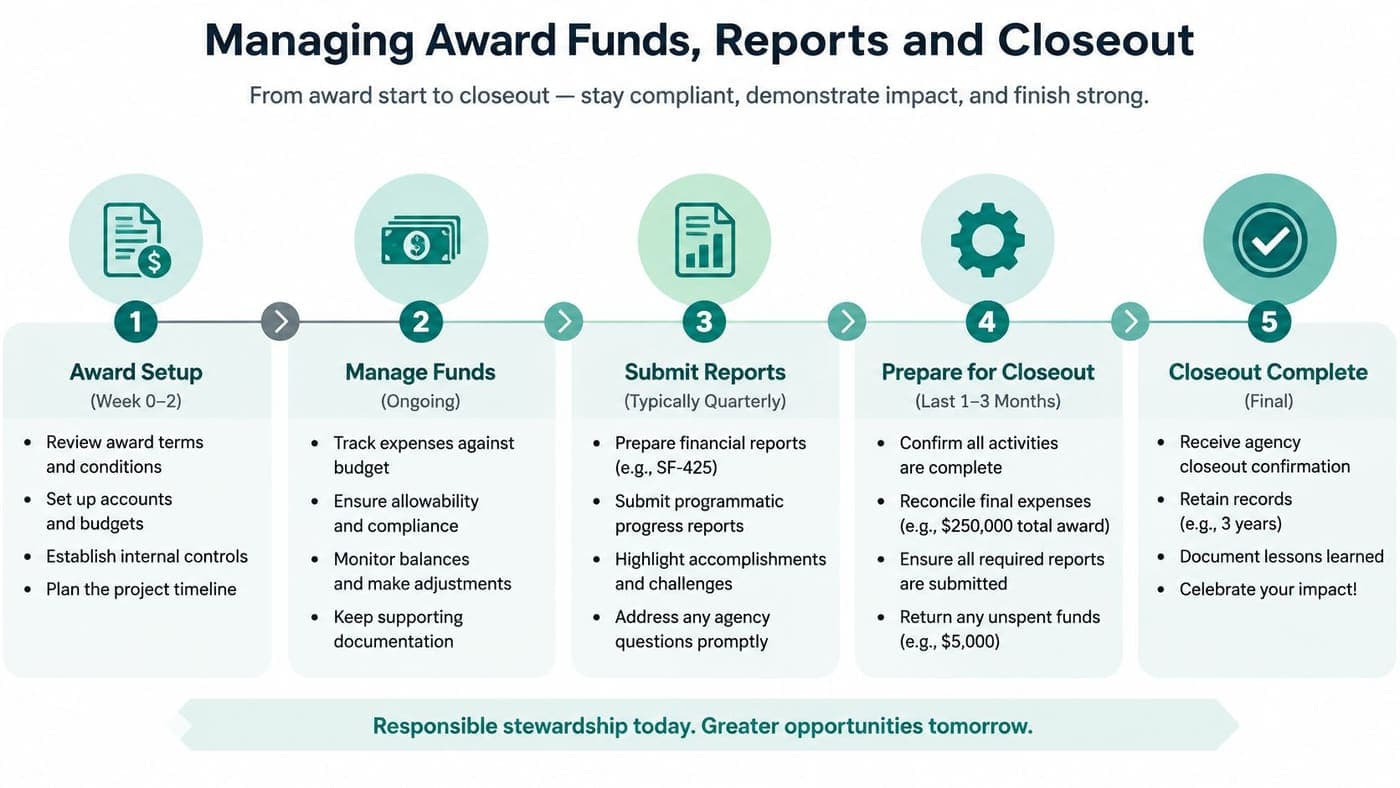
The routine below is the operating picture for award funds, reports, and closeout.
The monthly routine
- Load the Notice of Award into a grant record with amount, period, restrictions, and report dates. A grants receivable record keeps the award and the cash you still expect in one place.
- Code every transaction to the award, the restriction, and the cost category when it is entered. Fixing codes at month-end is how charges land on the wrong fund.
- Compare spending and outputs to the budget each month. Write down the correction when a line is materially off.
- Track drawdowns against cash timing. Reimbursement grants pay you after you spend. That is a cash problem, not a revenue problem.
- Build financial and performance reports from the same records. Two spreadsheets that do not match will not survive a site visit.
- Reconcile and close inside the funder's window, then keep the file.
IRS Form 990, Part IX asks for expenses by program, management and general, and fundraising. Organizations under 501(c)(3) or 501(c)(4) complete all of those columns. Shared costs need a written allocation rule you use every month, not a new method at filing time.
Classes in QuickBooks can label a transaction. They do not enforce a restriction or stop an overspend. True fund accounting does. Blackbaud Financial Edge and Aplos are established choices that show restricted balances as you work, and a small team can run either one well.
Deadlines that do not move
Federal timing comes from 2 CFR 200.329 and from Grants.gov's post-award guidance.
| Requirement | Timing | Why it matters |
|---|---|---|
| Reporting interval | No less often than annually, and no more than quarterly unless the award says otherwise | Sets how often financial and performance data must line up |
| Annual performance report | Due no later than 90 days after the reporting period | Ties spending to results for the funder |
| Subrecipient final report | Due within 90 days after the period of performance ends | Applies to fiscal sponsors and pass-through organizations |
| Closeout reports | Generally due within 90 days after the award expires or is terminated | Starts the funder's compliance review |
| Record retention | At least three years from the final expenditure report | Keeps the audit trail if questions come later |
Fiscal sponsors cannot stop at collecting an invoice. You review financial and performance reports, and you act when a project is slipping.
If a payment is late, ask the funder in writing for the expected date. Bridge the gap from the cash runway you set before you started work. Do not draw restricted funds early to cover another program. If reporting rules change mid-award, request the change in writing and update the grant record the same week.
Deciding Whether a Grant Is Worth Accepting
A grant is worth accepting when three things are true at once. Restricted money covers the true cost. Reporting fits the staff you have. The payment schedule fits your cash, not a hopeful version of it.

A test you can run on one page
- Overhead: Indirect costs are recovered, or you have already funded the gap from unrestricted money.
- Match: The source of every match dollar is named, including any donor gift or allowed volunteer time.
- Calendar: Report dates are on one list a person owns.
- Cash: The runway covers reimbursement delays.
- Mission: The work is work you would do anyway, at this size.
An award that passes strengthens the organization. One that fails can leave a deficit that outlasts the grant. The true-cost check from the budget stage and the single grant record from the first stage are the two tools for that call.
Put every current award in that record and look at restricted fund balances each month. At AlignMint, our fund accounting shows those balances as you post, builds the Form 990 Statement of Functional Expenses from the same codes, and lets you ask Minty AI about your own numbers. Organizations raising up to $100,000 a year can start on the free tier, with no per-seat fee, so the bookkeeper and the director can both see the fund.
AlignMint keeps grant awards, restricted balances, and the reports those awards require in one place, beside giving, volunteers, and events. If you are tired of hoping a class code will protect restricted money, AlignMint is ready for a free account, including the free tier for organizations raising up to $100,000 a year.
Ready to try AlignMint with your nonprofit?
Start free — set up donor tools, giving pages, and Minty. Upgrade when you need accounting.