

A grantor is the foundation, government agency, or corporation providing grant funding, while your nonprofit is the grantee receiving it. In 2024, U.S. foundations provided $109.81 billion in charitable giving, representing approximately 18.5% of all charitable giving, according to Giving USA's 2025 summary.
You're probably dealing with this right now: a grant arrives for a valuable program, but the award letter carries deadlines, spending limits, reporting duties, and questions about which costs qualify. The practical answer to what is a grantor is more important than a dictionary definition. A grantor creates obligations your finance team must track from award through final report.
Quick Answer: What a Grantor Is
A grantor is the foundation, agency, or company that awards grant funds. Your nonprofit is the grantee, and the award letter sets the purpose, budget, deadlines, and reporting you must track.
Start with fund accounting and what grant accounting covers. For sponsor awards, see fiscal sponsorship accounting models.
Defining the Grantor and Grantee Relationship
A grantor is the person or organization that provides grant funding. The grantee is the recipient responsible for accepting the award, following its conditions, and showing how the money supported the approved purpose. A grantor may be a private foundation, public charity, government agency, corporation, donor-advised fund sponsor, or another charitable institution, as UK charity guidance explains.
Consider a community nonprofit receiving funding from a family foundation for a youth literacy program. The foundation is the grantor. Your nonprofit is the grantee. The award might define eligible staff costs, supplies, reporting dates, performance goals, and whether unused funds must be returned.
That arrangement differs from an ordinary individual donation. An individual may give to your general mission with limited follow-up. A grantor usually issues a written agreement with a defined purpose, budget, payment schedule, and reporting requirements.
The people and organizations you may encounter
The source of the award changes the paperwork, but not the basic relationship.
- Private foundations may fund programs, general operations, equipment, or endowment needs.
- Public agencies may attach federal, state, or local compliance rules.
- Corporations may support community programs connected to their charitable priorities.
- Donor-advised fund sponsors may recommend grants while retaining charitable oversight.
- Public charities and other institutions may distribute funds through a competitive award process.
The word “grant” doesn't mean unrestricted money. Some awards let you decide how to spend the funds. Others limit spending to a program, time period, location, or approved budget category.
Practical rule: Read the award agreement before recording the money as available operating cash.
Your accounting records should identify the grantor, award name or number, purpose, restrictions, payment terms, and reporting dates. That basic discipline prevents the common mistake of treating every incoming grant as interchangeable revenue. You can also keep the terminology close at hand through this grant definition for nonprofit teams.
Grants Versus Contracts in Public Funding
You win a public award, book the receivable, and start staffing the program. Then finance reads the agreement and finds invoice terms, acceptance language, and detailed service levels. At that point, the label on the cover matters a lot less than the obligations inside.
Public agencies draw a real line here. A grant supports or stimulates a public purpose, while a contract purchases goods or services for the government's direct benefit, as explained in Pennsylvania public-sector guidance. That distinction changes how your team budgets, documents costs, and handles payment risk.
A city award for pantry expansion usually reads like assistance. The agency wants community benefit and checks that you used funds for eligible activities. If the same city requires a set number of meals, specific delivery terms, and formal acceptance of performance, you are much closer to procurement. In practice, that often means tighter invoicing, closer scrutiny of whether a service was delivered, and less room to shift costs when the work changes.
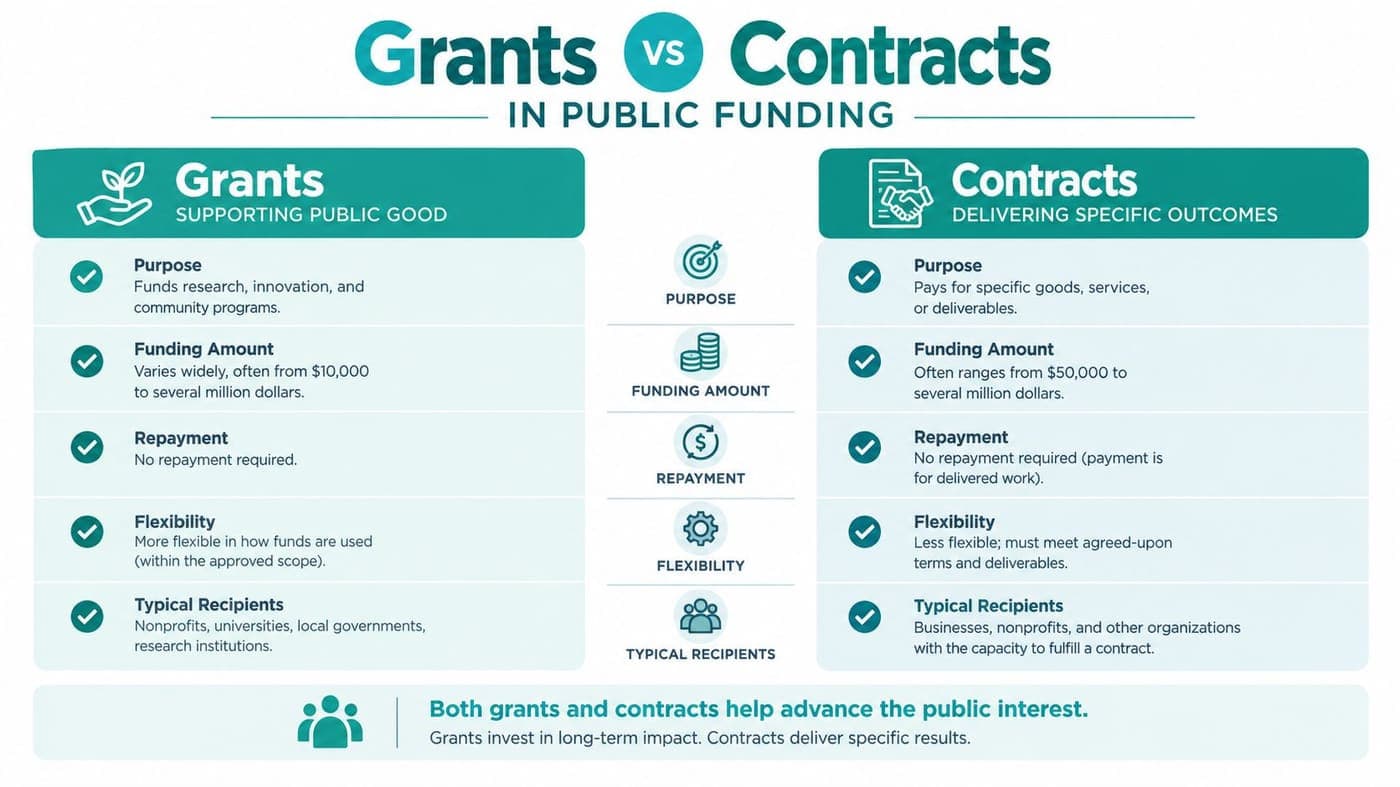
Before anyone records revenue or spends against the award, read the operational clauses. Start with principal purpose. Then check the performance terms, payment method, compliance language, and whether you are the direct recipient or a subrecipient. Those sections tell you what the government is asking you to do.
Nonprofits often get into trouble here. Program staff hear “grant” and expect flexible mission funding. Finance may be dealing with reimbursement claims, retention rules, audit access, and return-of-funds provisions. If your accounting system cannot track award purpose, approved budget, billing basis, and performance conditions in one place, misclassification turns into late invoices, questioned costs, and bad board reporting.
At the opportunity stage, a government RFP database helps screen for assistance awards versus service procurements before your team spends time chasing the wrong fit.
Managing Donor Restrictions and Fund Balances
A grantor's restriction determines whether your team can spend the money broadly or only on an approved purpose. An unrestricted award can support general operations. A restricted award may cover only youth literacy, building improvements, a defined project period, or another stated purpose.
Under guidance summarized for ASC 958, money restricted for a program remains in net assets with donor restrictions until your organization spends it for that purpose or satisfies the applicable time condition, as described in this nonprofit grant accounting guide.
The bank balance won't answer the question your board is asking: “How much can we spend?” Cash may sit in one account while different awards carry different legal and ethical limits.
Restricted and unrestricted funds behave differently
| Fund type | Spending decision | Board reporting need |
|---|---|---|
| Unrestricted grant | Leadership may apply funds to eligible general needs | Show overall operating use |
| Purpose-restricted grant | Costs must support the stated program | Show qualifying expenses and remaining balance |
| Time-restricted award | Spending or recognition may depend on the stated period | Show the relevant time condition |
| Budget-limited award | Costs must remain within approved categories or amendments | Compare actual costs with the approved budget |
For example, a grant restricted to youth literacy remains restricted until qualifying literacy costs occur. The release moves the satisfied amount from net assets with donor restrictions to net assets without donor restrictions. Total net assets don't change, because the entry changes classification rather than adding new resources.
Build records around the restriction
Track the award purpose beside every relevant transaction. Your board packet should show the original award, qualifying expenses, released amount, remaining restricted balance, and any pending amendment or reporting issue.
A spreadsheet can help with a small award, but it becomes fragile when several programs share staff, supplies, or facilities. Your restricted funds documentation should explain the rule in plain language and show how your team applies it consistently.
Meeting Grantor Reporting and Monitoring Duties
The hard part of grant compliance usually shows up a month before the report is due. Finance has one set of numbers. Program staff have activity notes in another place. Someone is chasing invoices, payroll support, and an old amendment. That scramble is avoidable if the reporting trail is built at the start of the award.
A grantor wants more than a spending summary. They need to see that funds were used for the approved purpose, under the stated terms, and within the reporting period. For private foundations handling expenditure responsibility, reports commonly address use of funds, compliance with conditions, and progress toward objectives, as the IRS guidance for grantee reports explains.
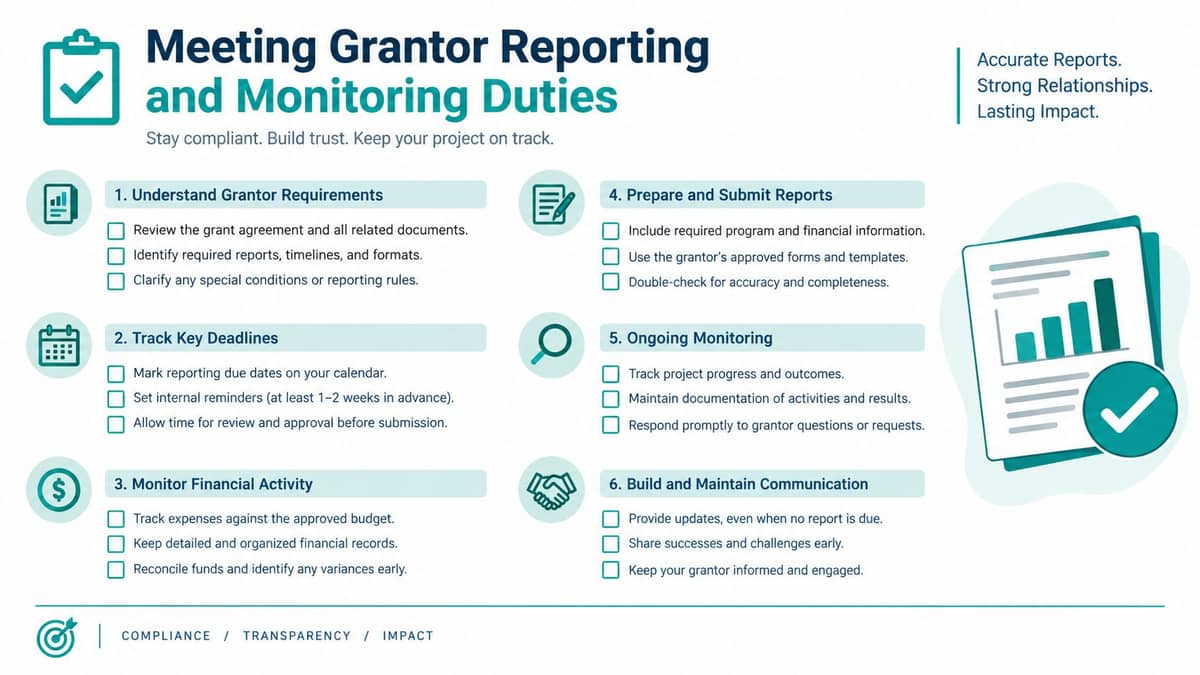
What matters in practice is having one record that ties the award terms to daily transactions and then to the final report. I look for six things right away: the signed agreement and approved budget, every reporting and renewal date on a calendar, expenses coded to the grant and budget line, supporting documents stored with approvals, deliverables matched to the reporting period, and a pre-submission reconciliation of expenses, payments, restricted balances, and reported totals.
That last step prevents avoidable errors.
If a report goes missing, the consequences are practical, not abstract. A private foundation may need to pursue collection efforts and pause future payments until the grantee complies. The foundation is also expected to retain the grant agreement, grantee reports, and any relevant audits or investigations for review.
This is why spreadsheets break down once multiple people touch the award. A finance lead may have the expense detail, while program staff hold the outcome data the grantor asked for. An all-in-one reporting process closes that gap. It gives the team a shared view of balances, deadlines, support, and open follow-up items. The grant reporting overview shows the kind of review structure that keeps those pieces together, and Bruce and Eddy's reporting solutions are another example of reporting tools teams may evaluate.
A short monthly review between finance and program leadership usually catches coding problems, missing support, and reporting gaps before they become compliance problems.
Grantor Rules in Fiscal Sponsorship Arrangements
A common fiscal sponsorship problem looks simple on the surface. A donor gives for a project, the project leader asks for the money, and staff feel pressure to release it quickly. The compliance burden starts right there.
Under fiscal sponsorship, the grantor relationship runs through the sponsor, not around it. The sponsor may receive funds for a charitable purpose and then make grants to the sponsored project, but it has to keep discretion and control over how those funds are used. The Fiscal Sponsorship Guide describes that structure clearly.
In practice, that means the sponsor cannot treat restricted gifts as project property waiting to be passed through. It has to review what the project is asking to spend, decide whether the request fits the charitable purpose, approve the disbursement, and keep records that show the decision. If that review is weak, the accounting gets messy fast. So does the legal exposure.
The hardest part is not writing the rule. It is proving the rule was followed.
Good sponsors build that proof into daily operations. They keep each sponsored project separate in the records, with incoming receipts tied to the original donor intent, funding requests matched to approvals, disbursements linked to the authorized purpose, restricted balances that show what is still available, and progress reports that connect spending back to the approved work.
Project leaders may direct the day-to-day activity. The sponsor still carries the legal and fiduciary responsibility. That line should show up everywhere: in the agreement, the approval workflow, the chart of accounts, and the messages sent to the grantor.
A sponsor protects everyone by keeping authority visible. Project independence does not change the sponsor's duty to review and approve charitable spending.
Once a sponsor supports several projects, spreadsheets start hiding the picture. Shared staff time, shared facilities, and pooled fundraising can blur which balance belongs to which project. A practical fiscal sponsor compliance guide helps teams set up controls that match the relationship and keep fund balances defensible.
Tracking Awards with True Fund Accounting
Spreadsheets fail when they become the place where award terms, expenses, donor records, and reporting dates all meet. They may show a balance, but they rarely enforce the difference between cash on hand and money available for a particular purpose.
QuickBooks can serve many small organizations well, especially where basic bookkeeping and familiar workflows matter. Its class tracking can provide useful reporting when configured carefully. But classes aren't the same as true fund accounting. A class may label a transaction, while a fund structure can preserve restrictions, balances, releases, and fund-level reporting as part of the accounting model.
Put the award at the center
Your system should let you connect the grantor, award number, approved purpose, dates, restricted status, budget, transactions, payments, and reports. It should also show program costs without forcing staff to reconcile separate donor, volunteer, event, and marketing databases.
That connected view matters because grant work touches more than finance. Donor management helps staff understand the funding relationship. Volunteer management can document service activity. Event and online giving records can support program income. Team communication keeps deadlines visible.
Choose tools that reduce manual reconciliation
An all-in-one platform can be practical when your organization needs accounting, CRM, volunteers, events, marketing, and team communication in one place. AlignMint offers true fund accounting for restricted funds, grants, and programs, along with donor management, volunteer tools, events, online giving pages, a built-in marketing suite, and Minty AI for questions about your organization's data. It also provides plan-based access without per-seat fees and a free tier for nonprofits under $100K, as described in the publisher's platform information.
The right choice depends on your controls, staff capacity, budget, and reporting needs. Test whether a system can produce a restricted balance, grant drawdown, budget comparison, and board-ready report without exporting data into several disconnected files.
Start with your next reporting cycle. List every active award, restriction, deadline, and unresolved reconciliation. Then compare that list with your current accounting, donor, volunteer, and communication tools using this fund management documentation.
AlignMint brings true fund accounting, grant tracking, donor management, volunteer coordination, events, marketing, and online giving into one nonprofit platform. Visit AlignMint to see whether its grant and fund management tools fit your reporting needs.
Ready to try AlignMint with your nonprofit?
Start free — set up donor tools, giving pages, and Minty. Upgrade when you need accounting.