

For related tools, see AlignMint features.
Nonprofit Expense Reimbursement: Simplify Your Process
Quick Answer: Nonprofit Expense Reimbursement: Simplify Your Process
Nonprofit expense reimbursement works best when the request captures the business purpose, receipt, approver, and fund assignment before payment. That keeps reimbursements fair for staff and volunteers while protecting restricted funds, audits, and Form 990 reporting.
You probably have a few receipts on your desk right now, a staff member asking when their check is coming, and a quiet worry that one expense hit the wrong grant. That mix of delay, ambiguity, and cleanup work is exactly why expense reimbursement becomes such a drain in nonprofits.
The good news is that this problem is fixable. If you set clear rules, tie every reimbursement to the right fund from the start, and stop relying on paper and memory, you protect cash, donor intent, and your own time.
Introduction Getting Reimbursed Should Not Be This Hard
Expense reimbursement sounds simple until you're the one sorting it out. A program manager buys supplies with a personal card, a volunteer submits mileage three weeks late, and finance has to decide whether the cost belongs to a grant, a program budget, or general operations.
In a nonprofit, reimbursement isn't just about paying someone back. It's about compliance, donor trust, clean books, and fair treatment of staff and volunteers.
If you're still handling this with email threads, stapled receipts, and a spreadsheet nobody likes, you're carrying more risk than you need to. A good process doesn't create bureaucracy. It removes guesswork.
The IRS framework matters first. Under an accountable plan, expenses need a business connection, proper documentation, and timely substantiation. That sounds manageable in a standard business. In a nonprofit, it gets harder because every reimbursement can also touch restricted funds, grant rules, and functional expense reporting.
A reimbursement process should answer two questions immediately. Was the expense valid, and did it belong to the right fund?
If your current form doesn't force those answers, fix the form first. A nonprofit-specific expense reimbursement form should capture the vendor, date, amount, purpose, receipt, approver, and the fund or program attached to the expense.
That's the shift I want you to make. Stop treating reimbursement as a back-office nuisance. Treat it as a financial control that protects the mission and makes audits far less painful.
Why Nonprofit Expenses Are a Unique Challenge
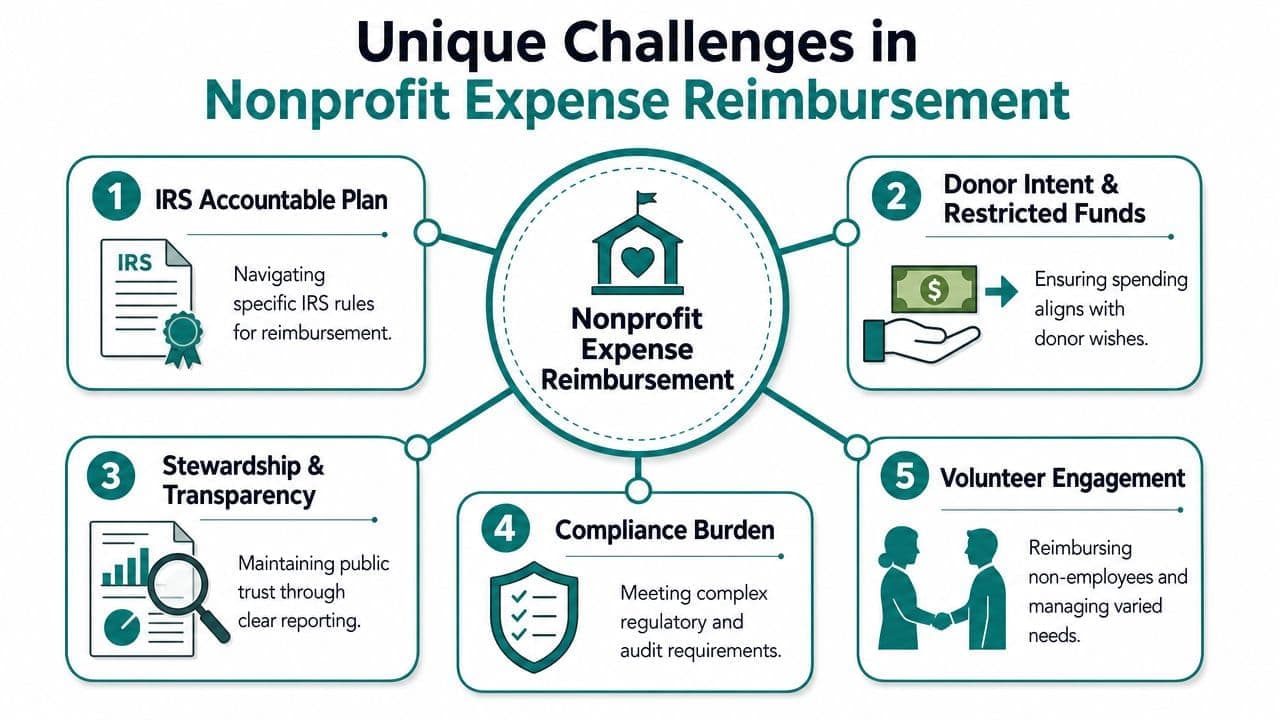
An accountable plan is the starting point, not the finish line. Under IRS rules, reimbursements aren't taxable income when the expense has a clear business connection, the person substantiates it properly, and any excess amount gets returned within a reasonable period.
That framework is necessary. It is not enough for a nonprofit.
The real issue is fund assignment
A business can often stop at "Was this expense legitimate?" You can't. You also need to ask, "Which fund pays for it, and does that match donor intent?"
That difference changes everything. A box of art supplies might be perfectly valid for program use, but still wrong if it gets charged to an unrestricted admin bucket instead of the youth grant that funded the activity.
If you rely on after-the-fact coding, your team will make innocent mistakes. Then finance spends month-end reclassifying transactions and explaining them to auditors or board members.
Practical rule: If a reimbursement isn't tagged to the correct fund at submission, expect cleanup later.
Many organizations outgrow generic bookkeeping setups. QuickBooks is strong for many small organizations, and plenty of nonprofits start there for good reason. But class tracking isn't the same thing as true fund accounting. If you're trying to preserve restricted balances and report by grant, program, and function at the same time, the cracks show quickly.
A plain-language primer on fund accounting for nonprofits is worth reviewing if your reimbursement process still treats funds like an afterthought.
Donor intent is part of the control
The most overlooked part of nonprofit expense reimbursement is donor restriction. A reimbursed expense may look ordinary, but that doesn't make it allowable against every source of money in your system.
The problem gets worse when departments approve expenses without finance review. As noted in Emory's guidance on reimbursement and nonprofit reporting, confusion over allowable costs is a leading cause of misstated net assets and incorrect Form 990 reporting, especially when teams are guessing what counts as program-related versus overhead and making decisions without finance oversight (Emory reimbursement guidance).
Volunteers and board members add another layer
Employees usually know there is a policy, even if they don't read it. Volunteers and board members often don't. They may assume "reasonable" expenses will be covered, then feel blindsided when finance asks for details weeks later.
That tension isn't minor. In nonprofit work, reimbursement delays and confusion can damage goodwill fast.
Here's the essential checklist your policy needs to protect:
- IRS compliance: Business purpose, documentation, and timely submission.
- Fund integrity: Every reimbursement tied to the right grant, campaign, or unrestricted fund.
- Functional reporting: Program, fundraising, or management and general coded correctly.
- Approval authority: Department leaders can't be the only checkpoint.
- Volunteer fairness: Non-employees need clear rules too.
If any one of those pieces is weak, reimbursement turns into a bookkeeping problem, a morale problem, and sometimes a reporting problem all at once.
The Essential Parts of a Strong Reimbursement Policy
Most reimbursement policies fail because they're too vague. They say receipts are required, but don't define what counts. They say expenses must be timely, but don't set an actual deadline. They say managers approve reports, but don't explain who approves a board member's conference trip.
Write the policy your tired future self will thank you for.
Start with the IRS minimum
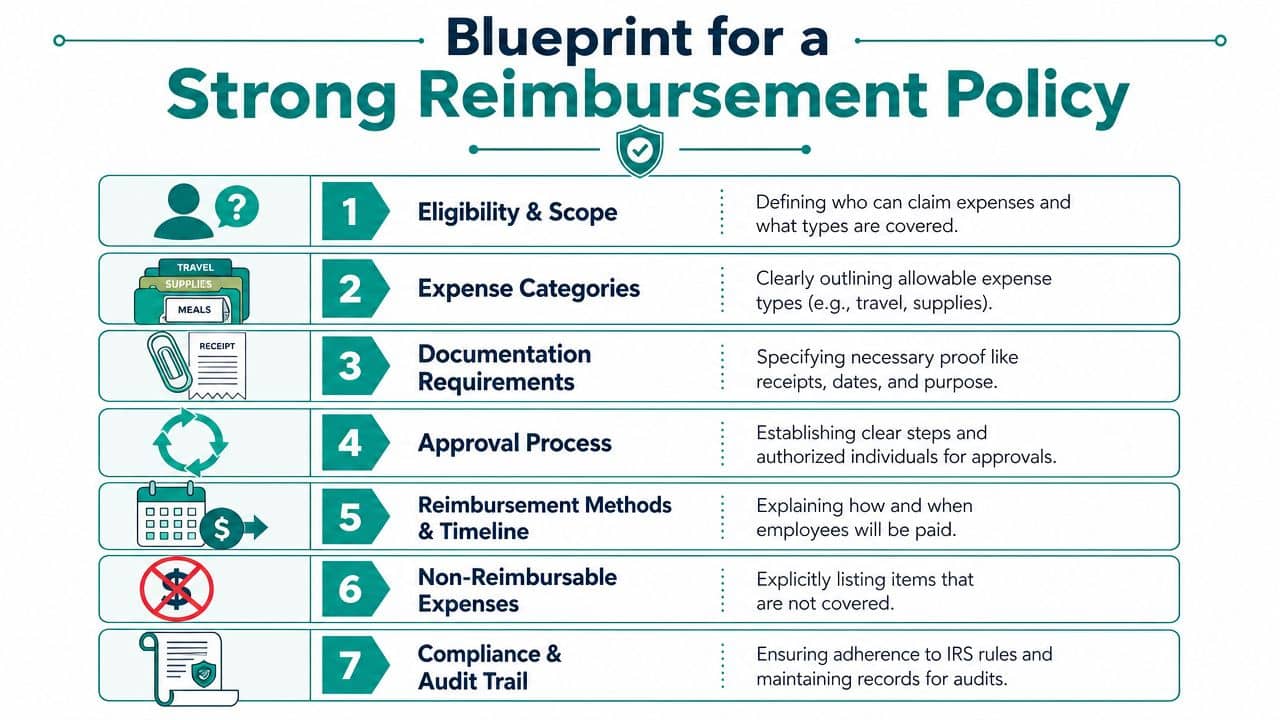
The floor is clear. For an expense reimbursement arrangement to qualify as an accountable plan under IRS rules, the expenses must have a clear business connection, be substantiated with adequate documentation within a reasonable period, and any excess advance amounts must be returned within a reasonable timeframe, typically interpreted as 60 days for substantiation (accountable plan summary).
That language belongs in your policy. Then translate it into plain English your team can follow.
Put these rules in writing
A workable policy should answer these questions without anyone emailing finance:
- Who can request reimbursement: Staff, volunteers, interns, clergy, teachers, board members, or sponsored project leaders.
- What counts as reimbursable: Travel, supplies, approved meals, event costs, program materials, and other mission-related spending.
- What doesn't count: Personal items, missing-purpose purchases, late submissions beyond policy limits, and anything outside approved categories.
- When it's due: Set a submission window and enforce it.
- Who approves it: Supervisor first, finance second for restricted or unusual expenses.
- How it gets coded: Fund, program, grant, department, and functional category at the time of request.
If you don't state these points directly, people fill in the blanks themselves. That's when inconsistency starts.
Manual versus disciplined workflow
Below is the comparison I see most often.
| Approach | What happens | What it costs you |
|---|---|---|
| Manual process | People save receipts, fill out forms later, and finance recodes expenses at month-end | Delays, inconsistent coding, missing documentation |
| Structured digital process | Receipt, purpose, fund, and approval captured at submission | Faster review, cleaner books, fewer corrections |
A policy isn't just words on paper. It should shape the workflow so the right information is gathered before the reimbursement ever reaches accounting.
The easiest reimbursement to process is the one that arrives complete, coded, and approved the first time.
Be specific about common problem areas
These categories create most disputes, so don't stay general:
- Mileage: Require trip date, origin, destination, business purpose, and miles.
- Meals: Require attendees, business purpose, and itemized receipts.
- Volunteer purchases: State whether pre-approval is required before a volunteer spends personal funds.
- Travel: Clarify lodging, transportation, and event registration rules.
- Advances: Explain how unused amounts are returned and documented.
If you're revising your policy, don't start from a blank page. A reimbursement policy template gives you a faster way to standardize language, then tailor it for grants, churches, schools, or fiscal sponsorship work.
Build fairness into the policy
This part often gets ignored. A reimbursement rule isn't neutral if only people with extra cash can float expenses for weeks.
Say plainly whether pre-approval can trigger an advance, whether volunteers can request direct purchase instead of reimbursement, and how quickly approved requests will be paid. That isn't soft management. That's basic stewardship of your people.
A Clear Workflow from Purchase to Payment
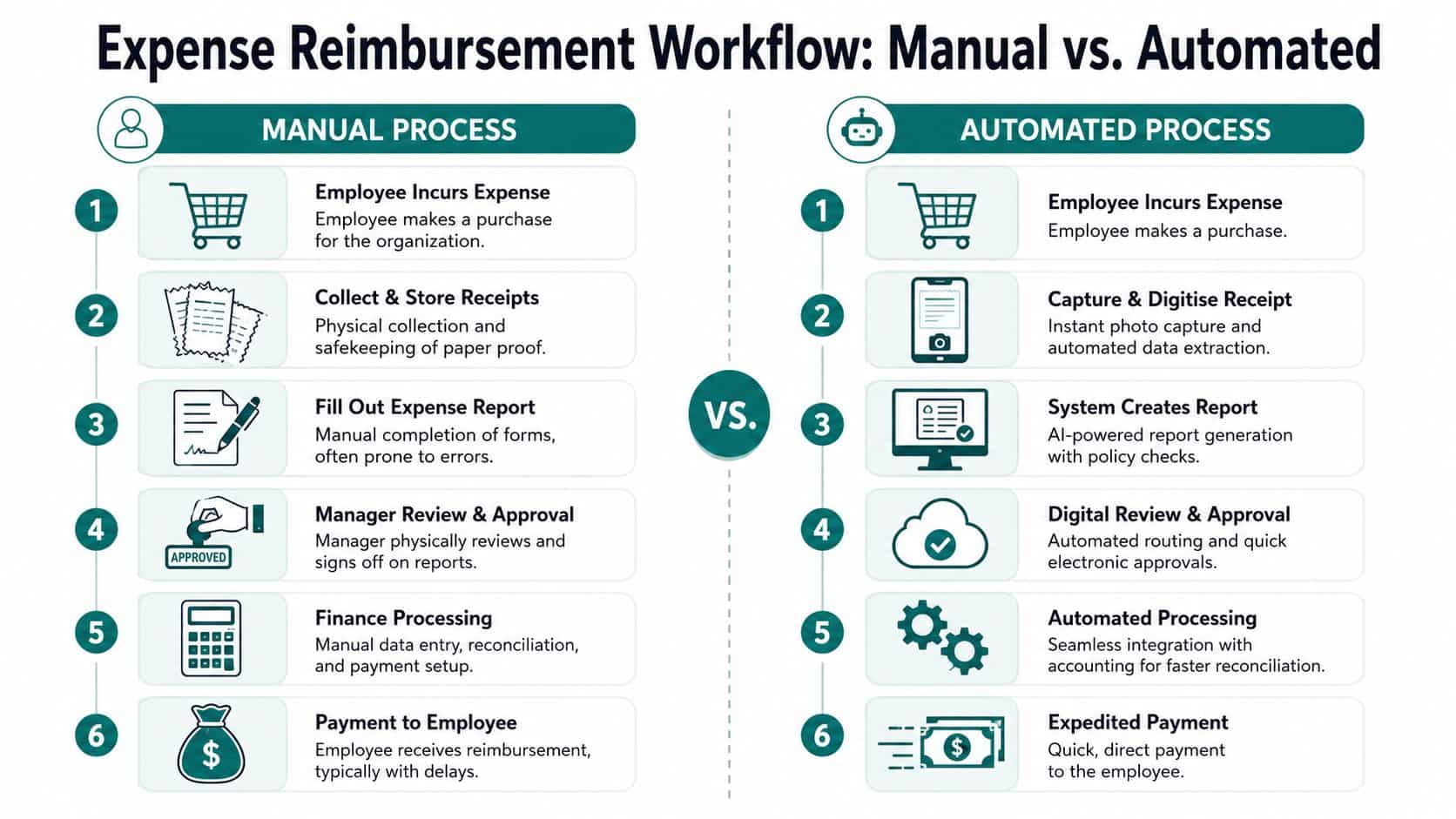
The old workflow is familiar because most nonprofits inherited it. Someone buys something, puts the receipt in a wallet, forgets about it, fills out a report at the end of the month, and sends finance a half-complete packet. Finance then has to chase signatures, decode handwriting, and decide which grant should pay.
That isn't just annoying. It's expensive. According to APQC benchmark data, the median total cost to process an individual expense reimbursement ranges from $15 to $30 per transaction with manual processes. This cost can be reduced by 30-50% with automated systems, which also cut the average approval-to-payment cycle from 10-14 days to just 3-7 days (APQC expense reimbursement benchmarks).
Story one, the program manager
Your youth program manager stops at a store for supplies before an after-school session. In a manual process, she keeps the receipt, maybe writes a note on it, and submits it days later. By then, the details are fuzzy, and finance has to guess whether the expense belongs to the grant-funded program or unrestricted youth ministry.
In a disciplined workflow, she captures the receipt right away, adds the purpose, and tags the expense to the youth grant before submission. Her supervisor approves it, and finance reviews a complete record instead of reconstructing one.
Story two, the volunteer driver
A volunteer delivers meals or transports students. He isn't an employee, so the reimbursement process often gets awkward. He may not know what records are required, and staff may not know how to review his request consistently.
A better workflow gives him a simple path. He records the trip details, states the ministry or program served, and submits the mileage request with the same coding logic staff use. Finance can reimburse him fairly without bending the rules.
When volunteers have to guess the process, they either stop submitting expenses or submit them badly.
Story three, the board member traveler
A board member attends a conference on behalf of the organization. Manual workflows often create a strange blind spot here because senior people are assumed to know what to do. They usually don't. They just have more confidence while doing it.
A strong workflow routes that reimbursement based on role and amount. The conference fee, hotel, and meals get reviewed under the same policy, with the correct approver and the correct fund assignment.
What the better process looks like
You don't need complexity. You need order.
- Expense happens: Staff, volunteer, or board member pays an approved business expense.
- Receipt gets captured immediately: No shoeboxes, no desk piles.
- Purpose gets written while it's fresh: This reduces vague descriptions.
- Fund and program are selected at entry: Coding happens before accounting cleanup.
- Approval follows role-based rules: Managers approve mission need. Finance protects compliance.
- Payment closes the loop: Reimbursement status is visible, not buried in email.
That workflow is what good software should support. It should not force you to become the human connector between forms, inboxes, spreadsheets, and accounting entries.
If you're evaluating how to set this up in practice, the reimbursements documentation shows the kind of workflow nonprofit teams should expect from a modern system.
Real Examples of Nonprofit Expense Scenarios
Expense reimbursement policies become real when they meet ordinary nonprofit life. That's where weak systems fail. They may work for a hotel receipt from staff headquarters. They fall apart when a volunteer, board member, or program lead has a less standard expense.
Grant-funded program supplies
A program manager buys materials for a youth arts session funded by a restricted grant. The expense is legitimate, the receipt is clean, and the purchase supports the program. The important question is whether the reimbursement is coded to the grant at submission or left for finance to fix later.
If the grant pays for program supplies, code it there immediately. Don't dump it into office supplies and promise yourself you'll reclassify it later. You might remember. Your successor might not.
The reporting outcome matters. When the reimbursement hits the right restricted fund and program category from the start, the grant budget reflects real spending, the restricted balance stays accurate, and your board report tells the truth.
Volunteer mileage for delivery or outreach
Volunteer reimbursement is where many organizations get sloppy. They want to be kind, so they accept vague mileage claims with almost no support. That's generous in spirit and weak in control.
For personal automobile use, records should include the date of travel, locations traveled to and from, number of miles driven, and the business purpose of each trip according to the guidance summarized by Calibre CPA Group (vehicle and meal documentation guidance).
That means "Meals delivery, 42 miles, Tuesday" isn't enough. You want the trip date, origin, destination, mileage, and purpose. If a church volunteer drove meals to homebound members, say that clearly. If a school volunteer drove students to a competition, document that clearly too.
Board travel and hosted meals
Board member expenses deserve more scrutiny, not less. They aren't suspect. They are sensitive because governance spending attracts attention from donors, auditors, and the board itself.
If a board member travels to a conference, reimburse approved transportation, lodging, and mission-related meals under the same written standards you use for staff. If the expense includes a hosted meal, require the itemized receipt and the purpose of the meeting. The same Calibre guidance notes that itemized receipts detailing each item are required for client meals in the business context, which is a smart discipline for nonprofit governance spending as well.
Board expenses should be easy to defend in one sentence to an auditor and one sentence to a donor.
Why these examples matter
The common thread is not paperwork. It's mission integrity.
A good reimbursement process tells you four things at once:
- Was the expense allowable
- Was it documented well enough
- Was it approved by the right person
- Did it hit the right fund and functional category
When your system can't answer all four, finance becomes a repair department. That's a poor use of experienced nonprofit staff, and it leaves too much to memory.
This is also where integrated operations start to matter. Reimbursement connects to volunteer management, because volunteers submit requests. It connects to donor management, because restricted gifts shape what can be reimbursed. It connects to fiscal sponsorship, because sponsored projects need clean separation. And for churches and schools, it ties directly into event costs, ministry travel, parent activities, and program materials.
Disconnected tools can handle pieces of this. They usually don't protect the whole chain.
Automating Compliance and Reporting for Peace of Mind
A program director buys supplies on a personal card, a volunteer submits a blurry receipt two weeks later, and finance has to guess which fund should absorb the cost. That is not an efficiency problem. It is a control problem. In a nonprofit, reimbursement software should protect restricted dollars, keep volunteer activity documentable, and give leadership clean reporting without month-end detective work.
That matters to your people too. A 2023 poll of 1,190 U.S. workers found that 42% of employees who pay out of pocket for business expenses wait at least one month to be reimbursed, and the delay creates cash-flow strain for many of them (reimbursement delay data). In nonprofits, slow reimbursement does more than frustrate staff. It weakens trust with employees, volunteers, and program leaders who are already stretching limited resources.
What good automation should do
Skip flashy features. Buy control.
The right system should reduce judgment calls, not create new ones. If a reimbursement touches a restricted grant, a school activity account, a church ministry budget, or a fiscally sponsored project, the coding and approval path should be clear before payment is released.
Look for software that can:
- Capture receipts and expense details in the same record: No separate inbox, no missing attachments.
- Route approvals by role, amount, and expense type: Staff, volunteers, executives, and board members need different controls.
- Require fund, program, and functional coding up front: That keeps restricted gifts from drifting into general expenses.
- Flag missing documentation before approval: Finance should not be the last line of defense.
- Feed reporting automatically: Board packets, grant reports, and internal reviews should pull from the same coded transaction.
- Keep related operational data connected: Volunteer activity, donor restrictions, events, and reimbursement records should not live in systems that cannot talk to each other.
AI can help if it is tied to your records and permissions. A plain-English assistant such as Minty is useful when it helps finance and leadership answer specific questions about spending, coding, and reporting without exporting data into another tool.
Be honest about tool tradeoffs
QuickBooks handles general bookkeeping well. Expensify is good at receipt capture. Many nonprofits also stack donor databases, volunteer platforms, church systems, school tools, and email software that each solve one narrow problem.
Finance pays for that patchwork later. Staff re-enter coding, reconcile conflicting records, chase approvals across email, and clean up reports after the fact. That is where restricted-fund mistakes happen.
AlignMint is one option that combines accounting, CRM, volunteer management, events, marketing, team communication, online giving pages, fiscal sponsorship support, Minty, and true fund accounting in one system. For smaller nonprofits, it also offers a free tier for organizations under $100K and does not charge per-seat fees, which matters when finance, development, ministry leaders, and volunteers all need access.
If software leaves your team maintaining connections by hand, it has not solved the underlying problem.
A few practical questions worth settling now
If your work crosses borders or you support affiliates abroad, country-specific guidance matters. For teams operating in the Gulf region, this guide for UAE business owners gives useful context on expense accounting issues outside the U.S. nonprofit framework.
For your internal process, answer these this week:
- Can staff and volunteers check reimbursement status without emailing finance
- Can every request be tied to the right fund and functional category before approval
- Can exceptions and missing receipts surface automatically
- Can leadership receive recurring summaries without asking finance to build them manually
If the answer is no, fix that before your next audit or grant report. Automatic email reports for finance and leadership are a practical way to keep reimbursement status, fund activity, and exceptions visible without adding another standing meeting.
If your reimbursement process still depends on paper, memory, and cleanup work, it's costing more than it looks. AlignMint gives you one place to manage fund accounting, donor records, volunteers, events, marketing, giving pages, team communication, and expense reimbursement without stitching together separate tools. If you want tighter control and cleaner reporting with less manual work, it's worth a closer look.
Ready to try AlignMint with your nonprofit?
Start free — set up donor tools, giving pages, and Minty. Upgrade when you need accounting.