

Encumbrance in Accounting: A Nonprofit Director's Guide
You're probably staring at a budget report that says you have money left, while your inbox says otherwise. A contract got signed, a purchase order went out, or a travel approval got posted, and the balance on paper still looks too healthy. Encumbrance in accounting is the missing budget control that shows those committed dollars before cash leaves the bank, so your board sees the accurate picture.
For nonprofit leaders, that matters most at month-end and year-end, when commitments pile up. It also matters when you need a clean handoff between finance, program staff, and the board, especially if you manage multiple funds, grants, or sponsored projects.
Quick Answer: Encumbrance in Accounting
An encumbrance reserves budget authority for an approved commitment before cash leaves the bank. It is not an expense yet. Nonprofits use encumbrances to show available balances clearly, then liquidate them when invoices post, contracts change, or commitments cancel.
For the surrounding budget workflow, see fund accounting and restricted vs unrestricted funds. Journal mechanics are covered in journal entries.
Why Your Budget Reports Feel Incomplete
The panic usually starts before a board meeting. You open the budget vs. actual report, see a comfortable balance, and remember the $15,000 contract you signed last month that never showed up as “spent.”
That gap is what makes budget reports feel incomplete. Standard reports track actual expenses, but they can leave out commitments that are already spoken for, so the report looks healthier than the cash picture really is.
What your board is really asking
Your board usually is not asking for a more complicated report. They want a trustworthy answer to one question, “How much can we still spend without creating a problem?”
A budget that ignores commitments makes that answer harder to trust. A signed contract, a travel authorization, or a pre-encumbrance can sit outside the available balance even though the money has already been set aside. That is like counting the same dollar twice, once as available and once as promised.
Practical rule: if the money is already promised, your board should not treat it like free cash.
For nonprofits, the issue shows up fast when program plans and donor intent have to stay aligned. If you already map your budget in tools like AlignMint's nonprofit budget workflow, the encumbrance layer gives you the control point between approval and payment, and it also helps you explain why year-end reports can change when invoices arrive late, differ from the original commitment, or cross into the next fiscal year.
How Encumbrance Accounting Works
A commitment can look harmless on paper and still change what managers think is available to spend. That is the point of encumbrance in accounting, it gives your budget a place to hold money before the vendor bill arrives.
When a nonprofit approves a purchase order, signs a service contract, or authorizes travel, it records an open commitment before cash leaves the bank. In a fund accounting system, that commitment stays visible inside the correct fund, which matters when directors are checking whether program spending still matches board intent. True fund accounting keeps those commitments from disappearing into a generic expense bucket.
The two-step encumbrance cycle
The basic cycle is simple, reserve the budget first, then clear that reservation when the cost is recorded. Accounting systems used for automated accounting practices often handle that reservation and reversal automatically, which helps keep the budget report aligned with what has been approved.
Here's the flow in plain language:
- You commit funds. A purchase order or contract gets approved.
- The budget is reserved. The amount is held aside, so it is not available for something else.
- The goods or services arrive. The vendor sends the invoice.
- The encumbrance is cleared. The reservation is reversed.
- The expense posts. The invoice amount becomes the expense and, if it has not been paid yet, a liability.
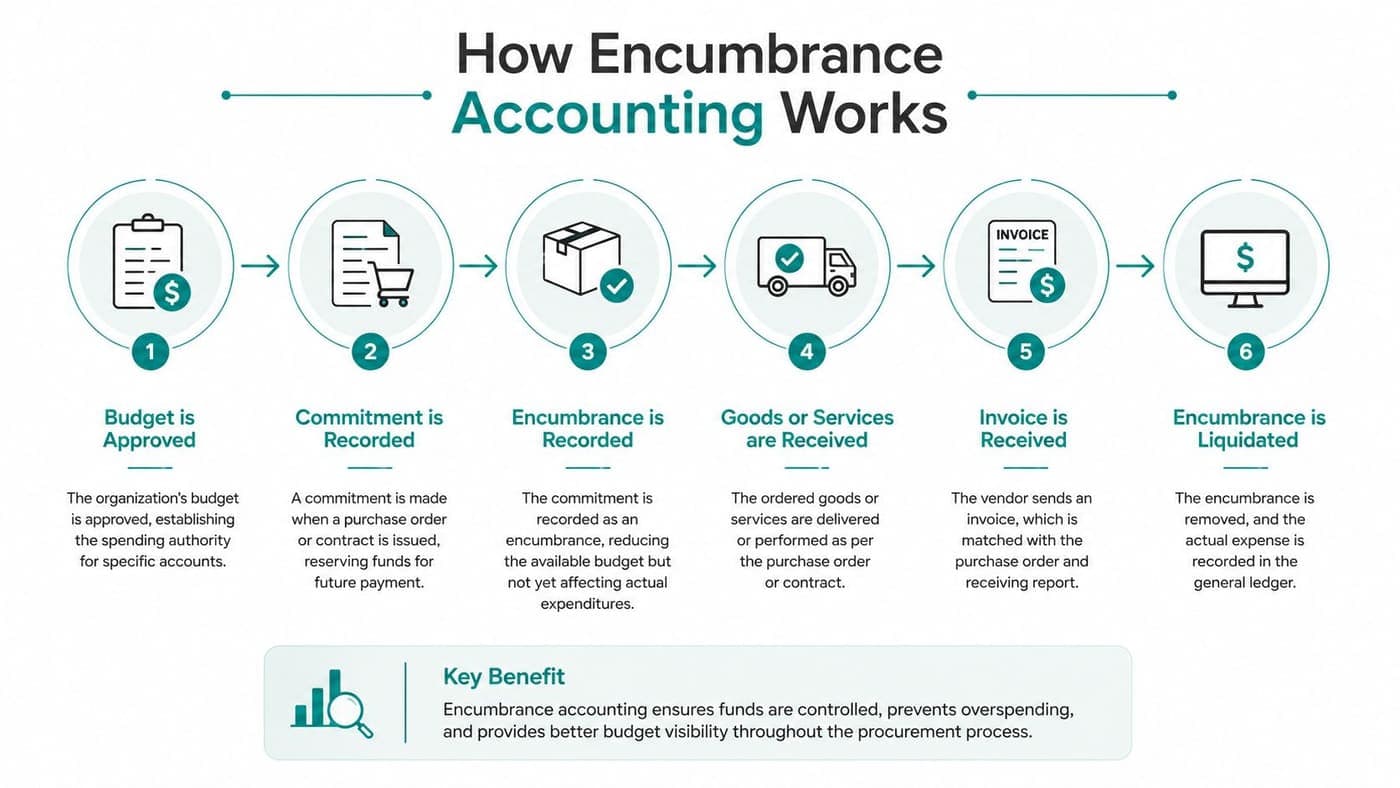
That is why encumbrances are not actual expenses. They protect the budget before payment happens, but they do not flow into expense totals until the invoice is real.
The cleanest way to think about it is simple, the encumbrance holds the budget seat, and the invoice eventually takes it.
If your accounting team uses fund accounting, the budget math is easier to trust. It shows commitments where they belong, so a director looking at the monthly report can see what has been promised, what has been spent, and what is still available without guessing.
Journal Entries for Encumbrances
The accounting entry is where the process becomes visible. The logic is simpler than the jargon, because the entry records a commitment first, then clears it later when the invoice arrives.
A supply order is the easiest place to start.
Say you issue a $5,000 supply order. In a budgetary system, the commitment is recorded like this:
| Transaction | Debit | Credit | Amount |
|---|---|---|---|
| Create encumbrance for supply order | Encumbrances | Reserve for Encumbrances | $5,000 |
| Reverse encumbrance when invoice arrives | Reserve for Encumbrances | Encumbrances | $5,000 |
| Record actual supply expense | Supply Expense | Accounts Payable | $5,000 |
If you want a plain-language reference for the journal flow, the journal entry guide lays out the same basic sequence. In many offices, especially those using automated accounting practices, that reversal and reposting happen with less manual work, which keeps the budget report closer to the approval trail.
A consultant contract follows the same pattern. If you approve a $20,000 agreement, the budget is reserved at approval, then the reservation is cleared when the invoice shows up. The expense posts at the billed amount, not the original commitment amount, so the ledger reflects what was owed.
Bookkeeper's shortcut: the encumbrance protects the budget seat, and the expense shows the historical record.
What happens when the invoice differs
This is the part many teams miss. If the invoice comes in lower than the original encumbrance, the original encumbrance is still liquidated in full when it is cleared, following the standard clean-up approach used in public-sector guidance. The unused portion is released back to available budget, which is what you want when the commitment no longer matches the actual bill.
That matters in a board meeting. A director may see a line item reserved for a vendor, then wonder why the final invoice does not match the amount that disappeared from availability. The answer is usually timing: the encumbrance was a placeholder for the expected obligation, and the actual expense is posted only when the invoice confirms the final amount.
When the invoice is higher than the original commitment, the reverse also happens. The old encumbrance is cleared, then the extra amount is handled through the normal invoice process so the books reflect the actual liability instead of the earlier estimate. That is why year-end review matters, because invoices that cross a fiscal year or come in with different amounts can change how much budget is freed up and which period takes the expense.
If your team is building repeatable posting routines, keep the steps tied to the invoice and the release of the reservation, not to memory or habit. That makes the clean-up easier when a purchase order spans months, closes after year-end, or settles for less than expected.
The bookkeeper's control point
The entry matters less than the discipline behind it. A good workflow answers three questions fast, what was promised, what was received, and what still needs to be paid.
For a nonprofit, that is the difference between a clean budget and a surprise at month-end. If your accounting system can store these entries natively, use that. If it cannot, your staff will spend too much time fixing timing errors by hand.
Encumbrances vs Restrictions and Reservations
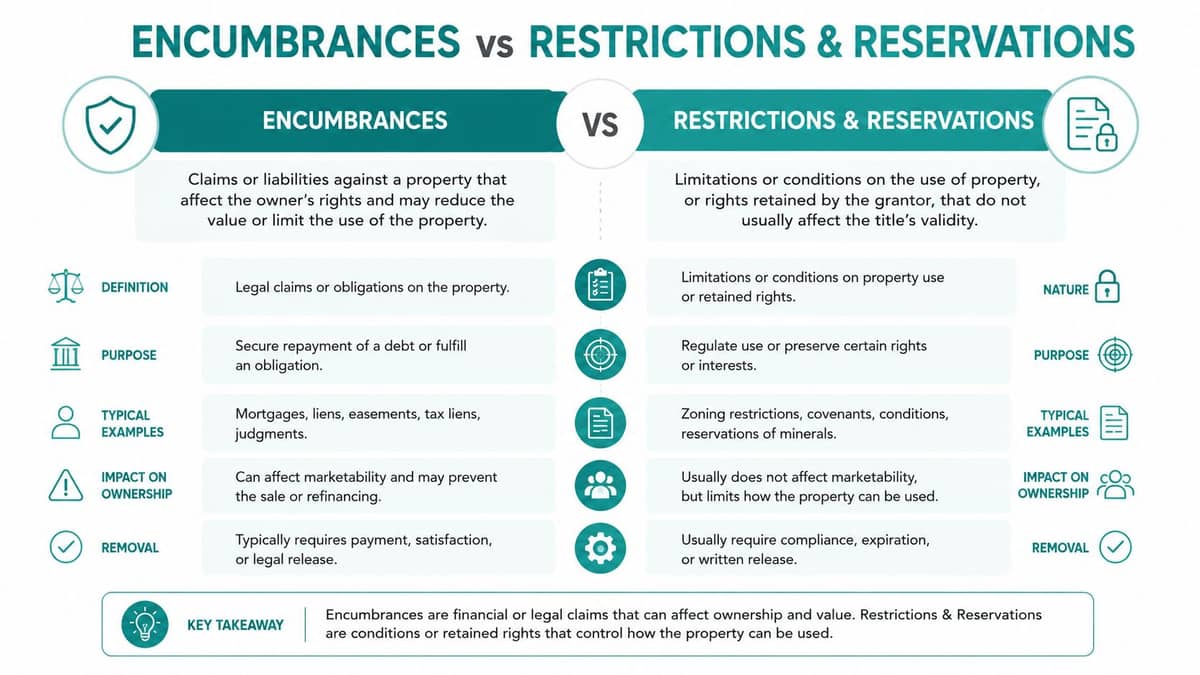
People mix these up because they all sound like “money set aside.” They're not the same, and that distinction matters when you're explaining reports to a board or grantor.
Encumbrances track commitments to vendors or contractors. Restrictions come from donors or grantors. Reservations are internal board decisions. The money may feel unavailable in all three cases, but the control source is different.
A side-by-side way to think about it
| Concept | Who creates it | What it tracks | Typical trigger |
|---|---|---|---|
| Encumbrance | Finance or purchasing process | A future vendor obligation | Purchase order or contract |
| Restriction | Donor or grantor | Allowed use of funds | Gift agreement or award terms |
| Reservation | Board or management | Internal set-aside decision | Board designation or policy |
For a clear nonprofit-specific comparison of donor restrictions versus unrestricted funds, see restricted vs unrestricted funds.
The key confusion comes when a board asks why money is unavailable. If it's restricted, the donor or grant terms control it. If it's encumbered, your team already promised it to someone else.
That matters in fiscal sponsorship too. One project can be restricted by the grant, reserved by board policy, and encumbered by a signed contract at the same time. Your reports need to show each layer separately, or someone will think the organization has more flexibility than it really does.
Year-End Encumbrance Treatment and Liquidation
Year-end is where encumbrances stop being an abstract control and start showing up in audit questions. A board can approve a contract in good faith, but if the invoice arrives after the books close, or never arrives at all, the accounting still has to explain what happened to that reserved budget.
That is why the year-end review should start with the open commitments list. If your team has a documented budget request workflow, it is much easier to trace which commitments were approved, which ones were still open, and which ones should have been cleared before close.
When the year closes before the invoice
This is the scenario nonprofit directors run into most often. A contract starts in one fiscal year, the vendor finishes late, and the invoice lands in the next period, or the final work slips past year-end entirely. The accounting treatment depends on the fiscal period and the fund rules, not just on the contract date.
New York State guidance says encumbrances are liquidated at their original amount, and any unspent portion removes the remaining appropriation. South Dakota's municipal guidance adds that an encumbrance stops being an encumbrance when it is paid or when the actual liability is incurred, which is the point when the open commitment becomes a payable.
That leaves the year-end question in plain terms. Did the obligation become a liability before the books closed, or was it still only a promise to spend?
Lower invoices, lapsed authority, and unfinished work
When the final invoice is lower than the original commitment, the reserve still needs to be cleared at the original amount. The difference does not stay parked in the encumbrance. It returns to available balance, which keeps the next budget review from overstating what is already spoken for.
The same logic applies when authority lapses before the work is done. Washington's policy distinguishes operating and capital timing, so operating appropriation encumbrances lapse at the end of the appropriation period, while capital appropriation encumbrances lapse at the end of the biennium unless they are reappropriated. For boards reviewing facilities work, campaign projects, or other multi-period commitments, that distinction decides whether an open encumbrance can remain or must be closed out.
If the commitment no longer exists, the encumbrance should not sit open just because the invoice has not caught up.
For nonprofits, schools, and fiscal sponsors, the practical step is a clean closeout process for open commitments, not a spreadsheet full of stale items. A late-arriving vendor bill, a reduced final invoice, or a project that stretches across fiscal years all need the same treatment, clear the encumbrance, match it to the actual liability, and return any unused authority to the budget. Even a modest purchase, such as ordering rush jersey tees for events, can create year-end timing problems when the order, delivery, and invoice land in different periods.
Implementing Encumbrance Policies Without the Chaos
Good encumbrance control starts with policy that staff can use. If people do not know when to reserve funds, how to update a commitment, or when to close it, the accounting system turns into a spreadsheet cleanup project by the time the books need to close.
Set rules people can follow
Begin with approval thresholds. Decide which purchases, contracts, travel requests, and grant-related commitments must be encumbered, then document who approves them and where the record lives.
From there, spell out the supporting paperwork and the point at which an encumbrance ends. The key is to treat the reservation as a standing hold on budget authority until the organization has a real obligation, then clear it when the commitment is satisfied, changed, or cancelled. That keeps staff from treating an old reservation like money that is still unavailable.
A clean policy usually includes:
- Approval trigger: the amount or contract type that requires an encumbrance.
- Required document: purchase order, signed contract, or approved travel authorization.
- Update rule: what happens when scope or price changes.
- Closeout rule: when staff must reverse a cancelled or completed commitment.
- Review cadence: who checks open encumbrances before period close.
Year-end is where weak rules show up fast. If a vendor sends a lower final invoice than the original commitment, the encumbrance should come down to the actual liability and the difference should return to available budget. If the invoice arrives in the next fiscal year, the team still needs to clear the old reservation and book the expense in the period it belongs in, rather than leaving a stale hold in the prior year's reports. For a board member reviewing program spending, that is the difference between a clean budget and one that makes every program look more constrained than it is.
Keep the workflow inside the accounting system
Software matters here, but only if it matches nonprofit reality. AlignMint is one option that combines true fund accounting, CRM, volunteers, events, and marketing in one platform, with plan-based access and no per-seat fees. It also has a free tier for nonprofits under $100K in annual fundraising, so smaller organizations can test a structured workflow without buying disconnected tools.
That kind of setup matters because encumbrances do not live alone. They connect to donor records, grant restrictions, and budget reports, especially for churches, schools, and fiscal sponsors managing several programs at once.
If staff have to remember the process from memory, the process will fail during vacation, audit season, or a busy month-end.
If you are defining budget-request steps for department heads, the budget request workflow should show when an approval becomes a commitment and when finance must record the reservation. That keeps program staff from spending against money that is already spoken for.
Even a modest purchase, such as rush jersey tees for events, can create year-end timing issues when the order, delivery, and invoice land in different periods. Good policy gives finance a clear rule for those cases, so the open commitment is adjusted to the actual liability and not left hanging past close.
Taking Control of Your Nonprofit Budget
Encumbrances give you something every nonprofit leader wants but rarely gets cleanly, a real available balance. They help you prevent overspending, explain commitments to the board, and close the books without ugly surprises.
They also force better year-end discipline. If an order was never fulfilled, or a contract rolled into the next period, the encumbrance should not sit there as if nothing changed. Clean liquidation keeps your audit trail honest and your budget report useful.
The next time your board asks why available cash doesn't match the budget report, look at open commitments first. That's where the story usually is, and it's the story your financial controls should tell clearly.
If you want encumbrances to show up naturally in your budget reports, we can help you build that discipline into the way your team works. AlignMint brings fund accounting, donor data, volunteer tracking, and communication into one place, so commitments, grants, and available balances stay easier to see at month-end and year-end.
Ready to try AlignMint with your nonprofit?
Start free — set up donor tools, giving pages, and Minty. Upgrade when you need accounting.