

You're probably carrying the same knot many executive directors carry. The books need attention, the board wants clean reports, and the treasurer may be a willing volunteer who's unclear on the boundary between oversight and daily finance work. The good news is that nonprofit treasurer responsibilities become much easier once you separate governance from bookkeeping, then build a simple rhythm for reports, controls, and compliance.
If you want a broader view of how nonprofit operations can sit under one roof, our overview page is a useful starting point. For deeper context on the accounting side, this guide to fund accounting for nonprofits pairs well with the practical duties below, and this month-end close checklist can help you see where treasurer oversight ends and staff execution begins. For board-level governance context outside the nonprofit world, understanding corporate compliance is a helpful reference, especially if your board wants a cleaner model for reporting and risk.
Introduction to Nonprofit Treasurer Responsibilities
A treasurer role often starts as a practical handoff. One month it means reviewing bank statements and budget questions, the next it includes board reporting, restricted funds, and compliance deadlines that need clear answers.
That pressure is heavier in small nonprofits, where the treasurer may be a volunteer with limited finance experience and the staff team is already stretched. Oversight becomes easier once the board treats oversight as the treasurer's main job and leaves the transaction work to the people who handle it day to day.
That is easier when the finance core is purpose-built. Fund accounting gives the treasurer a clearer view of restricted balances, program spending, and board-ready reporting.
The treasurer sits on the board side of the boundary, not in the bookkeeping seat. The role is to review reports, ask whether the numbers make sense, and confirm that someone accountable is handling the entries, reconciliations, and filings.
A simple rule helps. If a task creates the numbers, staff or a contractor should usually do it. If a task checks the numbers, the treasurer should usually review it.
That boundary is the part many resources miss. A clear governance model, like the one described in understanding corporate compliance, helps boards separate oversight from execution without turning the treasurer into a second accountant.
For a nonprofit, the same idea applies in a more practical way. The board approves direction and watches risk, while the finance routine belongs to staff, a bookkeeper, or an outside accountant. A useful starting point is the main nonprofit operations overview, which fits this broader view of how the pieces connect.
Understanding Core Treasurer Concepts
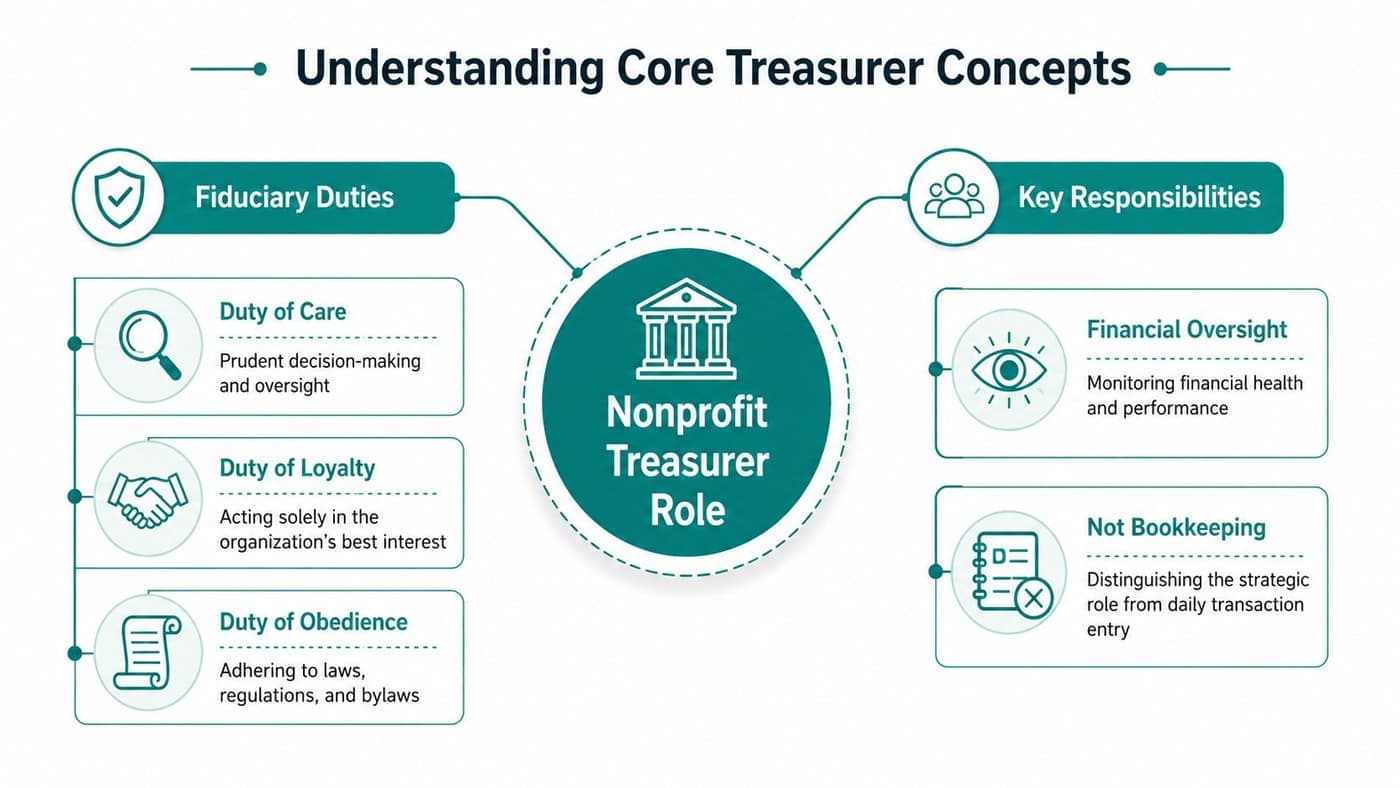
A treasurer is the board's financial guardian, and that title points to judgment, not data entry. The role is to protect the organization's money, review whether reports are accurate, and keep the board informed enough to make sound decisions. A board can't govern what it can't see, so this visibility is part of the job, not an extra.
A simple way to picture the role is as an air traffic controller. Staff and contractors move the planes, while the treasurer watches the pattern, confirms spacing, and helps prevent collisions in policy, cash flow, and reporting. That oversight only works when the treasurer understands what belongs to the board and what belongs to day-to-day staff work.
Fiduciary duties in plain English
The usual fiduciary duties are care, loyalty, and obedience. Duty of care means you read the reports, ask questions, and make prudent decisions. Duty of loyalty means you put the organization's interests ahead of personal ties. Duty of obedience means you follow the bylaws, laws, and donor restrictions that govern the money.
Those duties are not abstract legal language. They show up when you ask whether a restricted gift is being tracked correctly, whether a payment needs a second approval, or whether the board understands a cash shortfall before it grows. They also shape how the treasurer works with staff, since the board should oversee the system while staff carries out the transactions.
Oversight is not bookkeeping
Boards often get tangled when defining the treasurer's transactional duties. The treasurer should verify that books are accurate, reconciliations exist, and reports are timely, but the treasurer should not be the only person entering transactions.
That distinction protects both the organization and the volunteer. If one person records, approves, and reconciles everything, the board loses a basic control and leaves more room for error or misuse.
The treasurer's fundamental job is to keep the financial story honest, not to write every line of it.
For nonprofits that track donor limits, internal structure matters even more. A dedicated system for restricted and unrestricted funds is part of the job, and true fund accounting gives those categories a proper home instead of forcing everything into one generic ledger. That same separation also makes it easier for the board to ask the right questions without drifting into bookkeeping detail.
Understanding the boundary between oversight and execution keeps conversations calmer and more useful. It also helps the treasurer know when to review a process, when to question a report, and when to let staff handle the mechanics. For a broader view of that boundary in practice, see understanding partnership fiduciary responsibilities.
Daily Monthly and Annual Treasurer Tasks
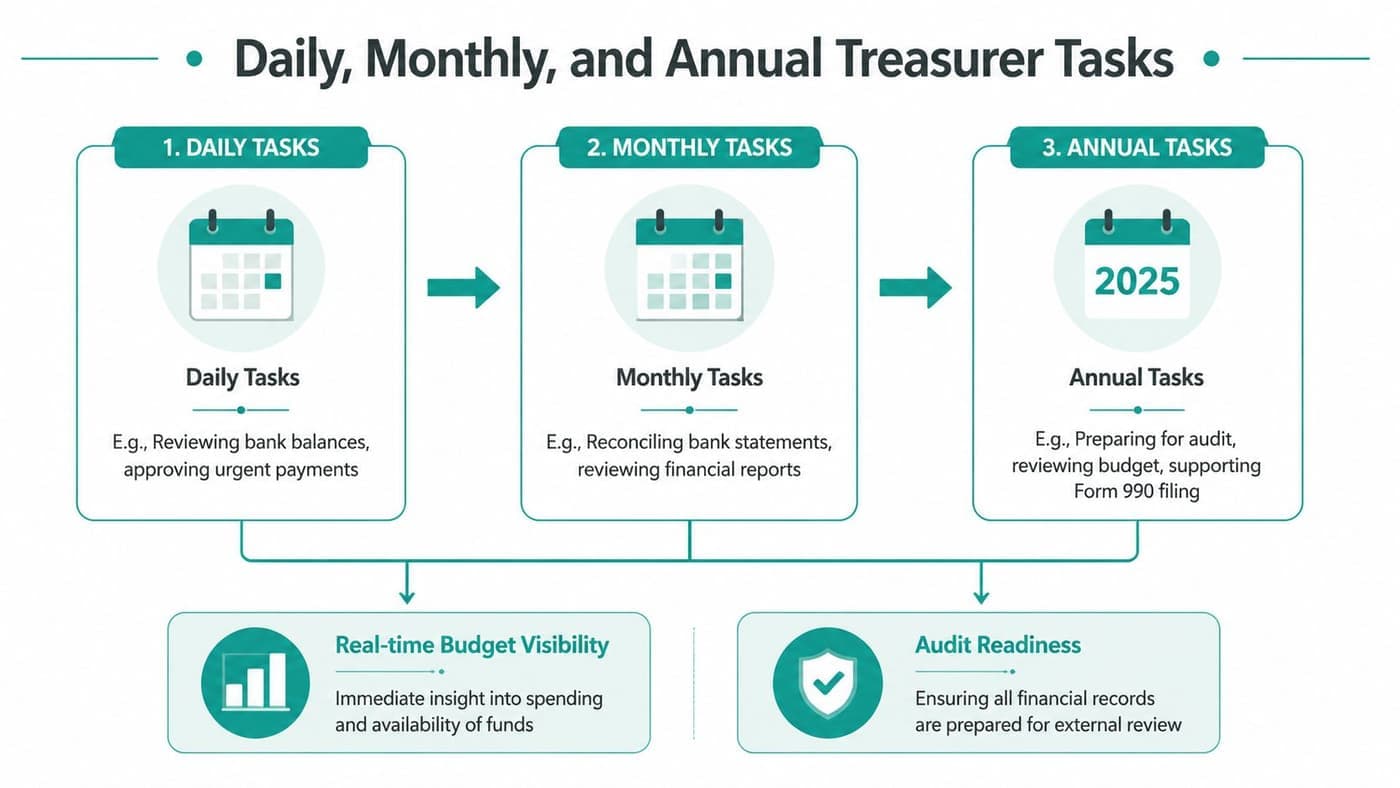
A treasurer's workload becomes easier to manage when it follows a steady rhythm. Cash checks happen often, reconciliations happen on a schedule, and compliance work should not wait until a filing deadline is already in front of the board.
That rhythm also protects the mission. If you know where the money is, what is restricted, and what has already been promised, you can support payroll, programs, and board decisions with less guesswork. In a small nonprofit, that clarity works like a shared map, it helps the board oversee the picture without slipping into transaction-level bookkeeping.
Daily and weekly checks
A useful daily habit is a quick look at cash position and unusual activity. That does not mean the treasurer should approve every payment personally. It does mean someone should be watching money movement closely enough to spot problems early.
From an operational-control perspective, treasurers are commonly responsible for the cash-management cycle, including bank relationships, bank statement reconciliation, cash flow tracking, and reserve monitoring, because these indicators show whether a nonprofit can meet payroll and sustain programs, according to Nonprofit Law Blog's treasurer duties guide.
A steady weekly pattern usually includes these checks:
- Review bank activity: Look for deposits that have not posted, duplicate withdrawals, or anything unusual.
- Confirm cash availability: Make sure near-term obligations will not strain liquidity.
- Check open items with staff: Ask whether any donation batches, reimbursements, or grant receipts need attention.
A short review is often enough to catch a mismatch before it spreads into the rest of the month. That is especially helpful for busy executive directors, because a missed deposit or delayed reimbursement can distort the numbers the board relies on.
Monthly reporting and board visibility
Monthly work is where oversight turns into board intelligence. The treasurer should review reconciliations, compare actual results with budget, and present the story in plain language.
That monthly report should help the board answer a few basic questions. Are we on pace, are any programs overspending, and are restricted balances still protected? Those questions matter because a board cannot govern what it cannot see.
A practical month-end routine often includes:
- Bank reconciliation review: Confirm the books match the bank, then resolve differences.
- Variance analysis: Explain why spending or income differs from plan.
- Statement review: Look at the Statement of Financial Position, Statement of Activities, and cash summaries before the board meeting.
For teams that want a repeatable process, this internal guide can help turn month-end close into a checklist instead of a scramble. That kind of routine gives board members cleaner information and gives staff a predictable handoff point.
Annual responsibilities that can't slip
The annual cycle is where compliance and planning come together. Budget planning should happen before the board needs to vote, audit prep should start before auditors ask for documents, and the IRS filing process needs enough lead time for review.
For U.S. nonprofits, the annual Form 990 is a recurring milestone, and many exempt organizations must file it each year to preserve transparency and tax-exempt status, as noted in the treasurer guide from Get Holdings. That same source also points to the treasurer's role in reviewing financial statements and compliance reporting.
Simple rule: if a task affects public trust, tax status, or board decision-making, it belongs on the treasurer calendar.
Used well, the yearly calendar keeps the board informed without forcing the treasurer to become a part-time accountant. It also gives the executive director and finance committee a cleaner way to divide duties, with staff handling the records and the board focusing on review, questions, and approval.
Establishing Controls and Delegation Boundaries
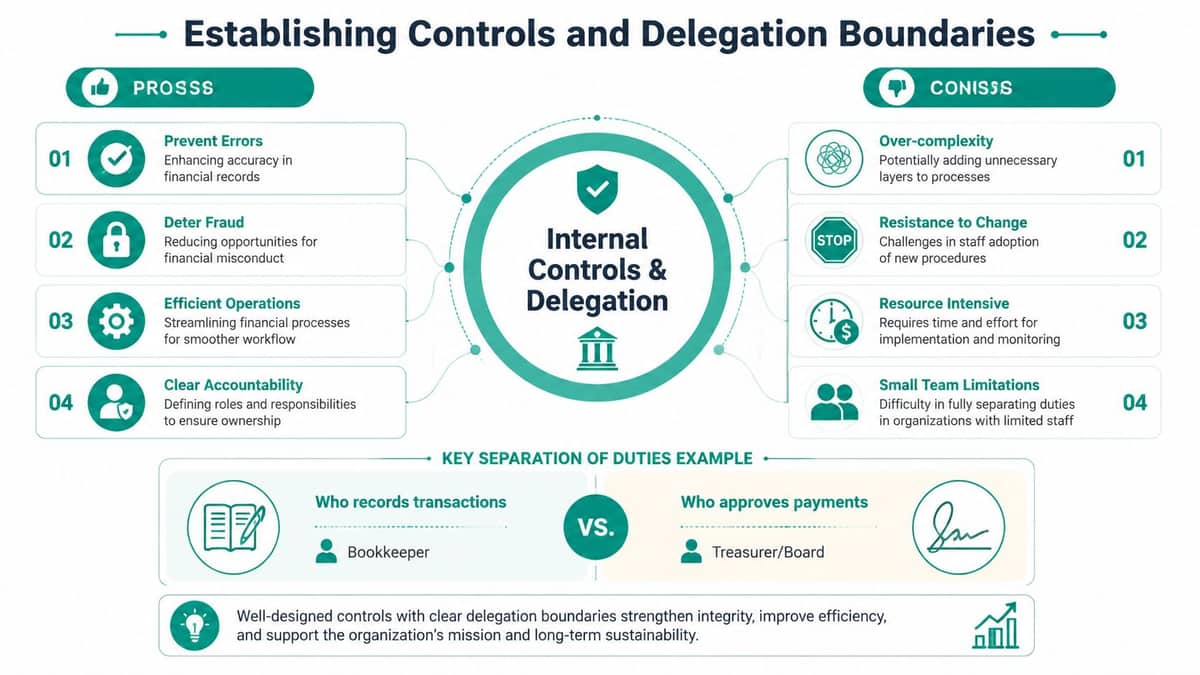
The fastest way to reduce treasurer stress is to make approval rules clear. When people know who records, who reviews, and who approves, the finance process gets safer and the board gets better oversight.
That clarity matters even more for small nonprofits. Many boards have a volunteer treasurer, one bookkeeper, and a staff person wearing three other hats, so blurred roles can create confusion and burnout.
What controls the treasurer should verify
The treasurer doesn't need to create every control personally. The board does need to confirm that basic safeguards exist and are followed.
A useful control set usually covers separation of duties, approval thresholds, and regular reconciliation. One person should not be the only person who can enter, approve, and close the same transaction cycle.
What should be delegated
The boundary is easier than it looks. Day-to-day bookkeeping, invoice entry, deposit posting, and payroll processing usually belong to staff or a contractor. The treasurer should then review reports, ask for explanations, and verify that the controls are working.
That distinction is one of the most underserved parts of nonprofit advice. Many guides focus on oversight and reporting, but they rarely spell out the handoff between board work and staff execution, which can leave small teams guessing, according to Jitasa's nonprofit treasurer guide.
Trade-offs small nonprofits should expect
Internal controls are helpful, but they can also feel heavy if the team is tiny. A board with two finance-minded volunteers can separate tasks more easily than a church or school running on shared labor.
The best approach is practical, not perfect.
- Prevent errors: Separate recording from approval so mistakes are easier to catch.
- Deter fraud: Limit how much one person can control without review.
- Reduce burnout: Give the treasurer oversight work instead of daily transaction work.
- Keep accountability visible: Put the approval process in writing so the board can check it.
Controls should fit the size of the organization. If they're too complex to follow, they won't protect anything.
If you're reworking volunteer finance roles, this transition checklist is a practical reference point for handoffs and documentation. A small nonprofit doesn't need a perfect corporate structure, but it does need one clean line between approval and execution.
Reporting and Compliance Requirements
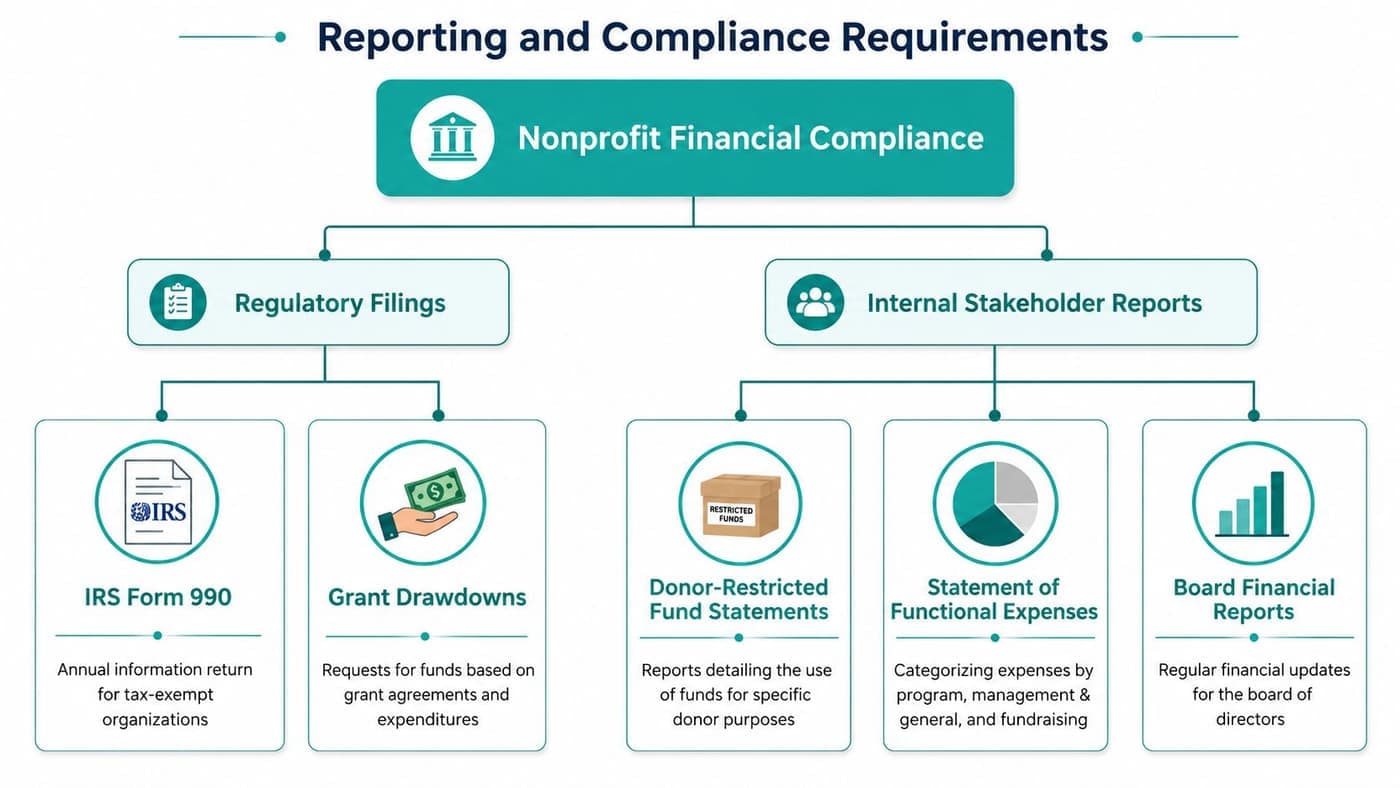
The treasurer's reporting work protects both credibility and continuity. Boards, donors, grantmakers, and regulators all need different views of the same financial truth, and each one expects the numbers to line up.
That's where fund accounting becomes essential. Nonprofits track donor-restricted money in separate buckets, not one generic business ledger, and TreasuryXL's nonprofit treasurer guide is clear that software or a dedicated fund accounting system is necessary, not optional.
What goes to regulators
The annual IRS Form 990 is the best-known filing, and it exists to preserve transparency and tax-exempt status. Treasurers also need to pay attention to payroll tax filings and any reporting tied to the organization's legal structure or local requirements.
For nonprofits with grants, drawdown requests matter too. Those requests should match the spending rules in the grant agreement, so the treasurer can see whether reimbursable costs and restricted balances are aligned.
What goes to the board
Board reports should answer governance questions, not bury directors in account detail. A clean package usually includes the Statement of Financial Position, Statement of Activities, cash summaries, and the split between restricted and unrestricted balances.
You may also need the Statement of Functional Expenses when the board wants to understand how money flowed to programs versus administration and fundraising. That report becomes especially useful when directors need to explain finances to supporters or auditors.
What the treasurer should be watching
The treasurer does not need to produce every report alone. The treasurer does need to verify that the reports are accurate, complete, and useful before they reach the board or the filing deadline.
- Restricted funds: Confirm donor restrictions are honored and visible in the reports.
- Compliance timing: Make sure filings are submitted on schedule, not rushed at the end.
- Audit trail: Keep bank reconciliations, trial balances, and support documents organized.
If a report can't be traced back to the books, it isn't ready for the board.
For a practical filing aid, this Form 990 checklist is a good companion when filing season gets busy. The reporting habit is the point, because a board that trusts its numbers can govern with more confidence.
Collaborating with Staff and Finance Committee
Good treasurers don't work in isolation. They build a clear working relationship with the executive director, the bookkeeper, and the finance committee so financial issues get solved before they become board problems.
That partnership matters because each person sees a different part of the picture. Staff know the operating details, the bookkeeper knows the transaction flow, and the treasurer keeps the board focused on oversight and risk.
The best finance meetings are short, structured, and predictable. A simple agenda might move from cash position to budget variance, then to restricted balances, then to decisions that need board action.
Practical rule: the treasurer should never surprise the executive director in a board meeting. If a question is likely to come up, discuss it first.
That approach also helps non-finance board members stay engaged. Instead of hearing raw numbers, they hear the meaning behind the numbers, which makes it easier to approve budget changes or ask better questions.
The finance committee can also carry a lot of the detailed work that the full board should not have to absorb. A strong committee reviews draft reports, checks assumptions, and flags issues early, then the treasurer brings a clear summary to the board.
Communication templates help too. A short monthly note can cover cash, variances, and any compliance items that need attention, while a quarterly meeting can handle deeper questions about reserves, grant timing, or capital needs.
Skills Templates and Implementation Advice
A capable treasurer is part interpreter, part reviewer, and part process keeper. The role works best when the board gives that person a clean framework, not a pile of disconnected files and vague expectations.
That's why templates help. A skills checklist, approval log, and board report format can turn a volunteer role into a manageable governance job without forcing anyone into daily bookkeeping.
Treasurer duties commonly include budget control with variance reporting and regular accounting review, including budgets that are prepared, approved, and monitored with recurring reports such as bank reconciliation statements and trial balances for management review, as stated in the FMSF guide.
Skills worth checking
The treasurer doesn't need to be a CPA, but the person should be comfortable reading financial statements and explaining them in plain English. That includes knowing the difference between restricted and unrestricted money, understanding why reconciliations matter, and spotting when a report doesn't make sense.
A good skills checklist should also ask about communication and judgment. The strongest treasurers are rarely the loudest people in the room, but they do ask the clearest questions.
Templates that save time
A practical board package usually includes three parts. First, a summary page with cash, budget variance, and any risk items. Second, the financial statements. Third, any action items the board needs to approve.
For a small nonprofit, a one-page approval log can be just as useful as a long policy manual. It shows who approved what, when they approved it, and whether a second review was required.
How to adapt for churches, schools, and fiscal sponsors
Churches often need clearer tracking for designated gifts and ministry budgets. Schools usually need tighter reporting around grants, tuition, and event income. Fiscal sponsors need clean project-level reporting so each sponsored program can be reviewed separately.
Those differences matter, but the workflow stays familiar. One system for the numbers, one process for approval, and one person accountable for oversight is enough for many small organizations.
If you're thinking about user access, a good rule is simple. Every staff member or volunteer who needs to see the data should have access, without creating extra seat fees that punish collaboration. That's especially useful when several people help with finance, events, donor follow-up, or volunteer coordination.
Start Streamlining Treasurer Duties with AlignMint
If your treasurer process still depends on spreadsheets, manual reports, and scattered tools, the role will keep feeling heavier than it should. A cleaner setup gives board leaders and staff a clearer view of funds, donors, volunteers, and reports, without turning finance into a puzzle that only one person can solve.
AlignMint brings accounting, CRM, volunteers, events, and marketing into one place, with true fund accounting, unlimited users, and a free tier for nonprofits under $100K. It also includes a built-in marketing suite and Minty, so your team can move faster without stitching together separate systems.
The bigger advantage is governance clarity. Board treasurers can stay focused on oversight, review, and approval, while staff handle day-to-day data entry and follow-up inside the same system. That split matters for small nonprofits, where one person often wears several hats and the line between board duty and staff work can blur quickly.
If you are comparing tools, start with our all-in-one platform page. Then review how donor management workflows can reduce manual follow-up while keeping the treasurer's oversight role intact.
A CTA for AlignMint.
Ready to try AlignMint with your nonprofit?
Start free — set up donor tools, giving pages, and Minty. Upgrade when you need accounting.