

Church Financial Management: A Practical Guide for Leaders
You're probably living with the same problem every church leader faces. The giving comes in unevenly, the bills don't, and somebody still wants a clean answer about restricted money before lunch.
That's why church financial management feels harder than it should. The fix isn't more chaos, more spreadsheets, or another shiny software demo, it's a system that matches how churches handle money.
Quick Answer: Church Financial Management
Church financial management is the system that turns uneven giving, restricted gifts, and weekly operations into fund balances, controls, and reports leaders can trust. The work is structural: donor intent, cash timing, and access have to stay visible without a reconstruction project.
Pair this with church financial reporting and church accounting software for small churches. For the ledger, see fund accounting.
Why Church Financial Management Feels Harder Than It Should
Monday morning at a church office usually starts with paper, not clarity. There's a stack of bank statements, a member asking for a giving statement, a pastor wanting a budget update, and a payroll run due Friday.
The pressure comes from the shape of church money itself. Member contributions dominate revenue, and the Faith Communities Today finance report found 85% of congregational revenue comes from participant contributions such as tithes, offerings, and dues, while only 4% comes from fundraising events, 4% from rental income, and 6% from other sources (Faith Communities Today finance report). That means your finance team is not managing a business-like revenue mix, it's managing donor intent, cash timing, and trust.
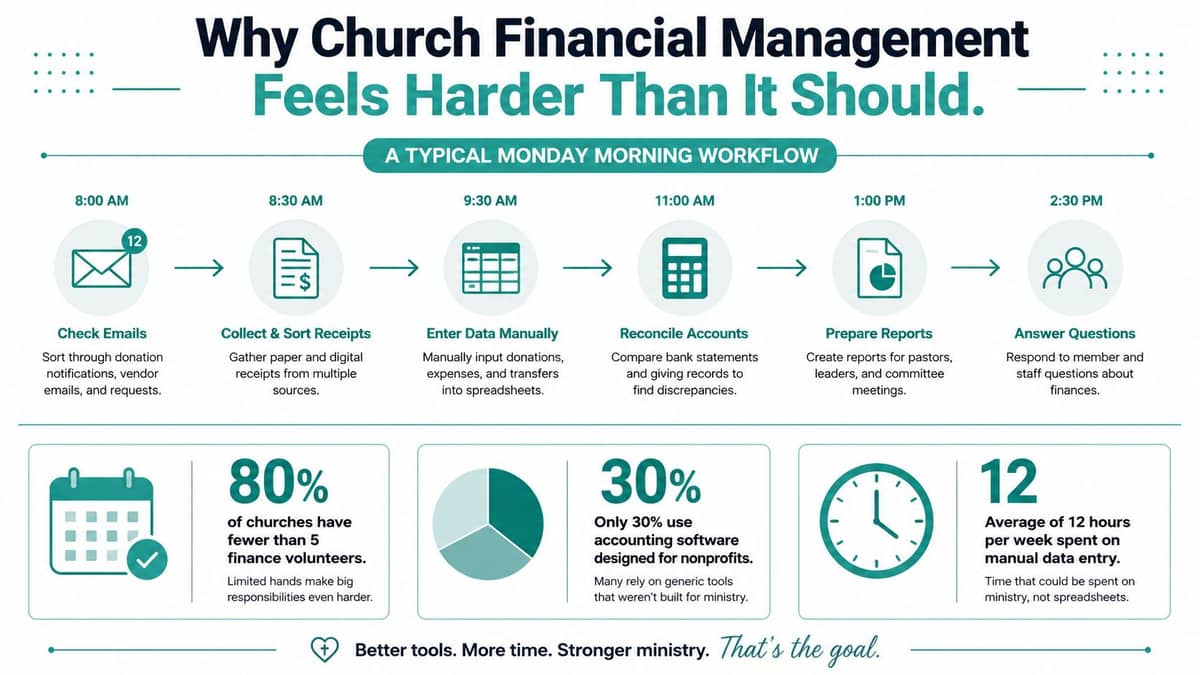
The real strain is structural
Church income is often modest, and it can shrink. The same Faith Communities Today report noted a median income or gifts of $120,000, which was a 20% decline from 2010 (same report). That matters because a church with fixed payroll and utility bills can't absorb slippage the way a commercial business can.
Practical rule: if restricted gifts, general offerings, and designated funds are not tracked separately, your reports will look cleaner than your books really are.
The sector also has a scale problem. Slightly more than half of American worshipers, 51%, attend large congregations with budgets over $1,000,000, even though most congregations are small and have budgets under $100,000 (Faith Communities Today finance report). Small teams can't copy large-church systems and expect them to work.
If your office feels underpowered, that doesn't mean you're failing. It means your finance system was built for a simpler organization than the one you're leading. If you want a free starting point for smaller congregations, see our guide on how small churches can manage finances for free.
Fund Accounting and Restricted Funds Without the Headache
Think of fund accounting as labeled envelopes, not one giant cash pile. Each envelope has its own donor intent, its own balance, and its own rules.
That's the whole point. A donor who gives for a roof repair expects roof repair money, not general payroll support. Churches that mix those funds create confusion fast, even when nobody means to do it.
Start with the donor's intent
Use three basic categories. Unrestricted funds are general tithes and offerings your leaders can allocate. Temporarily restricted funds are gifts tied to a purpose or time period, like a building campaign or a mission trip. Permanently restricted funds are usually endowment-style gifts that can't be spent directly.
A real fund accounting system keeps those buckets separate automatically. It tracks each gift to its fund, shows live balances, and makes it much easier to produce the statements board members and donors expect.
Donor intent isn't a nice extra. It's the line between trustworthy stewardship and sloppy bookkeeping.
You can see this idea in practical use through the 1021 Events portfolio, where fund management is treated as a separate reporting discipline instead of a loose spreadsheet habit. That's the right instinct for churches too.
The operational benefit is simple. Leaders stop guessing at what's available, finance volunteers stop reclassifying gifts by hand, and monthly reports stop turning into detective work. If your software can't show restricted balances clearly, it's not helping you manage church finances, it's hiding the problem.
For a deeper reference on fund structure and restricted balances, use our internal guide on restricted funds. A good system should make that separation visible without making your treasurer become an accountant.
Budgeting Around People, Property, and Volatile Giving
Church budgets break in predictable places. Payroll, utilities, insurance, and maintenance keep coming even when giving dips, and that's why a church budget is really a fixed-cost problem with a variable-income layer on top.
The expense mix is the clue. Church Law & Tax summarized survey data showing that almost half of congregational resources are invested in personnel and another quarter in maintaining facilities (Church Law & Tax). A related benchmark from Leadership Network, cited by Vanderbloemen, found the average church allocates about 52% of its budget to staff compensation, with a typical range of 46% to 60% (Church Law & Tax). More recent U.S. research reported 43% for staff salaries and 26% for building operations, with 11% for program materials and 13% for mission and benevolence (Church Law & Tax).
Stop treating the annual budget like the whole answer
A balanced budget on paper can still fail in a low-giving month. The better move is a 12-month cash-flow view that lines expected giving up against known obligations, especially payroll.
Budget for payroll first, then ministry, then everything else. If you reverse that order, the church will eventually feel it.
You don't need fancy finance jargon to do this well. You need a realistic forecast, a reserve buffer, and the discipline to revisit numbers monthly instead of waiting for year-end panic. That's also why a template matters. If you want a practical starting point, our nonprofit budget template in Excel is a better baseline than building one from scratch in a rush.
For churches that publish books, events, or curriculum, the same discipline applies to every project. A cost structure makes sense only when it's compared against the cash that arrives, not the cash you hope will arrive. For a useful contrast on project planning and cost visibility, the BarkerBooks book production resource shows how careful cost planning changes the conversation before expenses pile up.
Internal Controls and Separation of Duties That Hold Up
Strong controls protect good people. They protect the treasurer from suspicion and the pastor from preventable messes. They also make it easier to see who touched the money, when, and why.
Church finance guidance is clear about the structure. The person who approves purchases should not prepare checks. Access to bank accounts should stay limited to a small group, and blank checks should never be pre-signed (Church Law & Tax internal controls). That is common sense, not bureaucracy.
Separate the responsibilities, even if the team is small
A small staff does not excuse sloppy process. It just means the process has to be simple enough for volunteers to follow and strict enough to keep one person from controlling every step.
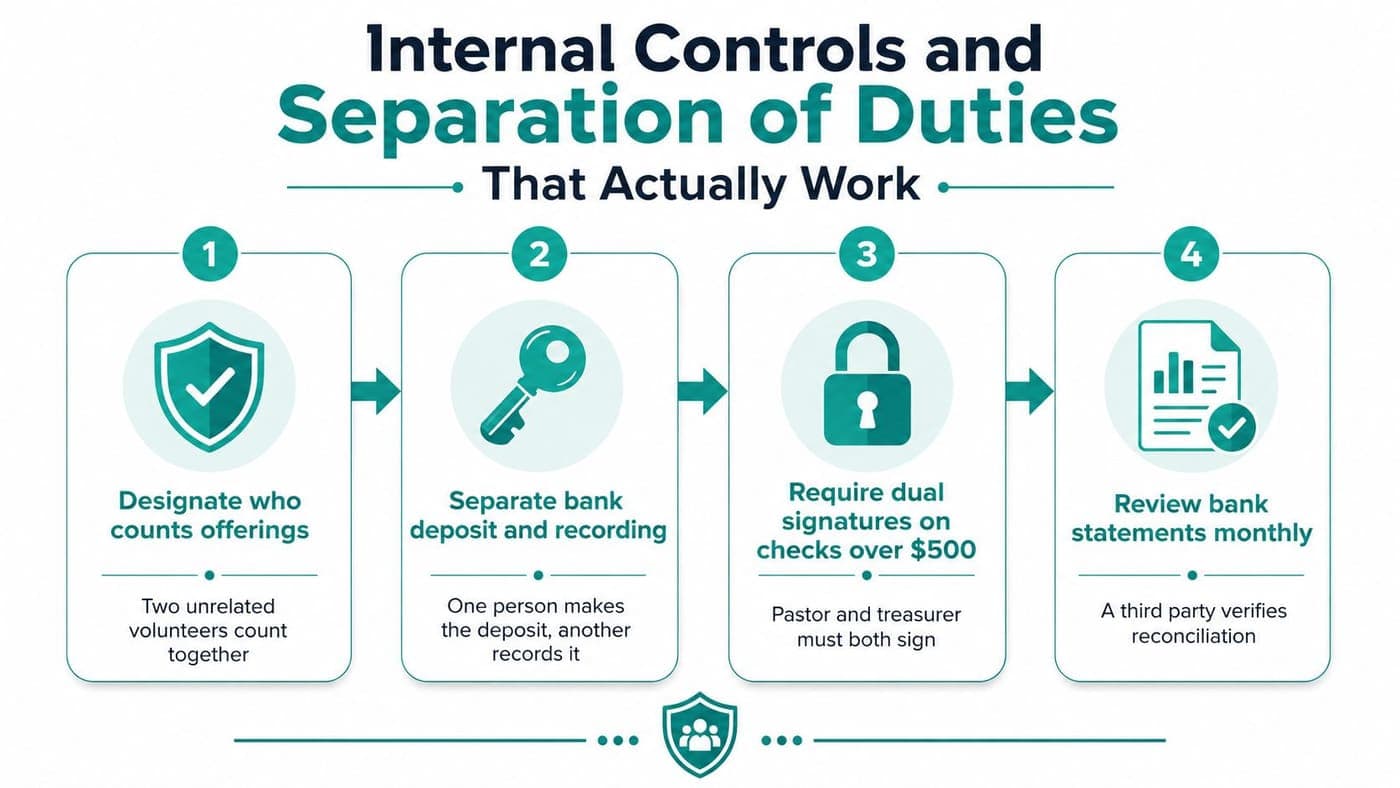
Start with the offering count. Two unrelated people should count together, and the count should be documented before anyone heads to the bank. Then separate the deposit from the recording, so the person who takes the money in is not the same person who posts it. Keep approval and payment apart, too. The person who signs off on a bill should not be the one cutting the check or reconciling the account.
Monthly bank statement review belongs in the hands of someone who did not process the transactions. If the same person records and reviews, the review is theater.
Churches that set up segregation of duties this way can tighten controls without slowing ministry work. Ministry leaders approve, finance staff process, and an independent reviewer checks the books.
If you need a practical reference for handling cash movement, our guide on cash disbursement journals is a useful companion piece. It helps turn “we should have controls” into a clear assignment of who does what.
Good controls are not about distrust. They make honest work easy to verify.
That matters most in churches where volunteers rotate often. The system has to be simple enough that a new person can follow it without special training, but firm enough that nobody can override it.
Donor Receipts, Pledge Tracking, and Form 990 Readiness
Giving statements, pledge tracking, and Form 990 prep should share one ledger. If those records sit in separate files, staff will waste time reconciling them, and January will turn into cleanup instead of administration.
Every restricted gift needs a receipt trail that stands up to review. Pledges also need to be matched against actual giving, or leaders will treat hoped-for cash as available cash and underfund the year. The same records also feed Form 990 readiness for a church or related entity that has to file.
Build the habit into the month, not the year
Receipting daily or monthly keeps year-end from becoming a fire drill. It also makes donor communication more reliable, because the thank-you message and the tax statement come from the same record.
For a donor-facing reminder of why giving matters spiritually, the piece on how tithing shows gratitude to God is a helpful complement to the administrative side. Churches often speak well about generosity, then handle the receipts carelessly. That split creates confusion for donors and extra work for staff.
Use our Form 990 checklist to keep January from becoming a scramble. Put the steps on a simple timeline:
- January: close the prior year and prepare 990 materials.
- March: send annual statements to donors.
- Every month: issue receipts, review pledge progress, and check fund balances.
Compliance gets easier when the daily habits are boring and consistent.
The value of a connected system is simple. Receipts, pledge tracking, and functional expense reporting all come from the same ledger, so staff are not rebuilding the same story three times. That also makes it easier to catch problems early, before a pledge report, donor statement, or filing deadline exposes the gap.
If your staff asks why this matters, answer plainly. It saves time, cuts errors, and makes your church easier to trust. That is the point of the paperwork.
Payroll, Benefits, and Audit Preparation Basics
Church payroll is not ordinary payroll. Ministers have a housing allowance issue, self-employment Social Security treatment, and parsonage considerations that regular office staff don't face.
That means the church must document clergy tax status before the numbers are paid, not after. If a housing allowance wasn't designated in advance, the paperwork gets messy and the risk rises. A pastor can be both an employee for income tax purposes and self-employed for Social Security, so this is not a place to improvise.
Make the file readable by a stranger
Audit readiness isn't about whether you're having a full audit this year. It's about whether someone new could open the books and understand what happened.
Keep these documents close at hand:
- Reconciled bank statements
- A chart of accounts by fund
- The general ledger
- Year-end giving reports by donor
- Board-approved financial policies
When those pieces are current, review work gets easier and anxiety drops. When they're scattered, even a basic review feels like a rescue mission.
Church financial management gets stronger when payroll, giving, and policies connect. If your payroll file says one thing and your giving records say another, someone will spend time untangling it later. That's avoidable.
The best test is simple. Could a board member, auditor, or outside accountant read the file without asking you to narrate every step? If the answer is no, the file isn't ready yet.
Choosing Church Financial Software Without the Sales Pitch
The right software should make restricted funds, donor records, and reporting line up without spreadsheet gymnastics. If it can't do that, it's a workaround, not a system.
QuickBooks is familiar and widely supported. Churches often use class tracking to mimic fund accounting, but that workaround can be fragile when restricted gifts, donor records, and reports need to stay linked. QuickBooks Online, QuickBooks Desktop, Aplos, Planning Center, and Blackbaud Financial Edge all have different strengths, but none should get a free pass on how they handle real fund balances.
Judge tools by the question they answer fastest
Ask one question during a demo. Show me a restricted gift moving from the donation page to the financial statement without exporting to a spreadsheet.
That question exposes the gap fast. A church tool can be friendly for weekly operations and still fall short on donor CRM depth. An enterprise platform can be powerful and still be too heavy or too expensive for a smaller congregation.
| Tool Category | Fund Accounting | Donor CRM | Pricing Model | Best Fit |
|---|---|---|---|---|
| QuickBooks Online | Limited by class workaround | External add-ons often needed | Subscription | Churches needing familiar bookkeeping |
| Aplos | Built for nonprofit fund tracking | Integrated | Subscription | Small to mid-sized nonprofits and churches |
| Planning Center | Strong for church operations | Integrated | Subscription | Churches focused on weekly ministry workflows |
| QuickBooks Desktop | Familiar desktop bookkeeping | Limited | License-based | Teams that prefer local software and simple records |
If you want one platform that connects accounting, CRM, volunteers, events, and marketing, AlignMint is in that category. It's built for churches and nonprofits that want true fund accounting, donor records, and live reporting in one place, rather than stitched together tools.
Your First 30 Days and a Clear Path Forward
Start with the facts on your desk, not a software demo. Pull the last three months of bank statements, list every restricted gift and its donor, identify who can access the bank account and online giving tool, and produce a current fund balance report, even if it's rough.
That will tell you more than a polished presentation ever will. If restricted fund tracking takes more than a day each month, if donor statements take more than a week to produce, or if the treasurer can't answer a building-fund question without digging through files, you've outgrown spreadsheets.
Use the next month to expose the bottlenecks
The goal isn't to redesign everything at once. The goal is to see where money gets stuck.
- Look at access first. Who can approve, pay, and reconcile?
- Then check fund visibility. Can you see restricted balances without manual math?
- Then test reporting speed. How long does donor receipt work take?
- Finally, ask about board clarity. Can someone read the reports without a walkthrough?
A clean system gives you live fund balances, connected donor records, and reports that make sense on the first read. That's the standard worth holding.
If you want a path that connects accounting, donor management, volunteer tracking, events, and church communication without per-seat fees, AlignMint is built for that. It includes true fund accounting, an integrated CRM, and a free tier for organizations under $100K, so smaller churches aren't forced into expensive software before they're ready.
If your church is still wrestling with disconnected spreadsheets, we can help you tighten the system without adding another layer of complexity. Visit AlignMint to see how true fund accounting, donor records, and practical reporting work together for churches like yours.
Ready to try AlignMint with your nonprofit?
Start free — set up donor tools, giving pages, and Minty. Upgrade when you need accounting.