

You're staring at a monthly finance packet that technically balances, yet your board still can't answer a simple question: how much cash can we spend on ministry this month? That gap between compliant statements and decision-ready information is where financial reporting for churches often breaks down.
The fix isn't another spreadsheet or a longer meeting. You need fund accounting that honors donor intent, statements that separate restricted resources, and internal cash reports that help leaders act confidently without creating more manual work.
Quick Answer: Financial Reporting for Churches
Financial reporting for churches works when fund accounting separates restricted gifts from operating cash, then the same records produce board packets, member summaries, and formal statements. If the board cannot see what is spendable this month, the reports are not finished.
Pair this with church financial reporting and church financial management. For the ledger, see fund accounting.
Why Church Financial Reporting Feels Overwhelming
The treasurer arrives with a balance sheet, a budget comparison, and several spreadsheets from online giving, events, and ministry accounts. The totals appear reasonable, but nobody can quickly explain whether the building fund is fully covered, whether unrestricted cash can support payroll, or why giving looks different from the bank deposit.
That frustration is understandable. Churches don't manage money like ordinary businesses because the same bank balance can contain resources with very different permitted uses. A general offering may support operations, while a donor-designated gift may belong to missions, a building campaign, or a specific ministry.
Compliance answers one set of questions
External reporting asks whether your records are accurate and properly presented. Your board asks different questions:
- Available cash: What can we spend on ordinary operations?
- Restricted balances: Which resources remain committed to donor-designated purposes?
- Operating results: Are unrestricted revenues covering unrestricted expenses?
- Timing: When will pledged or recurring gifts reach the bank?
- Accountability: Can we explain the numbers clearly to members?
A report can satisfy an auditor while leaving leadership without those answers. That's why your reporting system must produce both formal statements and internal management views from the same underlying records.
A 2015 ECFA church financial management survey found that just under 70% of ECFA-certified churches submitted an annual financial report to their congregations, compared with just under 36% of churches that weren't ECFA-certified (ECFA church financial management survey). The comparison shows why reporting practices matter as governance, not merely bookkeeping.
What good reporting feels like
Good reporting reduces explanation time. Your finance team records a gift once, assigns its fund correctly, reconciles the deposit, and lets the system reflect that activity in donor records, fund balances, and statements.
The board receives a concise packet with formal statements, budget-to-actual results, restricted fund activity, and operating cash. The congregation receives a readable summary that connects giving with ministry work.
For practical guidance on controlling costs while improving your process, see how small churches can manage finances for free. The right system turns reporting into a repeatable ministry discipline instead of a monthly rescue project.
Understanding Fund Accounting and Restricted Funds
Fund accounting starts with purpose. Instead of treating every dollar as interchangeable, you track resources according to the conditions attached to them. That structure protects donor intent and gives leaders a truthful view of available resources.
Church financial reporting should separate donor-restricted and unrestricted resources in the ledger and annual accounts because restricted gifts remain tied to a specific purpose or time period until the restriction is met (guidance on accounting for different types of funds).
Start with two operating categories
Use clearly labeled funds or fund centers for:
- Without donor restrictions: General offerings and other resources leadership can direct toward ordinary ministry and operations.
- With donor restrictions: Gifts committed to a stated purpose or time condition, such as a building campaign or mission trip.
Don't rely on memory, spreadsheet colors, or a note in a donor record. The restriction must remain visible in the ledger, reports, and approval process.
Consider a building campaign. A member gives specifically toward construction, renovation, or debt reduction. That money may sit in the same bank account as operating cash, but your accounting system must identify it separately. A healthy report shows the restricted balance and related spending without suggesting that leadership can redirect it toward salaries or utilities.
A mission trip works the same way. Record gifts designated for the trip in the appropriate restricted fund, charge qualifying travel and program expenses to that fund, and show the remaining balance after each close. The system should also preserve the transaction history so your team can explain how the fund moved.
Why classes aren't true fund accounting
QuickBooks classes can help categorize activity, and QuickBooks has strengths for familiar bookkeeping workflows. But classes are typically reporting tags layered onto accounts, not a native structure for managing donor restrictions, releases, and fund-level balances.
That distinction matters when you need to answer whether cash is available, whether a restriction has been satisfied, and how a release affects net assets. If your team must maintain separate spreadsheets to reconcile those questions, the system is creating risk rather than removing it.
Read this guide to fund accounting for nonprofits before choosing a platform. Ask vendors to demonstrate a restricted gift from receipt through deposit, expense allocation, release, and board reporting. If the demonstration skips those steps, the product probably won't fit your church.
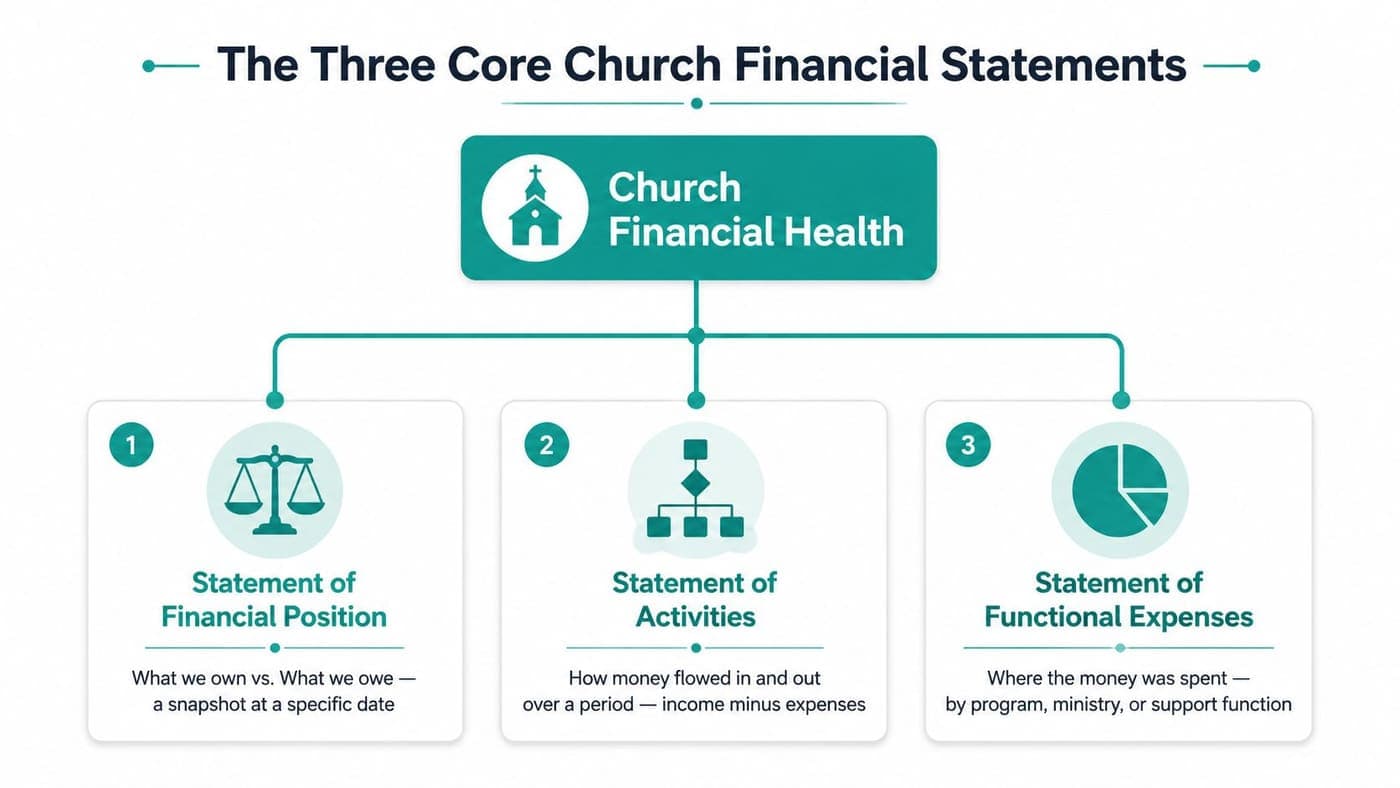
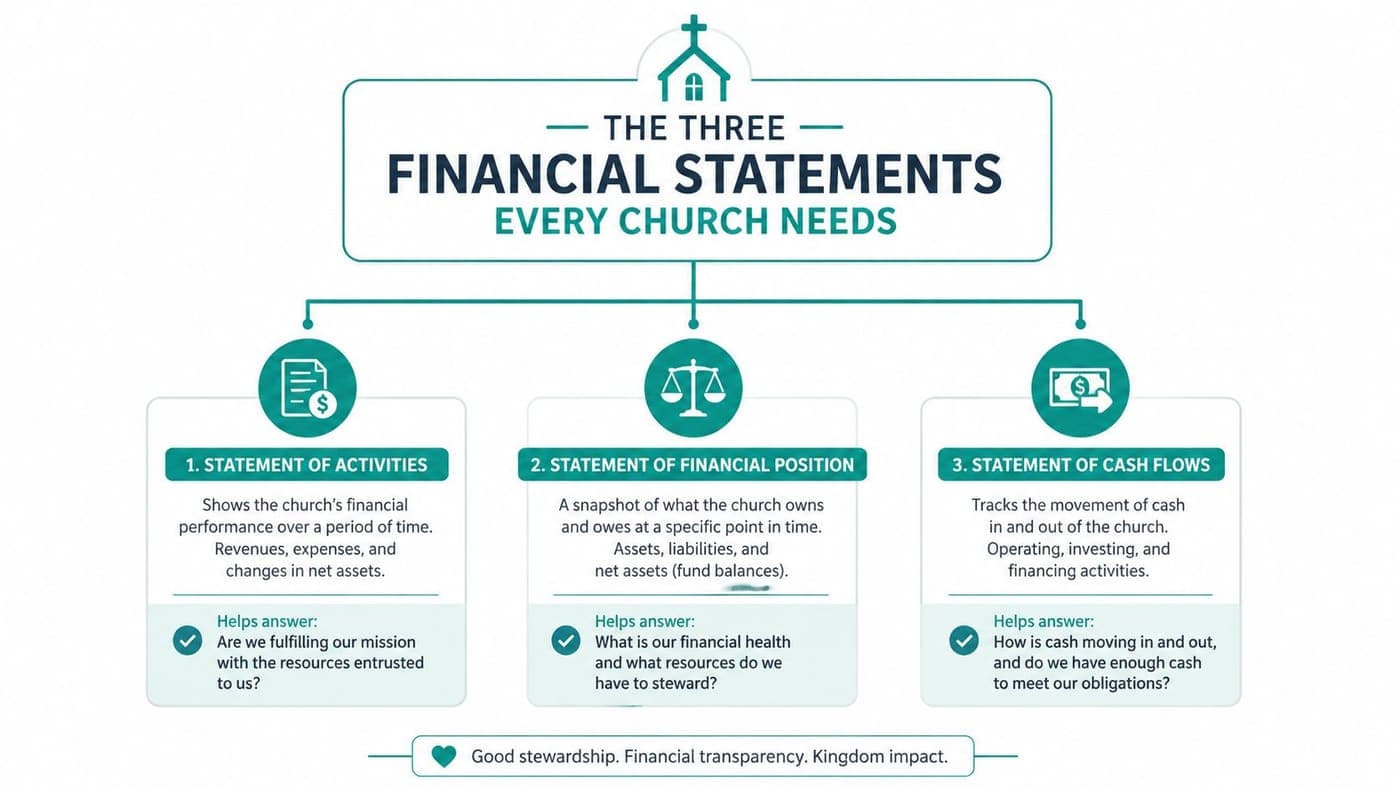
The Three Financial Statements Every Church Needs
Financial statements work together, but each one answers a different leadership question. Treating them as separate documents creates confusion. Reading them as connected views gives you a practical picture of financial health.
Statement of Financial Position
This statement shows assets, liabilities, and net assets at a specific date. It helps your board understand what the church owns, what it owes, and how resources are classified.
The key issue is availability. A large total asset balance doesn't necessarily mean your church has flexible operating resources. Restricted cash, debt obligations, and other commitments can limit what leadership can spend.
Statement of Activities
The Statement of Activities shows revenue, expenses, and changes in net assets over a period. It helps you evaluate whether ordinary operations are producing a sustainable result and whether restricted activity is being presented separately.
Look for the relationship between unrestricted revenue and unrestricted expenses. A positive total change in net assets can hide pressure in the operating fund if restricted contributions make up a meaningful portion of the period's activity.
Statement of Functional Expenses
This statement groups expenses by function, such as ministry programs, management and general activities, and fundraising. It gives leaders a clearer view of how resources support the mission.
The report is most useful when allocations follow a documented method. Shared costs, including staff time or facility expenses, shouldn't be assigned casually to make a program appear stronger.
The two net-asset classes
Under FASB ASU 2016-14, nonprofit financial statements use two net-asset classes instead of three: net assets with donor restrictions and net assets without donor restrictions (ASU 2016-14 presentation guidance).
Restriction releases should appear only when the relevant purpose or time condition has been satisfied. That timing can make your cash balance look healthy while operating liquidity remains tight, so include a fund-balance rollforward and a cash availability view with the formal statements.
Your board shouldn't have to reconstruct that story manually. Use a practical guide to creating financial statements to build a reporting packet that connects formal presentation with real decisions.
Choosing the Right Software for Church Finances
Your software choice should begin with the report your board needs, not the feature list a vendor wants to show. Generic accounting tools can be familiar and affordable, while church-specific platforms can handle ministry workflows more naturally. All-in-one nonprofit systems can reduce duplicate entry when finance, giving, events, volunteers, and communications share one record.
Electronic giving makes integration especially important. In the 2025 Annual Financial Audit summarized by Christian Standard, the average share of annual giving received electronically stayed between 38% and 41% from 2021 through 2025 (Christian Standard audit resources). Your system should reconcile online gifts, recurring contributions, donor records, and bank activity without forcing your treasurer to match everything manually.
Compare the approaches
| Software Type | Fund Accounting | Donor Integration | Form 990 Support | Best For |
|---|---|---|---|---|
| Generic business accounting | Often depends on classes, projects, or workarounds | Usually requires a separate giving tool | May support nonprofit reports with configuration | Churches prioritizing familiar bookkeeping |
| Church-specific platform | Often designed around funds and ministry activity | Usually connects giving and member records | Depends on the product and reporting setup | Churches needing ministry-focused workflows |
| All-in-one nonprofit operations platform | Can provide native funds, programs, and restrictions | Accounting, CRM, giving, events, and volunteers share data | Can support nonprofit reporting when configured properly | Churches seeking fewer systems and fewer duplicate entries |
QuickBooks deserves a fair assessment. It's widely understood, supported by many accountants, and useful for straightforward general-ledger work. Its limitation is that church fund accounting can require extra structures when restrictions, donor records, and ministry reporting need to remain connected.
Church-specific products may offer stronger contribution tracking, membership tools, and service management. Their trade-off is that finance, volunteer coordination, marketing, and events may still live in separate systems.
When evaluating integrations, Action Accountants Limited's guide to accounting software integration offers useful questions about how systems exchange data. Ask every vendor whether imports create duplicate donors, whether refunds flow back correctly, and whether bank reconciliation preserves fund detail.
Ask these questions during a demo
- Restriction handling: Can you show a gift, expense, release, and remaining balance?
- Cash visibility: Can leaders see unrestricted operating cash without excluding liabilities?
- Reporting: Can the system produce formal statements and board-friendly management reports?
- Users: Are additional pastors, finance committee members, and volunteers included without per-seat fees?
- Migration: Can you map existing funds, donors, pledges, and historical transactions safely?
AlignMint is one all-in-one option that combines accounting, CRM, volunteers, events, marketing, online giving pages, and team communication. It includes true fund accounting, a Minty assistant for questions about your data, plan-based access without per-seat fees, and a free tier for nonprofits under $100K. Compare it with other church platforms using this church accounting software guide.
Beyond Compliance and Building Real Transparency
An audit doesn't automatically give your leadership a useful cash report. Audited statements answer whether financial information is presented appropriately for the reporting purpose. They don't necessarily show which cash is available for payroll, which program is approaching a funding gap, or whether a restricted balance is sitting unused.
That distinction matters because a church can look healthy in aggregate while leadership lacks visibility into operating liquidity. Your board needs both external compliance and internal decision support.

Timeliness is part of transparency
Voice of the Faithful's 2025 diocesan transparency report found that the average transparency score fell from 71% to 66%, while current audited central-operations reports declined from 114 dioceses to 112 (2025 diocesan financial transparency report). The report identified delayed publication as a major driver of the downward trend.
The lesson applies to local churches. A report published long after a decision has passed doesn't provide the same accountability as a current, readable report.
Publish useful information
Your congregation doesn't need an accounting dump. It needs a clear explanation of what resources came in, where they went, and what remains committed.
Give the board a deeper internal packet:
- Operating cash view: Unrestricted cash, near-term obligations, and expected receipts.
- Fund rollforward: Opening balance, contributions, expenses, releases, and ending balance.
- Budget comparison: Significant variances with an owner and an explanation.
- Program view: Revenue and expenses by ministry, campus, or sponsored activity.
Give the congregation a concise external summary. Explain restricted giving separately, connect spending to ministry outcomes, and publish reports on a predictable schedule.
Practical rule: If leaders need three spreadsheets to explain one bank balance, your reporting workflow needs redesigning.
Setting Up Processes and Controls That Work
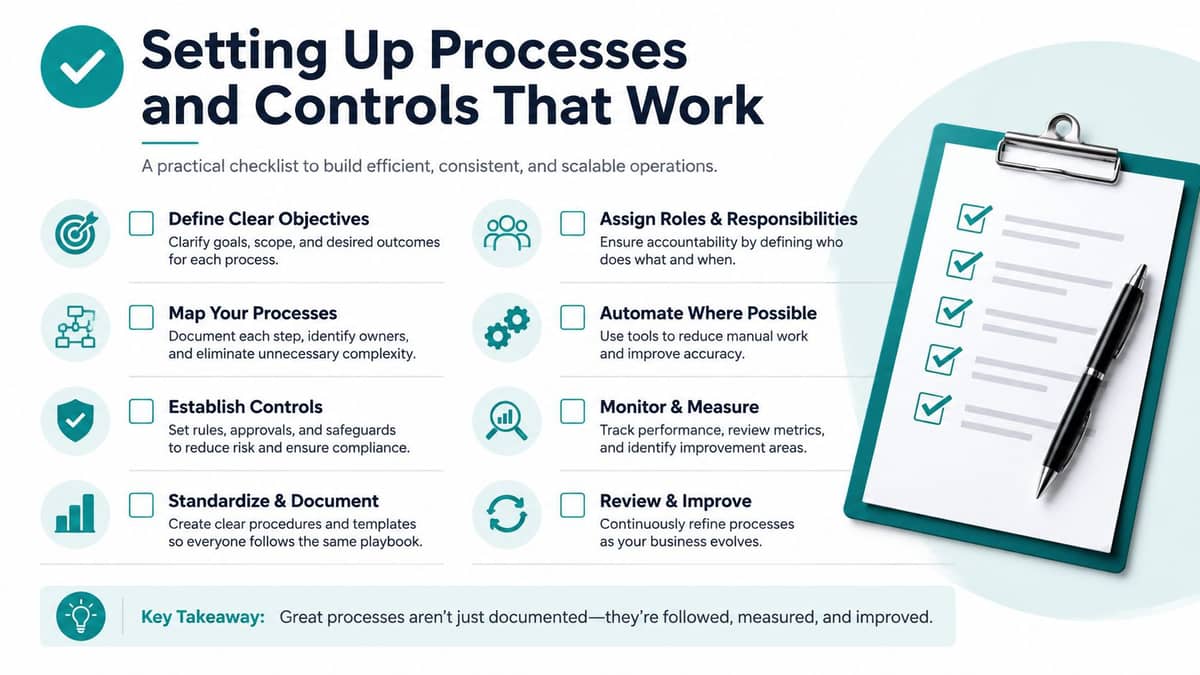
Reliable reporting comes from a disciplined close, clear approvals, and consistent ownership. Software can reduce entry, but it can't compensate for unclear responsibilities or undocumented decisions.
Start with a written monthly close calendar. Assign each task to a person, set a due date, and define what evidence proves completion.
Build the close around evidence
Use this order:
- Collect source documents: Gather bank statements, deposit records, invoices, reimbursement requests, payroll reports, and card activity.
- Record transactions: Enter contributions, bills, transfers, payroll, and adjustments in the correct accounts and funds.
- Reconcile accounts: Compare every bank and credit-card account with the ledger, then investigate differences.
- Review restrictions: Confirm designated gifts, eligible expenses, releases, and ending balances.
- Allocate functional expenses: Apply your documented program, management, and fundraising allocation method.
- Review reports: Compare results with the budget and prior periods, then document unusual variances.
- Approve and distribute: Have an appropriate reviewer approve the packet before sending it to the board.
Bank reconciliation deserves special attention. For a practical walkthrough, find how to reconcile statements and adapt the process to your church's accounts.
Separate duties without creating bottlenecks
The person who counts offerings shouldn't be the only person recording deposits and reviewing the bank reconciliation. The person approving a reimbursement shouldn't be the sole person issuing payment.
Small churches may not have enough staff for complete separation. In that case, assign compensating reviews to a pastor, board treasurer, or finance committee member. The reviewer should inspect supporting documents, unusual transactions, reconciliations, and restricted fund activity.
Handle legal requirements carefully
Churches, their integrated auxiliaries, and conventions or associations of churches are excepted from the IRS Form 990 filing requirement (IRS filing requirements for churches). That exemption doesn't eliminate every tax, employment, state, lender, grant, or denominational obligation.
Keep a compliance calendar and ask a qualified tax professional about your specific structure. Use the month-end close checklist to make recurring work visible, reviewable, and less dependent on one volunteer.
Your Action Plan for Better Church Financial Reporting
Start with the next reporting cycle, not a distant software project. Ask your team to produce one report showing unrestricted operating cash, one showing restricted fund activity, and the three core statements from the same ledger.
Then test your process against these questions:
- Can you explain every restricted balance?
- Can the board identify cash available for operations?
- Can donors' gifts move from receipt to fund report without duplicate entry?
- Can a second person review reconciliations and approvals?
- Can you publish a readable financial summary on a predictable schedule?
If the answers are unclear, document the gaps before choosing a replacement system. During vendor demonstrations, require a live example involving online giving, a restricted campaign, an expense, a release, a bank reconciliation, and a board packet.
Track improvement through practical milestones. Your close should become easier to repeat, your reconciliations should require fewer corrections, and your leadership meetings should spend less time reconstructing numbers. The true measure is whether your board can make decisions from current information without waiting for a custom spreadsheet.
Review the process with your treasurer, pastor, finance committee, and ministry leaders this week. Agree on the reports they need, the people responsible for each control, and the date those reports will be available.
AlignMint brings accounting, true fund accounting, donor management, online giving pages, volunteers, events, marketing, and team communication into one platform, with Minty answering questions from your real financial data. If you want fewer duplicate entries and clearer church reporting, visit AlignMint and review the free tier for nonprofits under $100K.
Ready to try AlignMint with your nonprofit?
Start free — set up donor tools, giving pages, and Minty. Upgrade when you need accounting.