

Giving to the Church a Practical Guide to Give Well
A donor arrives on Sunday ready to give. They may have a check in hand, open your church website, or look for a text-to-give number. Each choice feels simple to the donor, but your team still has to record the gift, apply its designation, issue a receipt, and answer questions later.
Giving to the church works best when the donor-facing experience and the financial records stay connected. This guide explains why people give, how giving methods compare, and how your church can protect donor intent while keeping reporting clear.
Quick Answer: Giving to the Church
Giving to the church stays trustworthy when the way someone gives and the way the church records the gift are the same path. Publish one giving page, name designations people recognize, and issue receipts from the gift record so restricted money stays in the right fund.
Start with church fundraising tips and donation pages. For receipts, see donation receipt requirements.
Introduction Why Giving to the Church Still Matters Today
Church giving remains a major part of charitable life in the United States. Giving USA estimated that giving to religion reached $146.54 billion in 2024, a 1.9% nominal increase from the previous year but a 1% decline after inflation (Giving USA figures summarized by Givelify). The figures point to two realities for church leaders. People continue to support religious organizations, but higher dollar totals don't automatically mean greater purchasing power.
Your church feels that tension in practical ways. A ministry budget may look stable while staffing, building, program, and service costs continue to rise. Meanwhile, donors expect a giving process that's easy to understand and trustworthy from the first click through the year-end statement.
A Sunday offering illustrates the challenge. One person places cash in an envelope. Another writes a check and adds “building fund” in the memo. A third scans the church website and schedules a recurring bank gift. These gifts may support the same mission, but they arrive through different channels and carry different recordkeeping needs.
Practical rule: Make the donor's choice simple, then make the church's records precise.
This guide follows that path. We'll begin with the purpose behind giving, then compare common methods, outline practical steps for reducing friction, and explain the connection between gifts, donor records, and fund accounting.
That connection matters because giving isn't complete when money reaches the bank. Your team still needs to know who gave, what the donor intended, whether the gift was restricted, and how the transaction should appear in reports.
The result should be more than convenience. Clear processes help your church protect trust, reduce follow-up work, and understand whether donors continue supporting the mission. They also give executive directors and finance teams a stronger foundation for planning when giving totals change in nominal and real terms.
Understanding Stewardship and the Heart Behind Giving
Stewardship starts with a simple idea. People give because they want to care for something shared, much like neighbors tending a community garden. Their gifts support worship, service, education, outreach, staff, facilities, and the people your church serves.
The motivation may be gratitude, mission alignment, spiritual practice, or belonging. Your job isn't to reduce those motives to a transaction. Your job is to create a trustworthy path for people who want their resources to support the church's work.

Start with the donor's intention
A general gift supports the church's broader mission. A purpose-specific gift supports a named ministry, building project, mission partner, school program, or emergency appeal. Both forms of giving can be meaningful, but they shouldn't be treated as interchangeable.
Before asking donors to choose a designation, define what each option means. Explain how your church uses general gifts and how designated funds are monitored. If a campaign has a defined purpose, state that purpose plainly on the giving page and in the receipt language.
The stewardship of donors guide offers a useful way to connect donor care with responsible administration. A donor should feel that the church understands both the heart behind the gift and the obligation attached to it.
Explain the numbers without judging the giver
Giving patterns differ widely. Only 27% of churchgoers tithe at or above 10% of income, while the average member historically gave 2.58% of income, equal to $697.28 in 2000 dollars. At the same time, 75% of congregations receive 90% or more of their revenue from parishioners (Vanco's summary of church giving research).
These figures shouldn't become a standard for judging individual donors. They do show why stewardship needs both pastoral care and sound administration. Churches depend heavily on household support, so retaining trust across many giving seasons matters.
Use plain updates to show where unrestricted and designated gifts go. Share outcomes without implying that one gift matters more than another. When people understand the connection between their giving and the mission, they can make informed choices.
Treat trust as part of the giving experience
A donor shouldn't have to wonder whether a designation was recorded correctly or whether a receipt will arrive. Your team can build confidence by using consistent fund names, reviewing exceptions promptly, and keeping communication aligned across pastors, finance staff, volunteers, and administrators.
Stewardship also includes restraint. Don't ask donors for information you don't need, and don't expose giving details to people who don't require access. A respectful process helps people give freely while protecting their privacy.
How People Give to Church Today Compared
Your donors don't all want the same giving experience. Some prefer a familiar check. Others want a mobile page, a text message, an automatic bank transfer, or an in-person kiosk. The right approach gives people choice without forcing your finance team to reconcile disconnected systems.
Digital giving has grown faster than cash and check giving in the reported church data. 57% of churches that reported higher giving also saw digital giving grow, compared with 31% that saw cash and check growth. Separately, 61% of surveyed churches reported an increase in digital giving, and recurring gifts were reported as up 10% year over year (CDF Capital's church giving report).
Church Giving Methods at a Glance
| Giving Method | Best For | Donor Experience | Recordkeeping Impact |
|---|---|---|---|
| Cash | Donors who prefer in-person giving | Familiar and immediate | Requires careful counting, deposit controls, and donor identification |
| Check | Donors who prefer paper records | Familiar, with room for a designation memo | Creates a clear bank trail, but manual entry can delay donor records |
| Online giving page | Donors who want convenience and account access | Available from a phone or computer | Can connect payment, designation, receipt, and donor history |
| Text-to-give | Donors who give from a mobile device | Fast for a known campaign or recurring action | Needs clear fund mapping and reliable donor matching |
| Bank transfer | Donors seeking a direct electronic method | Convenient for scheduled gifts | Supports recurring records when the account and designation stay connected |
| In-person kiosk | Donors giving during services or events | Useful for visitors and members on site | Works well when kiosk transactions enter the same donor and fund records |
Cash and checks can remain important, particularly for older donors and visitors. Their weakness isn't donor value. It's the extra control work required after collection, counting, deposit, entry, and receipt preparation.
Online pages and text options reduce physical handling. They also make recurring giving easier to offer, which can turn an occasional intention into a predictable pattern. Donors should still be able to select the purpose of a gift without navigating a long list of unclear fund names.
The best method is the one your church can explain, monitor, and reconcile consistently. A polished page won't help if a designated gift lands in a general account without the information your team needs.
Practical Steps Churches Can Offer to Make Giving Easy
Donors usually need fewer choices, clearer wording, and a path that works on the device already in their hands. Your team can improve the experience without launching a large technology project.
1. Publish one clear online giving page
Start with the donor benefit. A single page gives members and visitors one dependable place to make a gift, choose a designation, and find help.
Keep the page focused. State what general gifts support, name the available purpose-specific funds, and explain how recurring gifts work. Use familiar language rather than internal accounting labels.
Your page should also identify the church clearly and show what happens after submission. Donors want confirmation that the gift went through and a receipt will follow.
Review AlignMint's giving setup guidance when you're deciding what information the page should collect and how your team should route gifts.
2. Make recurring gifts easy to understand
Recurring giving helps donors act on a regular intention without remembering each payment date. Present it as an option, not pressure.
Explain the schedule, amount, designation, and cancellation process before the donor confirms. A donor should be able to change or stop a recurring gift without calling several departments.
Your team should review failed payments and changed cards promptly. A short, respectful message protects the relationship better than waiting until the donor notices a missing receipt.
3. Add a mobile option for simple moments
Text-to-give can help during services, appeals, and community events. Put the instructions where donors already look, including the website, service materials, and event communications.
Keep the first action obvious. If a donor must remember several codes or choose among confusing funds, the channel creates friction instead of removing it.
4. Use designations people can recognize
Call a fund what donors call it. “Youth ministry” is easier to understand than an internal code that only finance staff recognize.
Limit the list to active purposes. Retire old campaigns from the giving page, and document how your church handles gifts that arrive with an unclear or inactive designation.
5. Give every team member the same answer
A donor may ask a pastor, volunteer, bookkeeper, or administrator how to give. Each person should know the approved methods, the purpose of each fund, and where to send receipt questions.
Create a short internal reference. Include the online page, text instructions, escalation contact, and rules for recording cash or checks. Team communication becomes part of donor care when it prevents conflicting answers.
A clear giving process saves time twice. Donors finish their gifts faster, and staff spend less time repairing incomplete information.
Tax Receipts Privacy and Recordkeeping Essentials
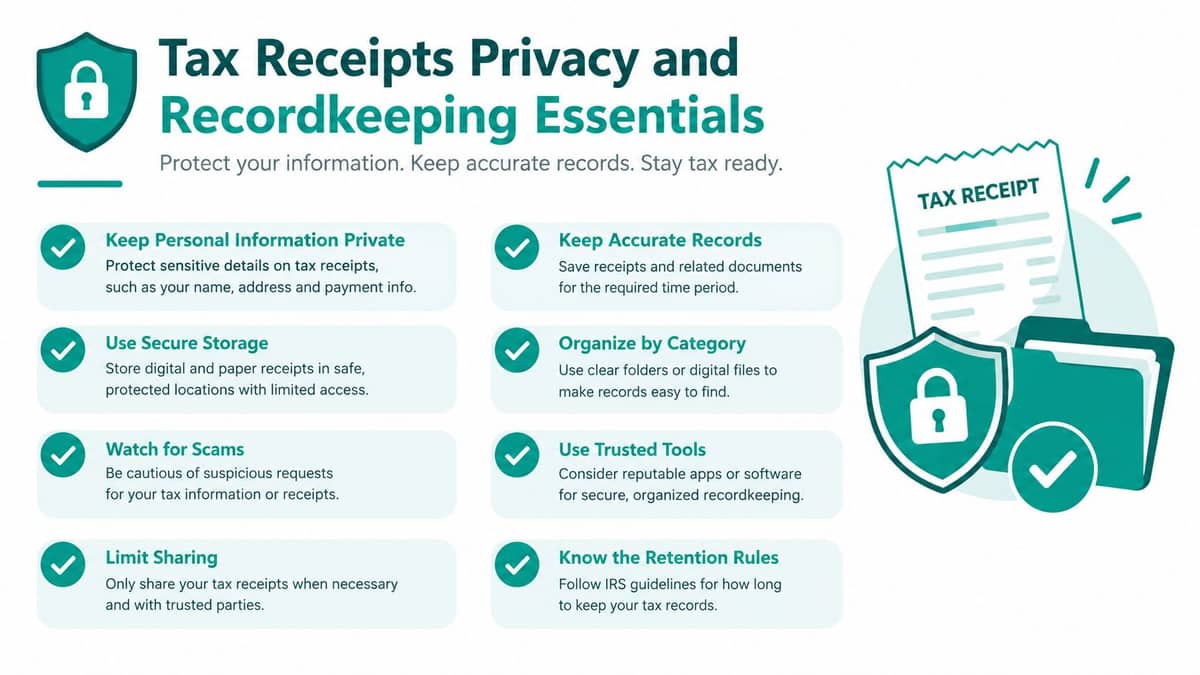
A receipt does more than confirm payment. It gives the donor a record, helps your team answer questions, and shows that the church treats contributions carefully.
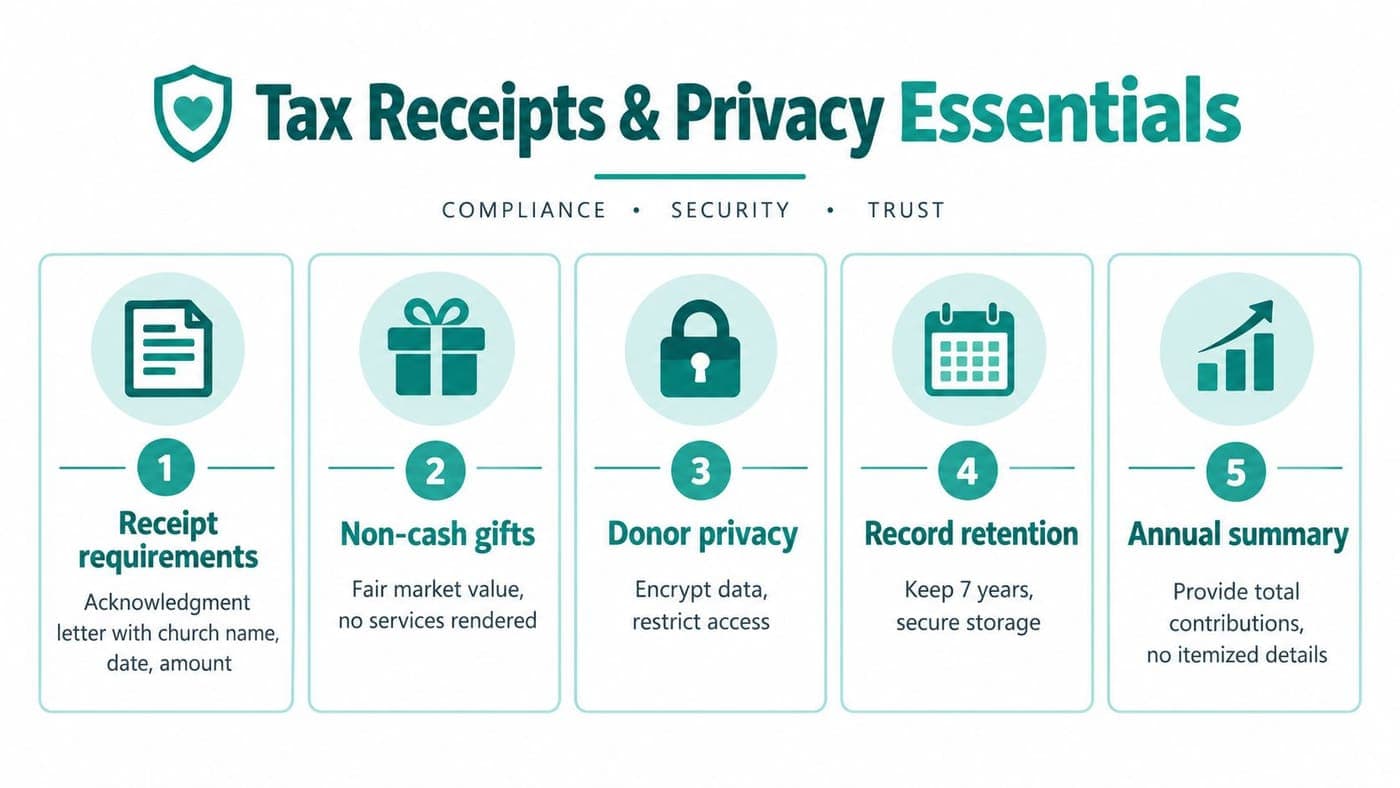
Your process should capture the donor's name, gift date, amount, payment method, and designation. It should also distinguish a contribution from a payment for goods, services, tickets, or another exchange.
Build a repeatable receipt process
Use the same basic review for online gifts, checks, cash, transfers, and kiosk transactions. Confirm that the donor record matches the payment and that the selected fund matches the church's approved designation.
For non-cash gifts, document the item and the information your tax adviser requires. Churches should avoid assigning a value casually when the donor, not the church, may need to determine fair market value.
A year-end statement should summarize contributions accurately. It shouldn't conceal missing donor data or unresolved fund assignments. If your current process depends on several spreadsheets, document who reviews them and when.
The donation receipt requirements guide can help your team organize the information donors commonly need. Tax treatment can depend on the gift and the donor's circumstances, so direct individual questions to a qualified tax professional.
Protect privacy through access and storage
Giving records contain sensitive financial and personal information. Limit access according to job responsibility, keep paper records secured, and protect digital records with strong account controls.
Your staff should know who can view donor history, who can edit designations, and who can approve corrections. These decisions shouldn't change informally from one staff member to another.
Use a documented retention policy and follow applicable legal, tax, and accounting requirements. A secure record is useful only if your team can retrieve it when needed.
Watch the broader giving environment
Giving USA estimated that religion received $146.54 billion in 2024, with growth of 1.9% before inflation but a 1% decline after inflation. Religion's share of U.S. charitable giving also fell from about 70% in 1954 to 23% in 2024 (Vanco's summary of church giving trends).
That context makes clean records more important, not less. Your board needs to distinguish higher nominal receipts from greater real capacity, while donors need confidence that directed gifts remain visible and accountable.
Donors who use charitable vehicles may also face changing rules. For background on new rules for donor-advised funds, share a qualified resource with your finance committee, then seek professional advice for specific situations.
Connecting Every Gift to True Fund Accounting
A donor may choose “building fund” on a giving page. That choice creates more than a label. It creates an obligation to preserve the donor's intent through the donor record, deposit, fund balance, reports, and financial statements.
Generic accounting software can record classes or tags, and products such as QuickBooks are familiar to many small organizations. Their strength is broad adoption and a familiar general ledger. The gap appears when your team needs donor restrictions, contribution history, receipts, program reporting, and reconciliation connected in one workflow.
Follow one gift from donor to report
A connected process should answer four questions:
- Who gave: Match the payment to the correct household, member, or organization.
- What was given: Record the amount, date, payment method, and contribution status.
- Why was it given: Apply the donor's selected designation according to church policy.
- Where does it appear: Reflect the gift in the appropriate fund balance and financial reports.
Churches preparing GAAP financial statements must present net assets in two classes, with donor restrictions and without donor restrictions, shown separately on the statement of financial position (REA Advisory's church accounting guidance). That requirement makes restricted-gift tracking a core accounting responsibility.
Choose connection over another isolated tool
Blackbaud offers established nonprofit fundraising and constituent management capabilities. Bloomerang is known for donor retention focus and fundraising workflows. Planning Center serves churches with strong ministry and service planning tools. QuickBooks remains familiar for general bookkeeping.
Those strengths are real. Your question is whether the tools connect the way your church operates. If finance, donor management, volunteers, events, and marketing live in separate systems, staff may still move information manually and resolve mismatched records.
AlignMint combines true fund accounting, donor management, volunteers, events, marketing, and online giving in one platform. Its Minty AI assistant can answer questions about your organization's data, while plan-based access avoids per-seat fees. A free tier is available for nonprofits raising under $100K per year, according to the publisher's stated offering.
A church should still test any platform against its own chart of accounts, approval process, privacy needs, and reporting requirements. The important standard is clear ownership of the data and a reliable path from gift to report.
A restricted gift should never depend on someone remembering to update a second spreadsheet.
Next Steps to Give Confidently and Steward Gifts Well
Your next move doesn't need to be a complete overhaul. Start by mapping the donor's path and the finance team's path on the same page.
A donor journey might begin with a service announcement, continue to an online page, and end with a receipt. The finance journey begins with the same gift, then continues through donor matching, designation review, reconciliation, fund reporting, and year-end statements.
Use this short action plan
- List every current giving method. Include cash, checks, online gifts, text gifts, transfers, kiosks, and gifts received through events.
- Name every active designation. Remove outdated choices and document how unclear designations are handled.
- Review one gift from start to finish. Confirm that the donor, receipt, fund, bank record, and report agree.
- Assign process ownership. Decide who handles exceptions, failed recurring gifts, corrections, and donor questions.
- Track retention and growth. Donor retention measures the share of prior-year donors who give again. Donor growth measures whether your donor base is expanding. Donor acquisition cost divides fundraising expenses by new donors acquired, according to Salesforce's nonprofit metrics framework.
Your church can also review volunteer growth, communication response, and recurring-gift retention alongside financial totals. These measures help you see whether people remain connected to the mission, not merely whether one campaign performed well.
For a deeper look at keeping relationships connected to giving, read donor management that keeps more donors giving. The practical aim is simple: donors should receive a clear experience, and your team should inherit complete records.
If your current tools make that difficult, compare platforms by workflow rather than feature count. Ask whether the system can connect online giving pages, donor records, true fund accounting, receipts, volunteers, events, marketing, and team communication without creating another manual handoff.
AlignMint brings giving, donor management, true fund accounting, volunteers, events, and marketing into one nonprofit operations platform, with a free tier for organizations under $100K and plan-based access without per-seat fees. Visit AlignMint to see how your church can connect every gift to the right donor record, fund, receipt, and report.
Ready to try AlignMint with your nonprofit?
Start free — set up donor tools, giving pages, and Minty. Upgrade when you need accounting.