

Donation Receipt Requirements What Every Nonprofit Must Know
Year end is coming. Your donor inbox is filling up with questions, your bookkeeper is closing the month, and someone on your team is asking whether the gala ticket receipt needs different wording than an online gift.
That's when donation receipt requirements stop feeling like paperwork and start feeling like risk management. If the receipt is wrong, your donor may lose a deduction, your staff may spend hours fixing avoidable mistakes, and your records won't match the story your accounting system tells.
Quick Answer: Donation Receipt Requirements
Donation receipt requirements depend on gift type, amount, and country. In the U.S., a single gift of $250 or more needs a contemporaneous written acknowledgment, and quid pro quo gifts over $75 need a disclosure of goods or services. Build receipts from the gift record so cash, noncash, and event tickets use the right fields and wording.
Start with donation receipts for nonprofits and donor management. For the product path, see donation receipts.
Introduction Why Donation Receipts Matter More Than You Think
Most of us have lived some version of the same scene. A loyal donor gives through your website, buys event tickets, drops off auction items, and then asks in January for “one tax receipt.” Your staff means well, but they're pulling data from different places and guessing which language belongs where.
That's where confusion starts. A receipt for a simple cash gift is not the same as a receipt for an event purchase, a noncash gift, or a payment where the donor received something in return.
If your organization also runs campaigns across mail, online giving pages, school events, church programs, or peer fundraising, the problem gets bigger. Teams often use one generic letter for every gift type, and that's where compliance starts to slip.
A good receipt does two jobs at once. It protects donor trust, and it supports tax substantiation. That matters whether you're a community nonprofit, a church, a school, or a fiscal sponsor managing several projects at once.
If you're also exploring new fundraising channels, it helps to see how receipting fits into campaign design from the start. This practical PledgeBox guide to nonprofit crowdfunding is useful because crowdfunding and campaign giving can create a lot of small gifts across different channels.
What usually trips teams up
The hardest part usually isn't gratitude. Nonprofits are good at thanking donors. The hard part is knowing when a thank-you note also needs to function as a compliant receipt.
Three questions cause most of the scramble:
- Gift type: Was this cash, noncash property, an event ticket, or a mixed payment?
- Threshold: Did the amount trigger a specific written acknowledgment or disclosure rule?
- Language: Did the donor receive goods or services, and did the receipt say that clearly?
Practical rule: Receipting works better when you treat it as a decision system, not a mail merge.
That's why a threshold-based approach helps. Once you know the gift type and the trigger, the wording gets much easier. If you want a companion resource focused on donor messaging, our guide to donation acknowledgment letters can help you separate stewardship language from compliance language.
How Donation Receipts Work and Why They Exist
A donation receipt is a written acknowledgment that confirms a gift was received. It isn't the same thing as a warm thank-you note, even though it can include appreciation.
The easiest way to explain this to staff or board members is to use a bucket picture. Your donor gives money or property. Your donor management process records the relationship. Your accounting system records where the gift belongs. The receipt sits between those two functions and confirms what happened.
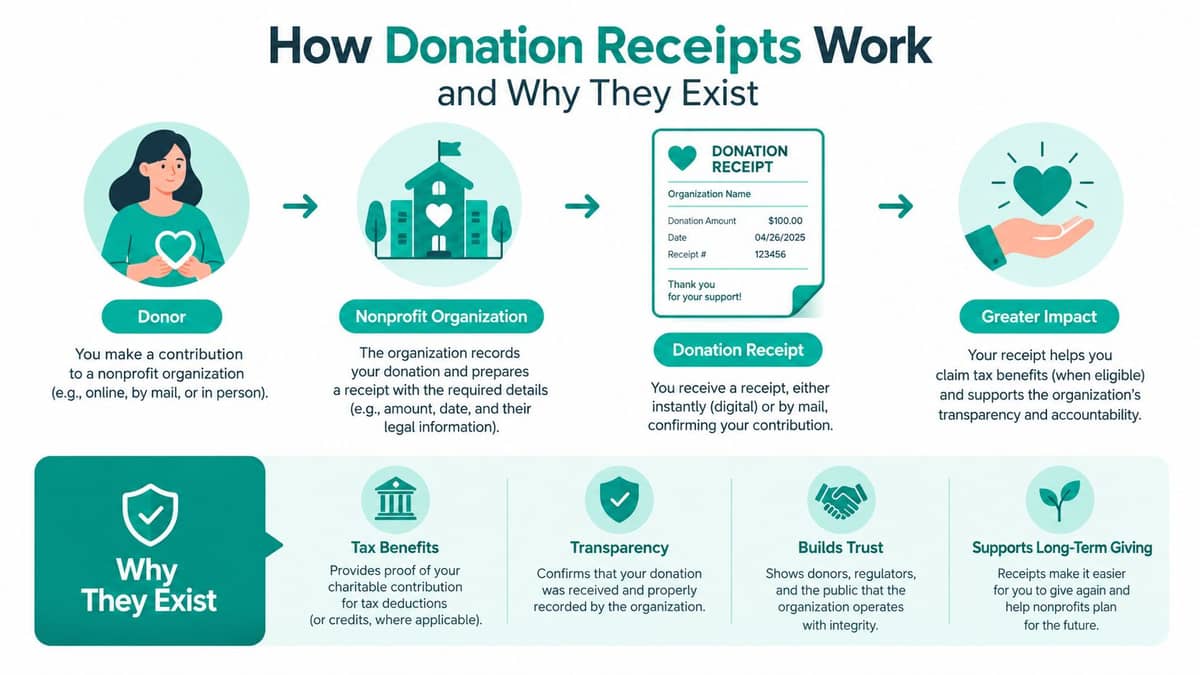
Receipts connect stewardship and accounting
When a donor gives, your team usually thinks first about appreciation. That's right and healthy. But the receipt also needs to align with your books, your restricted fund records, and your year-end reporting.
If your finance records say a gift was restricted to a scholarship fund, your donor history should reflect that same gift accurately. If your event team recorded ticket sales and sponsorships together, the receipt process has to separate the deductible and non-deductible parts correctly.
That's why receipting belongs in the same conversation as fund accounting, donor management, event records, and team communication. It isn't just an admin task. It's part of how your organization stays consistent.
A receipt is not just for the donor
Receipts also help your own organization stay organized. They create a clean paper trail between what the donor paid, what your team recorded, and what your auditors, accountant, or board may later ask about.
Think about the questions that come up after the fact:
- Board review: Why did this campaign total look different from deposits?
- Finance review: Was this sponsorship a donation, an event sale, or both?
- Donor follow-up: Why does the donor portal show one amount and the receipt another?
A receipt won't solve every data issue, but it often reveals them early. That's a good thing. It's much easier to fix coding, restrictions, or event allocations when the gift is fresh.
If a receipt can't be generated clearly, there's often a setup problem in the underlying donation or accounting record.
That's one reason many nonprofits move away from disconnected tools. When accounting sits in one system, donors in another, volunteers in a third, and marketing in a fourth, receipt mistakes multiply. If you're comparing processes, our overview of donation receipt software shows how the right system can reduce manual cleanup without changing your donor tone.
Required Fields Every Compliant Donation Receipt Must Include
This is the part leaders want in one place. What exactly has to be on the receipt?
The answer depends on country. In the United States, the baseline written acknowledgment rules focus on identifying the organization, the contribution details, and whether the donor received anything in return. In Canada, the official receipt standard is much more detailed and formal.
United States requirements
For a compliant U.S. written acknowledgment, the IRS says the receipt must identify the organization, state the cash amount, describe but not value noncash property, and state whether goods or services were provided in return. If something was provided, the charity must include a good-faith estimate of that value. If nothing was provided, the receipt should say that too, as explained in IRS Publication 1771.
That means your U.S. receipt usually needs these core elements:
- Organization identity: Your nonprofit's name must appear clearly.
- Contribution detail: Include the cash amount, or for noncash gifts, a description only.
- Date information: The contribution date needs to be clear.
- Goods or services statement: Say whether the donor received anything in return.
- Value statement when needed: If benefits were provided, include a good-faith estimate.
Canada requirements
Canada's rules are more prescriptive. The CRA requires official donation receipts to include the charity's legal name and address, registration number, unique serial number, place issued, donation date or year received, date issued, donor's full name and address, amount, any advantage received, eligible amount, and an authorized signature. For non-cash gifts, the receipt must also describe the gift and include the appraiser's name and address if one was used, according to the CRA guidance on what information must be on an official donation receipt.
That level of detail changes your process. If you're a Canadian charity, your system needs to capture receipt data fields that many U.S. teams treat as optional.
US vs Canada Donation Receipt Required Fields Compared
| Requirement | United States | Canada |
|---|---|---|
| Organization name | Required | Required |
| Organization address | Not listed in the core IRS content items cited above | Required |
| Registration or tax number | Not part of the cited core acknowledgment checklist above | Required CRA registration number |
| Unique serial number | Not part of the cited core acknowledgment checklist above | Required |
| Donor full name | Often included operationally, but not part of the cited core IRS content items above | Required |
| Donor address | Not part of the cited core acknowledgment checklist above | Required |
| Gift date | Required | Required |
| Date receipt issued | Not part of the cited core acknowledgment checklist above | Required |
| Cash amount | Required | Required |
| Noncash description | Required, but do not value it | Required, with added non-cash details |
| Goods or services statement | Required when relevant, and state if none were provided | Required through the advantage and eligible amount fields |
| Good-faith estimate of benefits | Required when benefits were provided | Reflected through advantage and eligible amount |
| Authorized signature | Not part of the cited core IRS content items above | Required |
If you want a head start, this donation acknowledgment letter template is useful as a drafting aid, but it still needs to match the gift type and the rules that apply to your organization.
Timing Thresholds and Language That Keeps Receipts Compliant
The most practical way to manage donation receipt requirements is to think in thresholds. Certain amounts trigger certain obligations. Once your team understands that, the timing and wording become much easier to control.
The two U.S. thresholds most teams need to remember
In the United States, a donor generally needs a contemporaneous written acknowledgment for any single contribution of $250 or more, and the acknowledgment must be received by the earlier of the date the donor files the original return for that year or the return's due date, including extensions, according to the IRS guidance on substantiating charitable contributions.
There's a second threshold for quid pro quo contributions over $75. When a donor pays more than that amount and receives goods or services in exchange, the charity must provide a written disclosure statement explaining the goods or services and their value, because only the deductible portion counts, as described in the IRS page on substantiation and disclosure requirements.
What the timing rule means in real life
Busy teams get caught here. They plan to send all receipts after year end, but that can be too late for some donors.
If a donor gives one qualifying gift and files early, your acknowledgment needs to be in their hands before that filing date. A bank record or canceled check can help with smaller gifts, but it doesn't replace the required written acknowledgment for a single gift at or above the threshold described above.
Here's a simple way to think about timing:
- Online one-time gifts: Send the written acknowledgment promptly after the donation posts.
- Mailed checks: Send after deposit and verification, not months later.
- Batch imports from events or campaigns: Review quickly so delayed reconciliation doesn't delay receipts.
- Year-end summaries: Helpful for stewardship, but they shouldn't be your only plan for gifts that need timely written acknowledgment.
Language that usually keeps teams out of trouble
The wording matters because it tells the donor and the tax preparer what happened.
For a straightforward gift where nothing was given back, your acknowledgment should clearly state that no goods or services were provided in exchange for the contribution.
For a mixed transaction, the receipt needs to identify what the donor received and give a good-faith value estimate of that benefit. That's what lets the donor determine the deductible portion correctly.
Keep this distinction clear: “Thank you for your support” is stewardship. “No goods or services were provided” is compliance language.
One operational challenge many modern guides still leave unanswered is what happens when donations come through different channels and receipts are issued after reconciliation. The gap is especially noticeable in current discussions of digital receipts and self-service workflows, as noted in this overview of donation receipt rules for 2026. The core rules remain familiar, but the workflow questions are where many teams still struggle.
Handling Noncash Gifts Quid Pro Quo and Event Tickets Correctly
One-template receipting starts to break down. Cash gifts, noncash gifts, gala tickets, auction purchases, and sponsorship packages may all look like “donations” inside your database, but they don't behave the same way on the receipt.
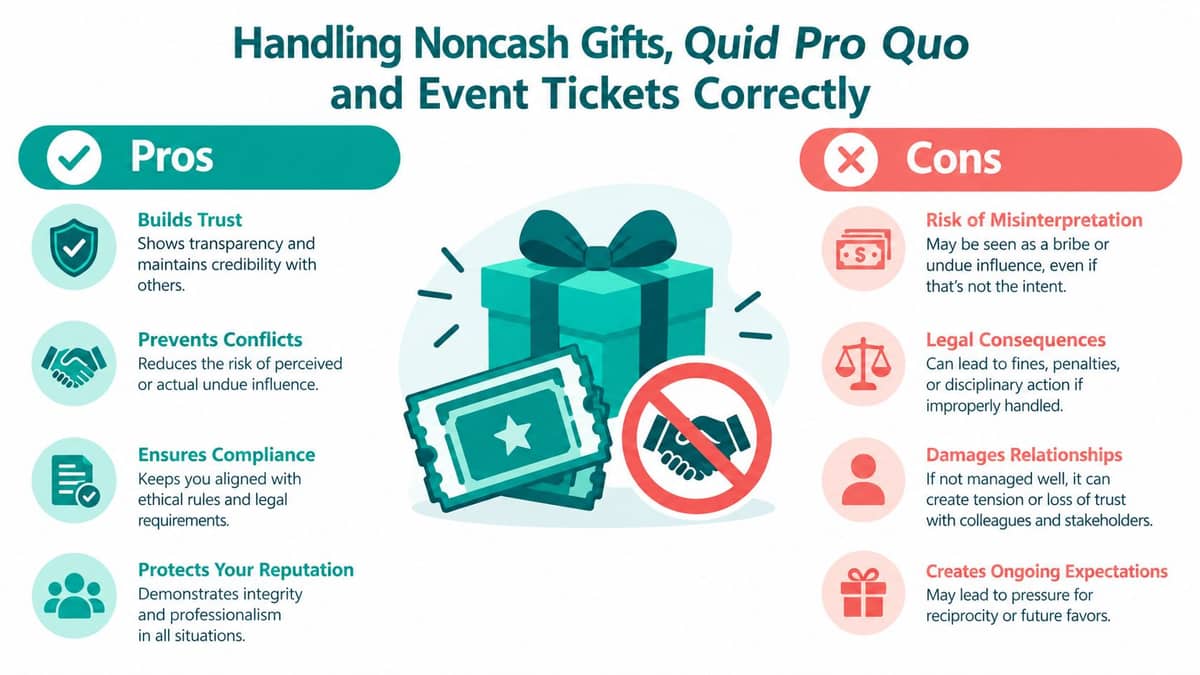
Noncash gifts need description, not valuation
For U.S. acknowledgments, a receipt for noncash property should describe the property but should not assign a value. That's a common mistake, especially when a donor asks your staff to “just put the amount on the letter.”
If someone donates furniture to a school, food to a church pantry, or equipment to a community program, your receipt should identify what was donated and when. It should not state what the item is worth.
That matters because the donor's valuation and tax reporting responsibilities are separate from your acknowledgment. The charity's role is to confirm receipt of the property.
Quid pro quo gifts need special treatment
A quid pro quo payment is one where the donor pays and receives something in return. Event tickets are the easiest example. The donor pays for admission and dinner. Part may be deductible, part may not.
A practical nonprofit guide that highlights this risk is FundSprout's piece on non-profit donation receipts. It points out that many FAQs explain the standard cash threshold but don't clearly walk through auctions, gala tickets, or bundled sponsorships, even though those are often the highest-risk scenarios.
The core distinction is simple:
- Pure gift: Nothing of measurable value comes back to the donor.
- Mixed payment: The donor receives goods, services, or event access.
- Purchase with little or no gift element: The payment is mostly transactional.
Mixed transactions need their own logic. They shouldn't inherit the wording from a plain donation template.
Event tickets and sponsorships are where teams guess
Churches and schools run into this often. A family buys table seats, receives dinner, maybe receives program recognition, and also makes an extra gift at checkout. If your system treats all of that as one donation line, your receipt language can become inaccurate fast.
A better approach is to separate the components in your records before the receipt is generated:
- Ticket portion: Record the goods or services connected to admission.
- Additional donation: Receipt this as a gift if it qualifies as one.
- Auction purchases: Treat purchased items differently from straight gifts.
- Sponsorship bundles: Review whether benefits like advertising, seats, or signage change the receipting language.
If your organization runs frequent events, your event software and receipt workflow need to work together. That's especially important for schools, churches, and other community nonprofits that rely on recurring event revenue. A practical place to start is this guide to nonprofit event ticketing software, because setup choices upstream often determine whether your receipts come out clean later.
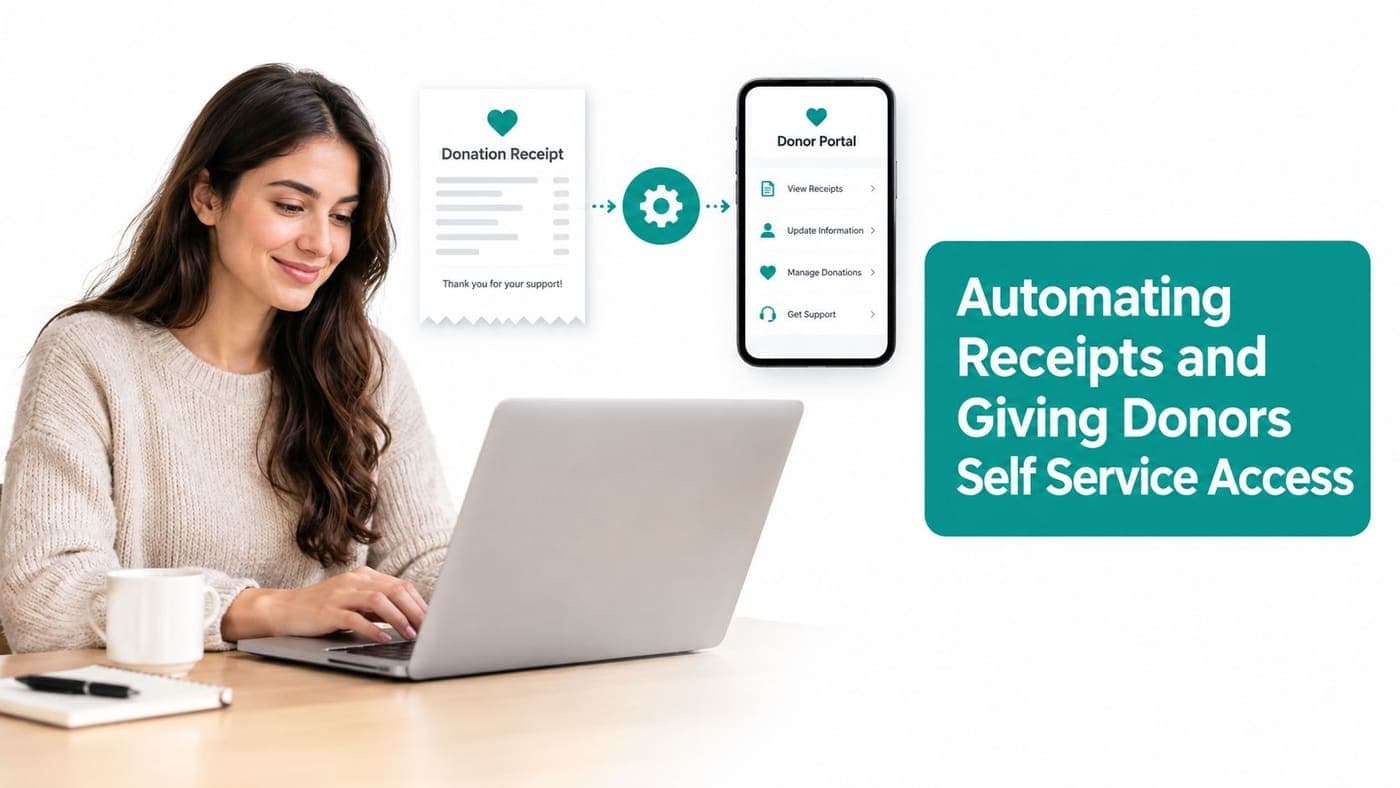
Automating Receipts and Giving Donors Self Service Access
Manual receipting usually breaks down when gifts arrive from more than one place. You may have online giving pages, recurring donations, event payments, church offerings, school campaigns, sponsorships, and checks entered later by staff. The rule itself may be clear, but the workflow isn't.
What automation should actually do
Automation helps most when it follows the logic your staff would use if they had time to review every gift carefully.
That means your system should distinguish between gift types, recognize when a written acknowledgment is needed, store the right language for each scenario, and keep donor records tied to the accounting record. It should also support donor self-service, so people can retrieve past receipts without emailing your office.
For many organizations, benefit isn't speed alone. It's consistency across accounting, donor management, marketing, and team communication. That becomes even more important if you have volunteer-led data entry, multiple campuses, or a fiscal sponsorship structure with several projects sharing one back office.
Where common tools help and where gaps remain
Blackbaud has deep history and broad capabilities, especially for larger organizations with established development operations. Aplos is familiar to many faith-based and small nonprofit teams and is often appreciated for accessibility. QuickBooks is widely known, and many leaders already understand its bookkeeping basics.
The challenge is that receipting gets harder when donor records, fund accounting, events, and communications sit in separate tools or depend on workarounds. QuickBooks, in particular, isn't purpose-built around true fund accounting in the way many nonprofits need. That can make restricted gifts and mixed event transactions harder to track cleanly from donation through receipt.
One option in this category is AlignMint, which combines accounting, CRM, volunteers, events, and a built-in marketing suite in one platform. It also includes true fund accounting, plan-based access with no per-seat fees, a free tier for nonprofits under $100K, and Minty AI for questions across your real data. For receipting, the practical value is that donor records and finance records live together, which reduces rekeying and helps support self-service access.
A simple workflow to aim for
They don't need a fancy process. They need a dependable one.
- Capture channel data early: Keep online pages, event records, and offline gifts coded clearly at entry.
- Separate mixed transactions: Don't lump tickets, sponsorship benefits, and extra gifts into one undifferentiated line.
- Use threshold logic: Let the system identify when special acknowledgment wording is required.
- Offer donor access: A donor portal reduces routine staff requests for old receipts.
- Review exceptions: Have a staff member check unusual gifts, noncash items, and project-specific gifts before release.
If you want to see how this works in practice, our documentation on donation receipts shows the operational side of setting up compliant acknowledgments inside a connected nonprofit system.
Your Next Steps to Confident Compliant Receipting
The simplest receipting system is a decision flow your team can repeat without guessing. First, identify the gift type. Then apply the right threshold. Then use language that matches what happened. Finally, send the acknowledgment on time.
That sounds basic, but it's where many teams save the most time. When your gift entry, fund accounting, donor management, online giving pages, event records, and team communication all agree, receipts stop being a year-end fire drill.
A short checklist for your team
Use this as a quick working list at your next staff meeting.
- Review your templates: Separate cash gifts, noncash gifts, and mixed transactions.
- Check your event setup: Make sure tickets, sponsorship benefits, and extra donations are tracked distinctly.
- Confirm your field capture: Your system should collect the data needed for your country's receipt rules.
- Set timing habits: Don't rely only on delayed year-end batch sending.
- Give donors self-service options: Fewer inbox requests means more time for real donor relationships.
Good receipting protects more than deductions. It protects trust in your records.
If your organization is a church, school, or fiscal sponsor, this discipline matters even more. Those models often involve recurring gifts, special events, designated funds, and shared staff workflows. Clear receipt logic helps everyone, from your finance lead to the volunteer entering gifts after Sunday services or the school event chair reconciling auction revenue.
The goal isn't perfection on day one. It's to stop using one generic receipt for every scenario and replace it with a process your team can defend with confidence.
If you want fewer receipt corrections and clearer donor records, AlignMint brings fund accounting, donor management, volunteers, events, and marketing into one place. Nonprofits under $100K can start on the free tier, and plan-based access means your whole team can work from the same data without extra seat fees.
Ready to try AlignMint with your nonprofit?
Start free — set up donor tools, giving pages, and Minty. Upgrade when you need accounting.