

You're staring at a stack of year-end acknowledgments while a donor waits for an answer about a missing receipt. The checks haven't all posted, your spreadsheet disagrees with the bank, and the person who normally fixes the template is away.
Donation receipts for nonprofits become stressful when teams treat them as documents created at the end of a process. They work better as a controlled workflow connecting the donor record, payment date, accounting entry, required disclosure, and audit trail.
Quick Answer: Donation Receipts for Nonprofits
Donation receipts for nonprofits should come from the gift record, not a year-end template scramble. For a single gift of $250 or more, U.S. donors generally need a contemporaneous written acknowledgment with the date, amount or description, and goods-and-services statement.
Start with donor management and a nonprofit donation receipt template. For the product path, see donation receipts.
The Year-End Receipt Panic and Why It Does Not Have to Be This Way
On December 31, an executive director can feel less like a mission leader and more like a detective. Envelopes sit beside sticky notes, an event spreadsheet has one total, the bank deposit shows another, and a donor has called asking why an acknowledgment hasn't arrived.
The bookkeeper is on vacation. A check received in December hasn't been posted. Someone edited a receipt template manually, then discovered the organization's legal name was inconsistent across files. Meanwhile, the board chair wants confidence that the year-end close is under control, and the executive director is wondering what an IRS inquiry would uncover.
The problem usually starts well before December. Gift information lives across email, online giving pages, bank deposits, event registrations, and separate donor spreadsheets. Staff then copy those details into templates, choose wording by memory, and repair formatting at the last minute. Each handoff creates an opportunity for a wrong donor name, an incorrect date, or a missing goods-and-services disclosure.
A better process begins by treating the receipt as the final output of clean data, not as a standalone PDF. Your team needs one place to record the gift, a clear rule for determining its date, and a template that changes according to the gift type.
Practical rule: If staff must retype a gift before issuing its receipt, your process is already carrying avoidable risk.
A repeatable workflow also improves January. Donors receive records they can understand, finance staff can reconcile receipts to deposits, and leadership can answer questions without searching several folders. This year-end giving statements guide is useful when you're preparing the annual close, but the stronger habit is issuing accurate acknowledgments at every donor touchpoint.
What a Donation Receipt Is and Why It Matters
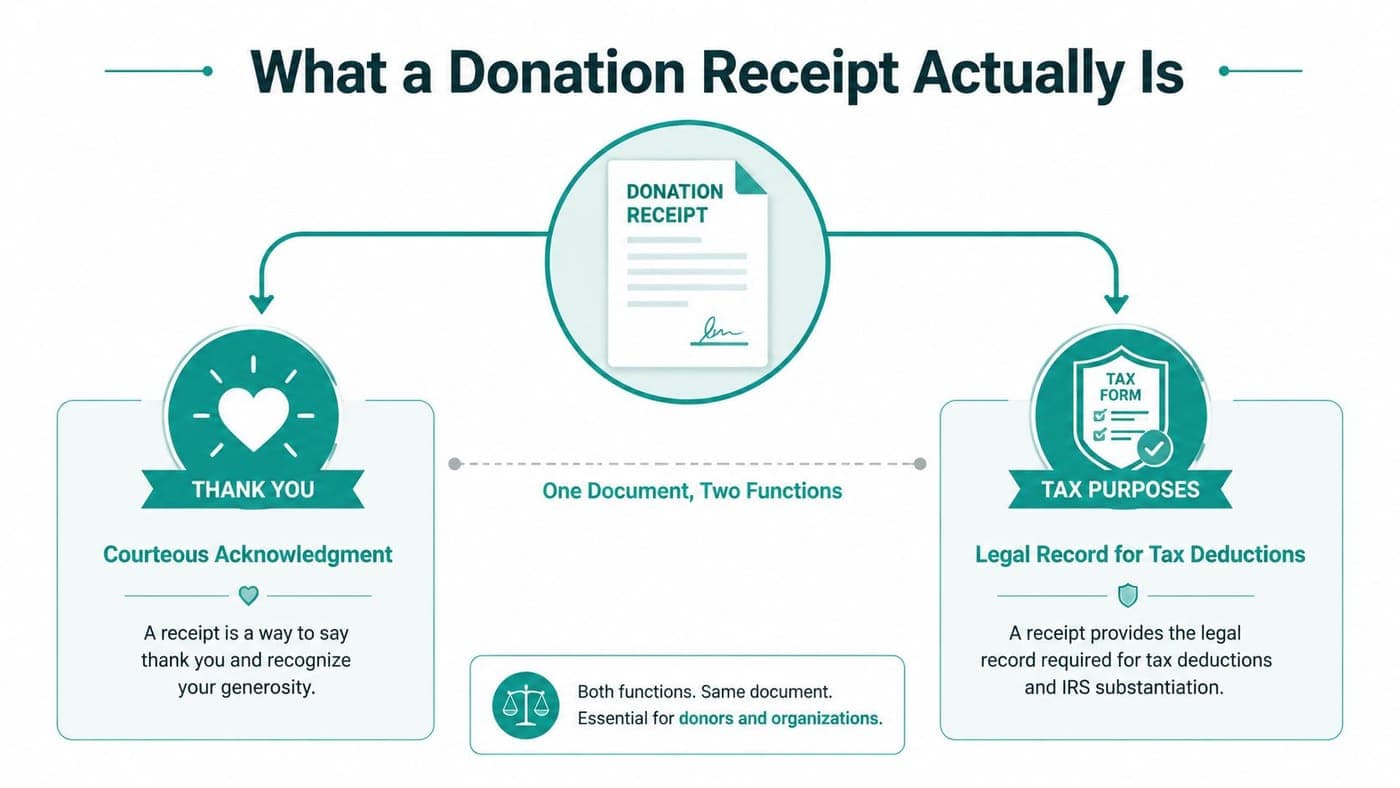
A donation receipt serves two purposes at once. It thanks the donor for supporting your mission and provides written evidence that may support the donor's charitable deduction under applicable tax rules. It is also a data record, connecting the gift, donor, date, payment details, and accounting history.
A receipt functions similarly to a stamped invoice. A hotel's thank-you message may be pleasant, but the folio is the document you keep when an employer requests reimbursement. For a nonprofit, a warm email can strengthen the relationship, while the written acknowledgment from the charity is the record the donor retains for tax support.
Receipt, thank-you, or pledge reminder
These documents often appear in the same donor workflow, but they perform different jobs:
- A receipt confirms a completed gift: It records what the organization received and supplies the required tax language.
- A thank-you letter builds the relationship: It can describe mission impact and express appreciation, but it may not contain every required acknowledgment element.
- A pledge reminder requests a future gift: It documents a promise, not money already received, so it should not be treated as a receipt for a completed contribution.
For U.S. nonprofits, a donor generally needs a contemporaneous written acknowledgment for any single gift of $250 or more before claiming the deduction, as described in IRS guidance on substantiating charitable contributions. That threshold applies separately to each contribution rather than pooling unrelated gifts.
You can issue receipts for smaller gifts as part of good stewardship and consistent recordkeeping. The important distinction is that a friendly acknowledgment becomes a regulated substantiation document when the applicable threshold and tax rules require it.
The receipt belongs in the donor's records, not only in your internal files. Accuracy therefore matters even after finance has recorded the deposit. Store the acknowledgment with the gift record in your accounting and donor systems, so the document, transaction, and audit trail remain connected. A donor may rely on that record years after the campaign has ended.
The Legal and Tax Elements Every Receipt Must Include
A receipt should answer a simple question for an outside reviewer: Who gave what, when did the organization receive it, and did the donor receive anything in return? Missing fields create uncertainty, especially when the receipt is the donor's primary tax support document.
For U.S. nonprofits, include your organization's legal name and identifying information, the contribution date, the cash amount or a clear description of non-cash property, and the relevant goods-and-services statement. If the donor received something of value, include a good-faith estimate of that value and identify the deductible portion.
The statement should be precise. If no goods or services were provided, say so directly. If the only benefit was an intangible religious benefit, use language that reflects that circumstance. A vague sentence about supporting the mission isn't a substitute for the disclosure.
The fields that prevent avoidable questions
| Element | IRS Rule | Common Mistake |
|---|---|---|
| Organization identity | Identify the charity issuing the acknowledgment and include its identifying information. | Using a program name instead of the legal organization name, or displaying an inconsistent EIN. |
| Donor identity | Address the receipt to the person or organization that made the contribution. | Sending the official receipt to a spouse, assistant, or fundraiser who only facilitated the gift. |
| Contribution date | Record the date the contribution is considered made under the applicable payment method. | Using the date someone entered the gift into a spreadsheet. |
| Cash amount or property description | State the cash amount, or describe non-cash property without assigning an unsupported value. | Adding the donor's purchase price or an internal estimate to an in-kind receipt. |
| Goods and services disclosure | State whether goods or services were provided, and disclose their good-faith value when applicable. | Leaving the disclosure line blank for event tickets, memberships, or other benefits. |
| Authorized signature | A signature can identify an authorized representative and reinforce document control. | Using a vague title or allowing anyone to sign without an approval process. |
For partially deductible gifts, the receipt should separate the amount paid from the value of the benefit received. An event ticket, for example, isn't handled like an unrestricted cash gift when admission, food, entertainment, or another benefit is included.
Canadian charities face a more formal receipt structure. The Canada Revenue Agency's official receipt checklist identifies fields including the registered name and address, registration number, serial number, place of issuance, received date, donor name and address, eligible amount, and authorized signature. Non-cash receipts also need a property description and appraisal details when applicable.
A receipt isn't bureaucracy for its own sake. It gives the donor a defensible record and gives your organization evidence that staff followed a consistent control. Your nonprofit tax filing requirements should be reviewed alongside your receipting process, especially when the same gift data supports financial reporting and annual filings.
Timing Rules That Decide Which Tax Year a Gift Belongs To
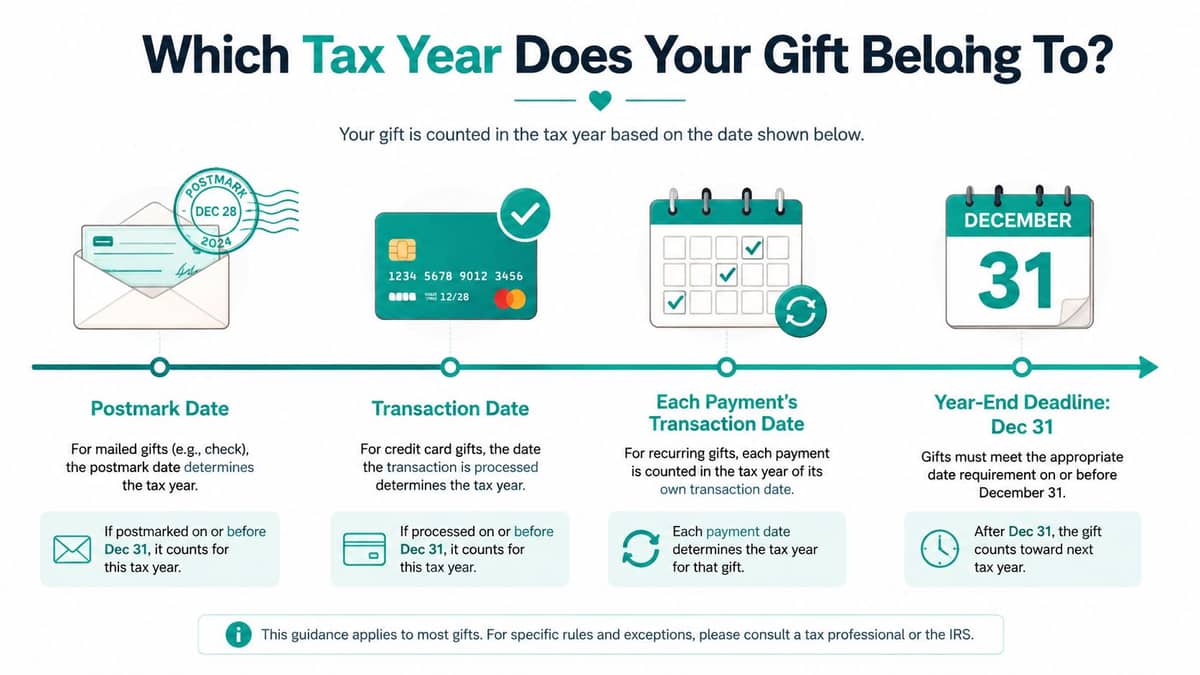
The date on a receipt should follow the contribution rule, not the date that staff had time to process the paperwork. For U.S. organizations, IRS guidance treats the contribution date as the date the donor gave the gift. That distinction becomes important during year-end closeout.
A mailed check is commonly tied to its postmark date, while a credit card gift is tied to the date the charge is posted. Those rules mean a December gift can belong to the earlier tax year even when your team deposits or acknowledges it in January.
Use the payment method as your first checkpoint
Staff don't need a complicated decision tree for ordinary gifts. They need the payment method captured at entry and a clear review path for exceptions.
- Mailed checks: Preserve the envelope or postmark evidence, then record the contribution date consistently.
- Credit card gifts: Use the date the charge is posted, rather than the date a batch is transferred to the bank.
- Recurring gifts: Treat each installment as its own contribution and apply the relevant transaction date.
- Bank transfers: Confirm the date your organization receives or settles the transfer under your accounting policy.
- Stock transfers: Record the date the shares enter the charity's account, then retain the transfer documentation.
- Pledges: Don't receipt an unreceived promise as though cash or property has already arrived.
A receipt dated January for a check that qualifies as a December contribution can mislead the donor about the tax year. The reverse problem can occur when staff receipt a pledge before the donor has transferred funds or property.
A practical year-end rule is simple: record when the donor made the gift, preserve evidence, and separate promises from completed contributions.
When a transaction needs review, issue a clear acknowledgment only after the date and donor identity are confirmed. Your donation recording documentation should support the same information that appears on the donor-facing receipt, so finance staff aren't reconciling two different versions of the gift.
Sample Receipt Wording for Cash, In-Kind, Recurring, and Event Gifts
The right wording depends on what the donor gave and what your organization provided in return. A single universal template often creates trouble because it treats an event purchase like unrestricted cash or assigns value to donated property.
Use the samples below as drafting models, not as a substitute for legal or tax advice. Replace bracketed fields with your organization's approved information, then keep the donor-facing language direct.
| Gift Type | Sample Wording | Quid-Pro-Quo Note |
|---|---|---|
| Standard cash gift | “Thank you for your contribution of [amount] received on [date]. No goods or services were provided by [legal organization name] in exchange for this contribution.” | Use when the donor received no benefit beyond any applicable intangible religious benefit. |
| Recurring gift | “We acknowledge your contribution of [installment amount] received on [date]. This installment was part of your recurring giving authorization. No goods or services were provided in exchange for this contribution.” | Each installment needs accurate gift and payment information. An annual summary can supplement individual records. |
| In-kind gift | “Thank you for your contribution received on [date]. Description of property: [description]. No value has been assigned to the donated property by [legal organization name].” | Describe the property clearly. Don't state the donor's purchase price or assign an unsupported value. |
| Event gift | “You paid [amount] for admission to [event]. The estimated value of goods and services provided was [value]. The deductible portion of your contribution is [eligible amount].” | Separate the payment, benefit value, and eligible contribution. |
Why small wording choices matter
For a cash gift with no benefit, the no-goods-or-services sentence should be unmistakable. Don't bury it inside a long paragraph about the campaign or mission.
For an in-kind gift, describe what arrived. A donation of office furniture, supplies, or equipment needs a usable description, but the charity shouldn't casually decide the property's tax value. Canadian rules require the receipted amount for a non-cash gift to reflect fair market value at the time of donation, and the receipt must go to the person or organization that made the gift, as stated in CRA's official donation receipt information.
Event gifts require the most care. If a donor pays for a ticket and receives admission or other benefits, the receipt must explain the benefit and the amount that remains eligible. The same principle applies to memberships with perks, auction purchases, and sponsorship arrangements that include advertising or access.
Review templates with counsel or a tax advisor each year. Rules and program details can change, and a short annual review is less disruptive than correcting a large batch of inaccurate acknowledgments.
For a practical starting point, compare these examples with a nonprofit donation receipt template, then adapt the language to your organization's actual programs and benefits.
Turning Receipts From a Manual Chore Into an Automatic Byproduct
The cleanest receipt process begins when someone enters the gift, not when someone opens a template. At the point of donation, capture the legal donor, payment method, amount or property description, contribution date, campaign or fund, and any benefit provided.
The system can then select the appropriate receipt logic. A cash gift with no benefit receives one wording pattern, an event payment receives another, and an in-kind gift prompts staff for a description rather than a value. That approach reduces the chance that an employee will copy yesterday's language into today's acknowledgment.
A connected workflow
A practical workflow should connect four records:
- The donor record: It identifies the person or organization legally entitled to the acknowledgment.
- The transaction: It records amount, payment method, date, and campaign details.
- The accounting entry: It posts the gift to the correct fund, program, or restricted account.
- The receipt history: It stores the issued document, delivery status, and any correction.
When those records remain separate, year-end staff export spreadsheets, merge templates, compare bank deposits, and attach PDFs by hand. When they connect, the receipt becomes a quiet byproduct of the transaction, while the audit trail preserves what happened and when.
This structure helps finance teams reconcile donor records with the general ledger and investigate exceptions without rebuilding the transaction from email. It also gives executive directors a clearer answer when a donor asks for a receipt, a board member asks about restricted giving, or an auditor requests supporting documentation.
Small organizations often need practical technology choices rather than expensive collections of specialized tools. A review of budget-friendly software for entrepreneurs can help frame that decision, especially when your team is comparing subscription costs, implementation effort, and the number of systems staff must maintain.
How AlignMint Handles Receipts Compared to QuickBooks and Donor CRMs
QuickBooks is strong at recording deposits and managing general ledger activity. It doesn't, by itself, provide the complete donor-facing acknowledgment workflow your fundraising team may need.
Bloomerang and DonorPerfect are recognized for donor management and branded acknowledgments. Their strength is relationship-centered fundraising, but organizations may still need separate accounting entries and reconciliation procedures. That separation can create gaps when the receipt record, donor record, and ledger entry don't share the same source data.
Compare the workflow, not just the template
| Platform | Receipt Generation | Donor Record Linkage | GL Posting | Audit Trail |
|---|---|---|---|---|
| QuickBooks | Records financial transactions; donor-facing receipt functions may require additional setup or tools. | Depends on the organization's configuration and connected systems. | Strong general ledger capability. | Financial entries are available, but receipt history may sit elsewhere. |
| Bloomerang | Supports donor acknowledgments within its fundraising focus. | Strong donor management orientation. | May require a separate accounting workflow. | Reconciliation can depend on exports and documented procedures. |
| DonorPerfect | Supports donor communications and acknowledgment workflows. | Donor records are central to the platform. | May require separate accounting systems or integrations. | Completeness depends on how systems are connected. |
| AlignMint | Generates donation receipts from the giving workflow, including branded receipt content and donor access to receipts. | Connects donor, gift, and finance records. | Posts gifts within an integrated accounting environment. | Keeps transaction and receipt information together for review. |
AlignMint's model combines fund accounting, donor management, volunteer management, events, and marketing in one platform. Its receipt workflow can apply the organization name, EIN, gift date, amount, goods-and-services disclosure, and tax-deductibility language from the underlying transaction.
That connected approach is especially relevant for small and mid-sized nonprofits, churches, schools, and fiscal sponsors that don't want staff maintaining several disconnected records. The donation receipt documentation provides the product-specific workflow details, while your finance policies should still govern approvals and exception handling.
Receipt Questions You Will Get Asked and How to Answer Them
Does a thank-you email count as a receipt?
It can serve as written acknowledgment only when it contains the required information and comes from the charity. A warm message without the contribution details or goods-and-services disclosure may not provide adequate substantiation.
What should we do when a check arrives without a donor name?
Don't guess. Hold the receipt, review the check, envelope, deposit documentation, and available donor records, then contact the giver if identification remains unclear.
What if a check arrives in December but we deposit it in January?
Review the postmark and contribution evidence. The deposit date isn't automatically the contribution date for a mailed check, so preserve documentation before issuing the acknowledgment.
Do recurring donors need one annual summary?
Keep the transaction records for each installment and issue the acknowledgments your process requires. An annual summary can help the donor organize records, but it shouldn't replace accurate installment data.
Who should receive the official receipt?
Issue it to the person or organization that made the gift. A family member, assistant, adviser, or fundraiser who directed the contribution may receive a separate thank-you, but not necessarily the official tax receipt.
AlignMint connects donation entry, donor records, fund accounting, and compliant receipt delivery so your team can replace year-end reconstruction with a repeatable process. Visit AlignMint to see how one nonprofit operations platform can keep every gift, receipt, and accounting record together.
Ready to try AlignMint with your nonprofit?
Start free — set up donor tools, giving pages, and Minty. Upgrade when you need accounting.