

December 28 is when a routine year-end task can become a governance problem. A major donor asks for a receipt, your database returns mismatched names, three gifts have no addresses, and an event contribution never had its goods-and-services value calculated.
The board chair wants everything on letterhead before the end of the day. A compliant non profit donation receipt process prevents that scramble by connecting donor records, gift terms, timing, and accounting rather than treating receipts as after-the-fact thank-you notes.
Quick Answer: Non Profit Donation Receipts
A non profit donation receipt is the written acknowledgment of a completed gift, not a pledge reminder or a warm thank-you. Record who gave what, when it arrived, any donor benefit, and keep that document tied to the accounting entry.
Compare donation receipts for nonprofits with donor management. For templates, see donation receipt template.
Why Donation Receipts Trip Up Even Experienced Nonprofits
A year-end gift arrives through the website, another through a spreadsheet, and an event contribution sits in a file that never records the meal or merchandise the donor received. The fundraising team may know the donors well, yet still lack the evidence needed to issue accurate acknowledgments.
Seven operational problems appear repeatedly:
- Acknowledgment versus substantiation: A warm thank-you may omit information the donor needs for tax reporting.
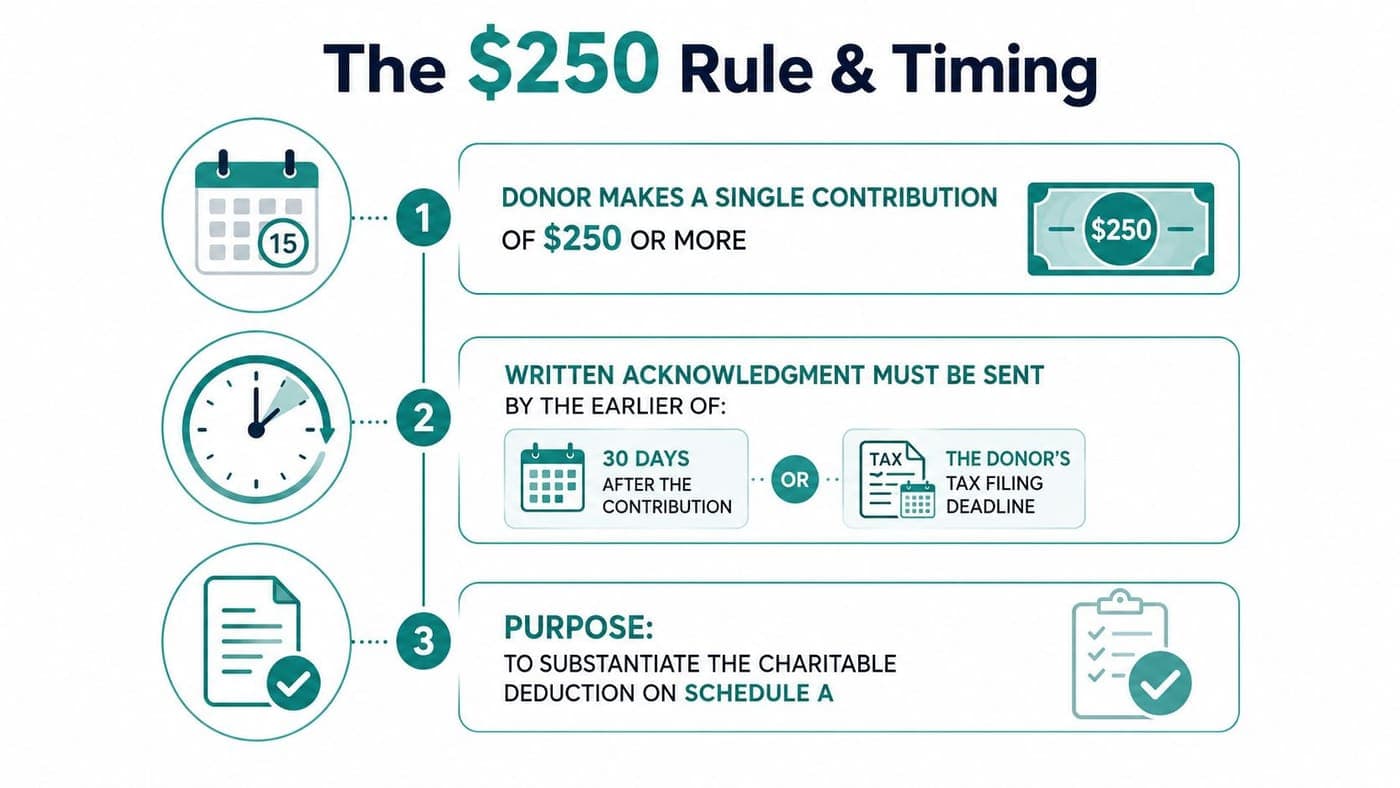
- Timing: For one contribution of $250 or more, the donor needs a written acknowledgment by the applicable filing deadline. The IRS substantiation rules explain the requirement.
- Quid-pro-quo math: Tickets, memberships, meals, and merchandise can reduce the deductible amount.
- In-kind valuation: Staff must describe donated property without casually assigning a value.
- Non-cash disclosures: The receipt needs enough detail for the donor's records, while valuation generally remains the donor's responsibility.
- Delivery records: Paper, email, and automated messages provide different evidence of when an acknowledgment was issued.
- Accounting connection: A receipt that does not connect to fund accounting can leave the donor record, restricted balance, and financial statements out of alignment.
Practical rule: Treat every receipt as a controlled gift record, not a document typed after fundraising is complete.
Canadian registered charities face the same operational need for complete records, with their own required fields. Official receipts generally identify the charity's legal name, registration number, serial number, donor, dates, amount, and eligible amount after an advantage is deducted, as described in guidance on Canadian donation receipts. Non-cash gifts also require appropriate descriptions and appraisal details where applicable, according to the CRA receipt checklist.
The practical trade-off is speed versus control. Manual receipts may suit occasional gifts, but they make timing, benefit calculations, duplicate records, and restricted-fund coding harder to review. A connected process can tie the receipt to the donor record, fund, payment, and supporting documents. The nonprofit donation management guide offers a related reference for organizing those records.
This guide focuses on the decisions that affect donor substantiation, non-cash descriptions, quid-pro-quo calculations, and a clean year-end close.
What a Non Profit Donation Receipt Is
A donation receipt is a written acknowledgment that your organization received a charitable contribution. The donor keeps it for tax records, while your organization retains the related gift record and supporting documentation.
Its role differs from a pledge reminder, payment confirmation, thank-you note, or fund accounting entry. A pledge records an intention to give. A payment confirmation shows that a transaction processed. A fund accounting entry classifies money internally. A receipt links the received gift to the donor and records the applicable tax disclosures.
Three terms that need separate handling
An acknowledgment letter is the communication your organization sends. It may include gratitude, mission language, and a description of the gift's impact.
Written substantiation is documentation the donor may need to support a deduction. For a single contribution of $250 or more, the donor needs a contemporaneous written acknowledgment from the charity, including the required gift and benefit information, as noted earlier.
People often call that document a tax receipt. The term is common, but the receipt does not create deductibility by itself. It documents the contribution and the terms surrounding it. The donor remains responsible for claiming only the deduction allowed by law.
For cash gifts below the federal written acknowledgment threshold, issuing a receipt remains sound practice. It gives the donor a reliable record, reduces follow-up questions, and helps your team reconcile the donor ledger with the payment and fund records.
What the receipt cannot do
A receipt cannot assign a deductible value greater than the eligible contribution. It also cannot turn volunteer time into a deductible charitable gift. If a donor gives property, the receipt should describe what the organization received without deciding its value for the donor.
Non-cash gifts may require documentation beyond the charity's acknowledgment. For contributions that require Form 8283, the donor may need an appraisal or other substantiation. The receipt and the donor's tax filing work together, but they are not the same document.
The tax receipt glossary definition offers a concise reference for the term. Operationally, label templates clearly so a pledge notice, acknowledgment, payment confirmation, and official receipt do not get confused. That separation matters when staff review donor records, calculate benefits, or prepare a year-end close.
Required Elements on Every Donation Receipt
Start with the gift type, then select the correct receipt template. A cash receipt and an in-kind receipt shouldn't share one undifferentiated form because their required descriptions and valuation treatment differ.
Cash contributions
A cash receipt should identify your organization's legal name and EIN, the contribution date, the amount in U.S. dollars, and the payment method. Payment methods may include check, card, ACH, or stock transfer, although stock requires a non-cash description rather than a cash amount.
The receipt should also state whether your organization provided goods or services in exchange for the contribution. If nothing was provided, say so directly. If something was provided, describe it and provide a good-faith estimate of its value.
The IRS describes these requirements in its written acknowledgment publication. Your organization should also retain a receipt number, donor identity, mailing address, fund designation, and delivery timestamp, even where a specific field isn't required on every receipt.
Non-cash contributions
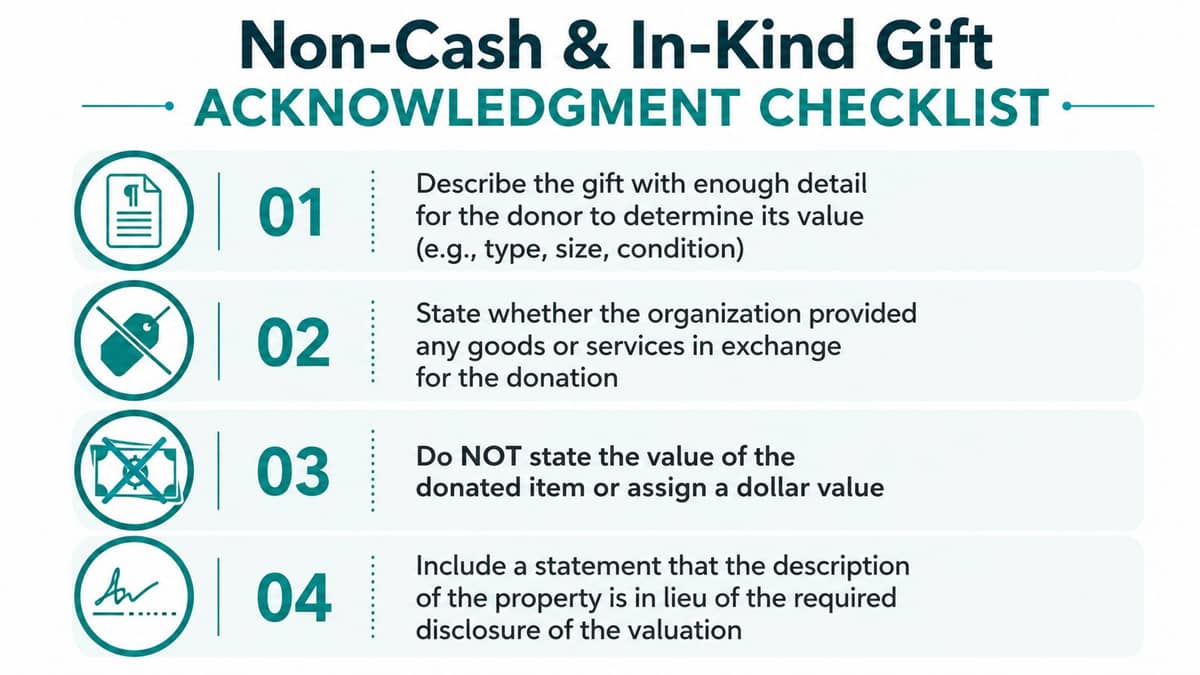
For property, stock, equipment, or other in-kind gifts, describe what your organization received without assigning a dollar value. Include the date received, the organization's legal name and EIN, and a statement about goods or services provided in exchange.
The donor, not the charity, generally determines the claimed value of donated property. Your staff can document condition, quantity, identifying information, and intended use, but shouldn't present an informal estimate as an official valuation.
| Element | Cash Receipt | Non-Cash Receipt | Optional but Recommended |
|---|---|---|---|
| Organization identity | Legal name and EIN | Legal name and EIN | Registration details |
| Gift information | Date and cash amount | Date and property description | Receipt number |
| Payment or transfer | Check, card, ACH, or other method | Transfer or delivery details | Donor contact information |
| Goods or services | State whether provided and estimate value if applicable | State whether provided | Clear disclosure language |
| Internal tracking | Fund or campaign | Fund, campaign, and asset record | In-memory or honor notation |
| Approval | Authorized issuer | Authorized issuer | Signature line |
A good receipt answers the donor's next question before they need to call your office.
Your donation acknowledgment letter template can help standardize the language, but review every template against your actual gift types. Schools, churches, fiscal sponsors, and event-based charities often need separate versions for tickets, restricted gifts, donated goods, and gifts routed through an intermediary.
The $250 Rule and Why Timing Matters
A donor claiming a single charitable contribution of $250 or more needs a contemporaneous written acknowledgment. The document should identify your organization, state the contribution date and cash amount or property description, and disclose whether you provided goods or services. The $250 rule concerns the donor's tax support, so issuing a receipt is not enough if the required details are missing.
Timing is equally important. The donor must obtain the acknowledgment by the earlier of filing the original return for the gift year or the return due date, including extensions, as explained in IRS Publication 526.
Why a late receipt can fail
A donor gives in December, files in March, and receives your acknowledgment afterward. The donation may be genuine, but the late document can fail the contemporaneous requirement. A bank record, appraisal, deed, or Form 8283 does not correct a missing or late acknowledgment.
A January batch run creates risk when delivery is not controlled. Your team needs a process that records both issuance and delivery, rather than relying on the date staff prepared the letter.
Common breakdowns include:
- Late issuance: Staff wait for year-end statements.
- Incomplete gratitude letters: The letter thanks the donor but omits the amount or goods-and-services disclosure.
- Unclear gift dates: The receipt shows the processing date instead of the date the organization received the contribution.
- No delivery evidence: Staff cannot confirm when an email or letter reached the donor.
Include the nonprofit tax filing requirements resource in the annual control calendar. Set receipt rules when gifts arrive, retain delivery records, and issue a separate year-end statement for convenience. This workflow also gives fund accounting and donor records the same date and gift details, reducing reconciliation work.
Quid-Pro-Quo Receipts and the Advantage Test
A quid-pro-quo contribution combines a payment with something the donor receives in return. Gala tickets, membership benefits, meals, branded merchandise, and auction purchases can all require a different calculation from a straightforward cash gift.
The basic calculation is simple:
Gross payment minus the fair market value of goods or services received equals the eligible charitable amount.
For example, if a donor pays $150 for an event ticket and the meal has a fair market value of $75, the eligible charitable amount is $75. The receipt should identify the payment, describe the benefit, and show the good-faith value assigned to that benefit.
Build the disclosure before the event
Event pages and registration forms should capture the benefit value before tickets go on sale. Finance staff shouldn't have to reconstruct the meal, entertainment, or membership allocation after the event.
The receipt must disclose the quid-pro-quo status even when the deductible amount appears close to the gross payment. Your organization can't inflate the deduction by assigning a value to the benefit below its reasonable fair market value.
Some Canadian guidance applies an 80% advantage test. If the advantage exceeds 80% of the donation value, no official receipt can be issued, according to the CRA information on required receipt details. Canadian charities should also account for the eligible amount after deducting the advantage.
| Line Item | Amount | Receipt Disclosure |
|---|---|---|
| Gross event payment | $150 | State the amount paid |
| Meal benefit | $75 | Describe the meal and good-faith value |
| Eligible charitable amount | $75 | State the amount eligible for deduction |
| Other benefits | Varies | List each material benefit separately |
The same discipline applies to memberships, sponsorship packages, and event bundles. If a donor receives advertising, admission, merchandise, or services, separate the charitable portion from the received benefit before the receipt is issued.
Non-Cash and In-Kind Gift Receipts
A donated laptop arrives with no model number, a box of securities needs transfer records, and a volunteer offers professional services. Each situation needs different documentation. A non-cash receipt should describe what the charity received without casually assigning a value the organization cannot support.
Describe the property precisely
“A laptop” may be too vague when an organization receives several computers. Record the manufacturer, model, serial number when appropriate, condition, accessories, quantity, and date received. The receipt could state, “One used Lenovo laptop, ThinkPad model, with charger, received in working condition,” without assigning a dollar amount.
Use the same approach for clothing, furniture, equipment, securities, cryptocurrency, and inventory. Identify the type and quantity clearly. The donor may need those details when determining value or completing additional tax forms.
Canadian receipts for non-cash gifts should describe the property and include appraisal details where applicable. The receipt amount should reflect fair market value at the time of donation. Guidance also indicates that gifts above the applicable threshold may require an independent appraisal, as explained in Canadian receipt guidance.
U.S. donors may face appraisal requirements for certain property as well. Rules depend on the property category, so staff should avoid promising a tax result based only on the receipt.
Separate property from donated services
Donated goods are property. Professional services and volunteer time are different records. They may warrant a sincere thank-you message, but their value generally is not treated like donated inventory for a charitable tax receipt.
Record services for volunteer management or program history, then send an appreciation message instead of a tax receipt. Keeping these records separate prevents the donor database from overstating contribution revenue and preserves a clear distinction between financial gifts and volunteer activity.
A practical receipt file should include:
- Property description: Type, quantity, condition, and identifying details.
- Receipt treatment: Description only, with no informal valuation.
- Donor documentation: Appraisal or valuation material supplied by the donor.
- Accounting treatment: Asset, in-kind revenue, restricted fund, or another approved classification.
Use the in-kind contribution glossary entry for staff training. For unusual gifts, including cryptocurrency, closely held interests, or valuable art, ask the donor to consult a tax adviser rather than estimating value on the organization's behalf. Keep the receipt record connected to the donor file and fund accounting entry, so the description, approval, and financial treatment remain traceable.
Paper, Email, and Automated E-Receipts Compared
Delivery method affects speed, donor confidence, and the quality of your records. No single channel fits every donor, but every channel needs a controlled source record.
| Channel | Cost per Receipt | Turnaround | Audit Defensibility | Donor Experience |
|---|---|---|---|---|
| Mailed paper | Printing, envelope, and postage | Slower | Strong when issuance and mailing are logged | Familiar and accessible |
| Manual PDF email | Staff preparation time | Moderate | Depends on saved message and attachment | Convenient but inconsistent |
| Automated e-receipt | System setup and transaction processing | Immediate or scheduled | Strong timestamp and source-record link | Fast, searchable, and easy to retrieve |
Paper remains valuable for donors who prefer mail, need large print, or don't use email. It also gives your organization a tangible letterhead document, but staff must manage returned mail, address changes, printing, and filing.
Manual PDFs work for occasional gifts or unusual circumstances. They become fragile when several people edit templates, copy donor details between systems, or forward attachments without preserving the original delivery record.
Automated receipts pull gift details from the donation form, payment record, or CRM. That reduces transcription and creates a clearer timestamped trail, provided your team reviews templates, permissions, and exception queues.
Edge cases that need human review
Recurring ACH donors may prefer an annual consolidated statement in addition to individual confirmations. A pledge shouldn't generate a receipt before the gift arrives, and an event ticket purchase needs the quid-pro-quo calculation before issuance.
Accessibility deserves equal attention. Offer large-print paper when needed, and keep email language readable in plain text rather than relying only on a designed PDF.
Automation should remove repetitive entry, not remove judgment from unusual gifts.
Your donor database should remain the source of truth. When a receipt is generated from a separate spreadsheet, finance staff may post the gift while development staff miss the acknowledgment status. A connected system keeps the gift date, donor identity, fund designation, and delivery record aligned.
Receipts, Retention, and Your Next Best Step
A receipt is not the end of the transaction. In a well-run nonprofit, it connects the donor record, finance entry, fund designation, delivery evidence, and year-end reporting. If those records live in separate spreadsheets, small discrepancies can become difficult to explain when staff change or a donor asks for a copy.
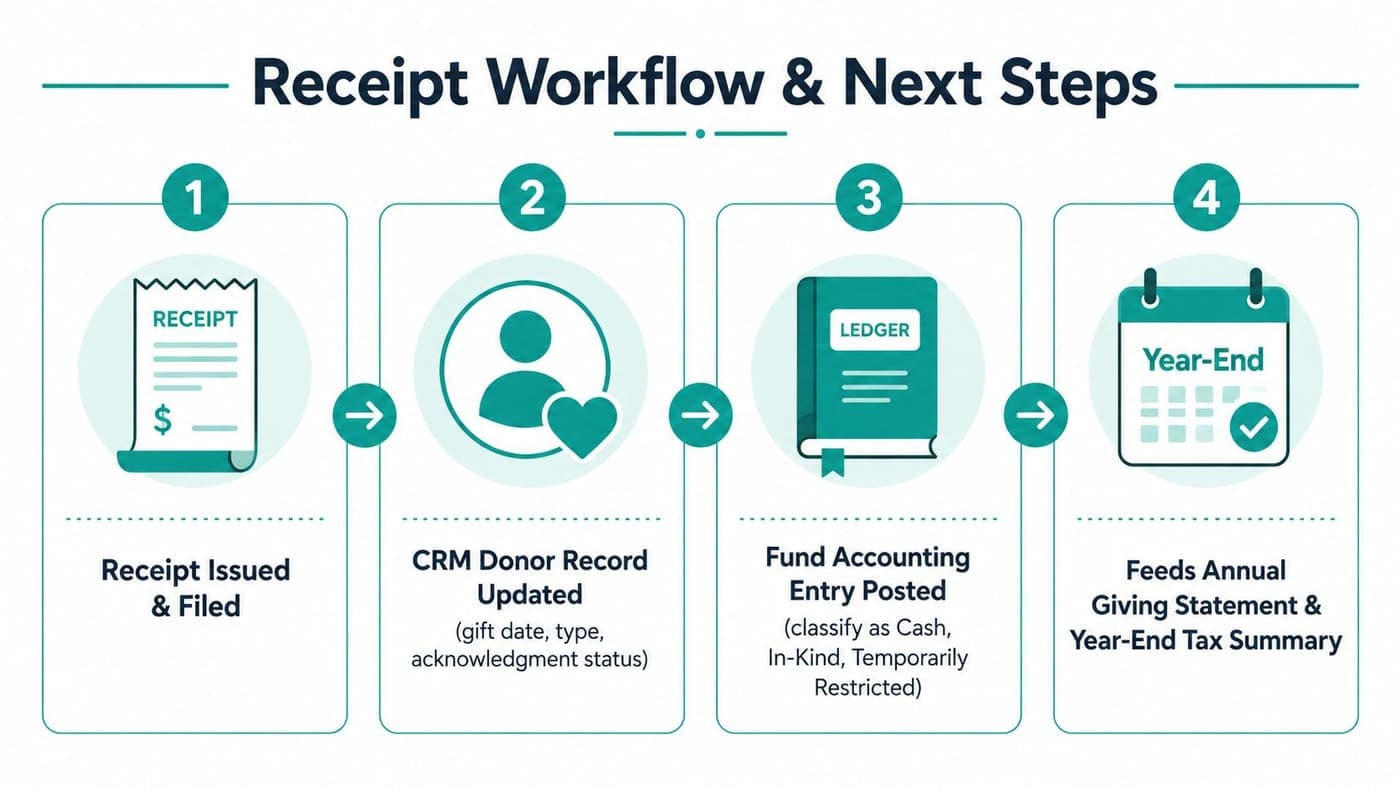
A practical workflow looks like this:
- Record the received gift: Capture donor identity, date, amount or property description, payment method, and any goods or services provided.
- Issue and file the acknowledgment: Save the receipt, delivery timestamp, and notes explaining any exception or manual review.
- Update the donor record: Mark the acknowledgment status and retain the gift designation, tribute details, and communication preference.
- Post the accounting entry: Classify cash, in-kind property, temporarily restricted funds, or another appropriate category in the fund accounting system.
- Review the year-end file: Reconcile donor statements, restricted balances, and financial reporting before sending summaries.
Retain records beyond staff memory
Keep written acknowledgments and supporting donor records for the period required by the applicable tax and charity rules. Store them so another person can understand the transaction without relying on the finance director, a departing volunteer, or an undocumented spreadsheet process. Record retention should cover the receipt itself, payment evidence, donor correspondence, valuation support for non-cash gifts, and any quid-pro-quo calculation.
Canadian official receipts must include prescribed information under Section 3501, including the charity's legal name and registration number, donor identity, serial number, received date, amount, and advantage information. The CRA's complete receipt guidance also explains eligibility. Only registered charities and other qualified donees may issue official tax receipts, so an ordinary nonprofit should confirm its status before adopting that format.
For 2026, review these controls:
- Template identity: Confirm the legal name, EIN or registration number, and receipt numbering.
- Event language: Test the goods-and-services disclosure on ticket and membership pages.
- Gift routing: Confirm that donor-advised fund, fiscal sponsorship, and intermediary gifts identify the true legal donor.
- In-kind handling: Require a description and condition record before staff issue the acknowledgment.
- Backup coverage: Train another person to issue, resend, and investigate receipts.
- Accounting review: Confirm each receipt posts to the correct cash, in-kind, program, grant, or restricted fund.
- Delivery schedule: Run a test receipt and document the first automated issuance process.
AlignMint combines accounting, donor management, volunteers, events, marketing, and online giving pages in one nonprofit operations platform. Its fund accounting model supports restricted funds, grants, and programs. Minty can answer questions from the organization's records. Nonprofits raising under $100K per year can use its free tier, and the platform offers plan-based access without per-seat fees.
This week, select five recent gifts and trace each from donor record through receipt, delivery evidence, fund classification, and year-end report. Note every handoff that requires rekeying or manual confirmation. Then visit AlignMint to assess whether one connected workflow could replace the receipt spreadsheet while keeping human review for unusual gifts.
Ready to try AlignMint with your nonprofit?
Start free — set up donor tools, giving pages, and Minty. Upgrade when you need accounting.