

For related tools, see the fiscal sponsor allocation calculator, fiscal sponsor administrative allocations, fiscal sponsor software, the fiscal sponsor operations kit, the U.S. fiscal sponsor directory, and nonprofit fund accounting.
Quick Answer: Model A vs. Model C Fiscal Sponsorship
Last updated: November 7, 2026.
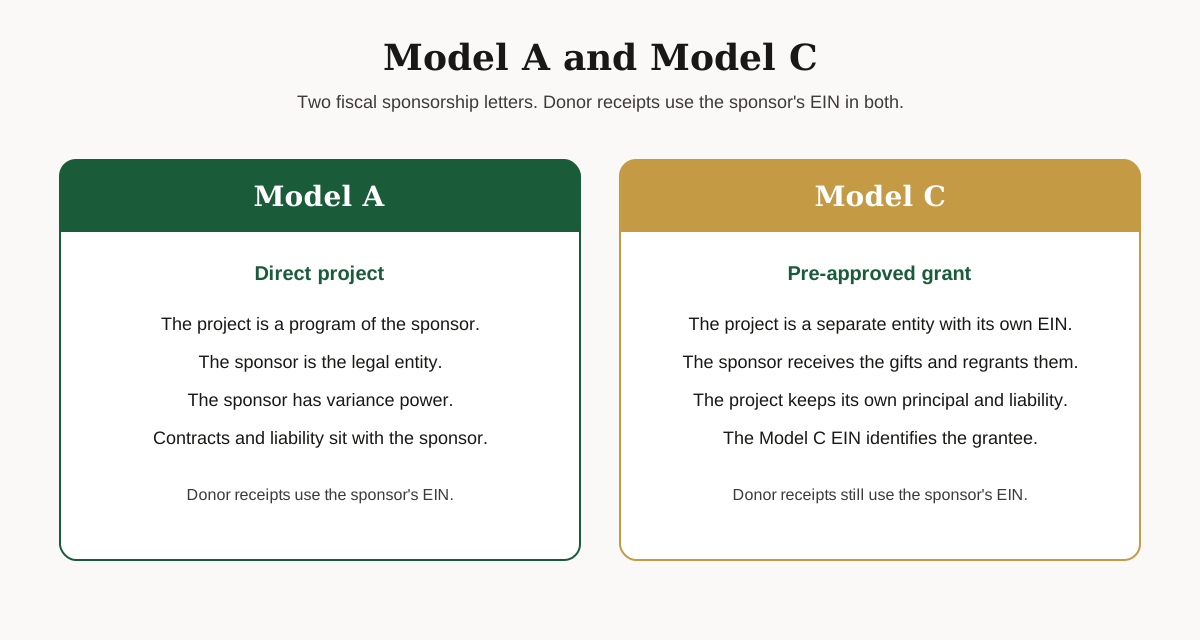
In Model A (Direct Project), the sponsored project is an internal program of the 501(c)(3) fiscal sponsor with no separate legal entity; activity belongs on the sponsor's books, donor receipts use the sponsor's EIN, and the sponsor employs staff, signs contracts, and carries liability. In Model C (Pre-Approved Grant Relationship), the project is a separate grantee (such as an LLC or non-exempt nonprofit) with its own EIN and its own books; the sponsor receives tax-deductible gifts under its 501(c)(3) EIN, records the receipt and regrant, and keeps those sponsor records distinct from the grantee's books. Software account separation does not establish legal-entity status, and advisor review is required to confirm your agreement.
Model A vs Model C fiscal sponsorship accounting
| Model | Legal relationship | EIN/receipt treatment | Books | Verified AlignMint workflow/access boundary |
|---|---|---|---|---|
| Model A: Direct Project | Project is a program of the 501(c)(3) sponsor; no separate legal entity | Donor tax receipts use the fiscal sponsor's 501(c)(3) EIN | Project revenue, expenses, and administrative allocations belong on the sponsor's books (Form 990 Part VIII & Part IX) | Operational fund can be set to Model A on the sponsor ledger, or run in a separate Enterprise organization workspace with isolated logins; not a separate legal entity |
| Model C: Pre-Approved Grant | Grantor-grantee relationship with a separate legal entity | Donor tax receipts use the fiscal sponsor's 501(c)(3) EIN; grantee EIN identifies the grantee | Sponsor records charitable receipts and regrants (Form 990 Part VIII & Part IX / Schedule I); the grantee keeps its own books | Operational fund can store Model C and the grantee's 9-digit EIN on the sponsor ledger; it does not create a separate organization, legal entity, or chart of accounts |
| Software account separation | Operational access boundary, not a legal model | Shared or separate software logins do not decide EIN or tax status | Enterprise isolates each workspace's ledger, donors, and reports | Enterprise parent hierarchy provides sponsor oversight across organizations; confirm legal structure with counsel and your CPA |
When a founder or board member says they want a fiscal sponsor, their very first structural decision is choosing between Model A and Model C — the two dominant frameworks defined by nonprofit tax attorney Gregory Colvin in * Fiscal Sponsorship: 6 Ways to Do It Right*.
Deep Dive: How Model A (Direct Project) Works
Under Model A, often called comprehensive fiscal sponsorship, the project belongs wholly to the fiscal sponsor. There is no separate corporation or bank account for the project.
Why projects and sponsors choose Model A
Model A is built for founders who want a turnkey back office so they can focus 100% on program execution:
- Full HR and payroll infrastructure: Project workers are hired as W-2 employees of the sponsor, gaining immediate access to the sponsor's payroll system, workers' compensation, and employee benefits.
- Insurance and contract umbrella: The sponsor signs venue leases, vendor agreements, and grant contracts, covering the project under its commercial general liability and directors and officers (D&O) policies.
- No separate tax return: Because the project is not a separate legal entity, it does not file a separate federal or state tax return; all financial activity is consolidated inside the sponsor's annual Form 990 and audited financial statements.
The trade-offs of Model A
Because the sponsor assumes 100% of the legal, employment, and financial liability for the project, the sponsor must enforce strict internal controls:
- Project leaders cannot sign contracts, open bank accounts, or hire staff in the project's name.
- Every vendor bill and reimbursement must pass through the sponsor's accounts payable workflow.
- Administrative allocations are set in the written agreement to cover HR, insurance, accounting, and audit exposure.
Deep Dive: How Model C (Pre-Approved Grant) Works
Under Model C, the project is a separate legal entity — commonly a nonprofit corporation waiting to file Form 1023, a mission-driven LLC, a media production company, or an unincorporated association — that has its own 9-digit EIN and its own bank account.
How the pre-approved grant flow works
- Board pre-approval: The 501(c)(3) sponsor reviews the project's charitable budget and formally approves it as furthering the sponsor's exempt purpose.
- Written sponsorship agreement: Both entities sign a Model C fiscal sponsorship agreement establishing that the sponsor retains variance power (discretion and control) over all charitable funds raised.
- Fundraising & receipting: Donors make checks payable to the 501(c)(3) sponsor (or give through a sponsor-controlled online donation page) earmarked for the project. The sponsor issues the 501(c)(3) tax receipt under the sponsor's EIN.
- Regranting: After recording the agreed administrative allocation, the sponsor disburses the net funds as a grant to the project's bank account upon receiving periodic financial and narrative reports.
Why projects and sponsors choose Model C
Model C is common when a project already has its own legal structure and wants operational independence while raising charitable gifts through a 501(c)(3) sponsor:
- Project autonomy: The project hires its own staff or independent contractors, signs its own leases, owns its intellectual property, and manages day-to-day cash from its own bank account.
- Liability firewall for the sponsor: Because the project is a separate legal entity, slip-and-fall claims, employment disputes, and vendor debts belong to the project entity rather than the sponsor.
- Clean spin-out path: If the project later receives its own 501(c)(3) determination letter, it already has its own corporation, EIN, bank account, and payroll setup.
Tax and reporting traps to watch in Model C
Model C is not free of tax rules for the separate project entity:
- If the project entity is a for-profit LLC, partnership, or C-corporation, grant funds received from the fiscal sponsor are generally gross income to the project entity for federal income tax purposes unless offset by deductible business/project expenses in the same tax year.
- The sponsor must report grants over $5,000 to the project entity on Form 990 Schedule I, and the project must submit regular financial expenditure reports proving the grant was spent strictly on the approved charitable purpose.
For the complete general ledger rules across Models A, C, D, and F, see fiscal sponsorship accounting models.
Decision Matrix: Should You Choose Model A or Model C?
Use these five questions to pick the right model before you interview sponsors:
- Do you need full-time W-2 employees with health benefits right now?
- Yes: Choose Model A so you can plug into the sponsor's existing HR, payroll, and benefits plans without setting up your own employer accounts.
- No (using contractors, stipends, or existing entity payroll): Model C gives you faster control and lower allocation rates.
- Who needs to own the intellectual property (film, software, curriculum, research)?
- If outside investors, publishers, or founders require the project entity to hold title to IP from day one, choose Model C.
- How much operational risk does the program carry?
- Programs involving youth services, international fieldwork, or physical events require direct insurance underwriting. Some sponsors require Model A to supervise high-risk programs directly, while others require Model C with proof of separate project insurance.
- Are you planning to spin out as an independent 501(c)(3) within 12–24 months?
- Model C makes spinning out much simpler because your corporate entity, EIN, and vendor contracts never have to be reassigned from the sponsor.
- What allocation percentage can your budget support?
- Test both allocation tiers against your projected grants and individual gifts using our free fiscal sponsor allocation calculator and compare rate structures in fiscal sponsorship administrative allocation structures explained.
Fiscal sponsor administrative allocation tracking
Whether you run Model A or Model C, the sponsorship agreement defines how the administrative share is calculated. AlignMint keeps planning estimates separate from ledger postings:
- Estimate only: The public fiscal sponsor allocation calculator models percentage, flat, or tiered administrative shares and does not post ledger entries.
- Review and confirm before posting: On Enterprise, fiscal sponsor administrative allocations uses Fund Accounting → Sponsor Administrative Allocation to compute each organization's share from eligible revenue, let parent directors review or adjust the rate before confirming, and post the allocation lines (with optional cash settlement) on confirmation.
How AlignMint Tracks Model A and Model C Funds
Whether you are a fiscal sponsor managing multiple projects or a project director reviewing monthly statements, your software must reflect the legal difference between Model A and Model C without implying that a software login is a legal entity.
In AlignMint:
- Operational Fund Settings record Not set, Model A (Direct Project), or Model C (Pre-Approved Grant) directly on each fund.
- EIN handling stays accurate: Model A funds inherit the parent sponsor's EIN, while Model C funds can store a separate grantee's 9-digit EIN for internal tracking while keeping the parent sponsor's EIN on all donor tax receipts. Recording Model C on a fund does not create that grantee, a separate organization, or a chart of accounts.
- Enterprise Multi-Organization Management lets fiscal sponsors manage separate organization workspaces from one parent account with data isolation between organizations, reviewed Sponsor Administrative Allocation postings, and consolidated reporting.
Read our how to choose a fiscal sponsor guide, fiscal sponsor guide, or best fiscal sponsor software to see how purpose-built fund accounting supports both models.
MonkeyPod supports Model C on an Enterprise subscription (MonkeyPod fiscal sponsorship, checked November 13, 2026).
Frequently Asked Questions
Under Model A (Direct Project), the project has no separate legal entity and operates as an internal program of the 501(c)(3) sponsor, which employs the staff and assumes all legal liability. Under Model C (Pre-Approved Grant Relationship), the project is a separate grantee with its own EIN; the sponsor receives tax-deductible donations and regrants them while the grantee keeps its own books.
No. Software account separation is an operational access boundary and does not establish legal-entity status. Recording Model C on an AlignMint fund stores the pre-approved grant label and grantee EIN on the sponsor's ledger; it does not create a separate organization, legal entity, or chart of accounts.
Model A administrative allocations reflect that the sponsor carries employment liability, runs payroll, signs vendor contracts, and includes the project on its insurance and Form 990 program reporting. Under Model C, the separate grantee entity handles its own staffing, contracts, and books after receiving regranted funds.
In both Model A and Model C, donor tax receipts always use the 501(c)(3) fiscal sponsor's EIN. Under Model C, the grantee has its own EIN for banking, payroll, and vendor contracts, but donors are legally contributing to the 501(c)(3) sponsor.
Ready to see how AlignMint fits your workflow?
Schedule a free walkthrough — we will help you map donors, funds, and migration steps.