

For related tools, see the fiscal sponsor allocation calculator, fiscal sponsor software, and nonprofit fund accounting.
Quick Answer: What Must Be in a Fiscal Sponsorship Agreement?
A valid fiscal sponsorship agreement is the contract that establishes how a 501(c)(3) public charity receives, oversees, and disburses tax-deductible funds for a sponsored project. To satisfy IRS Revenue Ruling 68-489 and FASB ASC 958-605, the agreement must state the sponsorship model (Model A or Model C), grant the sponsor complete discretion and control (variance power) over contributed funds, specify the administrative allocation (typically 5% to 15%), and define how funds, donor records, and intellectual property transfer at exit.
| Clause Category | Model A Agreement (Direct Project) | Model C Agreement (Pre-Approved Grant) |
|---|---|---|
| Contracting parties | 501(c)(3) sponsor + project director / steering committee | 501(c)(3) sponsor + separate legal entity (with its own EIN) |
| Variance power clause | Sponsor owns the restricted fund and holds unilateral authority to redirect funds | Sponsor owns donated funds and holds unilateral authority to withhold or redirect grants |
| Administrative allocation | Typically 7% to 15% of gross project receipts | Typically 5% to 10% of gross project receipts |
| Staffing & contracts | Only the sponsor may hire employees or sign vendor contracts | Separate project entity hires its own staff and signs its own contracts |
| Intellectual property (IP) | Held by sponsor during sponsorship; assigned to successor 501(c)(3) on spin-out | Retained by the separate project entity, subject to charitable-use grant restrictions |
| Exit / spin-out transfer | Asset transfer to a newly formed 501(c)(3) or successor fiscal sponsor | Final grant closeout and transfer of remaining restricted fund balance |
Too many fiscal sponsor arrangements start with a handshake or a two-page Memorandum of Understanding (MOU) copied from an unrelated charity. Six months later — when a major grant arrives, a vendor contract needs a signature, or the project is ready to spin out into its own 501(c)(3) — vague contract language turns into a governance crisis.
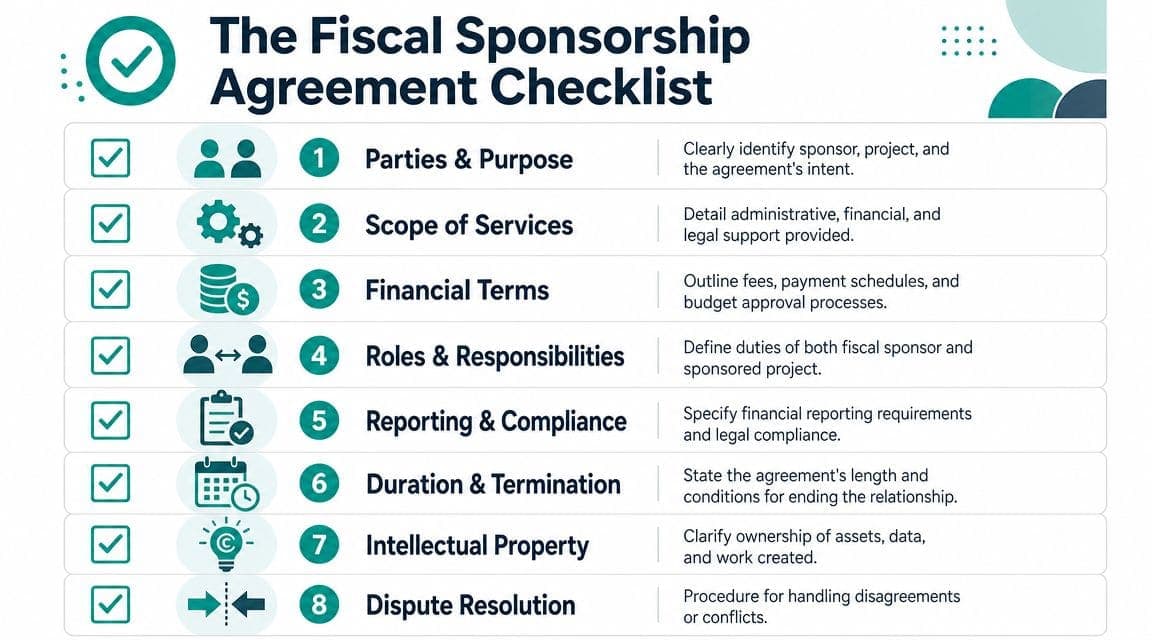
The 10 Essential Clauses in Every Fiscal Sponsorship Agreement
Whether you are drafting a contract with nonprofit legal counsel or reviewing an offer from a prospective sponsor, verify that all 10 provisions below are stated in plain language.
1. Charitable Purpose & Board Pre-Approval
The agreement must open with a formal recital stating that the sponsor's board of directors has reviewed the project's mission and determined that carrying out the project directly furthers the sponsor's own 501(c)(3) tax-exempt purposes. Under Model A vs. Model C fiscal sponsorship, this pre-approval is what distinguishes a lawful sponsorship from an earmarked conduit.
2. Variance Power (Discretion and Control)
This is the single most important paragraph for IRS compliance. If the contract reads like a fiscal agent agreement where the sponsor promises to pass through 100% of donations on demand, donor tax deductions are at risk.
What legal reviewers look for: Clear wording stating that all contributions received for the project are the legal property of the 501(c)(3) sponsor, held in a restricted fund for the project's charitable purposes, and subject to the sponsor's ultimate discretion and control (variance power) to redirect if the project violates the agreement or can no longer fulfill the charitable purpose.
3. Administrative Allocation & Direct Costs
Spell out the exact financial mechanics so neither side is surprised at month-end:
- Base percentage rate: State the exact percentage allocated from gross donations, foundation grants, and government awards (for example, 8% on individual and foundation gifts; 12% on government reimbursement grants).
- Timing of allocation: Clarify whether the administrative allocation is deducted upon cash receipt or during the monthly accounting close.
- Direct pass-through expenses: Specify which direct project costs are charged to the project fund on top of the percentage allocation — such as online credit card processing fees, project-specific insurance riders, independent contractor 1099 filing fees, or specialized legal review.
Use our free fiscal sponsor allocation calculator and guide to fiscal sponsorship allocation structures to benchmark your contract rates before signing.
4. Fundraising, Solicitation Disclosures & Grant Submissions
Because donors are legally giving to the 501(c)(3) sponsor, the agreement must govern how the project raises money:
- Required public disclosure: Every donation page, appeal letter, and brochure must display approved wording such as: "[Project Name] is a fiscally sponsored project of [Sponsor Legal Name], a 501(c)(3) public charity (EIN XX-XXXXXXX). Contributions are tax-deductible to the extent allowed by law."
- Grant application review: Specify how many business days in advance (typically 5 to 10 business days) the project must submit grant proposals and budgets to the sponsor before submission, and confirm that only an authorized officer of the sponsor may sign grant agreements.
5. Spending Authority, Reimbursements & Cash Disbursements
How does money actually move from the restricted project fund to pay for program work?
- Under Model A: Define the dollar threshold (for example, $1,000 or $2,500) below which the project director can approve budgeted expenses, the documentation required for staff expense reimbursements, and the turnaround time for accounts payable runs.
- Under Model C: Define whether pre-approved grant disbursements are released monthly, quarterly, or upon receipt of donor funds, and specify the expenditure report required before the next tranche is released.
6. Financial Reporting Cadence & Audit Cooperation
Projects need visibility to manage their budgets; sponsors need documentation to pass their annual audit and file Form 990. The contract should commit both sides to a clear schedule:
- Sponsor to Project: Monthly financial statements showing opening fund balance, itemized gifts received, administrative allocations deducted, program expenses paid, and ending restricted net assets (see fiscal sponsor monthly financial reporting).
- Project to Sponsor: Quarterly or annual narrative and financial reports, plus prompt cooperation with the sponsor's independent CPA during annual audit or Single Audit testing.
7. Employment, Independent Contractors & Volunteers
Misclassifying workers is one of the fastest ways to trigger state labor audits:
- In a Model A agreement: State clearly that all project personnel are at-will employees or vetted contractors of the fiscal sponsor, subject to the sponsor's employee handbook, background checks, payroll schedule, and HR supervision.
- In a Model C agreement: State that the separate project entity is solely responsible for its own employees, payroll taxes, workers' compensation, and contractor agreements, and indemnify the sponsor against employment claims.
8. Lobbying, Advocacy & Political Activity Ban
A 501(c)(3) public charity is strictly prohibited from intervening in any political campaign for or against a candidate for public office, and its legislative lobbying is capped under the IRS substantial-part test or 501(h) expenditure election. The agreement must:
- Prohibit partisan political campaign activity entirely.
- Require written pre-approval and separate expense tracking before the project conducts any direct or grassroots legislative lobbying.
9. Intellectual Property (IP), Domain Names & Donor Data
If a project builds a curriculum, software tool, documentary film, trademark, or a list of 2,000 donors, who owns those assets?
- Under Model A: Property created with sponsor funds starts as the legal property of the sponsor, but the agreement should include an explicit IP and donor-data transfer covenant guaranteeing that trademarks, domains, creative works, and project-specific donor records transfer to the successor 501(c)(3) upon a compliant spin-out.
- Under Model C: The separate project entity typically retains ownership of its IP, while granting the sponsor a non-exclusive license to verify charitable use.
10. Term, Termination & Spin-Out (Asset Transfer) Clause
Never sign a fiscal sponsorship agreement that is silent on how the relationship ends. As emphasized in D.C. Bar guidance on fiscal sponsorship termination, a complete exit clause specifies:
- Notice period: Typically 30 to 90 days written notice by either party.
- Eligible successor entities: Remaining restricted project funds may be transferred only to a newly formed organization that has received its own IRS 501(c)(3) determination letter, or to another qualified 501(c)(3) fiscal sponsor willing to assume the project.
- Holdback and liability settlement: How outstanding vendor bills, payroll liabilities, multi-year grant consents, and any closeout administrative allocation are settled before the final balance transfers.
Pre-Signing Review Checklist for Directors
Before signing your agreement, verify how the contract pairs with day-to-day operations using our fiscal sponsor compliance checklist and how to choose a fiscal sponsor guide.
When your organization is ready to manage sponsored project funds, administrative allocations, donor receipts, and monthly project statements without spreadsheet workarounds, explore AlignMint's fiscal sponsor platform. On Enterprise, each project or sponsored organization keeps its own fund accounting and access, and Sponsor Administrative Allocation lets parent directors review and confirm each organization's calculated share before posting.
Frequently Asked Questions
A fiscal sponsorship agreement is the legally binding contract between a 501(c)(3) public charity (the sponsor) and a charitable project or grantee. It defines the sponsorship model (such as Model A or Model C), grants the sponsor discretion and control (variance power) over charitable funds, sets the administrative allocation percentage, and outlines spin-out or termination rules.
The agreement must explicitly establish that the 501(c)(3) fiscal sponsor retains complete discretion and control (variance power) over all donated funds and restricts their use to furthering the sponsor's tax-exempt charitable purpose. Without variance power, the IRS can classify the arrangement as an invalid conduit and disallow donor tax deductions.
A Model A agreement establishes the project as an internal program of the sponsor, signed by the project's advisory committee or director, where the sponsor owns all assets, employs staff, and carries liability. A Model C agreement is a pre-approved grant contract between the 501(c)(3) sponsor and a separate legal entity (with its own EIN) that retains its own staff, contracts, and IP.
Because charitable funds legally belong to the 501(c)(3) sponsor, leftover restricted balances cannot simply be paid out to an individual. A well-written exit clause allows the project to transfer remaining net assets to a new qualified 501(c)(3) charity (either the project's newly approved 501(c)(3) or another fiscal sponsor) once unpaid liabilities and closeout allocations are settled.
Ready to see how AlignMint fits your workflow?
Schedule a free walkthrough — we will help you map donors, funds, and migration steps.