


For related tools, see the fiscal sponsor allocation calculator, fiscal sponsor software, and nonprofit fund accounting.
Quick Answer: Fiscal Agent vs. Fiscal Sponsor
A fiscal sponsor is a 501(c)(3) public charity that takes legal ownership, discretion, and control (variance power) over charitable funds raised for a non-exempt project, making donor gifts tax-deductible under the sponsor's EIN. A fiscal agent is a back-office intermediary that holds or disburses money under the direction of the project; because the project controls the money, a fiscal agency relationship does not confer 501(c)(3) tax-deductible status on a non-exempt project.
| Comparison Dimension | Fiscal Sponsor (Models A & C) | Fiscal Agent (Agency / Model F) |
|---|---|---|
| Who legally controls the funds? | The 501(c)(3) sponsor (holds variance power) | The project / principal (directs the agent) |
| Does the project need its own 501(c)(3)? | No — the sponsor extends its tax-exempt umbrella | Yes — if donors want a 501(c)(3) tax deduction |
| Are donations to a non-exempt project tax-deductible? | Yes — gifts are legally made to the 501(c)(3) sponsor | No — the IRS treats the agent as a mere conduit |
| Whose EIN goes on the donor tax receipt? | The fiscal sponsor's EIN | The project's own 501(c)(3) EIN |
| How does it appear on the sponsor/agent's books? | Revenue & restricted net assets on the sponsor's ledger | Custodial agency liability (not revenue or expense) |
| Primary IRS & accounting authorities | IRS Rev. Rul. 68-489 · FASB ASC 958-605 | Common-law agency · FASB ASC 958-605-25-24 |
Nonprofit directors, grantmakers, and board members frequently use "fiscal agent" and "fiscal sponsor" as synonyms. In everyday conversation that slip seems harmless, but in an IRS audit or financial statement review, confusing the two can invalidate donor tax deductions and misstate your organization's Form 990 revenue.
Why the Legal Distinction Matters to the IRS
Under federal tax law, a donor can deduct a charitable contribution under Internal Revenue Code Section 170 only when the gift is made to or for the use of a qualified 501(c)(3) organization.
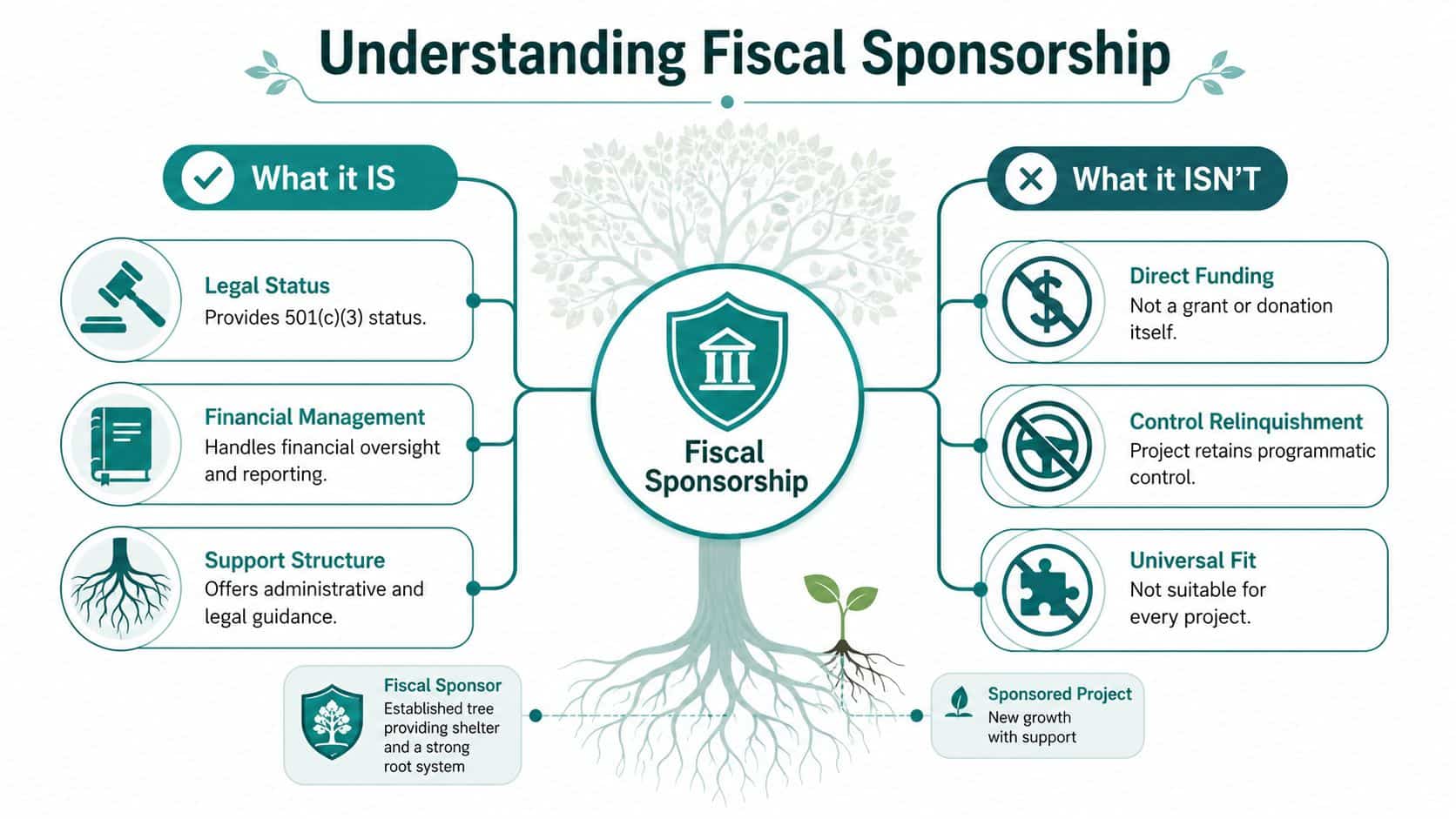
How IRS Revenue Ruling 68-489 governs fiscal sponsorship
In Revenue Ruling 68-489, the IRS confirmed that a 501(c)(3) organization does not jeopardize its exemption when it distributes funds to non-exempt organizations, provided the 501(c)(3) retains control and discretion as to the use of the funds and maintains records establishing that the funds were used for charitable purposes that further the sponsor's own exempt mission.
When a donor writes a check to a fiscal sponsor for a sponsored project:
- The donor is legally giving the money to the 501(c)(3) sponsor, not to the unincorporated project.
- The sponsor holds variance power — the unilateral authority to redirect the funds if the project fails to fulfill the charitable purpose or violates the sponsorship agreement.
- Because the 501(c)(3) sponsor is the true recipient and steward of the gift, the donor receives a valid 501(c)(3) tax receipt under the sponsor's EIN.
Why a "fiscal agent" fails the deductibility test for non-exempt projects
In legal terms, an agent works on behalf of a principal and must follow the principal's instructions. If an unincorporated community group hires a 501(c)(3) charity to act as its fiscal agent — meaning the charity agrees to deposit checks and pay bills strictly as directed by the community group — the 501(c)(3) has no variance power.
The IRS treats that arrangement as an earmarked pass-through or conduit. In the eyes of the IRS, the gift passed straight through the charity to a non-exempt group, meaning:
- Donors cannot legally claim a 501(c)(3) charitable deduction.
- Issuing 501(c)(3) tax receipts for conduit funds exposes the host charity to IRS penalties for false substantiation.
Practical rule: If your project does not have its own 501(c)(3) determination letter and you need tax-deductible donations or foundation grants, you need a fiscal sponsor, never a fiscal agent.
How Accounting Standards (FASB ASC 958) Treat Each Relationship
The difference between a fiscal sponsor and a fiscal agent also changes how money is recorded on the general ledger and reported on IRS Form 990.
Accounting for a Fiscal Sponsor (Variance Power Present)
Under FASB ASC 958-605 (Not-for-Profit Entities — Revenue Recognition), when a sponsor holds variance power over contributions raised for a project:
- Contributions are recognized as revenue on the sponsor's Statement of Activities (typically in a donor-restricted project fund).
- Project disbursements are recognized as expenses on the sponsor's books — either as direct program expenses under Model A or as grants paid under Model C.
- Administrative allocations are recorded as internal transfers moving funds from the restricted project fund to the sponsor's general operating fund (see fiscal sponsor administrative allocations).
Accounting for a Fiscal Agent (No Variance Power)
When an organization acts as a true fiscal agent (or provides Model F technical assistance to a separate charity that already has its own 501(c)(3)), FASB ASC 958-605-25-24 treats the transaction as an agency transaction:
- Incoming cash is recorded as a financial asset offset by an equal custodial liability (
Funds Held for Others) on the Balance Sheet. - Neither the incoming cash nor the outgoing disbursements are reported as contribution revenue or program expense on the agent's Statement of Activities or Form 990 Part VIII/IX.
- Only the management or bookkeeping fee charged by the agent is recorded as service revenue.
For a deeper breakdown of how Model A, Model C, Model D, and Model F map to the ledger, read our reference on fiscal sponsorship accounting models.
When Do Nonprofits Actually Need a Fiscal Agent?
Although most startup projects actually need a fiscal sponsor, there are three legitimate scenarios where a true fiscal agent (or administrative service provider) is the right choice:
- Coalitions of existing 501(c)(3) charities: Five established 501(c)(3) organizations pool money for a joint regional campaign and designate one charity as the fiscal agent to pay shared media or event vendors.
- Model F (Technical Assistance) back-office support: A small charity already has its own 501(c)(3) determination letter and EIN, but contracts with a management support organization to process payroll, accounts payable, and bookkeeping.
- Government contract disbursement agents: A municipal or state agency appoints a bonded fiscal agent (often in healthcare or self-directed disability services) to process timesheets and tax withholdings for participant-directed care workers.
How to Fix "Fiscal Agent" Language in Your Agreements and Grant Proposals
What if a foundation's online grant portal asks for your "Fiscal Agent Information"? Many private and family foundations still use legacy terminology on their intake forms even though their legal counsel requires a valid fiscal sponsorship.
Here is how to handle the mismatch safely:
- In the grant application: Enter your fiscal sponsor's legal name, EIN, and 501(c)(3) determination letter in the "Fiscal Agent" fields if the form uses that label, and clarify in the project narrative: "[Project Name] operates as a fiscally sponsored project of [Sponsor Name], a 501(c)(3) public charity (EIN XX-XXXXXXX), under a Model [A/C] fiscal sponsorship agreement."
- In your contract: Never sign a "Fiscal Agency Agreement" if your project lacks 501(c)(3) status. Use a compliant fiscal sponsorship agreement that explicitly grants the sponsor discretion and control over contributed funds.
- In your audit and compliance files: Run through our fiscal sponsor compliance checklist to verify that donation pages, receipts, and approval workflows reflect sponsorship rather than pass-through agency.
Keep Every Sponsored Fund Compliant in One System
Whether your organization sponsors five internal Model A programs or thirty Model C grantees, tracking variance power, restricted fund balances, and monthly administrative allocations in spreadsheets invites audit trouble.
AlignMint gives fiscal sponsors true fund accounting, reviewed Enterprise Sponsor Administrative Allocation that directors confirm before posting, connected donor receipting, and consolidated reporting in one platform — with plan-based user allowances (1 on Free, up to 10 on Plus, up to 25 on Pro, and unlimited on Enterprise). The fiscal sponsor allocation calculator estimates only and does not post ledger entries. Browse the U.S. Fiscal Sponsor Directory, or compare options in our how to choose a fiscal sponsor guide.
Frequently Asked Questions
No. A fiscal sponsor retains legal discretion and control over contributed funds so donors can claim a 501(c)(3) tax deduction for a non-exempt project. A fiscal agent acts on behalf of a principal that already controls the funds; if the principal is not tax-exempt, using a fiscal agent does not make donations tax-deductible.
Only if the underlying project or organization that hired the fiscal agent already holds its own IRS 501(c)(3) tax-exempt status. If the project is not tax-exempt, routing money through a fiscal agent is considered an earmarked conduit transaction by the IRS and does not qualify for a charitable deduction.
Many older foundation applications and grassroots leaders say "fiscal agent" when they legally mean a Model A or Model C fiscal sponsor. Always make sure the written contract is a fiscal sponsorship agreement that grants the 501(c)(3) sponsor variance power over the funds.
Model F (Technical Assistance) is the closest equivalent. Under Model F, a project that already has its own 501(c)(3) hires a back-office organization to manage bookkeeping, payroll, or disbursements as an agent without transferring control of the charitable funds.
Ready to see how AlignMint fits your workflow?
Schedule a free walkthrough — we will help you map donors, funds, and migration steps.