

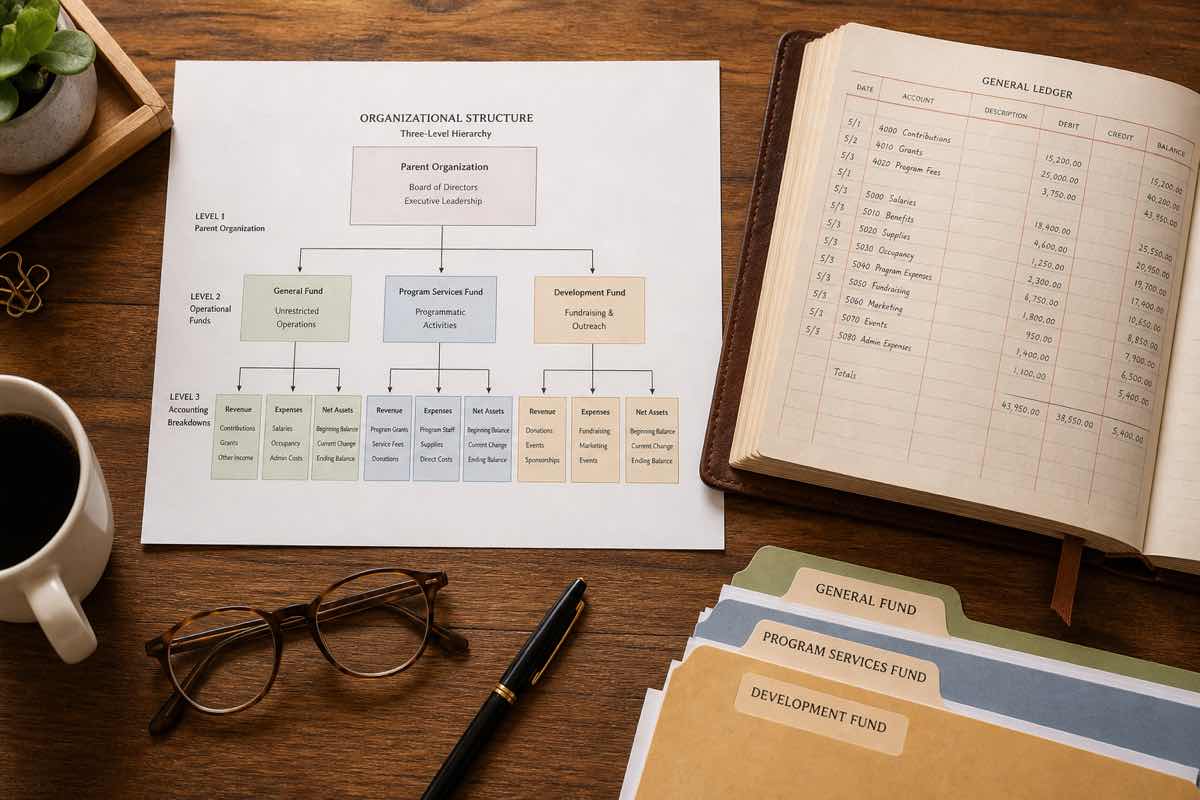
Nonprofit Fund Hierarchy: A Practical Guide
Your nonprofit tracks several programs, a building campaign, two grants, and a handful of designated gifts. The board wants to see each one separately. Your accountant wants one set of books. And you want to stop arguing about whether that means more organizations, more software, or more spreadsheets.
A clear fund hierarchy solves this problem. It gives your board the detail they want while keeping your books in one place. This guide shows how parent organizations, operational funds, and Accounting Funds fit together so you can report by ministry or program without creating another organization or giving page.
Quick Answer: Nonprofit Fund Hierarchy
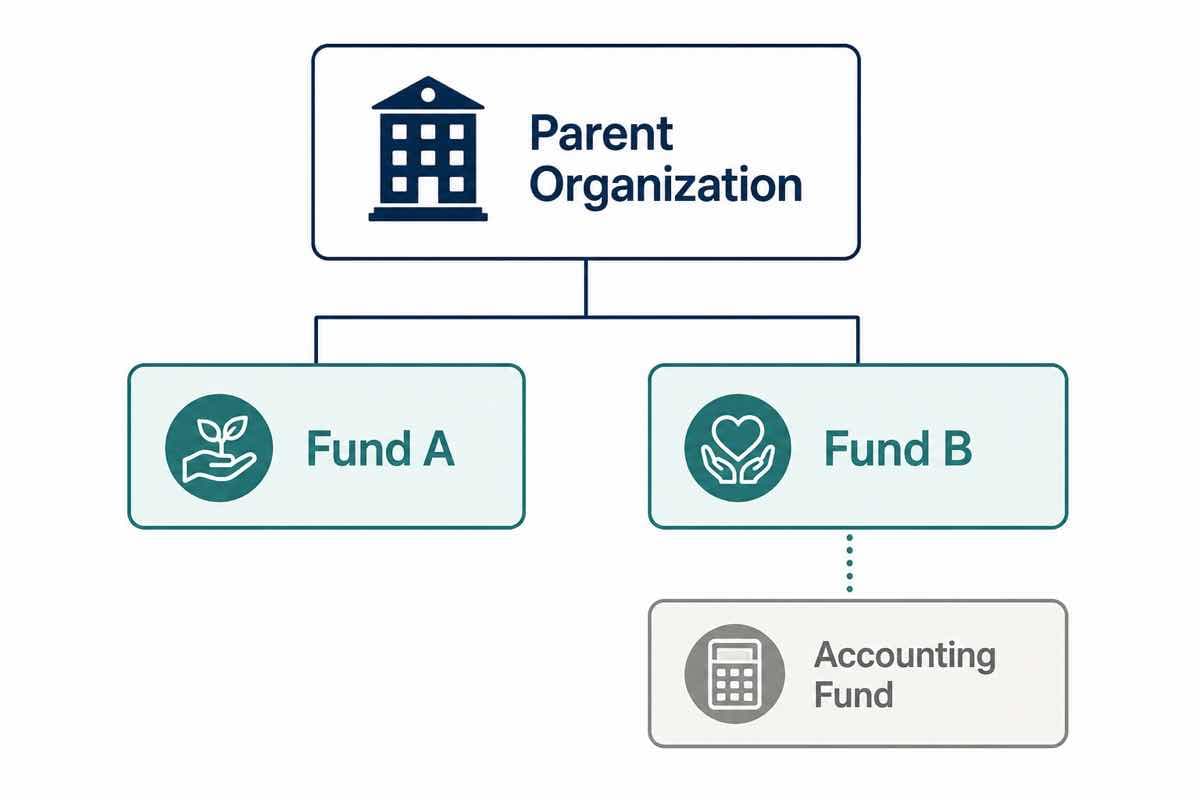
A nonprofit fund hierarchy organizes your financial records into levels. At the top sits the parent organization. Below it are operational funds, each representing a major program, campus, or purpose. When you need finer reporting detail inside a fund, you add an Accounting Fund, a terminal reporting partition that breaks down activity without creating a separate entity.
The key benefit is precision without complexity. You can report by mission trip, youth program, or building phase without spinning up another organization, another bank account, or another donor CRM.
For the operational tools behind fund-level tracking, see fund accounting features. For related reading on how restrictions and funds differ, see restricted vs. unrestricted funds explained.
The Three Levels: Parent, Fund, and Accounting Fund
Most nonprofit accounting works at two levels: the organization and its funds. That is enough for small shops. But as your programs grow, you need a third level that gives reporting detail without the overhead of a full fund.
| Level | What it represents | What it owns | Example |
|---|---|---|---|
| Parent organization | Your nonprofit as a whole | Bank accounts, chart of accounts, giving pages, donor records | First Community Church |
| Fund | An operational child of the parent | Its own income, expenses, and fund balance; can have giving pages and donors | Missions Fund, Youth Fund, General Fund |
| Accounting Fund | A terminal reporting partition under the parent or a fund | Income and expense slices for reporting; no separate giving page or donor list | Honduras Trip, Summer Camp, Building Phase 2 |
How the levels relate
A parent organization can have many funds. A fund can have Accounting Funds underneath it. An Accounting Fund is always the last level. It cannot nest further, and it does not create a separate organization or giving page. Donors give to the fund. The Accounting Fund only partitions where that money shows up in reports.
This means your treasurer can see Honduras Trip revenue on its own line without the missions director needing a separate bank account or a new donor portal. The giving page stays on the Missions Fund. The Accounting Fund just slices the reporting.
What Accounting Funds do not do
Accounting Funds are reporting partitions. They do not carry their own balance sheet, own their own donors, or accept gifts independently. They also do not nest under other Accounting Funds. The hierarchy is always parent, then fund, then Accounting Fund at the terminal level.
Nested Funds vs Restricted Funds vs Multi-Entity
These three concepts sound similar, but they solve different problems. Confusing them is one of the most common mistakes in nonprofit finance.
| Concept | What it tracks | When you need it |
|---|---|---|
| Fund hierarchy (nested funds) | Organizational structure: parent → fund → Accounting Fund | You want reporting detail by ministry, program, or campus |
| Restriction tracking | Donor intent: unrestricted, temporarily restricted, permanently restricted | You need to prove restricted dollars were spent correctly |
| Multi-entity accounting | Separate organizations under one umbrella | You manage a fiscal sponsorship or multiple legal entities |
A fund hierarchy and restriction tracking work together. You can have a Missions Fund (structure) that holds both restricted and unrestricted net assets (restrictions). They are separate dimensions of the same financial picture.
Multi-entity accounting is a different architecture. If you manage separate legal entities, each with its own EIN, you need multi-entity nonprofit accounting, not just nested funds. Multi-entity gives each organization its own books, donors, and giving pages. A fund hierarchy operates inside a single organization.
For a deeper look at how restrictions work separately from fund structure, see accounting funds vs restricted funds explained.
Why QuickBooks Classes Are Not a Fund Hierarchy
QuickBooks lets you tag transactions with classes, locations, or customers. That helps with basic segmentation, but it is not a fund hierarchy.
Here is the difference that matters:
| Feature | QuickBooks classes | True fund hierarchy |
|---|---|---|
| Tracks balances by fund | No. Classes tag transactions, not balances. | Yes. Each fund carries its own balance. |
| Income statement by fund | Partial. You can filter a P&L by class. | Yes. Native income statement by fund. |
| Balance sheet by fund | No. One balance sheet for the company. | Yes. Fund-level balance tracking. |
| Restriction tracking | No native support. | Restriction class is a separate dimension. |
| Hierarchical nesting | Classes are flat tags. | Parent → Fund → Accounting Fund. |
If your organization has outgrown classes and you need true fund-level balances with reporting detail underneath, you need purpose-built fund accounting software that models the hierarchy natively.
The workaround of tagging everything with classes works until the board asks for a balance sheet by fund. At that point, classes fail because QuickBooks tracks one set of balances for the whole company. A fund hierarchy tracks balances at each level.
How Boards and Treasurers Use the Hierarchy Day to Day
The hierarchy is not just an accounting exercise. It shapes how your board sees results, how your treasurer prepares month-end, and how your program leads know what is available.
Board reporting
A board that sees only the top-line income statement misses the story. Fund-level reporting shows how each program performed, whether restricted money was spent properly, and which funds are building or drawing down. For more on what board members actually need, see nested funds for nonprofit board reporting.
Month-end workflow
- Post income and expenses to the correct fund
- Review Accounting Fund activity for programs that track detail beneath a fund
- Reconcile bank accounts at the parent level
- Run the income statement by fund to confirm each program is on track
- Review any unassigned or direct activity that was not attributed to an Accounting Fund
- Prepare the board packet with fund-level summaries
Program lead access
Program directors do not need access to the full chart of accounts. They need to see their fund's balance, recent activity, and whether their budget is on track. A hierarchy makes this possible without giving everyone access to every fund.
How AlignMint Maps the Model
AlignMint's fund accounting maps directly to the three-level model described above.
| Plan | What you get |
|---|---|
| Plus | True fund accounting with operational funds and fund balance tracking. Consolidated financial statements. No statements by individual fund or Accounting Funds (Sub-Funds) on Plus. |
| Pro | Everything in Plus, plus Sub-Funds (Accounting Funds) for reporting breakdowns under your funds. Income and expense partitions at the Accounting Fund level. |
| Enterprise | Everything in Pro, plus multi-org management for fiscal sponsors and umbrella organizations that need separate books per entity. |
What is honest about the mapping
Plus gives you real fund accounting with fund-level balances and reporting. That is enough for many organizations. Pro adds the Accounting Fund layer when you need finer slices, like tracking a specific mission trip inside your Missions Fund, or a building phase inside your Capital Campaign Fund.
What Pro does not yet provide is a full balance sheet at the Accounting Fund level. Accounting Funds partition income and expenses for reporting. The full balance sheet stays at the fund and parent level. If your needs require full balance sheet separation per entity, that is a multi-entity problem, and Enterprise handles it.
AlignMint does not currently show a live interfund transfer interface. Interfund transfers are an important accounting concept, and they work in the journal entry workflow, but the dedicated transfer screen is still in development.
Common Mistakes When Nesting Funds
Creating a new organization when you need a fund
This is the most expensive mistake. Setting up a new organization means a new bank account, a new donor list, a new giving page, and separate reporting. If you just need to track a program's revenue separately, a fund is the right tool, not a new entity.
Treating every purpose as a fund
Not every designated gift needs its own fund. If a donor gives $500 to youth camp and $500 to youth supplies, those are two purposes inside one Youth Fund. An Accounting Fund can separate them for reporting. Creating a separate fund for every earmark leads to dozens of funds that are hard to report and harder to close.
Confusing Accounting Funds with restriction classes
An Accounting Fund is a reporting partition. A restriction class (unrestricted, temporarily restricted, permanently restricted) tracks donor intent on net assets. You need both dimensions. A missions trip Accounting Fund can hold restricted grant money and unrestricted donations at the same time.
Expecting Accounting Funds to nest under other Accounting Funds
The hierarchy is three levels. Accounting Funds are the terminal level. If you need deeper nesting, that is usually a sign you need a separate fund or a separate organization rather than another layer of Accounting Funds.
Skipping the hierarchy until audit time
The hierarchy works best when it is set up before gifts arrive, not retrofitted during the audit. If your structure is right from the start, reporting is a filter, not a reconstruction project.
If you are still tracking programs in spreadsheets or classes, consider whether a true fund hierarchy would make board reporting, month-end, and program oversight easier. For churches managing ministries as funds, see church ministry fund hierarchy explained. For a comparison of how fund structure and restriction tracking work together, read accounting funds vs restricted funds explained.
Frequently Asked Questions
Ready to try AlignMint with your nonprofit?
Start free — set up donor tools, giving pages, and Minty. Upgrade when you need accounting.