

What Does a Treasurer Do for a Nonprofit
You're probably looking at a bank balance that doesn't tell you what you need to know. The money is there, but the question is whether it's usable, restricted, or already spoken for. That's what a treasurer is for, and if the role is done right, it saves you from monthly guesswork and board-room confusion.
At a nonprofit, what does a treasurer do comes down to one thing, accountability. The treasurer turns raw transactions into a financial story the board can trust, the staff can act on, and the auditor can follow. For a clear board-level baseline, see the nonprofit board requirements guide at this board responsibilities resource.
Quick Answer: What a Nonprofit Treasurer Does
A nonprofit treasurer turns transactions into accountability. The role covers budgeting, financial controls, fund accounting, and board reporting so restricted balances, cash timing, and Form 990 readiness stay visible before problems reach the boardroom.
For related board finance work, compare nonprofit treasurer responsibilities with how to create financial statements. For the ledger side, see fund accounting.
The Treasurer You Actually Need at a Nonprofit
Your treasurer should remove the uneasy feeling that comes when the checking account looks fine, but nothing else is clear. A healthy balance does not tell you whether a grant is restricted, whether payroll is covered, or whether the board is about to approve a budget built on wishful thinking.
A real treasurer is the person who makes those questions answerable. That means cash forecasting, monitoring receipts and disbursements, keeping bank relationships steady, and making sure the organization can cover operating and capital needs. In nonprofit settings, that same person often prepares and presents budgets, accounts, and financial statements to the board on a recurring basis, not just at year-end, as described in nonprofit guidance from EDC Paris.
The job is bigger than signatory work
Too many boards treat the treasurer as a ceremonial check signer. That's a mistake. The role is central to keeping the organization honest about where money came from, where it went, and what still has to be paid.
Practical rule: if your treasurer can't explain restricted funds in plain English, the role is too thin.
Small nonprofits often need the treasurer to be hands-on, even handling deposits, expense tracking, and basic recordkeeping. Larger organizations need the same person to think more like a finance lead, handling borrowing decisions, investment of excess cash, and risk oversight. That shift is exactly why the role matters so much.
The right treasurer doesn't just close the books. They keep the board from drifting into bad assumptions, and they give the executive director a cleaner month.
The Four Core Duties Every Nonprofit Treasurer Owns
The role gets clearer when you break it into four duties that build on each other. Budgeting comes first, because your treasurer has to help turn program plans into a spending roadmap the board can approve. If the annual plan says you're adding a summer outreach effort, the treasurer should be checking whether the numbers support it before the vote, not after the money is gone.
Controls protect the bank account
The second duty is financial controls. That means approvals, reconciliations, and segregation of duties, so one person can't move money without anyone noticing. In a healthy setup, the treasurer asks who approves bills, who enters them, and who checks the bank statement against the ledger.
Fund accounting protects purpose
Third is recordkeeping and fund accounting. Every dollar needs to be tagged to its purpose, especially if a grant or donor restriction limits how it can be used. If you receive a restricted grant for a summer program, those funds should stay visible from the day they arrive to the day they're spent.
Reporting turns numbers into decisions
The fourth duty is reporting. The treasurer distills budgeting, controls, and fund accounting into monthly board packets, donor updates, and year-end statements that can survive scrutiny. A good board report tells directors what changed, what's tight, what's ahead, and what needs a decision now.
For a deeper look at financial statement presentation, use this guide to creating financial statements. If your treasurer can explain the year in one page and still name the restricted balances, you've got the right person.
How the Treasurer Role Changes by Organization Size
The most useful way to think about the role is by scale. In a small nonprofit, the treasurer is often close to the books, sometimes even doing deposits and tracking expenses directly. That's normal when the organization is lean and the staff is tiny, but it also means the treasurer becomes a practical operator as much as a board officer.
In a mid-sized organization, the treasurer should stop acting like the bookkeeper and start acting like the reviewer. The bookkeeper or accountant handles the daily mechanics, while the treasurer checks budget-to-actual results, asks hard questions about cash flow, and confirms the controls are working. At this stage, the role is less about data entry and more about deciding whether the data makes sense.
Larger nonprofits need a different shape entirely. The treasurer starts leading or supervising a finance function, advising on reserves, investments, compliance, and risk across multiple programs or locations. That's where the job becomes a strategic finance seat, not a volunteer chore.
Good rule of thumb: if the treasurer is still untangling transactions every month, the organization has outgrown the structure.
That size-based shift matters when you decide whether you need a volunteer, a part-time contractor, or a full-time finance leader. It also matters when you choose tools. A church, a school, or a fiscal sponsor with multiple streams can't run on a loose spreadsheet forever. For a practical option map, see accounting software for small nonprofits.
Governance, Compliance, and What's Behind Form 990
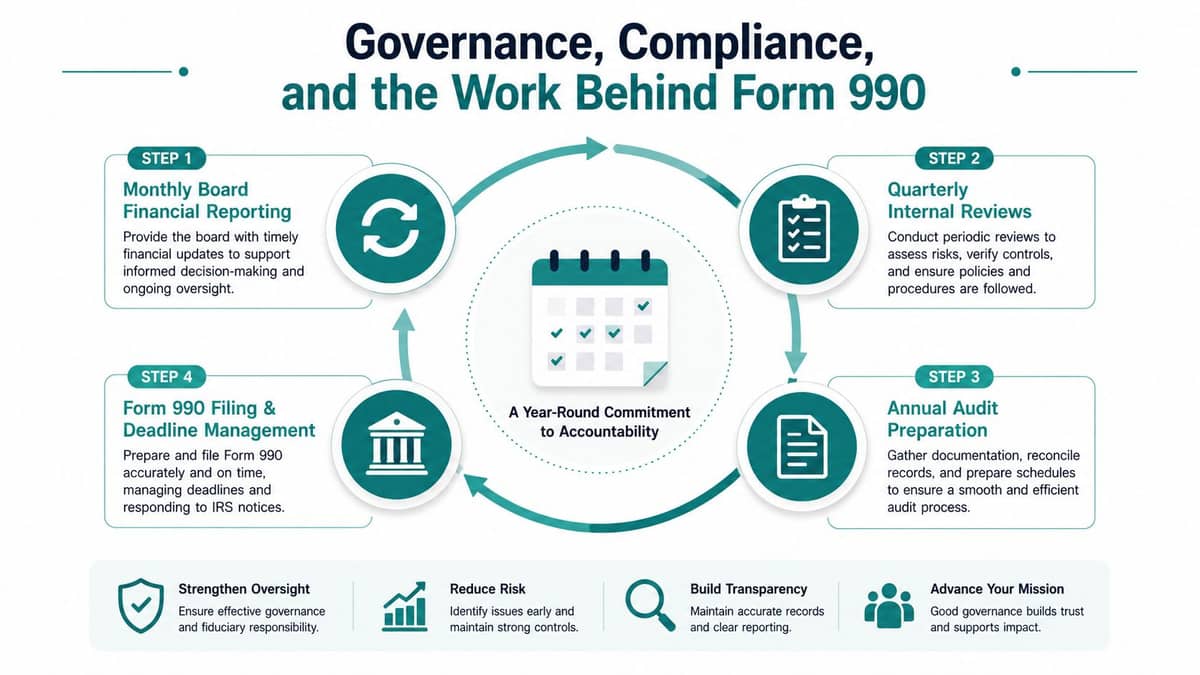
Governance is where the treasurer's job stops being abstract. A treasurer who only shows up at year-end is too late to help the board steer the organization. Nonprofit guidance commonly expects monthly financial reports, cash-flow updates, budget monitoring, and accounts prepared for audit or independent examination, and those rhythms are described in committee treasurer guidance.
The calendar is the job
A disciplined monthly cadence keeps the board honest. The treasurer reviews the prior month's reconciliation and confirms the statements match the bank, then checks budget-to-actual results and flags anything that needs attention before it grows into a larger problem.
The job does not stop there. Board materials need to be prepared with the right context, including restricted balances, grant conditions, and cash timing. The treasurer also helps line up audit documents, tax compliance items, and annual filing deadlines, including the Form 990 process and the Statement of Functional Expenses. A practical Form 990 checklist helps keep those filing steps organized instead of rushed at the end.
The guide from By Design Law Firm makes the governance point clearly, the board oversees, and staff or finance support handles the bookkeeping mechanics. That line matters. The treasurer supports oversight and keeps the board informed, without becoming the person who has to touch every bill or every journal entry.
Common trouble spots are predictable
The same mistakes show up again and again. Restricted grant funds get mixed with operating cash. Donor restriction notes disappear from the file. In-kind contributions lack documentation. Then the treasurer spends time cleaning up problems that should have been caught earlier.
Keep the job boring. Boring means documented, reconciled, reported, and filed on time. That is what protects the mission and keeps the board out of trouble.
Skills That Separate a Good Treasurer From a Great One
A good treasurer knows the numbers. A great one knows how to make those numbers useful to people who don't live in spreadsheets. That difference matters, especially when the board includes smart volunteers who need clear answers, not accounting jargon.
The skills that matter most
- Attention to detail with discipline: A great treasurer catches a missing restriction note before it becomes a reporting headache.
- Clear communication: They can explain a budget shortfall to the board without making the meeting feel like a lecture.
- Comfort with controls: They understand why approvals, reconciliations, and documentation matter before anyone accuses the organization of being overly cautious.
- Steady judgment under pressure: They stay calm during audit prep and keep the team focused on facts.
- Respect for boundaries: They don't push expenses into the wrong period just to make one month look cleaner.
These are not soft traits in the casual sense. They directly affect whether the organization can trust its own records.
A treasurer also needs enough finance fluency to ask the right questions. If a grant agreement has a covenant or spending condition buried in the fine print, someone has to catch it early. If the board sees a complicated report, someone has to translate it into one or two practical decisions.
The best treasurers are helpful, not controlling. They don't hoard knowledge. They make the finance conversation easier for everyone else, which is exactly what a time-poor executive director needs.
How the Right Software Changes the Treasurer's Workload
The right software changes the month, not just the desktop. Spreadsheet stacks can work for a while, and QuickBooks is familiar to many teams, but nonprofit finance gets messy fast when restricted funds, donor records, and board reporting live in separate places.
QuickBooks, Excel, and a nonprofit platform
QuickBooks is solid for general bookkeeping. It handles the basics well, and many small teams know it already. The gap is nonprofit structure, because fund accounting often gets mimicked with classes and locations instead of being built in from the start.
Excel gives you flexibility. It's useful for quick analysis, one-off schedules, and messy cleanup. The downside is version control, handoffs, and approval tracking, which turn every monthly close into a small detective story.
A platform built for nonprofits takes a different approach. AlignMint combines accounting, donor management, volunteers, events, and marketing in one place, with true fund accounting built in. That matters because a treasurer shouldn't have to stitch together systems just to produce board-ready reports.
For a practical buying lens, use this guide on choosing accounting software. If you also want a broader look at donation workflows, volunteer donation software is worth comparing because it shows how some teams handle giving and volunteer operations in one workflow.
A treasurer using spreadsheets may spend several days each month assembling reports, checking formulas, and reconciling data across tools. In a purpose-built system, that same work becomes far more direct because the records already live together. That's the difference between managing information and hunting for it.
A Practical Monthly Checklist for Nonprofit Treasurers
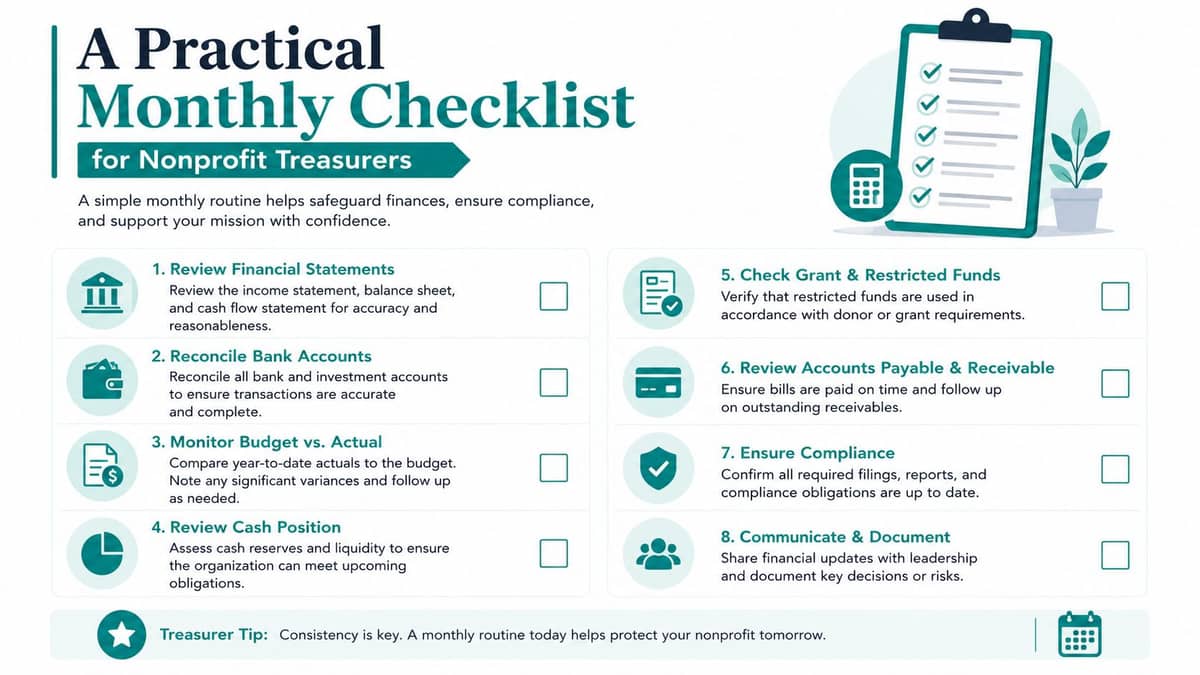
The best treasurers work on a steady rhythm. They don't wait for panic, and they don't let the month drift until the board packet is due. A simple four-week pattern keeps the month manageable without pretending the nonprofit has a full finance department.
Week one and week two
Start with the prior month. Reconcile the bank account, review financial statements, and confirm restricted balances are still correct. Those are treasurer-level checks, even if a bookkeeper does the first pass.
Then move into budget review and catch-up work. Confirm payroll postings, pay bills, and update the budget with anything the board needs to see. If something is off, deal with it early instead of waiting for the committee meeting.
Week three and week four
Week three belongs to reporting. Prep the board materials, analyze the numbers, and write the short explanation that tells directors what changed. A treasurer who can do that well saves everyone time.
Week four is forward-looking. Forecast cash flow, plan grant drawdowns, and line up compliance documents for the next cycle. If your organization runs lean, this is also where a bookkeeper can handle the mechanics while the treasurer keeps the oversight.
A practical monthly financial reporting checklist from Allied Tax Advisors can help you compare your own rhythm against a simple month-end routine. Keep the list short enough that someone will use it. If it takes a heroic effort to follow, it's too complicated.
Putting It Together and Choosing Your Next Step
A treasurer is the person who keeps the organization's promise to donors, the board, and the community. They protect cash, track restrictions, prepare reports, and make sure the numbers match the mission. In a small nonprofit, that may mean hands-on bookkeeping support. In a larger one, it means oversight, policy, and strategic judgment.
If your annual revenue is under $100K, AlignMint can cover the full treasurer workflow without per-seat fees. The free tier includes true fund accounting, donor management, plan-based access, and the reports treasurers need to stay ahead of the board calendar.
If your current process still depends on spreadsheets, separate donation tools, and too many manual handoffs, start by tightening the treasurer role itself. Then choose software that matches the role, not software that creates more of it.
Ready to try AlignMint with your nonprofit?
Start free — set up donor tools, giving pages, and Minty. Upgrade when you need accounting.