

Benevolent Fund Meaning: Policy vs Informal Aid
A benevolent fund is a charitable relief fund for members, former members, and dependents facing hardship, operating through a governed trust or charity rather than an informal collection. One long-running example began in 1853, helped 8 widows in its first year at a total cost of £105, and charged members a penny a week.
You may be facing a familiar situation. A volunteer needs help with a medical bill, a former employee is struggling with housing costs, or a family needs support after a disaster. Reaching into the general account feels compassionate, but informal decisions can create accounting, eligibility, and tax problems.
A properly structured fund gives your organization a defensible way to respond. It defines who qualifies, documents why assistance was approved, protects donor intent, and keeps sensitive decisions separate from everyday operations.
Quick Answer: What a Benevolent Fund Is
An informal gift from the operating account is not a benevolent fund. A benevolent fund has written eligibility, a decision path, and restricted-fund books so hardship aid stays defensible.
Keep hardship gifts in fund accounting, then compare restricted vs unrestricted funds with restricted fund accounting.
Understanding What a Benevolent Fund Actually Is
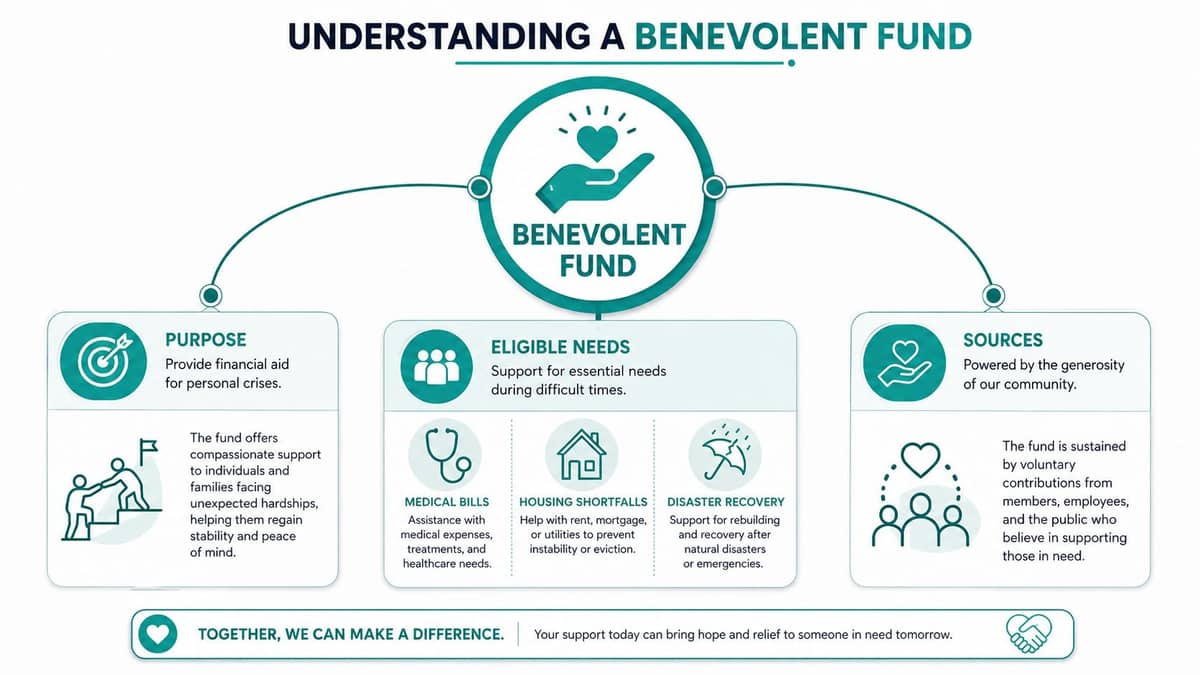
A benevolent fund turns goodwill into a controlled charitable process. Instead of asking one director, pastor, treasurer, or committee member to decide whether a request feels deserving, the organization establishes written rules and a consistent review path.
The core purpose is focused. A benevolent fund supports people connected to a defined group, such as current members, former members, employees, professional-association members, or their dependents. Assistance usually addresses personal hardship, including medical costs, housing shortfalls, utility needs, or disaster recovery.
Why informal assistance creates risk
Suppose a staff member asks for help after an unexpected crisis. The organization pays the bill from its operating account, then accepts a few donations to replenish the money. The immediate problem may be solved, but the records might not show whether the payment served a charitable purpose, whether similar applicants would receive equal treatment, or whether donors restricted their gifts.
A true benevolent fund answers those questions before the crisis arrives. Its governing document identifies the charitable purpose, its policy describes eligibility, and its trustees or committee approve grants according to recorded criteria.
The historical record of the BT Benevolent Fund illustrates how these arrangements can develop. Founded as the Post Office Clerk's Charitable Fund, it helped 8 widows in its first year at a total cost of £105. By 1902, it handled only 20 cases, and by 1950 it made 71 grants totaling £1,577, according to the BT Benevolent Fund annual report and accounts.
Practical rule: Compassion should guide the response, but written criteria should guide the decision.
The fund also needs a clear financial identity. Donors may give specifically for benevolence, and those dollars can't become general operating revenue. Our restricted versus unrestricted funds guide explains the accounting distinction that supports this separation.
Your public communication matters too. A clearly explained fund policy, donation appeal, and privacy statement help people understand the purpose without exposing beneficiaries. Organizations building that communication plan can consult this practical digital marketing for nonprofits guide for broader donor messaging context.
How Benevolent Funds Are Governed and Who Qualifies
Governance determines whether your benevolent fund is credible, fair, and legally defensible. A fund without defined authority can make inconsistent decisions, invite conflicts of interest, and leave future leaders unsure about their responsibilities.
Most established funds operate under a trust deed, declaration of trust, or formal policy. Trustees must act independently and in the charity's interests. The governing document should identify the beneficiaries, permitted assistance, approval authority, conflicts process, confidentiality expectations, and recordkeeping duties.
Build a decision path people can follow
The CIBSE model offers a concrete example. Its fund operates under a Declaration of Trust, is overseen by at least seven trustees, and uses a management committee for grant approvals. That committee meets quarterly, while emergency authority is delegated between meetings, as described in CIBSE's benevolent fund organization.
That arrangement balances oversight with responsiveness. A committee can review applications collectively, while delegated authority prevents an urgent request from waiting for the next scheduled meeting.
A practical governance framework should answer these questions:
- Who may apply: Define whether eligibility includes current members, former members, employees, dependents, or another specified group.
- What hardship means: Describe covered needs, such as medical expenses, housing, utilities, or disaster recovery.
- Who decides: Separate application review, approval, payment, and reconciliation wherever practical.
- How conflicts are handled: Require decision-makers to disclose personal relationships and leave affected discussions.
- What records are kept: Capture the hardship category, decision, approving authority, payment, and relevant supporting evidence.
- How privacy is protected: Record enough information for review without collecting unnecessary personal detail.
Eligibility must come from the governing document, not from an individual's personal judgment. A fund may serve a narrow occupational group, a professional association, a church community, or dependents connected to that group. The wider the eligible population, the more carefully you need to define available resources and review standards.
Keep support short-term and case-specific
Benevolent funds generally provide short-term, case-by-case assistance rather than open-ended support. That boundary protects the fund from becoming an unplanned substitute for employment benefits, social services, or a broader grant program.
Your policy can still allow discretion, but discretion should operate inside clear limits. If requests become recurring, the committee can consider referrals to housing agencies, financial counselors, government programs, or other organizations equipped for continuing support.
For board responsibilities and oversight expectations, keep your governance records aligned with your organization's broader nonprofit board of directors requirements. The benevolent fund shouldn't become a separate island in your accountability system.
Accounting, Tax Treatment, and Form 990 Implications
The accounting question is simple to state and easy to mishandle: which money belongs to benevolence, and which money remains available for general purposes?
Restricted funds are donor-imposed and legally binding. They must be tracked separately from unrestricted money. Under GAAP, restricted amounts appear as net assets with donor restrictions and are released when the stated purpose or time condition is satisfied, according to Propel Nonprofits' guidance on managing restricted funds.
Separate purpose from bank location
A separate bank account can help, but bank separation alone isn't fund accounting. Your general ledger must identify the fund, record restricted contributions, assign eligible expenses, and show releases when restrictions are met.
A useful monthly process includes:
- Recording gifts against the correct benevolent fund code.
- Matching each payment to an approved hardship request.
- Reconciling the ledger with bank records and donor agreements.
- Recording releases when the donor restriction has been satisfied.
- Reporting opening, received, spent, and closing balances.
Practical fund-accounting guidance recommends dedicated fund codes, monthly reconciliation, expense ties to donor restrictions, and release entries when conditions are met, as outlined in this restricted-funds general-ledger guide.
Tax classification depends on the vehicle
In the United States, “benevolent fund” doesn't identify one universal legal structure. The IRS treats certain employee-related funds as distinct exempt entities under sections 501(c)(4), 501(c)(9), or 501(c)(17). The applicable category depends on whether the fund functions as a local employee association, a voluntary employees' beneficiary association, or a cemetery fund, according to IRS guidance on employee benefit associations and funds.
That classification affects contribution treatment, eligible benefits, reporting obligations, and the types of hardship your fund may cover. A nonprofit shouldn't assume that a fund connected to employees, members, or a professional body automatically has the same tax treatment as its sponsoring charity.
Form 990 reporting also depends on the fund's legal status and accounting records. Your finance team should confirm whether the fund belongs inside the existing entity, requires separate reporting, or operates through another arrangement. The Form 990 guide for new nonprofits can help frame the broader filing questions, but counsel or a qualified tax professional should confirm the classification.
A clean ledger can't correct an unclear legal structure. Decide what the fund is before deciding how to report it.
Setting Up a Benevolent Fund Step by Step
A benevolent fund doesn't require elaborate technology at the outset. It does require deliberate choices, written authority, and a record trail that another responsible person can understand later.
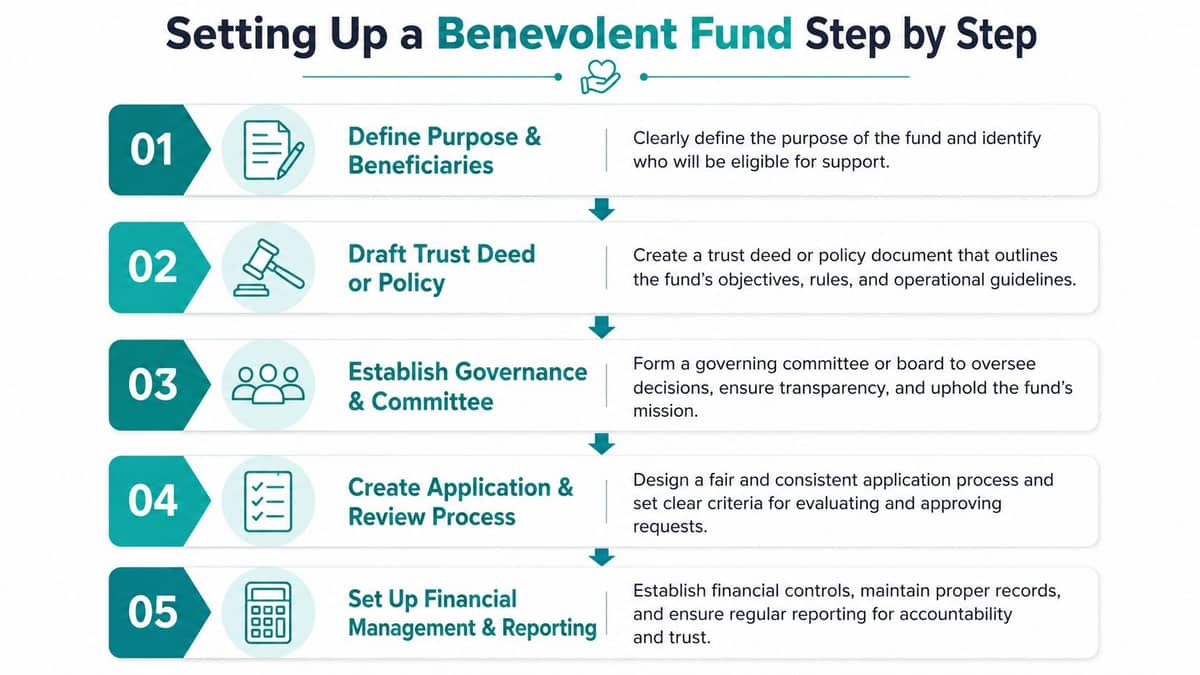
Start with purpose and eligibility
Write one plain-language purpose statement. Identify the people the fund serves and the hardship categories it may address. Avoid promises of unlimited support, because the fund's available resources and legal authority will always impose practical boundaries.
Next, adopt the governing document. Depending on your structure and jurisdiction, that may be a trust deed, declaration of trust, board-approved policy, or another formal instrument. Have appropriate legal and tax advisers review it before accepting contributions.
Assign responsibility before receiving requests
Appoint trustees or a management committee, then document their duties. Define who reviews applications, who approves grants, who releases payments, and who reconciles the fund. No single person should control the entire process where your staffing makes separation possible.
Create an application that requests only useful information. Applicants should know what documents to provide, how decisions are made, and when they can expect a response. Sensitive records need restricted access, not broad circulation through email.
Connect approvals to the ledger
Create a dedicated fund code in your general ledger. Each approved grant should connect to an application record, hardship category, approving authority, payment record, and donor restriction when relevant.
A monthly reconciliation should compare the fund balance, bank records, donor agreements, and outstanding approved payments. This routine catches misclassified gifts and duplicate payments before they become board-reporting problems.
A platform with true fund accounting can connect donations, expenses, approvals, and reports without forcing staff to maintain separate spreadsheets. AlignMint is one option that combines fund accounting with donor management, volunteers, events, marketing, and team communication. Its free tier is available to nonprofits under $100K, and it offers plan-based access without per-seat fees.
For the governing relationship between your board and fund policy, review this nonprofit bylaws template. The template won't replace legal review, but it can help your board identify missing authority and approval language.
Real-World Examples and Sample Policy Language
Established benevolent funds demonstrate that this model can operate as a formal charity rather than a casual relief account. Lloyd's Benevolent Fund was standard-registered on 22 November 1962. Its reported total gross income was £425,000 in 2024, compared with £334,000 in 2020, while expenditure rose from £453,000 to £466,000 over that period, according to the Charity Commission entry for Lloyd's Benevolent Fund.
The same registry entry shows BT Benevolent Fund reporting 2023 income of £1,257,273 and expenditure of £1,005,243, including £910,490 spent on charitable activities. Those records show the financial scale, reporting discipline, and regulated status that can exist when a benevolent fund has matured into an audited charitable entity.
What a workable policy says
Your policy should be compassionate without becoming vague. It needs enough detail for a committee member to apply the rules consistently, while preserving room for judgment when circumstances don't fit a standard form.
You might adapt language such as this:
Purpose: The Benevolent Fund provides charitable relief to eligible [members, former members, employees, and dependents] experiencing hardship.
Eligible needs: Assistance may address necessary medical costs, housing, utilities, or disaster-related expenses when the applicant meets the fund's criteria.
Decision process: Applications will be reviewed by authorized decision-makers under this policy. Each decision will be documented with the relevant hardship category, approval, and payment record.
Limits: Assistance is short-term and case-specific. The fund does not promise recurring support or replace public benefits, insurance, employment compensation, or other available resources.
Confidentiality: Records will contain only information needed to evaluate, approve, pay, and report assistance. Personal details will be restricted to authorized personnel.
Church-focused guidance increasingly emphasizes written policies and approvals because informal giving makes consistency difficult. The same principle applies to occupational charities and professional associations. For an example of a sponsor-linked charitable organization, review the Omaha Firefighters Cancer and Benevolent Fund profile.
Common Questions About Benevolent Funds
Is a benevolent fund the same as a general charity fund?
No. A benevolent fund normally addresses individual or family hardship within a defined group. A broader charity fund may support public-benefit programs, community services, grants, or long-term initiatives.
The distinction affects your governing purpose, eligibility rules, donor communications, and accounting. If your organization wants to fund recurring community programs, a broader grant program may fit better than expanding a narrow hardship fund informally.
Should a church or school create one?
A church may benefit from a benevolent fund when it needs a documented way to assist individuals or families with urgent personal needs. A school or educational nonprofit might instead need separate funds for student hardship, emergency support, scholarships, or program grants.
Don't combine those purposes just because they involve helping people. Separate policies and fund codes make it easier to explain donor intent and apply eligibility consistently.
Can fiscal sponsorship support a benevolent project?
Fiscal sponsorship is a contractual arrangement in which a 501(c)(3) sponsor receives tax-deductible donations for a project that hasn't applied for, or has chosen not to seek, tax-exempt status. The sponsor must retain ultimate direction and control over the funds and remain responsible for proper expenditure and accounting, according to the Fiscal Sponsorship Collaborative webinar materials.
That arrangement can support a sponsored relief project, but it doesn't eliminate the sponsor's duties. The agreement should define purpose, eligibility, approvals, reporting, records, and the sponsor's control over charitable funds.
What should donors expect?
Donors should receive a clear purpose, an explanation of eligible uses, and appropriate financial reporting. They shouldn't receive beneficiary identities or sensitive personal details. Your annual reports and board updates can describe fund activity while protecting privacy.
The director facing an urgent request can now respond with more than compassion alone. A defined purpose, independent oversight, restricted-fund accounting, and careful documentation give that compassion a safe operating framework.
AlignMint brings true fund accounting, donor records, volunteer management, events, marketing, online giving pages, and team communication into one platform. If your benevolent fund still depends on disconnected spreadsheets and manual reports, visit AlignMint to see whether its fund structure fits your organization.
Ready to try AlignMint with your nonprofit?
Start free — set up donor tools, giving pages, and Minty. Upgrade when you need accounting.