

A capital campaign is a time-limited, specially organized effort to secure large gifts for a defined capital purpose such as a building, equipment, an endowment or a major initiative. Your board may love the project, but enthusiasm doesn't answer the harder questions. Who tracks pledges for years, protects the annual fund, and reports restricted gifts correctly.
This guide explains what is a capital campaign in plain, practical terms. You'll see how a campaign differs from yearly giving and how the work unfolds. You'll also see the staffing, board, and bookkeeping work behind the public goal.
Quick Answer: Capital Campaigns
A capital campaign is a multiyear effort to raise large gifts for a building, equipment, an endowment, or another defined project. It needs its own pledges, restricted fund, and board roles, separate from the annual fund.
Start with fundraising and restricted funds. For pledge schedules, see pledge review.
What a Capital Campaign Is and How It Differs
A board member looks at the finance report and asks a fair question. Why does roof money keep getting mixed up with the annual appeal. That confusion is exactly why a campaign needs its own structure.
Think of your finances like a house that you maintain. Your annual fund pays the electric bill and keeps the lights on. A capital campaign replaces the roof so the house lasts.
What makes it different from a bigger appeal
A campaign isn't just a larger version of your yearly appeal. It has a separate case for support, goal, and prospect strategy. It also needs a gift schedule, volunteer structure, and pledge process.
Those pieces support long-term priorities rather than routine annual operations. Common purposes include facilities, major equipment, an endowment, or a major initiative. Capacity projects can also fit when they change what you can do.
Scale explains why the recordkeeping burden feels so different. A 2015 study reported in The Chronicle of Philanthropy found campaigns were generally planned to last about five years. The same study found an average goal of $45 million among respondents.
Your goal may be far smaller, and that's completely normal. The lesson isn't the dollar figure itself. It's the multiyear planning, board leadership, and disciplined reporting campaigns demand.
| Approach | Purpose | Typical length | Gift pattern | Accounting focus |
|---|---|---|---|---|
| Annual fund | Pays for yearly operating costs | Renewed every 12 months | Many gifts, mostly small to mid-size | Mostly unrestricted |
| Special appeal | One urgent or specific need, such as disaster relief | Weeks to a few months | Broad base of small gifts | Often restricted to the appeal |
| Capital campaign | Facilities, equipment, endowment or a major initiative | Typically 3 to 5 years | Few large gifts plus multiyear pledges | Restricted gifts and pledges tracked separately |
A worked example you can picture
Say your school was built in the 1960s and needs work. You plan a $1.2 million gym renovation over four years. A handful of large gifts comes first, then multiyear pledges follow.
Families and alumni join later through a broad community phase. Meanwhile, your annual fund still pays teachers, utilities, and classroom supplies. If both efforts share one bucket, nobody can answer simple questions.
Practical rule: If donors gave for the gym, you must prove gym money stayed separate.
Treat the campaign as a multiyear operating project, not a donation drive. Give it its own budget, board roles, donor records, and reports. That separation protects donor trust and makes board meetings much calmer.
How a Capital Campaign Unfolds, Stage by Stage
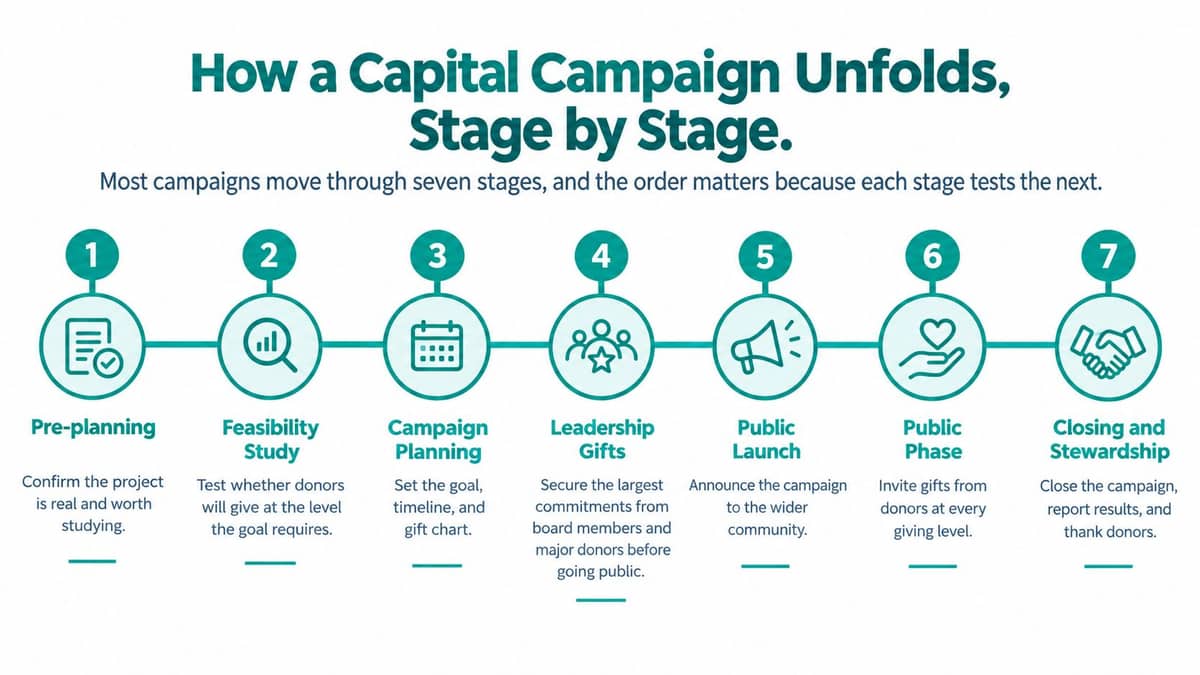
Most campaigns follow the same order for a good reason. Each stage tests whether the next stage is safe to attempt. Skip a test, and you'll usually pay for it later.
A DonorSearch campaign plan guide lists seven distinct stages for a campaign. Those stages are pre-planning, feasibility study, planning, and quiet phase. Public kickoff, public phase, and wrap-up complete the sequence.
The early stages do the quiet testing
Pre-planning confirms the project is real and worth studying carefully. You define the need, rough cost, owner, and decision timeline. You also name who'll lead if the answer is yes.
A feasibility study then interviews prospective top donors and stakeholders. It tests campaign messages, identifies objections, and checks organizational health. You learn whether donors support the project before you commit publicly.
That study may tell you to revise the goal. It may also expose weak staffing, unclear costs, or board hesitation. Hearing that early is disappointing, but it's far cheaper.
During planning, you set the goal and write the case. You also build the gift table, volunteer structure, and campaign budget. At this stage, vague hopes become named assignments and dates.
Why quiet work comes before public work
The quiet phase seeks major gifts from selected donors first. Board members and top prospects make commitments before broad outreach begins. Their gifts create credible momentum for everyone who follows.
Say you're adding classroom space that cannot wait for construction alone. Clear project details help early donors judge the request seriously.
At public kickoff, you announce the campaign with leadership gifts visible. The public phase then adds events, peer appeals, crowdfunding, and direct mail. Wrap-up covers thanks, final reports, pledge follow-up, and long-term stewardship.
Before moving forward, ask which stage you're truly in. Then ask what evidence must exist before the next stage. If you can't name that evidence, you're not ready yet.
Board Roles and What the Campaign Costs
Your board's commitments set the practical ceiling for your public target. If board members won't give first, major donors will notice. If they won't ask peers, staff will carry too much alone.
Three jobs your board cannot delegate
Board members first give in a way that's personally meaningful. Second, they get gifts by asking peers and joining visits. Third, they open doors to prospects staff cannot reach alone.
Complete participation matters even when individual gifts differ in size. Foundations and major donors often ask whether every board member contributed. A clear yes strengthens every conversation that follows.
Name a campaign chair or committee between regular board meetings. That group reviews prospects, removes roadblocks, and keeps assignments moving weekly. Our development board guide can help you shape those working roles.
There are useful reference points for sizing board giving. A 2024 benchmark report covering organizations in the United States and Canada reported board members contributed an average of 15% of the campaign goal. The median contribution represented 10.5% in that same report.
Those figures aren't a quota for your board. They show why leadership gifts need discussion before the public target. Each member should know the expected commitment before quiet work starts.
Build a campaign budget the board can see
Put campaign costs on their own approved budget lines. Don't hide them inside ordinary operating expenses where nobody sees them. Hidden costs create surprises, staff resentment, and awkward board questions.
- Feasibility and advice: Study costs, consultant time, and prospect research tools.
- People and materials: Campaign staff, printing, events, and site visits.
- Care and records: Donor stewardship, pledge reminders, and extra bookkeeping time.
Construction and renovation budgets deserve the same plain speaking. Bring those questions to the board before the public launch.
Ask your board to approve a contingency line as well. Costs change, pledge timing slips, and events need adjustments. An approved cushion lets you respond without raiding operating cash.
How to Size a Goal Donors Can Reach
A reachable goal starts with arithmetic, not hope or project cost. Your building may carry a firm price tag on paper, but donors still need the capacity and willingness to fund it. Sizing works like setting a price you already know buyers can pay.
Read the gift table from the top down
A gift table, also called a gift pyramid, maps the gifts you need. It shows how many donors are required at each level, and it reveals whether your prospect list can actually support the goal.
Non-Profit Kit For Dummies campaign guidance cites a lead gift of roughly 10% to 20% of the total, with the top ten gifts contributing about 50% under conventional benchmarks. Prospect pools may need to be three to four times larger than the number of gifts sought.
That concentration surprises leaders used to broad annual appeals. A campaign does not need hundreds of equal gifts to succeed. It needs a small number of leadership gifts secured early.
| Gift level | Gifts needed | Gift size | Share of goal |
|---|---|---|---|
| Lead gift | 1 | $150,000 | 15% |
| Top tier | 2 | $75,000 | 15% |
| Second tier | 4 | $40,000 | 16% |
| Third tier | 8 | $20,000 | 16% |
| Mid-level gifts | 20 | $10,000 | 20% |
| Smaller major gifts | 40 | $2,500 | 10% |
| Broad community gifts | 80 | $1,000 | 8% |
| Total | 155 | $1,000,000 | 100% |
Walk this $1 million example one row at a time. One donor gives $150,000, and two give $75,000 each. Four donors at $40,000 and eight at $20,000 follow. Twenty donors then give $10,000 through the middle tiers, forty give $2,500, and eighty give $1,000 each.
The broad community matters, but it closes rather than carries.
Test the table against real people
If leadership prospects aren't qualified early, choices become painful fast. You'll lower the goal, extend the timeline, or chase impractical volume. Small gifts cannot replace missing leadership gifts without huge effort.
Many campaigns aim to secure a large share of the goal before going public, so quiet phase work determines public credibility. Announcements sound different when most money is already committed.
- List prospects: Add capacity ratings, relationships, and likely solicitation owners.
- Build the pyramid: Match each level with more prospects than gifts.
- Confirm lead gifts: Secure board and top commitments before public math.
- Check feasibility findings: Compare donor feedback with your operating assumptions using our nonprofit operating budget template.
Record solicitation stage, pledge probability, households, and soft credits carefully. Compare committed amounts with cash received every single month. A gift table only helps when donor records stay current.
Fundraising Strategies for Each Phase
Quiet phase work is relationship work with a short list. Public phase work is breadth work with many people. Confusing those jobs wastes staff time and disappoints volunteers.
| Strategy | Best phase | Who it reaches | Watch out for |
|---|---|---|---|
| Board and leadership gifts | Quiet phase | Board members and top prospects | Must be secured before the public launch |
| Personal visits to major prospects | Quiet phase | Donors with proven capacity | Needs tracked solicitation stages |
| Multiyear pledges | Quiet and public phases | Major donors and loyal supporters | Pledge schedules need active tracking |
| Events and site tours | Public phase | Community members and mid-level donors | Costs can reduce the net result |
| Peer-to-peer fundraising | Public phase | Volunteers and their networks | Needs training and a thank-you routine |
| Crowdfunding | Public phase | Wide online audience | Usually small gifts, so it supports major gifts |
| Email and direct appeals | Public phase | Full donor file | Needs clean records and segmentation |
Choose fewer strategies and staff them properly
Personal visits carry the quiet phase because gifts are large. Each visit needs preparation, a clear ask, and prompt follow-up. Track who's visited, who asked, and what happens next.
Multiyear pledges help donors make larger commitments over time. They also create years of reminders, receipts, and schedule changes. Our pledge campaign guidance shows the recordkeeping those schedules require.
Events and site tours can build belief in the project. They can also consume a large share of proceeds. Review net revenue and staff hours, not attendance alone.
Peer-to-peer fundraising works when volunteers understand the story. Train them, give sample language, and thank their donors promptly. Without that care, enthusiastic volunteers can drift off message quickly.
Crowdfunding brings visibility and many smaller gifts from online networks. It supports major gifts rather than replacing them. Set expectations before volunteers assume social sharing will fund construction.
Email and direct appeals depend on clean, segmented donor records. Board prospects, past campaign donors, and annual donors need different messages. Bad addresses and duplicate households steadily reduce every appeal's return.
Choose three strategies that match your donors, staff hours, and current phase.
Write one owner beside each strategy you choose. Add the audience, cost, timing, and follow-up routine. A short plan you'll run in practice beats an ambitious list.
Tracking Restricted Gifts and Pledges Correctly
Clean campaign books give you calm answers under board scrutiny. Donors can see their intent honored in every report. You can also tell cash apart from promises instantly.
The two classes in plain language
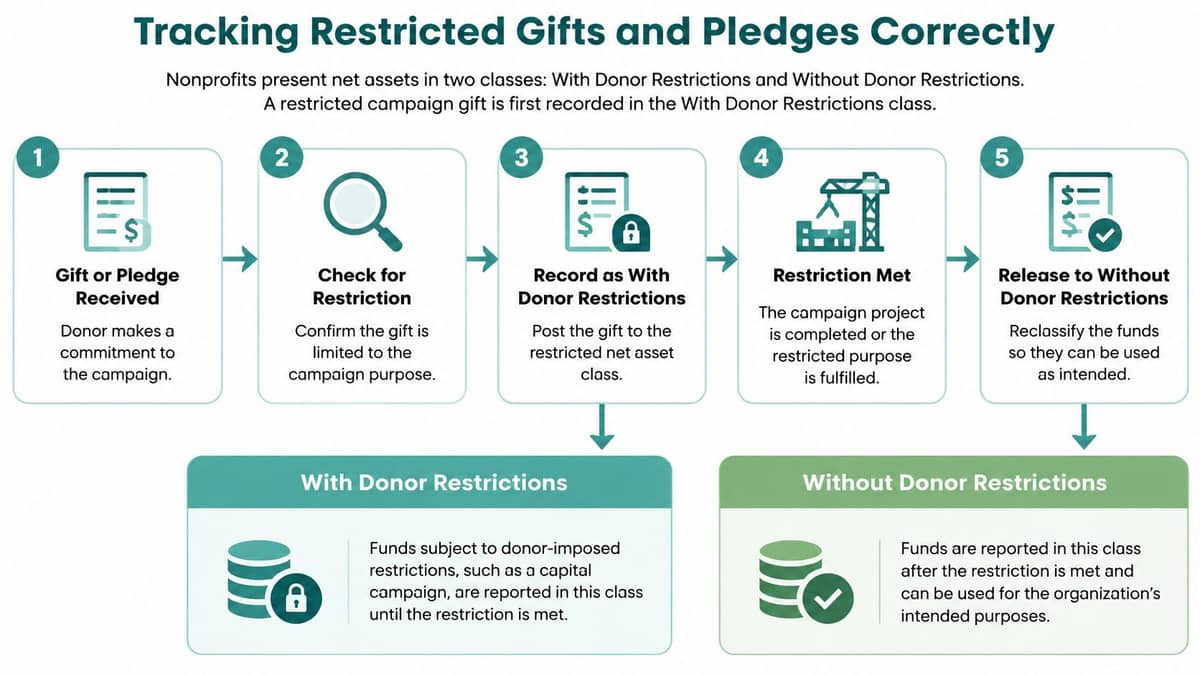
Under FASB ASU 2016-14, nonprofits present net assets in two classes. Those classes are with donor restrictions and without donor restrictions. An Intuit guide to restricted funds nonprofit accounting explains that a restricted contribution is initially recorded in the restricted class.
When you spend money for the donor-specified purpose, amounts move. The applicable amount is reclassified to net assets without donor restrictions. The related expense is recorded at that point as well.
Say a donor gives $50,000 restricted to roof replacement. That gift sits in the restricted class after you receive it. It stays there until the roofing contractor is properly paid.
Then you release the amount and record the expense. Your reports now show both donor intent and project spending. Nobody has to reconstruct the story from old emails.
Follow each gift from promise to release
- Record the pledge: Note its restriction, conditions, amount, and donor.
- Track the schedule: Keep expected payments separate from cash received.
- Deposit carefully: Post each payment against the right campaign fund.
- Record project spending: Match each expense to the approved purpose.
- Reclassify the release: Move the amount when restrictions are met.
- Report against budget: Compare receipts and spending with the approved project.
Our restricted funds documentation outlines how those balances stay visible. Related reading on fund accounting and fund accounting software explains the broader system. True fund accounting keeps restricted and unrestricted dollars tied to purpose.
That design differs from QuickBooks classes, which many nonprofits use well for general bookkeeping. Your local accounting rules still govern your own reporting.
Review outstanding pledges and restricted balances with finance staff monthly. Investigate old balances before audit or grant reports are due. Small corrections are easier while memories and documents remain fresh.
Measuring Whether Your Campaign Succeeded
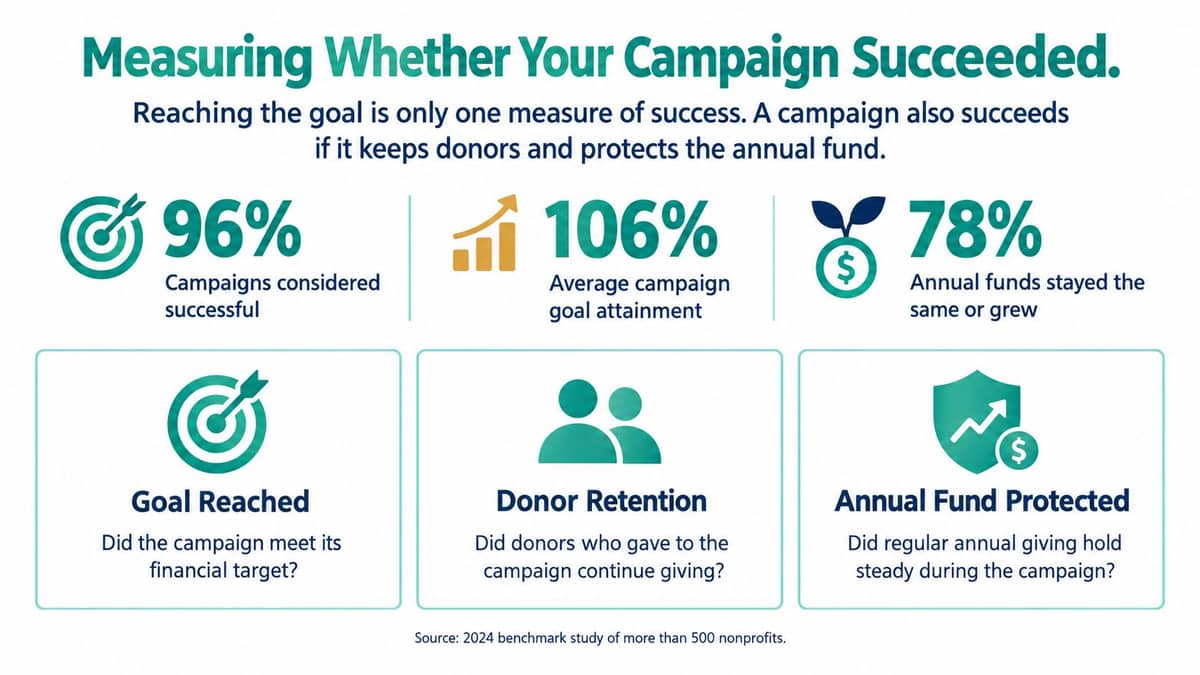
Reaching the dollar goal matters, but it's only one measure. A campaign can hit its target while exhausting donors. It can also leave your annual fund weaker for years.
Use benchmarks as reference points, not promises
A 2024 benchmark study covering more than 500 nonprofits in the United States and Canada reported a 96% campaign success rate. Organizations raised an average of 106% of their original goals. The average campaign lasted 3.7 years in that study.
The same study found 96% of campaigns accepted multiyear pledges. More than three-quarters said annual-fund results either stayed level or increased during campaigns. 74% reported increased annual funds in years afterward.
| Measure | What it tells you | 2024 benchmark |
|---|---|---|
| Goal attainment | Whether the campaign reached its target | 106% of original goal on average; 96% success rate |
| Campaign length | How long the work actually took | 3.7 years on average |
| Multiyear pledges | How willing donors are to commit over time | 96% of campaigns accepted them |
| Annual fund results | Whether core giving held up during and after | Over 75% held level or grew during; 74% grew afterward |
Those figures set expectations for duration and pledge administration. They don't guarantee your donors or project will behave similarly. Compare them with your own history and current donor base.
Review leading measures every month
Final totals arrive too late to fix a stalled campaign. Monthly measures show trouble while you can still respond. Put them on one page that board members read.
- Gift table progress: Commitments secured at each level against plan.
- Pledge collection rate: Cash received compared with amounts currently due.
- Prospect movement: Donors advanced to the next solicitation stage.
- Board participation: Gifts made, visits joined, and doors opened.
- Annual fund comparison: Current giving measured against the prior year.
Give every measure a named owner and review date. Minty can draft board updates, campaign notes, and report summaries. You still decide what action each number requires next.
Decide Whether Your Organization Is Ready to Launch
A compelling need and enthusiastic donors don't prove you're ready. You may still lack staff time, clean records, or cash reserves. Launching anyway can damage programs that donors already trust.
Recent Chronicle of Philanthropy coverage of small nonprofit capital campaigns notes organizations with annual budgets below $1 million are increasingly running campaigns. Reported average results ranged from $3.3 million to $9.5 million. Campaign size alone is therefore a poor proxy for readiness.
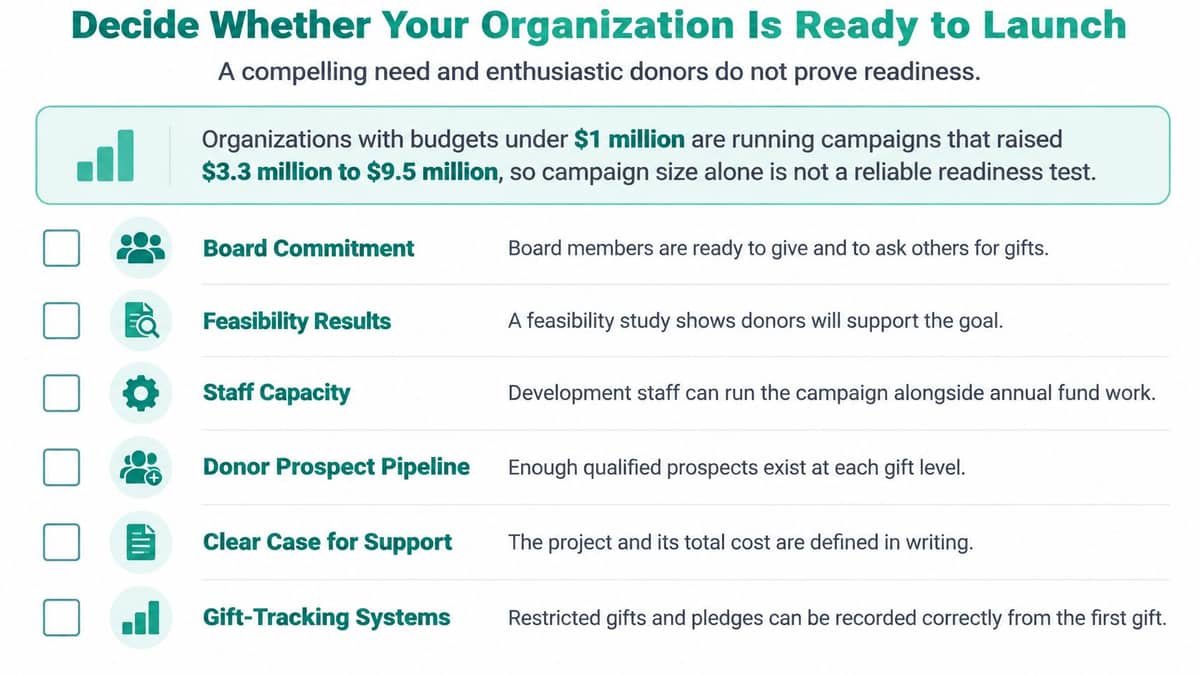
Test six practical areas honestly
- Operational bandwidth: Staff can run campaign work without neglecting programs.
- Cash-flow resilience: Operations continue when pledge payments arrive late.
- Board participation: Members will give, ask, and attend prospect visits.
- Gift-processing controls: Receipts, deposits, and thank-you letters happen promptly.
- Restricted-fund tracking: Campaign balances stay separate from the first gift.
- Post-campaign upkeep: You can maintain and staff the completed asset.
Churches, schools, fiscal sponsors, and emerging nonprofits feel strain quickly. The same person may manage grants, programs, events, and finance. Our fundraising readiness health check helps you score those pressures plainly.
Ask whether campaign work can continue without harming annual fundraising. Ask the same about core programs and donor relationships. If answers are shaky, fix the gap before asking publicly.
Make one of three clear decisions
You can launch when evidence supports the goal and systems. You can delay while prospects, staffing, or board commitment improve. You can pause and repair records before another gift arrives.
A no or not-yet feasibility answer is useful information. It protects donors from a promise you cannot administer well. It also protects staff from years of avoidable catch-up work.
Book our free setup call before your campaign systems harden. We walk you through fund accounting, donations, and reporting on your plan. We also hold a weekly walkthrough webinar following a real workflow.
Our free plan covers nonprofits with up to $100K in annual donations. No credit card is required to get started. Our true fund accounting replaces QuickBooks classes with purpose-based funds.
If your campaign needs cleaner pledge tracking, restricted-fund reporting, and donor records your board can trust, we can help you set up one shared record for finance, fundraising, volunteers, events, and marketing. Visit AlignMint to book your free setup call and walk through your own campaign plan with our team.
Ready to try AlignMint with your nonprofit?
Start free — set up donor tools, giving pages, and Minty. Upgrade when you need accounting.