

Pledge Review for Nonprofits: A Practical Guide
Your board wants a year-end fundraising update, but your pledge information sits across spreadsheets, emails, accounting records, and personal notes. A practical pledge review brings those promises into one reliable picture, then separates recognized revenue from cash you can realistically expect to receive.
Quick Answer: Nonprofit Pledge Review
A pledge review checks every outstanding donor promise for amount, timing, restrictions, payments, and follow-up. Treat the promise as expected support, and treat cash as available only after it arrives.
Start with donor management and restricted vs unrestricted funds. For the close, see how to close revenue accounts.
The Year-End Pledge Puzzle
The board meeting is approaching, and you're assembling a fundraising report from several sources. One spreadsheet shows the original commitments, your inbox contains revised installment dates, and the accounting system reflects only payments that someone recorded.
That process may produce a total, but it doesn't necessarily produce confidence. A pledge can appear successful because the donor promised the money, while your bank balance tells a different story because the next installment is late.

Suppose a donor committed support for a program, but the second installment hasn't arrived. Your development notes say “on track,” your finance report shows an outstanding receivable, and the program director has already planned spending around the expected funds. Nobody has the complete answer.
Practical rule: A promise belongs in your review, but it shouldn't be treated as available cash until payment arrives.
The relationship risk matters, too. If two staff members contact the same donor, or nobody follows up because responsibility isn't clear, the donor may feel overlooked. A thoughtful fundraising process should support trust, not turn every overdue balance into an awkward surprise.
Your year-end records also need structure. The 501(c)(7) year-end records checklist can help you organize supporting documentation around reporting and financial review. For broader charity communication and outreach ideas, the Carlos Alba Media charity guide offers useful context for connecting fundraising activity with public engagement.
A strong review gives you three answers before the meeting. What was promised, what has been received, and what action should happen next? Without those answers, your report may look tidy while hiding a cash-flow problem.
What Is a Pledge Review?
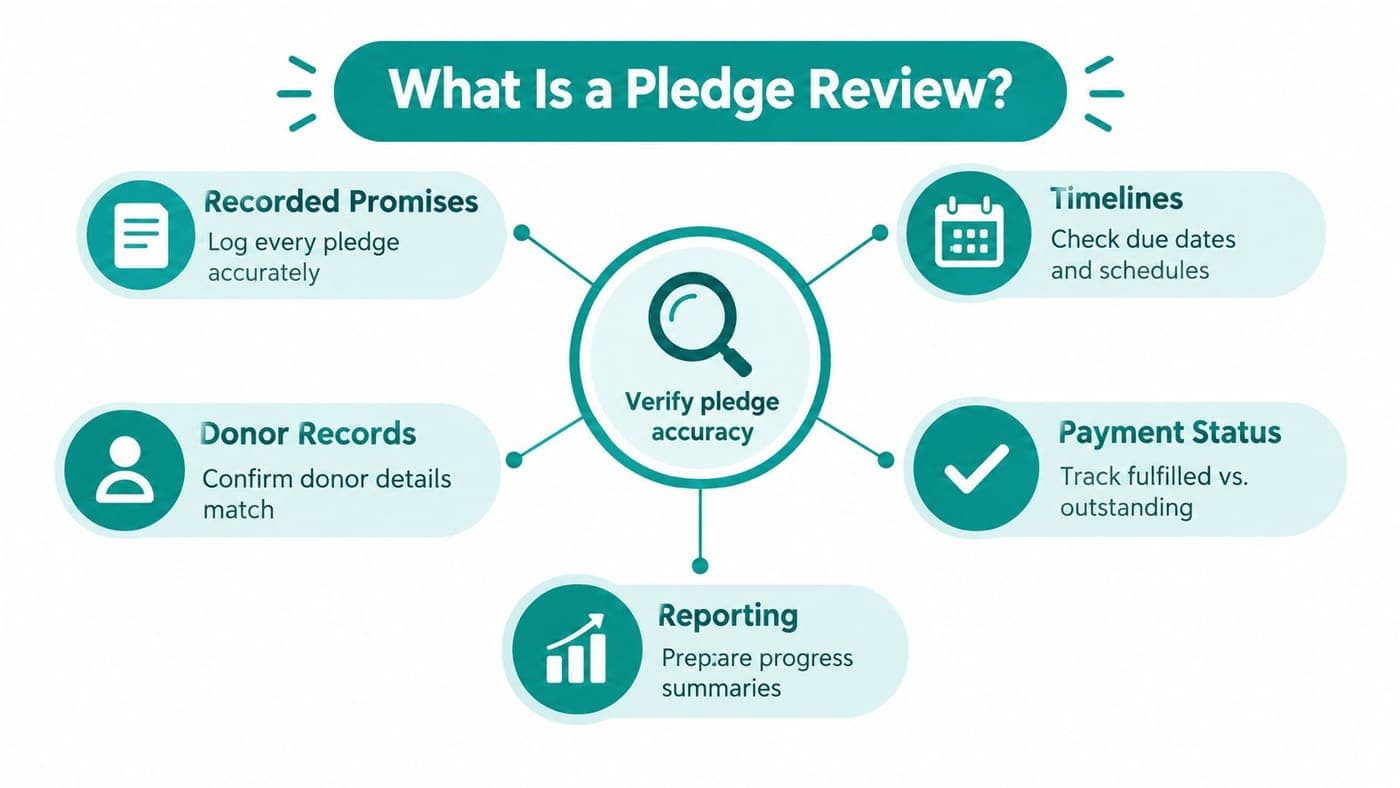
A pledge review is a structured check of every outstanding donor promise, including its amount, timing, restrictions, payment history, and follow-up status. Think of it as checking your bank balance before writing checks, except you're testing expected income before committing organizational resources.
The process starts with accurate records. Confirm the donor's identity, the original commitment, the campaign or fund connected to it, the installment schedule, and every payment received. Then compare the operational record with your accounting treatment, because a pledge can be meaningful for fundraising while requiring careful judgment for financial reporting.
Start with the promise
Ask whether the pledge is documented clearly enough for another staff member to understand. A good record identifies the donor, purpose, restrictions, due dates, payment terms, and any conditions attached to the commitment.
Next, separate pledge progress from cash received. A donor may have fulfilled part of a commitment without completing it, and a campaign may be ahead on promises while behind on deposits. Those are different management situations requiring different conversations.
True fund accounting adds another layer of control. Rather than treating restrictions as labels attached to ordinary transactions, it tracks resources according to their permitted purpose, such as a grant, program, building effort, or ministry activity. That distinction helps you see whether a pledge supports the fund that needs it, not just whether the organization expects more money.
The pledge definition in AlignMint's glossary provides a concise reference for keeping your team's terminology consistent. Consistent language matters when development, finance, and program leaders review the same donor record.
Key Steps in Your Pledge Review
Begin with an aging schedule. Segment outstanding balances into delinquency bands such as 30, 60, 90, and 120-plus days, then assign a next action and an owner to every overdue pledge. This approach is recommended in guidance on nonprofit pledge tracking and fulfillment management.
Aging changes the conversation. Instead of asking, “How much remains outstanding?”, you can ask, “Which balances need attention now, who will contact each donor, and what should that conversation accomplish?”
Build the working file
Your review should show more than a total balance. Include:
- Donor and fund: Confirm the donor record, campaign, designation, and restricted purpose.
- Payment history: Match each installment against the bank deposit and accounting entry.
- Upcoming dates: List expected installments so finance can plan cash and staff can prepare reminders.
- Age and risk: Highlight overdue balances, broken promises, and commitments with uncertain collectability.
- Ownership: Assign one person to the next action, with a documented date and outcome.
A pledge manager should support this workflow rather than merely store a number. The pledge management documentation is useful when deciding which fields and follow-up details your team needs to maintain.
Assign the right conversation
Not every late payment deserves the same message. A recent delay may call for a courteous reminder, while a long-outstanding balance may require a personal conversation about timing, capacity, or whether the donor wants to revise the commitment.
Keep relationship notes factual and respectful. Record what the donor communicated, what your organization agreed to do, and when someone will follow up. Don't let collection activity become detached from donor care.
Finally, use the schedule to forecast cash separately from revenue. Expected installments can inform monthly planning, but only received amounts improve liquidity immediately. That distinction protects program decisions from optimistic assumptions.
Understanding Reporting and Recognition
The accounting question is not just whether a donor made a promise. Your team must determine how the pledge should be recognized, valued, presented, and reviewed for collectability.
For nonprofit accounting, unconditional pledges are typically recorded at fair value when promised. Multi-year pledges should be discounted to present value, and an allowance for uncollectible pledges should be estimated using aging and collectability review. These principles are summarized in nonprofit accounting guidance on pledges.
Accrual and cash methods differ
Under accrual accounting, an organization may recognize an unconditional pledge when it is made, subject to the applicable recognition and valuation rules. A multi-year pledge may be discounted to present value in the first year, with accretion reported in later years.
Under cash accounting, the organization reports amounts received during the year. The pledge still matters for fundraising and relationship management, but it doesn't become reported support until cash arrives.
The IRS explains that pledge receivables reported for Form 990 public support must follow the accounting method the organization uses on its return. The IRS guidance on pledge receivables for Form 990 distinguishes these treatments clearly.
Prepare for the board's questions
Your board may ask why fundraising commitments exceed deposits, why a receivable changed, or why a pledge was reduced. Answer with a simple reconciliation:
| Question | Evidence to provide |
|---|---|
| What was promised? | Signed agreement or documented donor commitment |
| What was received? | Deposit and accounting records |
| What remains? | Current balance and installment schedule |
| What is uncertain? | Aging, donor communication, and collectability assessment |
| Where does it belong? | Campaign, fund, program, or restriction |
Form 990 instructions require organizations to include pledges receivable, net of estimated uncollectible amounts, along with grants receivable. The instructions also include pledges from officers, directors, trustees, key employees, and highest compensated employees in that total, as explained in the IRS Form 990 instructions.
Your donor reports should support both relationship management and financial review. A donor-facing statement may emphasize generosity and progress, while an internal report must show timing, restrictions, outstanding balances, and follow-up responsibility.
Common Issues and Best Practices
The most common pledge problems aren't caused by a lack of goodwill. They come from disconnected records, unclear restrictions, inconsistent follow-up, and reports that mix commitments with deposits.
Restricted funds deserve particular attention. A donor may intend support for a named program, while a staff member records the payment against an unrestricted campaign. The money may be in the bank, but your organization still needs to honor the purpose attached to it.
Reconcile before you report
Compare the donor record, general ledger, bank activity, and fund balance. Investigate differences instead of forcing the totals to agree. A reconciliation should explain the difference between what your fundraising team believes is outstanding and what finance has recognized.
The revenue reconciliation documentation can help establish a repeatable process for matching operational records with accounting data. That routine becomes especially important when several people enter gifts, update donor notes, or manage campaign activity.
Board-ready question: What part of this reported support is cash, what part is receivable, and what part may not be collectible?
Long-outstanding pledges also need a written policy. Your policy should explain how staff assess collectability, when leadership reviews a balance, who approves adjustments, and when a pledge may be written off after extended nonpayment. A write-off is an accounting decision, not a statement about the donor's character.
Good practice also includes documenting forgiven or adjusted pledges, preserving the original commitment, and noting why the balance changed. That record protects your organization from presenting an outdated promise as current support.
The benefit is practical clarity. Your finance team gets cleaner records, your board receives a more honest report, and your development team can approach donors with context rather than confusion.
Simplify Your Process Today
You don't need a complicated technology project to improve pledge review. You need one dependable place where donor history, payment activity, fund restrictions, installment dates, notes, and follow-up tasks can be viewed together.
Our all-in-one platform combines true fund accounting, donor management, volunteer management, events, marketing, and team communication. That matters because pledge review rarely stays inside the finance office. Development staff need donor context, program leaders need restricted-fund visibility, and executive directors need a clear view of expected cash.
Choose tools that reduce handoffs
QuickBooks can serve organizations that need familiar bookkeeping, and products such as Blackbaud, Bloomerang, and DonorPerfect offer established fundraising or donor-management strengths. The trade-off is often the number of systems, exports, integrations, and manual reconciliations your team must maintain.
Our approach keeps accounting and CRM records connected while supporting restricted funds, grants, programs, receipts, donor notes, events, volunteers, and marketing activity. Minty AI can answer questions about your organization's real data, helping you find information without building another spreadsheet or waiting for an export.
A small organization can start with our free tier for nonprofits under $100K. The platform also includes plan-based access without per-seat fees, which makes it easier to give finance, development, program, and leadership staff appropriate access.
The right system won't replace judgment. It should make judgment easier by showing which pledges are current, which require outreach, which support restricted work, and which need accounting review. That is the difference between storing commitments and managing them.
Our platform brings pledge tracking, donor records, fund accounting, payment history, and follow-up tasks into one place, so your year-end review starts with dependable information. Visit AlignMint to see how your nonprofit can replace scattered pledge records with a clearer workflow and invite your team into the same financial picture.
Ready to try AlignMint with your nonprofit?
Start free — set up donor tools, giving pages, and Minty. Upgrade when you need accounting.