

A consolidated financial report is a single set of group-level statements that combines a parent and the entities it controls, then removes internal activity so readers see only what happened with the outside world. Under IFRS 10, consolidation follows control, including power over an investee, exposure to variable returns, and the ability to affect those returns.
You may be facing this question after opening two bank statements, a project budget, and an audit request due Friday. Your organization's money sits across separate entities, restricted funds, sponsored projects, and shared services, yet the board wants one reliable picture.
The challenge isn't adding columns. You must decide which entities belong in the group, reconcile separate ledgers, remove internal transactions, and preserve the entity-level detail needed for grants and management. This guide shows how that recurring month-end discipline works, not just how a year-end report looks.
Quick Answer: What Is a Consolidated Financial Report
A consolidated financial report presents a parent and the entities it controls as one group, then removes internal loans, fees, and transfers so readers see only what happened with the outside world. Entity-level books still matter for grants and day-to-day control.
Compare multi-entity nonprofit accounting with fiscal sponsor. For the ledger, see fund accounting.
A Quick Win for Your Readers
The problem is scattered entity data. One nonprofit finance director may hold a parent organization's bank statement, a project company's ledger, and a sponsor report, while each document tells only part of the story.
A group-level report brings those pieces together. It helps you distinguish money received from outside donors from transfers between related entities, so your board doesn't mistake internal movement for new resources.
By the end, you'll be able to:
- Identify controlled entities: Determine which subsidiaries, affiliated programs, and sponsored structures may belong in a group report.
- Follow the close process: Understand how separate trial balances become one statement set.
- Choose the right format: Distinguish consolidated, consolidating, and combined reporting.
- Handle nonprofit structures: Apply the ideas to fiscal sponsors, church networks, school groups, and multi-entity organizations.
- Answer with consistency: Use aligned figures when directors, donors, auditors, and Form 990 reviewers ask different questions.
Practical rule: Keep entity-level reports for operating accountability, then use the group report for the organization's external financial picture.
Your month-end routine should support both views. A program director needs to know whether a restricted grant remains available, while the board may need to understand the entire controlled group's reserves, liabilities, and activity.
A clear annual narrative also depends on consistent financial numbers. AlignMint's annual report template for nonprofits can help connect financial reporting with the broader story your supporters receive.
The benefit is immediate. You don't have to choose between local visibility and group accountability when your process preserves both.
The Core Idea in Plain English
A consolidated financial report presents a parent organization and its controlled entities as one economic entity. It combines their assets, liabilities, revenue, expenses, and other relevant balances, then removes activity that occurred only inside the group.
Consider a parent nonprofit that operates programs directly. It also has a separately incorporated research arm, a gift shop LLC, and a fiscally sponsored project, each maintaining its own books.
The parent might lend money to the gift shop LLC. The research arm might charge the parent for administrative support. Each entity records those transactions correctly in its own ledger, but the group hasn't earned outside revenue merely by moving money internally.
Consolidation adds the like items together and cancels the internal loan, fees, and corresponding balances. The resulting statements show transactions with donors, vendors, employees, governments, and other outside parties.
Control matters more than ownership alone
The key question isn't, “Who owns the largest percentage?” Under IFRS 10, an investor assesses power over the investee, exposure or rights to variable returns, and the ability to use power to affect those returns. The IFRS 10 standard replaced earlier consolidation requirements in IAS 27 and SIC-12.
That means a party with less-than-majority voting rights can still consolidate when contracts or other arrangements provide effective control. Conversely, a majority interest may not settle the question if another party holds the meaningful decision-making rights.
For nonprofit leaders, read “control” as the ability to direct significant activities and receive, bear, or influence the related economic results. A contract or affiliation agreement can matter, particularly when one nonprofit controls another and has an economic interest, as described in guidance on nonprofit reporting entities under ASC 958-810.
A consolidated report answers, “What did this controlled group do with the outside world?”
It doesn't replace each entity's books. Instead, it adds a group lens above them, allowing you to review local budgets and the organization's total position without confusing one for the other.
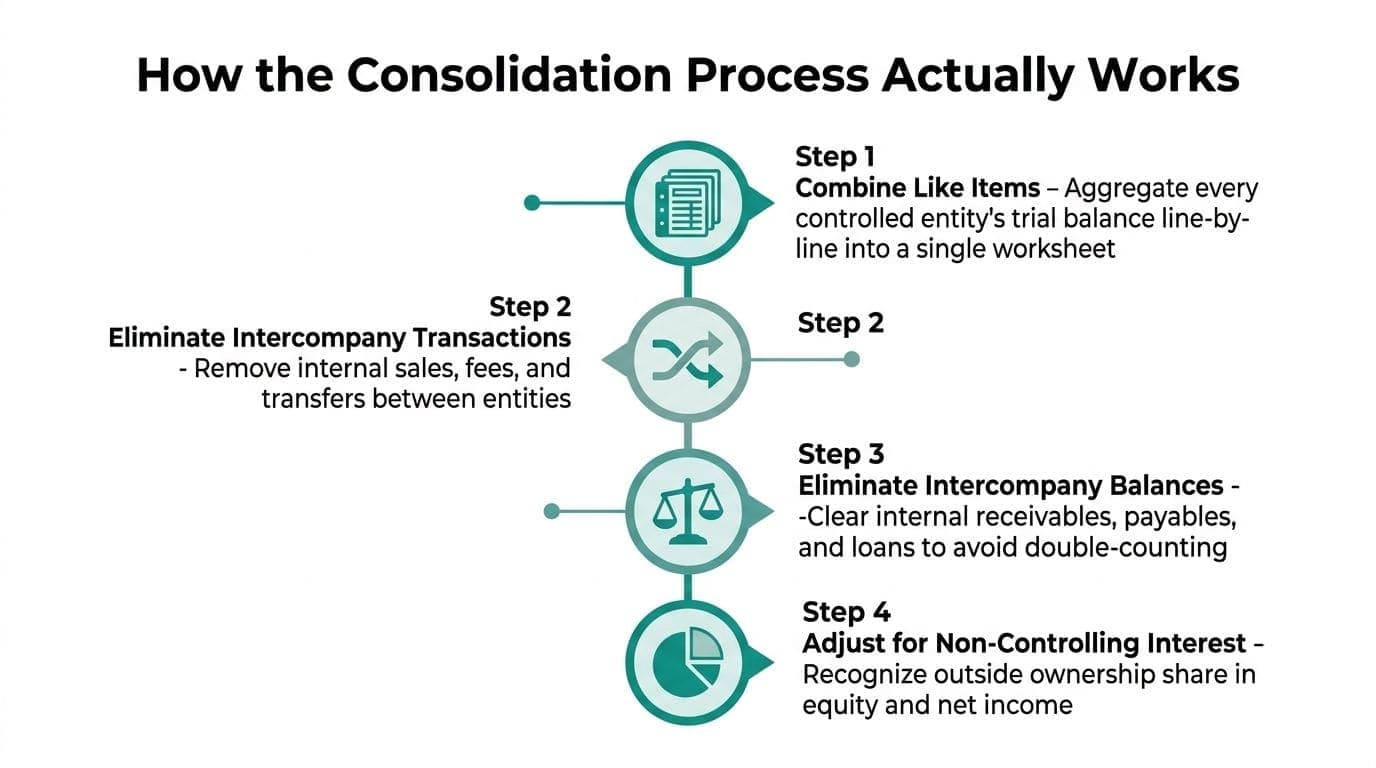
How the Consolidation Process Actually Works
A bookkeeper doesn't create a consolidated report by copying totals into a new spreadsheet. The work follows a sequence that makes the final statements traceable.
1. Combine the controlled entities
Start with each controlled entity's trial balance. Map comparable accounts into a consolidation worksheet, then combine assets with assets, liabilities with liabilities, revenue with revenue, and expenses with expenses.
At this stage, internal activity remains visible. The combined column may show a parent receivable and a subsidiary payable, or management-fee income alongside the related expense. The first total is therefore a starting point, not the answer.
2. Align accounting policies
The entities must apply consistent accounting policies before their figures can be meaningfully combined. Review depreciation methods, revenue recognition timing, fund classifications, and other policies that affect comparable lines.
For a nonprofit, fund classification deserves special care. Restricted gifts, grants, and program costs can look consistent in total while carrying different meanings across ledgers. Uniform policies help preserve comparability across the group, as noted in ACCA's guidance on consolidated statements.
If a material policy difference affects prior periods, the finance team may need to restate those figures according to the applicable reporting framework. Keep the adjustment schedule with the close file, so reviewers can follow what changed and why.
3. Eliminate internal activity
Next, prepare elimination entries. Remove intercompany loans, receivables, payables, management fees, shared-service charges, internal revenue and expense, dividends, and unrealized profit still held inside the group.
The objective is simple. Internal activity must net to zero at the group level. A useful intercompany accounting guide from HireAccountants provides additional context for reconciling balances before elimination.
4. Present one group
After adjustments and eliminations, present the consolidated statement of financial position, statement of activities, cash flows, and supporting notes as one organization's report.
If a subsidiary isn't wholly owned, show the outside ownership share separately. A nonprofit parent with a consolidated subsidiary and a noncontrolling interest must present a schedule reconciling the beginning and ending balances attributable to the parent and the noncontrolling interest, as explained in noncontrolling interest guidance for nonprofit entities.
Your working papers should preserve each stage. A reviewer should see the entity columns, policy adjustments, elimination entries, and final group totals. If your organization maintains separate books, AlignMint's multi-organization documentation illustrates why entity-level records and group reporting need to coexist.
Consolidated vs Consolidating vs Combined
Teams often use these words loosely, but they describe different outputs and processes. The distinction matters when your auditor, lender, board, or donor asks for a specific report.
| Format | Who Appears | Treatment of Internal Activity | Typical Nonprofit Use | Primary Audience |
|---|---|---|---|---|
| Consolidated statements | A parent and the entities it controls, such as a parent nonprofit and project LLC | Internal balances and transactions are eliminated | Final group report for a controlled structure | Board, auditors, lenders, regulators, major donors |
| Consolidating schedules | Separate entity columns plus adjustment and elimination columns | Internal activity remains visible until elimination entries are applied | Working papers for a fiscal sponsor or multi-entity close | Finance team, auditors, reviewers |
| Combined statements | Independent organizations presented together for a defined purpose | Treatment depends on the reporting arrangement, with no controlling parent relationship | Coalition of charities sharing a back office but not a board | Coalition members, funders, internal stakeholders |
A parent nonprofit with a project LLC rolled in as a subsidiary needs consolidated statements when control exists. The finance team may first prepare a consolidating schedule, but that worksheet isn't the final external report.
A fiscal sponsor may attach sponsor-only schedules beside project-level reports while reconciling each project separately. That arrangement supports management visibility, but it shouldn't be confused with the final consolidated output.
A coalition of independent charities may present combined information for a shared grant or administrative arrangement. Because no single charity controls the others, combined reporting answers a different question.
Auditors, banks, and Form 990 reviewers may view consolidating-only or combined-only information as incomplete when control requires consolidated statements. The practical distinction is covered further in multi-entity nonprofit accounting guidance.
What This Looks Like for Fiscal Sponsors and Multi-Entity Nonprofits
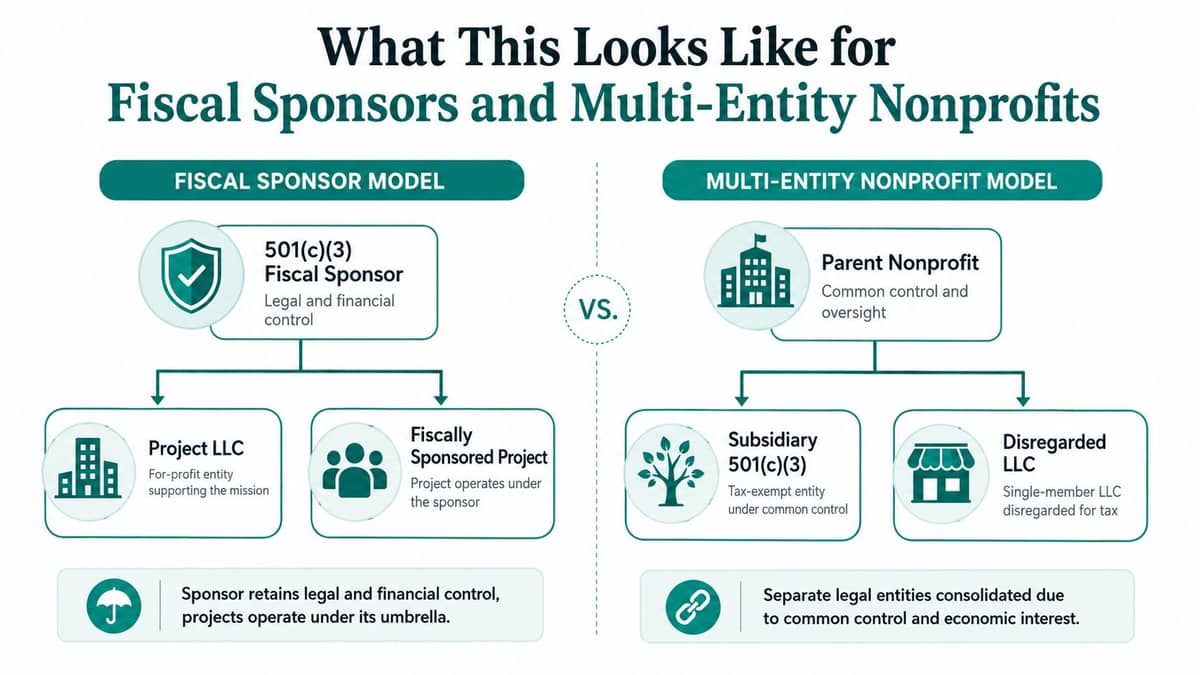
At month-end, a fiscal sponsor may be responsible for several sets of books at once: a 501(c)(3) sponsor, a project LLC, a fiscally sponsored project with its own advisory board, and a supporting organization. Each may produce separate trial-balance data, even when the sponsor holds the legal and financial responsibility for sponsored activity.
The finance team starts with project-level and entity-level review. It checks receipts, expenses, restrictions, inter-entity balances, and available funds for each project, then brings the appropriate amounts into management reports. Leaders can see how one project is performing while also seeing the sponsor's position as a group.
The group rollup follows that detailed review. The sponsor combines controlled entities, removes internal transfers, and prepares reports for its board, auditors, and major donors. Project schedules remain in the close package because grant managers still need to trace spending to individual awards and program commitments.
The fiscal sponsor's reporting responsibility
Fiscal sponsorship adds a reporting responsibility that can confuse teams. The fiscal sponsor sends donor gift acknowledgements and records sponsored income and expenditures in its own accounting records, including its IRS Form 990, according to the National Council of Nonprofits' fiscal sponsorship resources.
Sponsored projects still need their own accountability. The reporting setup should connect project-level records with the sponsor's formal financial statements without treating those views as interchangeable. Guidance on fiscal sponsorship accounting models can help teams set up that connection.
A monthly close might include:
- Project schedules: Show each sponsored project's activity, restrictions, and remaining funds.
- Entity trial balances: Preserve the sponsor, LLC, and supporting organization records.
- Elimination worksheet: Remove internal advances, reimbursements, and shared charges.
- Group statements: Present the controlled structure to the board or another defined audience.
A multi-entity nonprofit example
A parent nonprofit might oversee a subsidiary running fee-for-service programs, a real estate entity holding the building, and a separate foundation raising endowment funds. Each entity can have a useful standalone report, while the parent also needs a group view for the monthly close.
After aligning account mappings and fund classifications, the parent combines the three sets of books. It removes rent paid to the real-estate entity and grants passed from the foundation to the parent because those flows occurred within the controlled group.
The statement of activities then shows external revenue and expenses. The consolidated statement of financial position shows group assets and liabilities without duplicating internal receivables, payables, or transfers.
Entity-level reports continue to support grant compliance and pass-through reporting. The program subsidiary may need detailed spending records, while the foundation may need to document its own distributions. The group report answers the board's total-position question, and the supporting schedules explain how each entity reached that position.
Church networks and school groups apply the same discipline. Fund accounting records income and expenses by purpose, including undesignated operating income and designated or restricted operating income, as described in this financial manual on fund accounting for churches and ministries.
Implications for Boards, Donors, and Form 990
The consolidated report becomes the outside reader's lens. It tells your board, donors, lenders, and regulators how the controlled group stands after internal activity has been removed.
What the board needs to see
Directors use group-level statements to discuss reserves, inter-entity loans, shared-service allocations, and the organization's total obligations. Entity-level reports still show whether each executive or program leader managed the budget responsibly.
That combination supports better questions. A board can ask why a subsidiary carries debt while the parent reports cash, or whether a building entity's rent arrangement serves the group's mission and liquidity.
What donors and grantmakers review
Institutional funders, banks, and sureties often want numbers that represent the full controlled group. Consolidated statements may accompany loan covenants, large grant applications, and due-diligence requests because a standalone parent report can omit important controlled assets or liabilities.
Donors also need understandable restrictions. A group total shouldn't blur the difference between unrestricted resources and funds committed to a specific purpose. True fund accounting keeps those distinctions visible while consolidation removes internal duplication.
What Form 990 reviewers connect
Form 990 asks about related organizations, relationships, and transactions. Schedule R reports transactions with interested persons and related entities, so your consolidated audit, entity ledgers, and tax filing should tell a consistent story.
A consolidated report doesn't replace the Form 990 schedules. It gives your preparer a reconciled group picture that can be checked against those disclosures. AlignMint's Form 990 checklist can support that broader preparation process.
Two situations require extra attention. A noncontrolling interest means an outside holder's share of net assets must remain separate, while an investment-entity exception can change line-by-line consolidation into fair-value measurement for qualifying investment holdings.
Edge Cases and Exceptions Worth Knowing
At the month-end close, a fiscal sponsor may discover that one project gained a new governing right, while another entity no longer follows the sponsor's direction. The rule remains simple, consolidate what the organization controls. The work lies in identifying when control begins or ends, documenting the change, and applying the right reporting treatment.
A newly sponsored project may enter the group when the sponsor obtains the relevant control rights. A previously controlled organization may leave when it becomes an independent 501(c)(3) and the parent no longer directs its significant activities. Record the effective point of each change rather than carrying the prior structure into every close.
Investment entities create a separate boundary. A foundation or LLC formed solely to hold investments may measure qualifying holdings at fair value instead of consolidating them line by line when the applicable exception applies. The board may therefore see a group investment balance without seeing every holding presented as its own subsidiary asset and liability.
Control is a conclusion you revisit, not a label you assign once.
Noncontrolling interests raise a different question. Outside board members alone do not always create an ownership interest. If another party holds a minority share in a consolidated subsidiary, that share remains separately presented within net assets. The nonprofit guidance on changes in noncontrolling interests explains the related reconciliation.
| Situation | Consolidation Treatment | Why It Matters |
|---|---|---|
| Control begins during the reporting period | Include the entity from the applicable control date | The group report reflects the period when control existed |
| Control ends during the reporting period | Stop consolidating when control ends | Continuing to include the entity can misstate group activity |
| Investment-entity exception applies | Measure qualifying investments under the applicable fair-value approach | The parent may not present each holding line by line |
| Outside ownership remains | Present the noncontrolling interest separately | The parent's totals should not absorb another party's share |
| Control exists but consolidated presentation is permitted rather than required | Keep entity-level reports and assess whether group statements serve lenders, donors, or the board | A permitted choice still affects disclosure and communication |
The reporting framework can change the answer. Under ASC 958-810, consolidation may be permitted rather than required when control arises through a contract or affiliation agreement instead of sole corporate membership or a majority voting interest. If consolidated statements are not presented, the notes should identify the related entity, describe the relationship, provide summarized financial data, and include related-party disclosures under ASC 850-10-50.
IFRS users should monitor related interpretation work. The IASB update on IFRS 10 and related work discusses reassessment of control and work involving an exception for a specific investment-entity-parent scenario. The update also identifies comments due 9 September 2026 and planned amendments by the end of 2026.
For recurring operations, the accounting platform should preserve separate entities, restricted funds, donor records, volunteer activity, events, and communication history while supporting group reporting. AlignMint offers true fund accounting alongside CRM, volunteer and event management, marketing tools, online giving pages, team communication, Minty assistance, and plan-based access without per-seat fees. Nonprofits under $100K can access its free tier, according to the publisher's stated offering.
A recurring close calendar still matters. Software can organize records, but the finance team must define control, approve policies, reconcile intercompany balances, and review the final report before the board receives it. Keep entity-level reports available beside the consolidated rollup so a board question about one project does not require rebuilding the month's numbers.
Ready to see how AlignMint fits your workflow?
Schedule a free walkthrough — we will help you map donors, funds, and migration steps.