

Board Resignation Letter Template for Nonprofits
You're probably dealing with a board member who's stepping down, and you need the paperwork handled without awkwardness or drift. The good news is that most board resignation letters are routine governance documents, not public drama, and a clear process protects both the person leaving and the nonprofit staying behind.
The strongest letters do one job well, they make the handoff clean. They also help your records, your minutes, and your finance team stay aligned while the board seat changes hands.
Quick Answer: Nonprofit Board Resignation Letters
A nonprofit board resignation letter should state the member's name, the board role, and a clear effective date. Copy a short sample below, then check the bylaws and state rules before you transfer signing authority, records, committee duties, and financial access.
For shared records and team handoffs, see workspace. For related reading, compare nonprofit board requirements with nonprofit bylaws.
Understanding Board Resignation Letters for Nonprofits
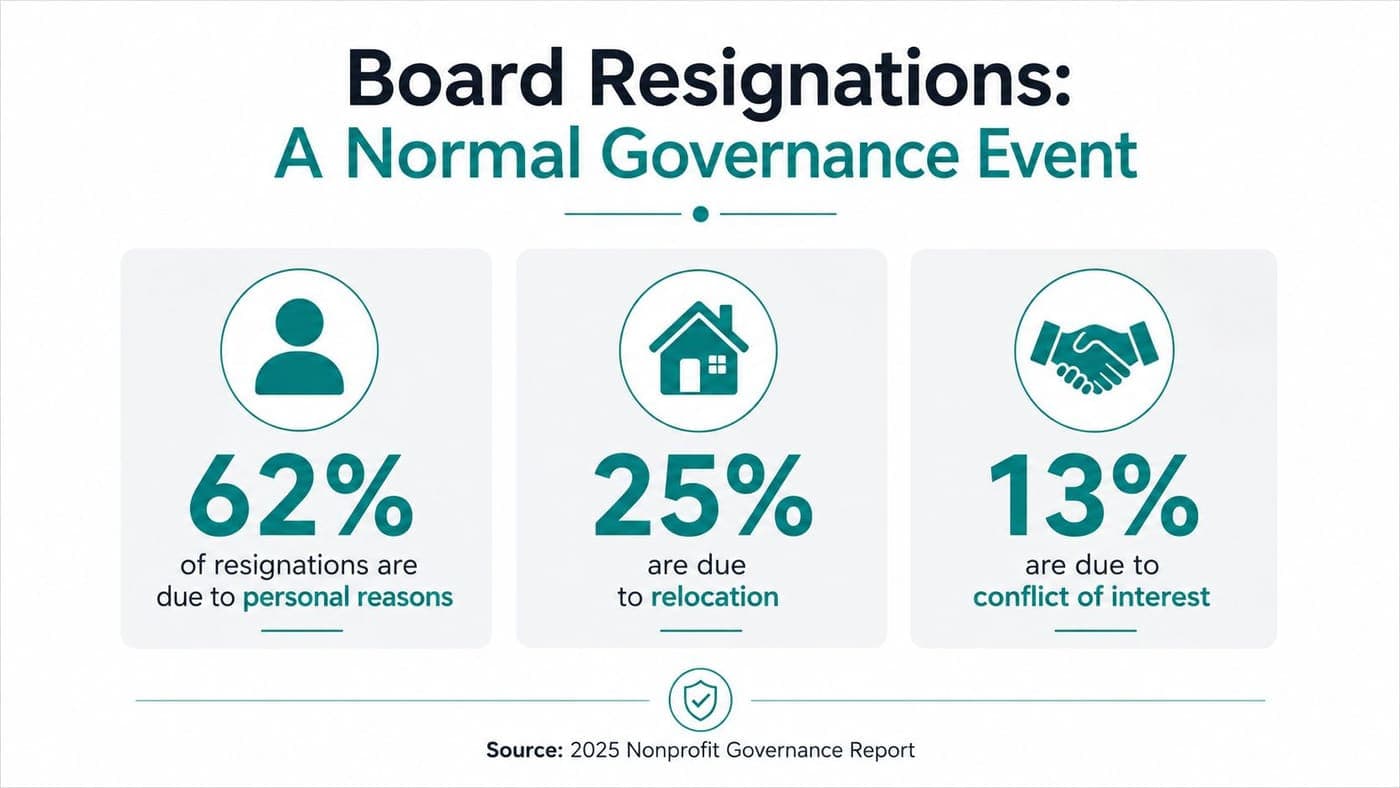
A resignation from a nonprofit board usually says more about life and workload than conflict. In a 2025 Russell Reynolds Associates report on companies listed on India's National Stock Exchange, 94% of all mid-term board cessations for independent directors in the first three quarters of 2024 were resignations source. The most common reason was preoccupation with other commitments, at 54%, followed by personal reasons at 27% and health or age at 6%.
That pattern matters for nonprofit leaders because it takes the heat out of the moment. Most departures are not a sign that the board is broken, they're a sign that someone's capacity changed.
The legal-academic study of S&P 500 firms from 2016 to 2024 points in the same direction, only 4 of 3,825 director and senior executive resignations were disclosed as disagreements with company operations, policies, or practices, about 0.1% of the sample source. In other words, outspoken protest exits are exceptionally rare, even in heavily watched public markets.
Practical rule: treat the letter as a governance handoff first, and a personal note second.
For a nonprofit, that means keeping the letter simple, dated, and usable in the record. If you're refreshing your board process at the same time, it helps to review your broader governance basics too, especially your board structure and duty expectations in this nonprofit board of directors requirements guide.
When the finance side matters, clarity pays off quickly. A clean resignation letter helps you preserve continuity in approvals, committee work, and restricted-fund oversight, which is why financial discipline and governance discipline belong together.
You'll also stay calmer if you can point staff to a stable internal reference for related governance documents, such as this nonprofit accounting software overview and this fund accounting software guide. They matter because departures often expose where records, duties, and money tracking were too scattered already.
When and How to Resign from a Nonprofit Board
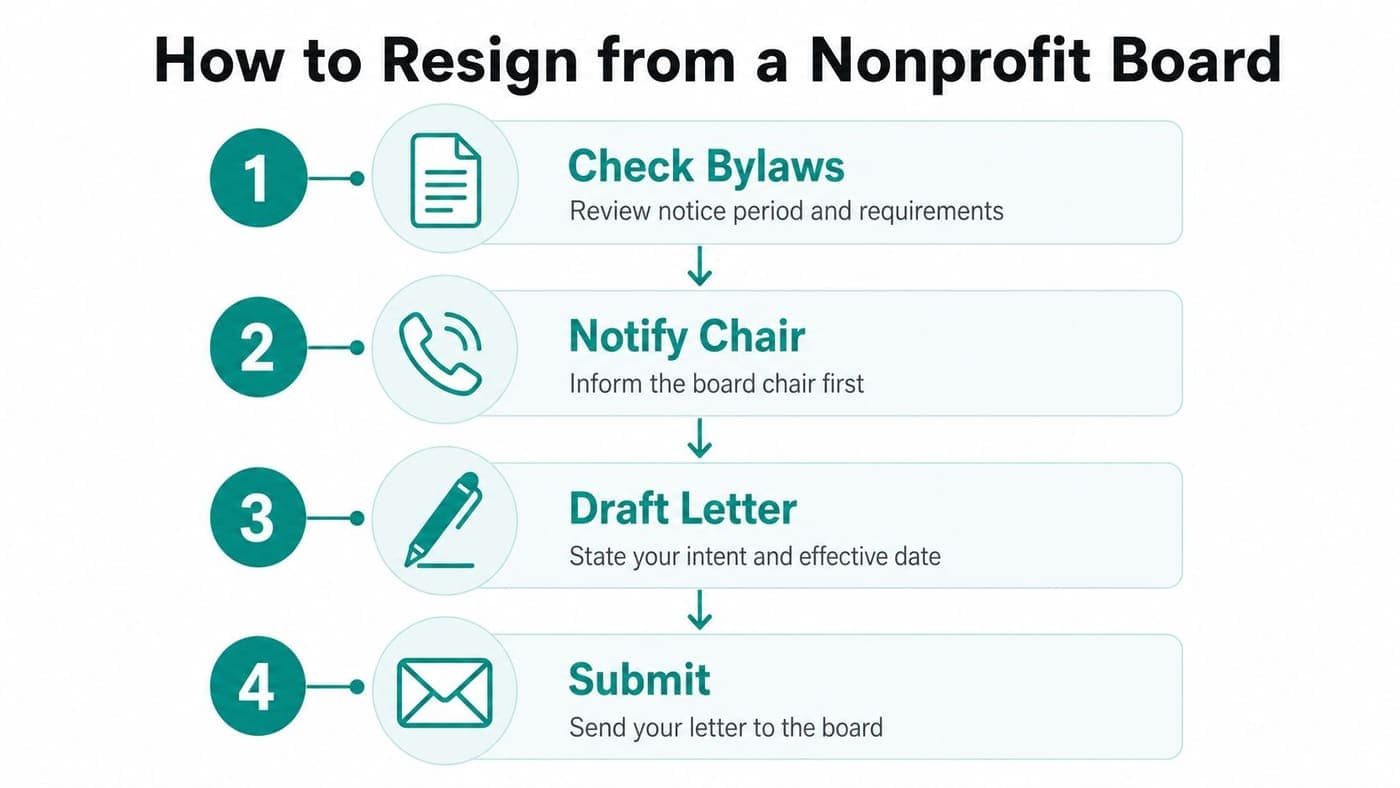
A good resignation starts before anyone writes the letter. First, check the bylaws, the notice terms, and any seat-specific obligations, then speak to the board chair before wider disclosure source. That order reduces confusion about who knows what, and it keeps the board from learning about the departure secondhand.
The safest sequence is simple. Verify the notice requirement, notify the chair, draft the formal letter, state the effective date clearly, and offer transition help.
Best practice: say the last day in the first paragraph, not near the end.
That directness matters because board records need a clean date. If the effective date is missing, the organization can end up unsure when the seat opened, which affects minutes, committee membership, and any vote tied to authority.
A practical letter also stays brief about the reason for leaving. Career guidance consistently recommends a short, professional explanation rather than a detailed story, especially when the departure involves workload, conflict, or health reasons. Negative detail can spill into board minutes, make successor transition harder, and invite unnecessary debate.
If you need a template base, use one that feels formal and plain. The free templates for nonprofit groups can help you see the bones of a clean message before you adapt it to board service.
A few timing habits keep the process sane. General resignation guidance often uses at least two weeks' notice, while some nonprofit board contexts recommend longer windows, including 60 days source. The right timing depends on how much committee work, signing authority, and financial oversight the person holds.
A letter should also fit the board's own document trail. One nonprofit board guide says the resignation can be read at the final meeting and entered into the minutes, which is often the cleanest administrative finish source.
A simple checklist keeps everyone aligned:
- Check the bylaws first. Confirm whether the board needs formal acceptance or a vote.
- Tell the chair before anyone else. That prevents mixed messages and protects governance order.
- Write the letter with the date and effective day. That keeps the record usable.
- Offer transition support. Even a small handoff note helps the next person.
For more structure around board rules, keep a copy of your nonprofit bylaws template nearby. It's often the fastest way to confirm whether the resignation process is routine or formally bound to notice language.
Handover and Financial Considerations After Resignation
The letter is only the first step. After that, you need to protect access, approvals, and the financial story the board leaves behind.
That's where a unified system matters more than another spreadsheet. An all-in-one platform keeps accounting, donor management, volunteer records, events, and marketing in one place, so the departing director doesn't leave behind a trail of disconnected logins and duplicate files. True fund accounting also matters here, because restricted gifts and program balances need to stay visible when leadership changes.
Practical rule: if the resigning person touched money, assign a review path before the final day.
That review should cover signatory access, donor records, grant notes, and any recurring approvals. It also helps your treasurer or finance lead see whether restricted dollars were tracked properly, which keeps the Statement of Functional Expenses easier to prepare when the board chair changes.
Piecemeal tools create friction. Platforms like Aplos and Blackbaud Financial Edge are respected for financial work, but they don't bring board transition notes and volunteer coordination together in the same way a unified nonprofit operations platform does. That gap shows up fast when a resignation affects both governance and day-to-day finance.
If you want a practical next step for a treasurer handoff, keep this treasurer transition checklist handy. It's the kind of reference that saves time when the resignation arrives faster than expected.
The benefit of a single platform is continuity. You can give a successor temporary review access, keep staff in the loop without extra per-seat cost, and avoid the awkward scramble of stitching together old files after a board member steps away. That matters even more for nonprofits under $100K, where a free tier can keep the transition orderly without adding another expense.
Sample Board Resignation Letters for Common Situations
The cleanest resignation letters sound calm, direct, and slightly boring. That's a strength, not a weakness, because the board needs a usable record more than a dramatic explanation.
Here's a simple model for a personal move:
Dear Board Chair, Please accept this letter as my resignation from the board of directors, effective [date]. I'm grateful for the chance to serve and appreciate the board's work. I'm happy to help with any transition materials before my last day.
Sincerely, [Name]
If the reason is relocation, you don't need to write a travel diary. Keep it short and professional, and if the distance affects attendance or committee service, say that plainly without extra detail.
For a conflict of interest, restraint matters even more. One practical reason to keep the explanation brief is that existing guidance is thin on when a board must formally accept the resignation and when silence is safer than explanation source.
A concise version works well:
Dear Board Chair, Please accept my resignation from the board, effective [date]. A change in circumstances has created a conflict that I need to resolve outside of board service. I appreciate the opportunity to serve and will support a smooth handoff.
Sincerely, [Name]
For health-related departures, the letter can be warmer, but it still doesn't need medical detail. The board only needs to know that the member can't continue and that the departure is respectful.
Dear Board Chair, Please accept my resignation from the board, effective [date]. Due to health reasons, I'm no longer able to serve in the way this role deserves. Thank you for the trust and collegiality I've received, and I'm glad to assist with transition notes.
Sincerely, [Name]

The point across all four versions is the same. State the effective date, keep the reason short, and offer a handoff. That approach protects board harmony and keeps the letter useful in minutes and files.
If donor communication may be affected by the resignation, it can also help to review how your external messaging is handled through your donor letters for nonprofits guide. Board departures and donor reassurance often land in the same week.
Tips for Writing a Professional Resignation Letter
A professional board resignation letter should look like a business document, not a personal email chain. Include the date, the board seat or title, the effective date, and a formal salutation, then keep the body to short paragraphs source.
The reason for leaving should stay brief and steady. A long explanation can make the record messy, and it can leave the chair guessing about what belongs in minutes and what should stay private.
A few formatting choices make the letter easier to file:
- Use a standard business layout. One-inch margins and a professional 10- to 12-point font keep it readable source.
- Keep the paragraphs short. Short blocks are easier to skim at a board meeting.
- Close with cooperation. Offer to help train a replacement or hand off documents.
- Make the effective date obvious. That date is the anchor for every follow-up step.
A chair can't manage what the letter doesn't clearly say. Missing the effective date, skipping the chair-first conversation, or forgetting to review bylaws are the operational mistakes that create friction later source.
Keep the tone kind, plain, and unhurried. That usually reads as more professional than polished language.
If the board reads the letter aloud at the final meeting, the wording needs to stand on its own. It should also be recorded in the minutes, which helps avoid disputes about timing and confirms the organization treated the departure formally source.
When you're under time pressure, simplicity protects you. A clear letter is easier for staff, easier for the secretary, and easier for the next director who has to step into the seat.
How Boards Should Handle a Member Resignation
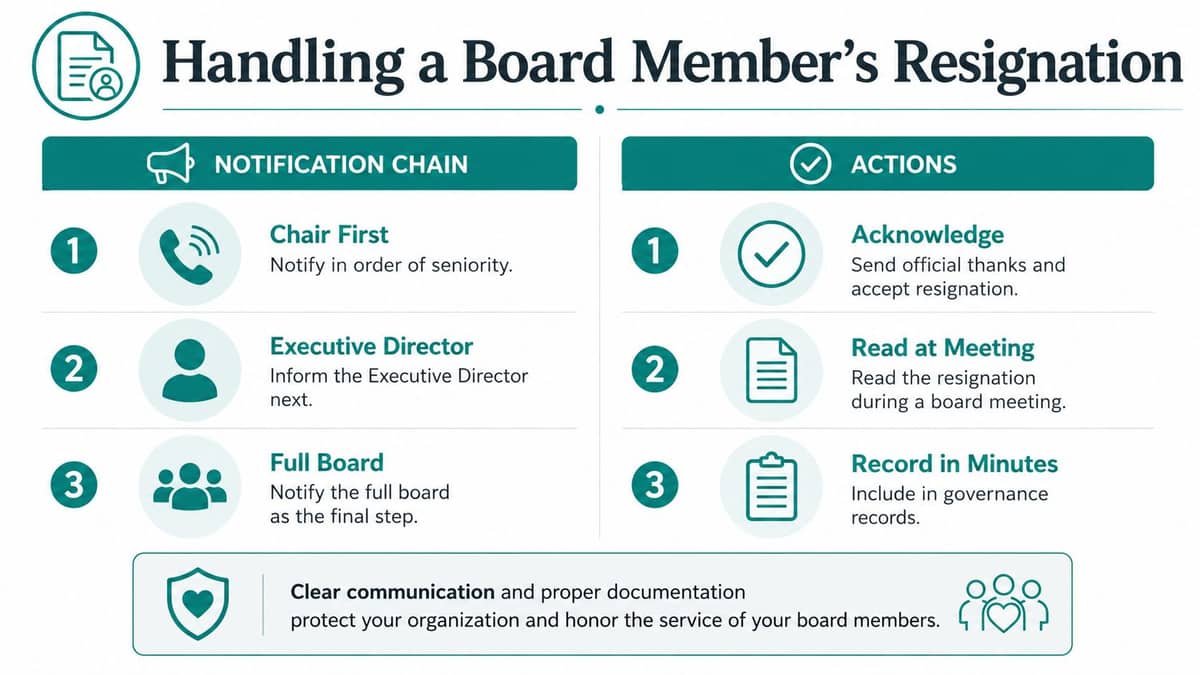
A board resignation should move through a clear notification chain. The board chair hears first, then the executive director, then the full board, which keeps authority orderly and avoids side conversations source.
That sequence is especially helpful when the resignation is sensitive. It gives the chair a chance to frame the departure, prepare the agenda, and confirm whether the bylaws require any formal acceptance.
The public-company record also argues for calm handling. In the S&P 500 study from 2016 to 2024, disagreement-based resignations were only 4 out of 3,825, about 0.1% source. Most board departures are routine, so the board should act that way unless the facts say otherwise.
A practical action list keeps the process tight:
- Acknowledge the resignation promptly. Thank the member and confirm the effective date.
- Read the letter at the final meeting if that fits your process. It creates a clean public record inside the board.
- Record the resignation in the minutes. That helps with audit trails and later questions.
- Check whether the bylaws require a vote. Some boards need formal acceptance before the seat is treated as open source.
The reason to be careful here is not ceremonial. If the organization loses track of who accepted what, liability questions and committee confusion can follow. A documented handoff reduces that risk and keeps the board's records defensible.
For a board that already uses shared governance documents, this is the moment to keep meeting files current through your board meetings documentation guide. The resignation should live in the same record trail as the rest of the board's decisions.
Conclusion and Next Steps with AlignMint
A strong board resignation letter does more than announce an ending. It protects the board chair, keeps minutes clean, and gives your nonprofit a stable handoff when people's lives change.
The same is true for your back office. If board departures touch finance, donor records, volunteers, or committee work, an all-in-one system makes the change easier to manage because the information isn't scattered across separate tools. That's where true fund accounting matters, along with a built-in marketing suite, Minty assistant, and online giving pages that keep your nonprofit moving while leadership shifts.
A unified nonprofit workspace can keep accounting, CRM, volunteers, events, and marketing in one place, with plan-based access that does not charge per seat. That helps you keep the right people informed without buying another license every time a role changes.
It also fits organizations that live with more complexity than a simple donation tracker. Churches, schools, and fiscal sponsors need restricted funds, program detail, and team communication to stay visible when a board seat opens up. Piecemeal software can do parts of that work, but it usually leaves the transition burden on your staff.
If you're comparing options, it's fair to respect what tools like Aplos and Blackbaud already do well. They're established names, and many teams rely on them for specific accounting needs, but board transition work still tends to sit outside the financial record. That gap is where simpler continuity gets lost.
The easiest time to tighten the process is before the next resignation lands. Put the letter format, minutes process, and finance handoff in one place now, and your team won't have to improvise later.
When evaluating a workspace for board transitions, look for shared records, clear permissions, finance continuity, and team communication in one place.
Ready to try AlignMint with your nonprofit?
Start free — set up donor tools, giving pages, and Minty. Upgrade when you need accounting.