

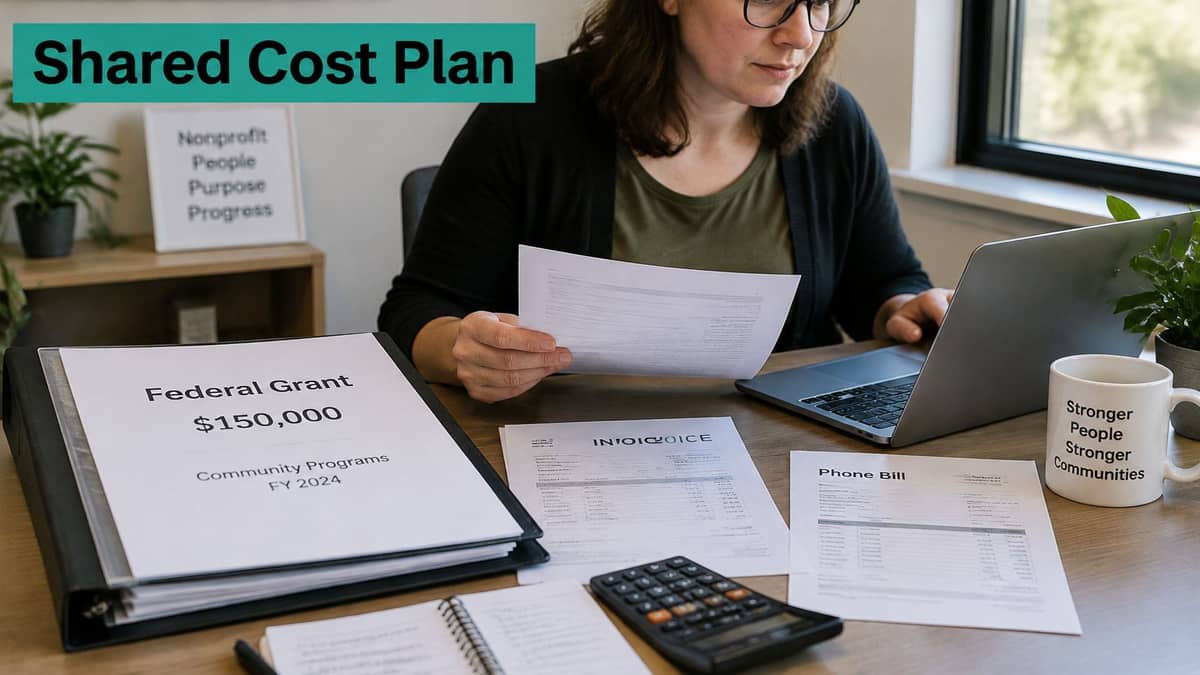
You hold a $150,000 federal grant, and the phone bill still sits on unrestricted cash. The bookkeeper's hours look the same. A written cost allocation plan splits those shared costs by benefit, so the grant carries its fair share and general gifts stay free for the work donors named.
Quick Answer: Cost Allocation Plan
A cost allocation plan is the written method, the steps, and a worked example that split shared bills by benefit. What cost allocation means, before you write the plan, is a separate guide.
Start with fund accounting and what cost allocation is. For the rate math, see how to calculate overhead rates.
What a Cost Allocation Plan Covers and How to Sort Your Costs
A cost allocation plan is the written method that decides who pays for each shared bill. Rent, utilities, accounting, and the director's time all serve more than one program, and the plan records how each program's share gets set.
Direct costs are bills you can tie to one award or activity without a guess. Program salaries backed by time records are direct. So are supplies bought for that grant alone.
Indirect costs are the shared bills. Rent, utilities, building depreciation, accounting, payroll services, and IT used by every team sit in this group. You cannot point at one program and say the whole bill belongs there.
Federal rules do not hand you one formula. The Electronic Code of Federal Regulations on indirect costs says you assign costs by the relative benefits programs receive. A nonprofit with more than $10 million in direct federal funding counts as a major nonprofit organization and must sort indirect costs into Facilities and Administration. A smaller group with one main function may use a simpler method when programs benefit about equally.
Here is the trade-off a written plan settles. Split nothing and the grant looks cheap while unrestricted gifts cover rent and bookkeeping. Split everything evenly and some programs get overcharged while cost drivers go unbilled. A benefit-based plan lands between those two failures: the grant pays for what it used, and general donations stay free for the work donors named.
Sort each cost before you charge it
A short sort keeps the grant file and the general ledger telling the same story.
| Cost | Classification | Why |
|---|---|---|
| Program staff salaries | Direct | Time records tie them to one program |
| Grant-specific supplies | Direct | Identified with one award |
| Rent and utilities | Indirect | Shared by every program and office |
| Building depreciation | Indirect | Benefits all activities in the building |
| Accounting and payroll services | Indirect | Supports every fund and grant |
| IT systems used by all staff | Indirect | Shared across programs and administration |
| Executive director salary | Split | Time spent on grants, fundraising, and administration |
| Donated volunteer hours | Direct or indirect | Assign by whether one award benefits from the work |
Donated hours need their own line. When donated services directly benefit a federally funded project, they must receive a proportionate share of applicable indirect costs, and those costs may be reimbursable or used as cost sharing, under 2 CFR 200.436. Value the hours at a fair local rate, keep the log, and assign them to the activity they served. Free labor is not cost-neutral on a federal award.
Churches, schools, fiscal sponsors, and nonprofits holding several restricted grants need this plan most. One building and one finance desk are carrying many promises at once.
The sort starts with the receipt, not the spreadsheet. You can automate receipt capture and expense categorization so small bills land in the right pool before month-end. Those pools should also match the functional expense report your board already reads.
Practical rule: If you can trace the cost to one award without an estimate, it is direct. If you can't, it needs an allocation method.
Choose an Allocation Method That Matches Each Cost
A shared cost should follow the benefit each program receives, not the number that is easiest to pull. Under 2 CFR 200.405, when a cost benefits two or more projects and the proportions can be set without undue effort, you must use that proportional benefit. Every activity that benefits, including unallowable work and donated services, gets an appropriate share.
Say your executive director's log shows 40% of working time on a grant-funded program, 35% on fundraising, and 25% on administration. The salary splits 40 / 35 / 25. An even three-way cut would overcharge the grant and undercharge fundraising.
Match the base to the cost
| Allocation base | Best for | Example |
|---|---|---|
| Documented time | Staff who split hours across programs | Grant program receives 40%, fundraising 35%, administration 25% |
| Square footage | Rent, utilities, cleaning | Program occupies 30% of the floor space |
| Headcount or users | Software, HR, IT support | A program with 12 of 40 users takes 30% of the IT pool |
| Direct cost base | Shared purchases tied to spending | Program holds 60% of direct spending |
| Award size | Last resort only | Program receives 25% of total awards |
Documented time fits people who move between programs. A weekly log beats a year-end memory. Square footage fits the building. Measure the rooms each program uses, then spread halls and restrooms by that same share. Headcount or users fits software, HR, and IT support, because the cost rises with people, not with grant dollars. A direct cost base fits shared purchases that track spending, such as a supply closet used in proportion to program buying.
Award size is the weak base. It shows who has the money, not who used the phone, the office, or the bookkeeper. I would use it only when no better measure exists and the file says why.
Don't pick the base that produces the highest recovery. Pick the base you can explain to a board member in one sentence.
One more guardrail. Don't dump every shared cost onto the grant that is easiest to invoice. Fundraising, lobbying, and general administration still take their share, even when a federal award can't pay it.
How to Build Your Plan in Six Steps
A short plan beats a thick binder nobody opens. Work from last year's bills, write the method once, and keep the proof next to it.
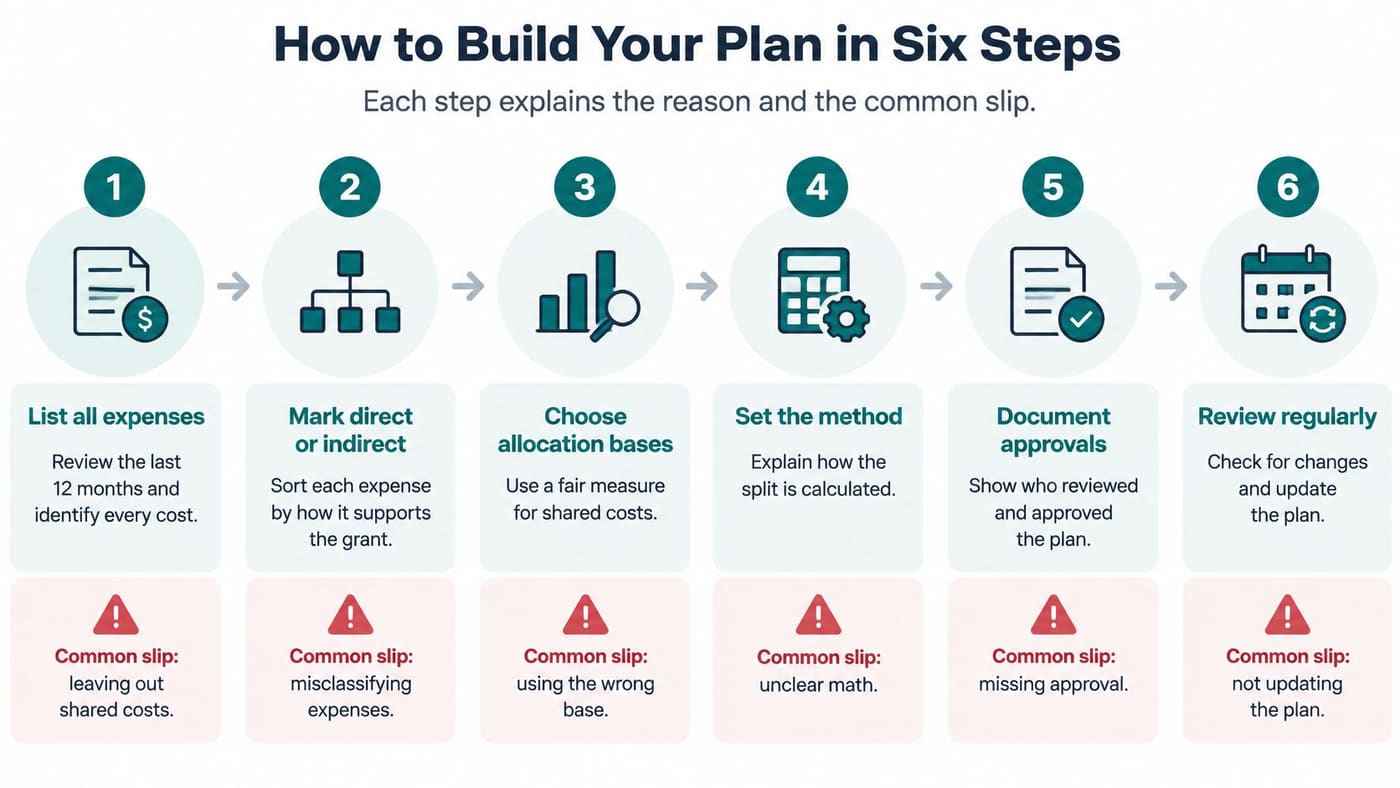
- List every expense from the last 12 months and mark each one direct or indirect. The list is your full cost base. The common slip is skipping small recurring bills, such as the copier lease or the church wifi.
- Group shared costs into pools. Occupancy, technology, finance, and administration each need one method. Mixing unrelated costs in one pool hides a bad base.
- Apply the base you already chose for that pool. The base must show how programs benefit. Don't switch it each year to favor the grant with room in the budget.
- Gather the proof. Payroll, time logs, floor plans, and user counts do the work. A percentage remembered in a meeting will not hold up.
- Calculate each program's share and confirm the shares equal 100% of the pool. A total that misses 100% is an error, not a rounding style.
- Write the plan on one or two pages and keep the board approval date with it. That dated page is your audit evidence. Store it with the logs, not in a personal email folder.
Our fund accounting, fundraising, donor management, volunteers, events, and payments share the same operating record, so the hours and the bills are not in rival files. Volunteer logs by person and program give you the donated-time support the plan needs. Expense tracking is where those bills should land before you build the pools.
The result is a page any board member can read in five minutes, with the records behind it in one place. Minty AI can answer a plain question about those records without an export to a side sheet.
Plan Template and Worked Example
Copy this outline into a document. Keep it to one or two pages, and file it with payroll and time logs.
The five parts to copy
- Purpose and scope. Name each award and program. State the period the plan covers, such as the fiscal year that matches your grant budgets.
- Cost pools. For each pool, list the expenses and the base. Staff salaries use documented time. Occupancy uses square footage. Software uses user count.
- Worked split. The executive director's salary follows the log: 40% to the grant-funded program, 35% to fundraising, and 25% to administration. The grant carries only its share. Fundraising does not move onto the award because the award is easier to bill.
- Indirect rate line. Show the pool, the base, and the rate for the year. Note whether the figures are budgeted or actual, and leave a line for the year-end true-up.
- Review and approval. Record the board approval date, the annual review date, and who reconciles billed indirect amounts to year-end actuals.
Why this shape works: an auditor asks for the method, the math, and the approval. A one-page plan answers all three without a narrative nobody will update.
Add a one-line note under each pool for what you will not charge. Lobbying and other unallowable activity stay visible, then come out of the federal share. Restricted gifts stay in their own fund. The plan assigns cost. It doesn't remove a restriction.
Calculate Your Indirect Cost Rate with Real Numbers
A funder asks for your indirect rate, and the answer has to come from math. Allowable indirect costs, net of credits, divided by an equitable base produce the percentage you apply to eligible awards.
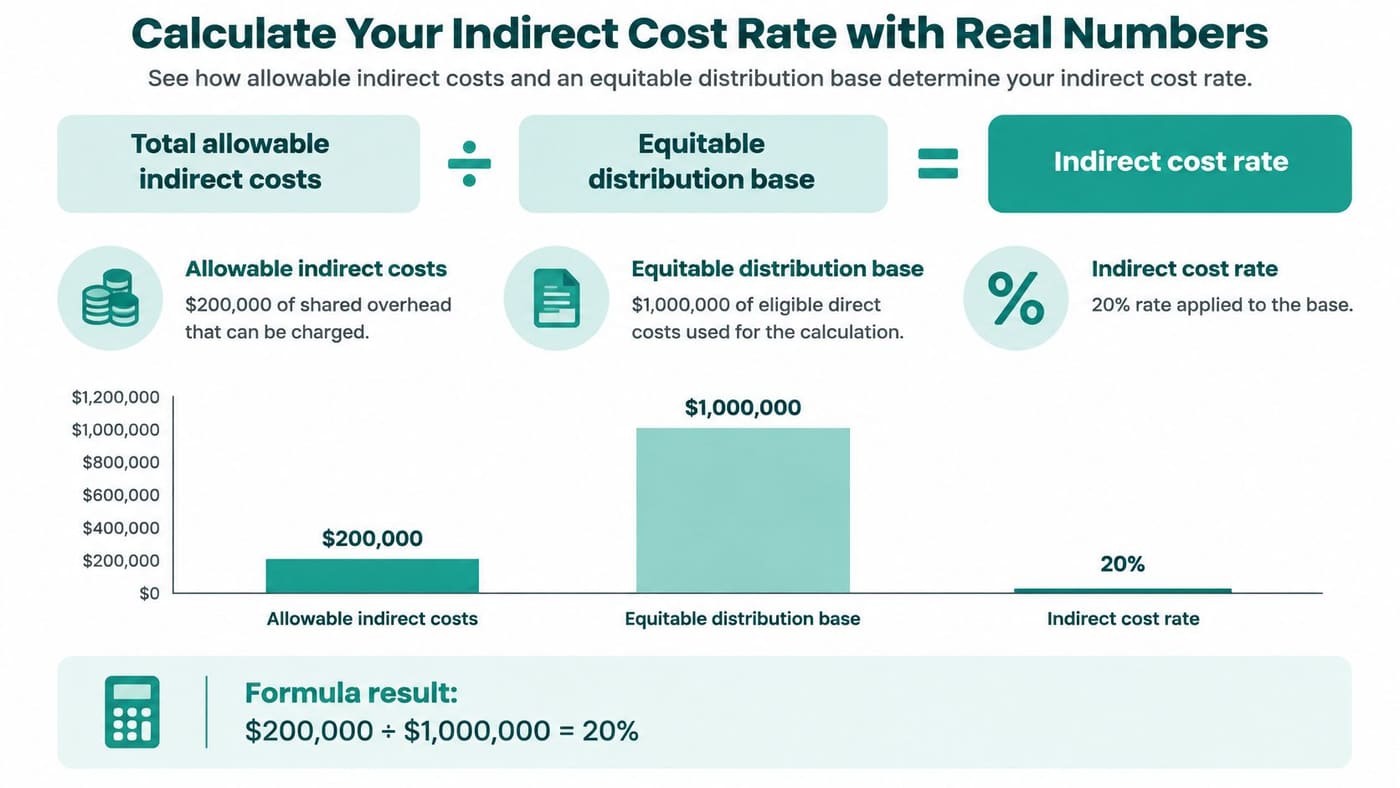
Take $200,000 of allowable indirect costs over a $1,000,000 base. That pair produces a 20% rate. The base is modified total direct costs rather than total spending, and some items are excluded under the governing rules, so count the base the same way every year.
Applied to a $150,000 eligible award, a 20% rate returns $30,000 of indirect-cost recovery, subject to award terms. Three adjustments follow the rate through the year: provisional, final, and carry-forward. At year-end, compare what you billed with actual allowable costs and adjust. That reconciliation protects you on both sides: under-recovery that drains unrestricted cash, and over-recovery you cannot support.
One rate can still overcharge a function that barely uses the building or the finance desk. When major functions differ in a material way, separate pools and separate rates are the fairer path.
What each rate returns on the same award
Under Appendix IV to 2 CFR Part 200, organizations without a negotiated rate may use the de minimis rate, which federal guidance raised from 10% to 15% of modified total direct costs. It is the simplest option on the table, and it can still leave finance, technology, facilities, and compliance costs unrecovered. A written, benefit-based plan is what lets you justify a rate above it.
| Rate | Recovery on $150,000 | When it applies |
|---|---|---|
| 10% illustrative rate | $15,000 | Comparison only. It is not proof that your shared costs equal 10% |
| 15% de minimis rate | $22,500 | Organizations without a negotiated rate, applied to modified total direct costs |
| 20% calculated rate | $30,000 | Built from a $200,000 indirect pool over a $1,000,000 base |
These rows are illustrations. Each rate carries its own rules, and a funder cap can still limit what you bill. Reconcile actual costs. Don't treat the percentage as proof of your true overhead.
Federal Deadlines and Mistakes That Cost Reimbursement
The common assumption is that a fair method can wait until the audit. The calendar doesn't agree.
Under U.S. Department of Education rules at 34 CFR 76.560, a proposal or plan normally goes to your cognizant agency within 90 days after the grant award notification. Miss that window and you may be barred from charging indirect costs from the end of the 90 days until a federally recognized agreement is in place. If you must have a recognized rate and don't yet, the Secretary may allow a temporary indirect cost rate of 10% of budgeted direct salaries and wages. That 10% is a provisional mechanism in specified programs. It is not a universal overhead rate, and it doesn't mean your real shared costs equal 10%.
Churches, schools, and fiscal sponsors on federal awards should treat that 90-day mark as a budget control, not a paperwork footnote.
Mistakes that show up as lost money
- No written method on file. Questioned costs follow, because "we have always split it this way" is not a method.
- All shared costs pushed onto one grant. The other programs look cheaper than they are, and unrestricted cash absorbs nothing it should.
- Donated services left unrecorded. You understate the true cost and can also miss allowable cost sharing.
- Fundraising and lobbying left in the federal pool. 2 CFR Part 200 requires lobbying to be identified in the indirect cost rate proposal and treated as an unallowable activity, with an annual certification if you seek reimbursement.
- A provisional rate never reconciled to actuals. You keep billing a guess after the year has closed.
- No board approval date. The single audit file then has math and no owner.
Put your current plan's approval date next to each award date. If the award is newer than the approval, the plan may not cover it.
Track Shared Costs in One Fund Accounting System
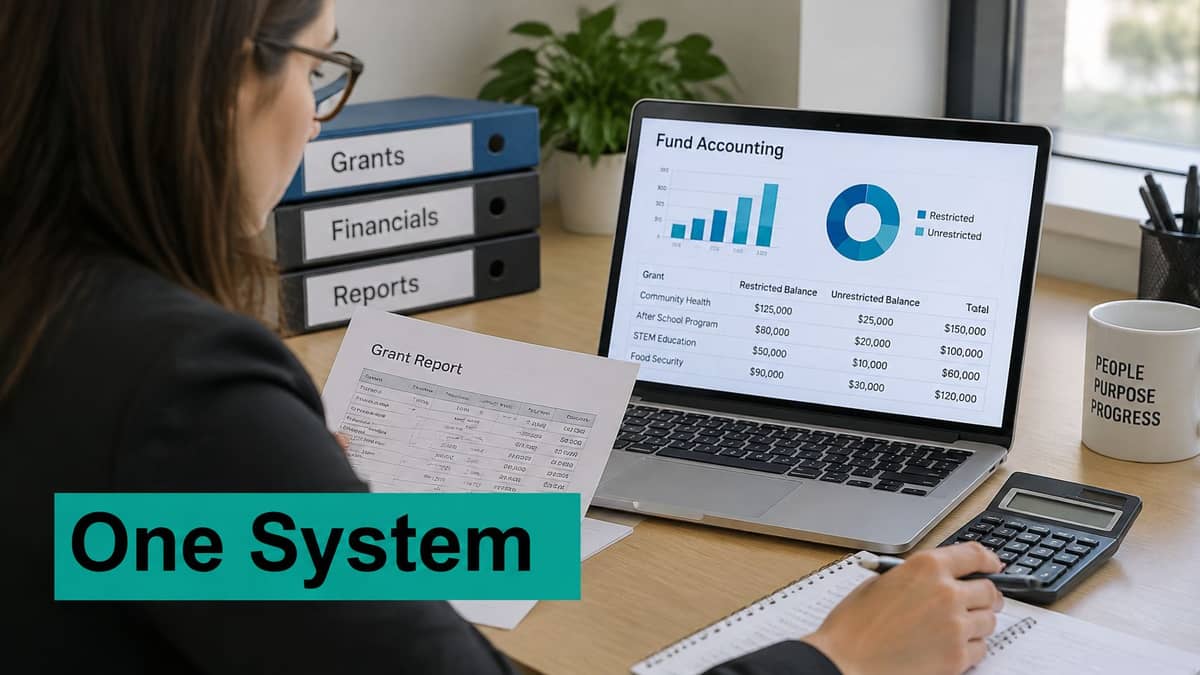
The payoff is simple. Restricted and unrestricted balances stay tied to each grant, and the plan's shares show up in the reports without a side spreadsheet.
You need a full chart of accounts, separate restricted and unrestricted funds, and standards-ready reporting. A bank feed then drops each transaction into the right fund as it posts, instead of waiting for a monthly cleanup. Our fund accounting is built for that split. It isn't a class tag on a small-business ledger.
Plus is $199 per month, or $1,704 billed annually. It includes fund accounting, Plaid bank feeds, standard reports, and volunteer and event management. Bank reconciliation is included on Pro and Enterprise. See how fund accounting holds restricted and unrestricted funds on one chart.
Aplos remains a common pick for small nonprofits that want straightforward books. Sage Intacct and Blackbaud Financial Edge fit larger finance teams that already run a full finance shop. QuickBooks classes can label a cost, but they don't model restricted funds the way a grant file needs. Run one test in your current tool. Enter one shared bill and see whether it splits by the base you chose.
Confirm Your Plan Before Your Next Grant Budget
- Pick one pool this week. Rent or the finance team is enough. Calculate the split and check that the shares equal the whole pool.
- Write the one-page plan and send it to your board before the next grant budget is due. A dated approval is the piece most files lack.
- Test the plan on one grant and compare the result with year-end actuals. Use the grant budget template so the budget and the allocation tell the same story.
Book the free setup call. Our team walks you through fund accounting, donations, and reporting on your own plan. Organizations with up to $100K in annual donations can start on the Free plan at $0, with no credit card, one user, and 10 GB of storage. The plan is a habit you keep, not a one-time project.
AlignMint keeps fund accounting, donor records, volunteer hours, and grant reports on one record, so a cost allocation plan is backed by the same numbers you bill. You can see restricted and unrestricted balances without a side spreadsheet, and you can start with a free setup on your own awards. Visit AlignMint when you are ready to put the plan into the books.
Frequently Asked Questions
The written method, the steps, and a worked example that split each shared bill by benefit. What cost allocation means, before you write that plan, is a separate guide.
Accounting starts on Plus at $199 per month, or $1,704 billed annually, and includes fund accounting and bank feeds. Bank reconciliation is included on Pro and Enterprise. Free is one user for nonprofits with up to $100K in annual donations, and no credit card is required.
Ready to try AlignMint with your nonprofit?
Start free — set up donor tools, giving pages, and Minty. Upgrade when you need accounting.