

The rent invoice lands, and the development director asks how much of it belongs to fundraising. The room goes quiet. Shared costs are where nonprofit budgets get fuzzy, yet Form 990 and your funders still expect a split you can defend.
That split is ordinary work, not a special project. For tax year 2024, the typical U.S. nonprofit still put the large majority of functional expenses into programs, with a smaller share in management and general, based on Form 990 filings analyzed by Roundpaper. Those ratios are the sum of small coding decisions, and most of them happen when a cost is recorded.
Skip the hunt for one perfect formula. Match the method to the cost in front of you, write a one-page rule that names who decides, and drop the method the moment it stops telling the truth.
Seven methods follow. Each one starts at a single decision moment: the invoice, the board's request for a split, or a funder's question about a ratio. Each one ends with a practical rule for when to stop using it. Use that path. Do not treat the list as a glossary.
Quick Answer: Functional Expense Allocation Methods
Use the allocation method that matches the cost, then write the rule down. This page compares seven methods. What functional expenses are, the written cost allocation plan, and when the statement is required are separate guides.
Start with fund accounting and what functional expenses are. For the written plan, see the cost allocation plan guide. For the idea before the plan, see what cost allocation is. For the filing rule, see when a statement of functional expenses is required.
1. Direct Cost Assignment
The invoice hits the inbox and someone has to code it before lunch. Direct cost assignment is that decision: name the one function that consumed the cost, using your cost allocation categories, and tag the full amount there. Printing for a youth summer camp brochure is program. The program gets all of it. Nobody splits a percentage.
The IRS has required that order for decades. The 1991 Form 990 instructions told organizations to assign direct costs to the function they clearly supported, then allocate only what benefited several functions. That same sequence still governs the statement of functional expenses.
What It Looks Like on a Tuesday
A food pantry codes truck fuel for food pickups to hunger relief. A community arts nonprofit codes ticket printing for its gala to fundraising. The answer sits on the face of the invoice, which is why this method comes first.
- Write a one-page coding guide. Give every staff member the same five or six examples, so coding doesn't depend on who opens the mail.
- Review uncoded lines monthly. A miscoded transaction caught in March takes a minute. The same one found in October during 990 prep takes an afternoon.
- Classify restricted costs as you book them. A restricted program cost coded at entry stays in the right column all year. Waiting until 990 prep mixes it with shared overhead.

Practical rule: Stop using direct assignment the moment an invoice genuinely serves two functions. Splitting a shared bill by guesswork is worse than allocating it with a documented driver.
2. Full-Time Equivalent (FTE) Allocation
The decision lands the week the board asks what share of one salary belongs to programs. FTE allocation is the answer you can give without a timesheet. Estimate the portion of a full-time job each person spends in each function, then apply that portion to salary and benefits. A development director at half time fundraising and half time programs puts half her pay in each column.
Small and mid-sized organizations reach for this first because people wear three hats and nobody punches a clock. The estimate comes from the job, not from a log. An executive director at 40% fundraising and 60% programs splits her salary that way. A literacy nonprofit assigns its operations coordinator 70% to management and general and 30% to programs.
What Makes an FTE Split Hold Up
No formula arrives from a standard. The Johnson O'Connor nonprofit practice guide states the test plainly: neither the IRS nor GAAP prescribes one universal method, but the result must be reasonable, applied consistently, and disclosed. Written, signed FTE estimates clear that bar.
- Put every split in writing. One paragraph per role, reviewed by the board or finance committee once a year.
- Update after a real change. A new grant, a departure, or a promotion changes the mix. Waiting for year end leaves the error sitting until the auditor finds it.
- Watch the neat numbers. If every role lands on a clean half, expect a question about how you measured it.
Tie each percentage to the dollars it covers on the payroll summary. The board should see the same pay the split was applied to, not a second set of figures built later.

Stop using FTE estimates when a role turns over quickly or is paid from a federal award. The estimate goes stale before the fiscal year closes, and a stale split is worse than no split.
3. Time and Effort Allocation
Time and effort allocation replaces the estimate with a record. Staff log how their hours were spent, and those logs drive the salary split. This is the method federal grant reviewers expect, and it's the one that holds up when a program officer asks how you know.
The mechanics are simple enough. Each pay period, staff record hours against programs, management, or fundraising, and payroll follows the split. A community health organization can run a two-week time study each year to set the pattern. A youth services nonprofit with several federal awards uses periodic certifications to support the charges.
Keep the Paperwork Light Enough to Survive
Time studies rarely fail because they're complicated. They fail because the form takes eleven minutes and people stop filling it in by March.
- Shorten the category list. Six time codes is plenty. Match them to your grant budgets and functional categories from day one, not after the first drawdown.
- Collect weekly. A Monday reminder for last week's hours produces better records than a quarterly reconstruction over coffee.
- Certify where it counts. For federally funded staff, signed periodic certifications are the evidence that survives an audit.
A two-week study with honest entries tells you more about your real split than a year of tidy estimates.
The ECFA sample financial policies show the pairing in practice. Employee costs, office expenses, technology, occupancy, and depreciation carry time-and-effort estimates, while fees for service, advertising, and insurance run through direct assignment. That's a template worth copying.

Stop tracking full time for any role with no grant funding and no material split. Give that person an FTE percentage instead, and spend the attention on the roles that need it.
4. Square Footage and Occupancy Allocation
The finance committee opens the packet and asks why rent hit program so hard. The landlord's invoice will not answer that. Rent, utilities, property insurance, and janitorial serve every function at once, so the split has to be decided when the bill is recorded, not after the ratio looks inconvenient.
Measure the space each function occupies and apply those percentages to the shared occupancy pool. A church splits building costs across children's ministry, worship space, and administrative offices. A school-based nonprofit assigns classrooms to tutoring and the back office to management and general. Anyone in the room can walk the hallway and see the basis.
The 2024 Form 990 instructions point to time records for shared personnel, headcount or square footage for occupancy, and usage or transaction volume for technology and administrative services. Set the driver before you post. Choosing the basis after year end is how ratios move with no explanation you can defend.
Walk the building once with a tape measure, or pull the floor plan from the lease, and record square footage by room and by function. Hallways, restrooms, and the lobby stay in the shared pool under one written rule, used every year. Keep the floor plan with the allocation file so the annual review is a short check, not a weekend rebuild.
If a program director works from home, measure that workspace by floor area. The EndureGo Tax home office guide shows how to do that measurement.
Map each room to the fund or program it serves in your chart of accounts so the occupancy split is traceable. Organizations that keep building records in AlignMint can store them with its facilities management tools.
The trade-off to name out loud: square footage reflects space, not effort. A tiny development office that raises most of the budget still gets a tiny share of the rent. If that feels wrong, the cost you are arguing about is not occupancy.
Stop using square footage when programs stop living in the building. Move to headcount or usage, and write the reason into the policy.
5. Direct Labor Hours and Activity-Based Allocation
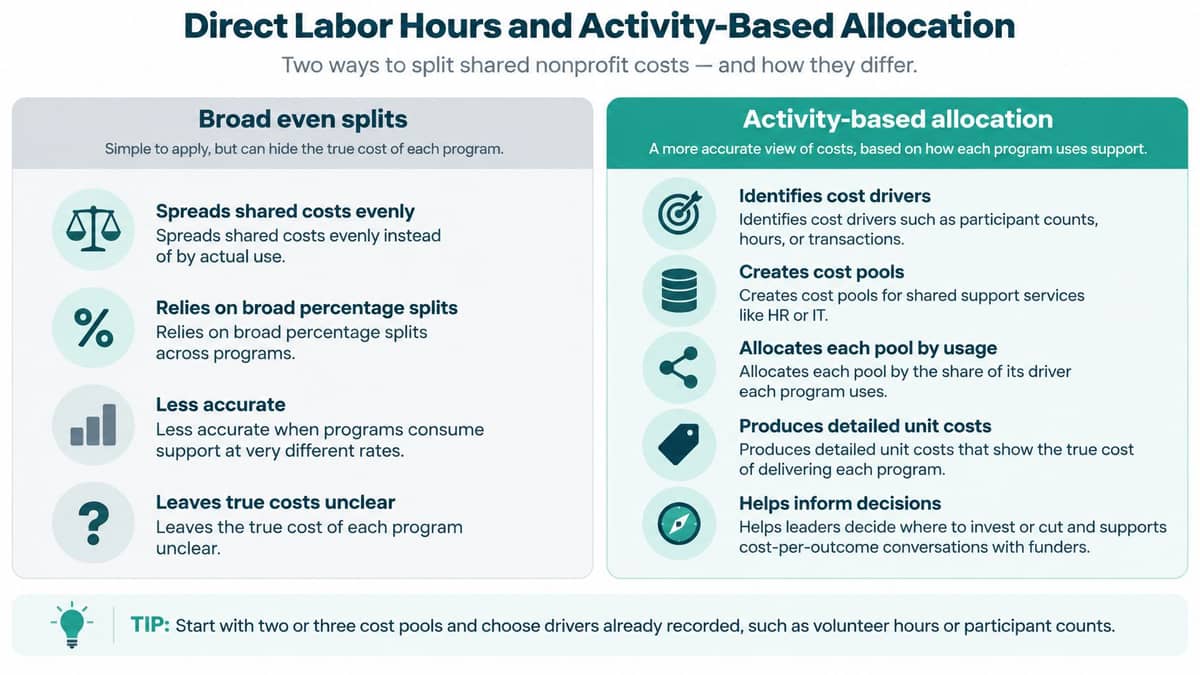
Pools and drivers sound like jargon until the first time you see a program's real cost. Activity-based allocation groups shared costs into pools, then distributes each pool by a driver that reflects use. HR support follows headcount per training track. Warehouse costs follow pounds of food moved.
This is the method that changes decisions, because it shows where support services are consumed. A workforce development nonprofit with two training tracks of very different sizes gets a different answer under participant counts than under an even split.
The mechanics are less frightening than they sound. The IRS example shows an indirect cost center holding $85,000 of expenses, with $70,000 allocated to program services, $10,000 to fundraising, and an offsetting negative adjustment in management and general, per the current Form 990 instructions. Total spending doesn't move. Only the columns do.
Pick Drivers You Already Record
The best driver is one your team captures for another reason. Volunteer hours logged for scheduling. Participant counts pulled for a grant report. Tickets sold for an event.
- Start with two pools. Technology and occupancy are usually enough to prove the value to your board.
- Test the driver before you commit. Run the split three ways and compare. If the answer swings wildly, you've learned something worth reporting.
- Expect the disclosure. FASB names information technology as a cost that supports accounting, human resources, fundraising, and program delivery at once, and it requires you to disclose the method in your ASU 2016-14 financial statements.
Our hour tracking tools feed the volunteer-hour driver without a parallel spreadsheet.
Stop using activity-based allocation when collecting a driver costs more than the insight is worth. Two pools done well beat six pools nobody maintains.
6. Revenue-Based Proportional Allocation
The finance committee wants a split before the packet goes out, and nobody logged hours against the shared costs. Revenue-based allocation distributes those costs in proportion to the revenue each function brings in. If individual giving produces a quarter of revenue, a quarter of shared overhead follows it. The math is simple, and you can explain it in one sentence.
Use it with care. Revenue measures income, not consumption. A quiet quarter can move the overhead split while the work itself does not change.
Where It Earns Its Place
Fiscal sponsorship is the clearest case. A sponsor records each project's income and expenses in its own books and reports them on its own Form 990, and it commonly charges an administrative fee set as a percentage of the project budget, as the National Council of Nonprofits explains on fiscal sponsorship. Allocating shared administration by project revenue share gives each project a number you can defend and gives the sponsor one consolidated view.
- Average several months. One transformational gift should not reset the overhead split for the year.
- Ask before you file. Many funders want a direct or time-based method for grant reporting. Confirm the basis is acceptable before you build a budget on it.
- Show each project its own column. Splitting shared administration across sponsored projects keeps the fee and the overhead on the same revenue base.
When someone waves a program-expense ratio at you, hold the method up to the work. Pushing shared costs into programs can produce a figure that looks ordinary and still says almost nothing about how the organization spent.
Stop using revenue-based allocation when your funders require a cost-driver basis, or when a single revenue source dominates the picture and makes the split an accident of fundraising timing.
7. Negotiated and De Minimis Indirect Cost Rates
A program officer asks why indirect costs sit on one line instead of a split of rent, software, and the finance team. Decide here: you are picking a recovery rate, not a new trace of every shared cost.
Indirect cost rates replace a stack of small splits with one percentage. Apply that percentage to a defined base of direct costs and recover shared overhead in a single line. Organizations holding a federally negotiated rate agreement use that number. Organizations without one can often use the federal de minimis indirect cost rate under the Uniform Guidance, a fixed percentage of modified total direct costs. Check the current figure in the regulation before you build the budget on it.
One rate, applied the same way every year, ends the argument about whether the copier belongs to programs or administration.
Know the Gap Between the Rate and the Cost
The rate recovers overhead. It does not measure what overhead costs you. The Nonprofit Finance Fund's 2025 survey found that 70% of respondents reported they could charge an indirect-cost rate of 10% or less, a level the survey describes as insufficient for a healthy organization.
Unrestricted revenue covers the rest. Reconcile recovery to actual shared costs every month so June is not the first time the gap shows up.
- Check the funder's cap first. Many set their own limit below the de minimis rate, and a budget built on the full rate gets rebuilt in a hurry.
- Write down your cost base. Modified total direct costs exclude some items. Define them once so the math runs identically each year.
- Compare recovery to actual. Track what you recovered against what shared costs really were, fund by fund, every month.
For the board packet: if your restricted grants recover half of your shared costs, the board needs to see that number before it approves next year's budget.
Stop using a negotiated rate when the awards it was built for end. Recalculate the base and reset the rate. Stop using the de minimis option when a funder rejects that base, or when recovered dollars no longer cover the shared costs those awards create.
How the seven functional expense allocation methods compare
| Item | Best For | Documentation Needed | Main Drawback |
|---|---|---|---|
| Direct Cost Assignment | Costs clearly tied to one activity | Consistent transaction coding and a clear chart of accounts | Cannot allocate shared costs |
| Full-Time Equivalent (FTE) Allocation | Shared staff costs in small or mid-sized organizations | Written staff allocation schedule, reviewed regularly | Percentages can become outdated or lack audit support |
| Time and Effort Allocation | Grant-funded staff costs requiring strong support | Timesheets, activity reports, or signed certifications | Adds administrative work for staff |
| Square Footage and Occupancy Allocation | Shared building and occupancy costs | Floor plan or space measurements and a rule for shared areas | Shared spaces can be difficult to allocate fairly |
| Direct Labor Hours and Activity-Based Allocation | Organizations with programs that use support services differently | Cost pools and reliable records for selected cost drivers | Takes time to set up and maintain |
| Revenue-Based Proportional Allocation | Shared overhead when revenue shares are a reasonable basis | Revenue records and a written allocation policy | Revenue may not reflect actual resource use |
| Negotiated and De Minimis Indirect Cost Rates | Recovering overhead on eligible grants | Rate agreement or documented cost base and rate application | The rate may not reflect actual overhead or may be restricted by funders |
Choose a Starting Method and Write Your Rule Down
Direct cost assignment comes first, always. Code every cost you can trace to one function at the moment it's recorded, because that's the cheapest accuracy you'll ever buy. What's left over is a much smaller pile, and smaller piles are easier to defend.
Then add one shared-cost method. Pick the one that matches your biggest shared pool. If salaries dominate, use FTE estimates or time and effort. If occupancy does, measure the building. If you run several programs with very different support needs, build activity-based pools with drivers you already capture.
Write it on one page. Name the pool, the driver, the person who approves changes, and the review date. The board or finance committee approves it once, and that same page answers the auditor's question and the new bookkeeper's question two years from now.
Review it annually, and off-cycle when something big changes. A new grant, a building move, a retirement in a three-person finance office. Those are the moments when last year's split stops describing this year's work.
Two habits to leave behind. Don't apply one blanket percentage across the whole ledger, because it has no driver and no defense. And don't treat a low overhead ratio as the goal. As Pease Bell's nonprofit practice notes observe, a higher support-cost ratio built on documented drivers reads as more credible than an artificially low one produced by weak ones.
The workload is real, and it usually lands on the same person who carries the audit and the grant reports. So make the process small enough to survive a busy spring. A monthly coding review, one page of policy, one annual conversation with your board.
Churches and schools often need one extra step. Map the building and the programs to the funds first, then let occupancy and program counts drive the rest. Fiscal sponsors should reconcile each sponsored project before consolidating, so no project's costs get absorbed into another's column.
If you want help mapping your funds and reports to your own categories, AlignMint offers a free setup call that walks you through fund accounting, donations, and reporting on your plan.
AlignMint is an all-in-one nonprofit platform with true fund accounting at its center, so restricted funds, grants, and programs stay tied to their purpose from gift to report. Costs get assigned to program services, management and general, or fundraising as they're recorded, and the Statement of Functional Expenses and Form 990 reports come out of the same data instead of a year-end spreadsheet. Visit AlignMint to see how the free tier works for organizations raising up to $100K a year.
Frequently Asked Questions
Match the method to the cost in front of you and write down the rule. What functional expenses are, the written allocation plan, and when the statement is required are separate guides.
Free is one user for nonprofits with up to $100K in annual donations, and no credit card is required. Fund accounting starts on Plus at $199 per month.
Ready to try AlignMint with your nonprofit?
Start free — set up donor tools, giving pages, and Minty. Upgrade when you need accounting.