

The popular advice is simple: keep overhead low, and donors will trust you more. That advice can distort decisions, because a percentage alone doesn't show whether shared staff, rent, software, and fundraising costs were assigned fairly.
You need a rate that helps you price grants, explain infrastructure to your board, and defend allocations during an audit. This guide shows how to calculate overhead rates, choose the right denominator, build a defensible indirect-cost pool, and use the result operationally.
Quick Answer: How to Calculate Overhead Rates
An overhead rate is supporting costs divided by a chosen denominator—total expenses, total revenue, or a direct-cost base such as MTDC. Write the denominator beside the percentage so grant, board, and audit readers interpret the same figure.
Start with cost allocation for nonprofits and fund accounting. For the Form 990 view, see statement of functional expense.
Why Chasing Low Overhead Misses the Point
A low overhead percentage can look reassuring while hiding weak cost allocation. If program staff spend time on administration, or one finance employee supports several grants, pushing every expense into program services may make the ratio look better without making the reporting more accurate.
Overhead commonly includes management and general costs plus fundraising costs, and some definitions also include membership development. The Indiana nonprofit finance guide explains that funders use the ratio to understand how contributions divide between programs and supporting activities, while Bridgespan's nonprofit costs analysis toolkit emphasizes rational allocation rather than a universal target.
The more useful question is whether your organization has the infrastructure required to deliver results consistently. A finance function, donor records, volunteer coordination, compliance work, technology, and leadership oversight all support mission delivery, even when they aren't classified as program expenses.
Practical rule: A defensible allocation is more valuable than an artificially low ratio.
What the ratio can and cannot tell you
Overhead is a summary measure. It can help you compare your own results over time, plan budgets, and explain the relationship between supporting activities and total operations. It can't, by itself, show whether a program is effective, whether fundraising is producing value, or whether your accounting team has assigned shared costs correctly.
A major nonprofit sector review reported a 2014 median overhead ratio of 16.3%, with a weighted average of 12.8%. The same review found that 20% of organizations had ratios of 7.6% or less, while 20% had ratios of 30.9% or more, demonstrating how much organizational structure affects the calculation. The review's overhead analysis also reported a 12.8% median administrative ratio and an 11.4% weighted average administrative ratio.
Those figures don't establish a correct target for your nonprofit. They show why benchmarks require context, especially when organizations differ in staffing, grant mix, fundraising model, facilities, and service delivery.
Treat overhead as a management tool
Boards need to know what it costs to operate responsibly. Funders need to understand how awards bear a fair share of shared costs. Program leaders need budgets that reflect the resources their work consumes.
That makes cost allocation the central task. Once you document the drivers behind shared salaries, occupancy, software, and utilities, your overhead rate becomes useful for decisions rather than a scorecard designed to reward underinvestment.
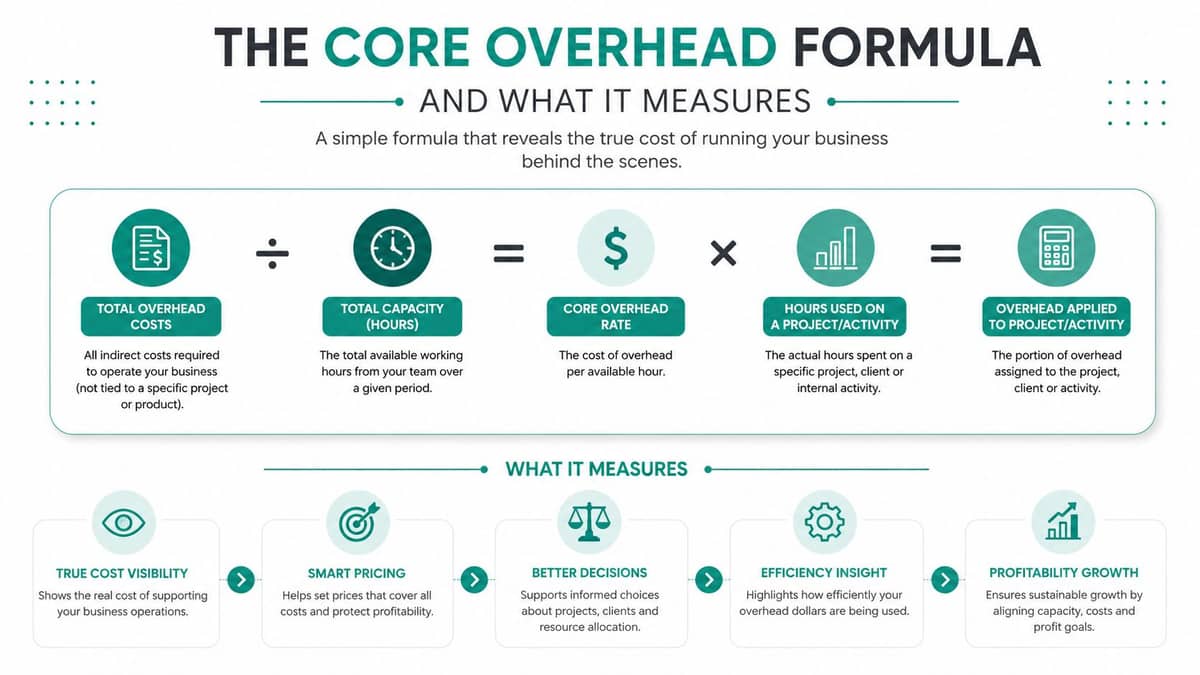
The Core Overhead Formula and What It Measures
The basic formula is straightforward:
Overhead rate = overhead costs ÷ selected denominator
For a reporting ratio, you might divide management and general costs plus fundraising costs by total expenses. Some nonprofit guidance also presents overhead as those supporting costs divided by total revenues. Both approaches can be valid for different decisions, but they aren't interchangeable.
A simple accounting example uses $15,000 in operating expenses divided by $75,000 in total expenses, producing a 20% overhead rate. That example appears in nonprofit accounting guidance discussed alongside government treatment of predetermined overhead rates in this U.S. Government Accountability Office decision.
Choose the denominator before you judge the result
If your denominator is total expenses, the rate answers, “What share of spending supported administration and fundraising?” If your denominator is total revenue, it answers, “What share of incoming resources supported those functions?”
For grant pricing, neither reporting denominator may be appropriate. You may need indirect costs divided by a direct-cost base, such as MTDC. A rate expressed against direct costs can look higher than a rate expressed against total expenses, even when the underlying overhead pool hasn't changed.
Write the denominator beside every rate. “Overhead is 20%” is incomplete. “Overhead is 20% of total expenses” or “indirect costs are calculated as a percentage of MTDC” gives the reader enough context to interpret the figure.
Classify accounts before calculating
Start with your Statement of Functional Expenses and chart of accounts. Separate:
- Management and general: Leadership, finance, legal, governance, compliance, and general office support.
- Fundraising: Development staff, appeals, donor events, grant development, and fundraising communications.
- Program services: Costs directly supporting the services or activities described in your mission.
The classification depends on the work performed, not merely the employee's job title. A development director's fundraising time belongs in fundraising, while time spent on general organizational planning may require a documented allocation.
If you want broader context on how organizations compare internal financial views, compare management accounting approaches before choosing reports for your board. For the reporting side, keep your Statement of Activities connected to the functional classifications that support it.
Understanding the Modified Total Direct Costs Base
Government and institutional grants often use Modified Total Direct Costs, or MTDC, as the base for indirect cost calculations. The important point isn't just knowing the acronym. You must know which costs enter the denominator, because the same indirect-cost percentage means something different against MTDC than against total expenses or revenue.
Federal guidance generally describes MTDC as including direct salaries and wages, applicable fringe benefits, materials, supplies, travel, and only the first $25,000 of each subaward. It excludes equipment, capital expenditures, patient care, tuition, participant support costs, and the portion of a subaward above $25,000. The U.S. Department of Education's financial guidance describes the federal 10% de minimis indirect-cost rate as a percentage of MTDC.
MTDC Base Inclusions and Exclusions
| Included in MTDC | Excluded from MTDC |
|---|---|
| Direct salaries and wages | Equipment |
| Applicable fringe benefits | Capital expenditures |
| Materials and supplies | Patient care |
| Travel | Tuition |
| First $25,000 of each subaward | Participant support costs |
| Subaward costs above $25,000 |
The table is a starting point, not a substitute for the terms of your award. Some funders impose specific definitions, caps, exclusions, or approval requirements, so read the notice of funding and negotiated rate language carefully.
Why base mismatch causes trouble
Suppose your indirect pool contains shared finance, occupancy, and technology costs. If you divide that pool by total expenses, you produce a reporting-style ratio. If you divide it by MTDC, you produce a grant-pricing rate. The denominator may exclude major purchases or the upper portion of subawards, so the resulting percentage can be materially different.
That difference affects recovery. A base that's too broad may spread overhead across costs that don't benefit equally from the shared functions. A base that's too narrow may assign an excessive burden to the remaining direct costs.
Federal indirect-cost guidance stresses that the rate must be stated with its base, such as Total Direct Costs or MTDC. The Department of Energy's indirect cost rate agreement and proposal guidance also emphasizes selecting a base that gives each award a proportionate share relative to the benefits received.
For chart-of-accounts preparation, keep grant categories and exclusions visible. A nonprofit chart of accounts template can help your team separate direct, indirect, restricted, and functional activity before the annual calculation.
Building Your Indirect Cost Rate Step by Step
A defensible rate begins in the general ledger, not in a benchmark report. You need a complete account list, a documented classification method, and a denominator that matches the decision you're making.
Start with the ledger
Export the most recently completed fiscal year of actual expenses, preferably from audited records. State guidance recommends using a full year of expense data and says budgeted or projected expenses may be used for a new organization without completed historical data.
Then work through the ledger in order:
- Build the account list. Include salaries, fringe, occupancy, insurance, technology, supplies, professional fees, and other operating accounts.
- Classify direct costs. Assign costs directly benefiting a program, grant, or sponsored project to that activity when the records support the assignment.
- Identify indirect costs. Place shared administration, general technology, occupancy, finance, and organizational support in the indirect pool.
- Remove unallowable items. Follow award rules and remove costs that the funding terms prohibit or that would distort the calculation.
- Select the base. Use total expenses, revenue, total direct costs, or MTDC according to the reporting or pricing purpose.
- Calculate the rate. Divide the indirect cost pool by the selected base.
- Document the method. Preserve the account mapping, allocation drivers, exclusions, period, and approval.
Allocate shared costs with evidence
Shared staff time deserves more care than a blanket percentage. Use time records, workload estimates, grant activity, program schedules, or another rational driver that reflects the benefit received.
For rent, square footage can make sense when programs occupy distinct areas. For utilities, occupied space or usage may be reasonable. For software, user counts, active projects, or functional use can provide a better basis than dividing the invoice equally.
The same principle applies to a finance director who supports several grants and general administration. Assign documented project time directly where appropriate, then place the remaining support in the indirect pool. Don't classify the entire salary as program cost just because the role helps programs.
Your nonprofit cost allocation guide can serve as a working reference while you write the policy. The policy should explain who approves allocations, how often drivers are reviewed, and what happens when actual activity differs from the estimate.
Audit test: Another finance professional should be able to reproduce your rate from the ledger and allocation schedule.
Avoid stale actuals
A prior year may not represent your current operation after a new grant, office move, staffing change, or major program expansion. Federal guidance says provisional and fixed rates should rely on the most current audited actual data or well-supported estimates, because expected changes can make prior-year costs misleading.
Review the rate when the cost structure changes materially. Don't revise it casually every time one invoice moves, but don't keep using a stale denominator when your organization has changed shape.
Applying Overhead Rates to Real Operational Decisions
A calculated rate earns its keep when it changes a budget, contract, or board decision. Use the reporting ratio to explain the organization, and use a documented indirect rate to price work that consumes shared capacity.
Grant proposals should identify the base and show how the rate applies. If a funder won't reimburse the full amount, record the gap explicitly rather than absorbing it into unrestricted operations. That makes the subsidy visible and gives the board a clearer choice.
Your nonprofit budget template can help show direct costs, indirect recovery, restricted revenue, and the unrestricted contribution needed to close a gap.
Fiscal sponsorship
A fiscal sponsor provides fiduciary oversight, financial management, and administrative services for a sponsored project. The National Council of Nonprofits explains fiscal sponsorship. Sponsors commonly receive and administer the charitable contributions, and the agreement sets an administrative share as a percentage of the project budget. Sector pages often call that percentage a fee. On the books it is an administrative allocation of funds the sponsor already holds.
One published rate structure uses 8% for projects under $500,000, 7% for projects between $500,000 and $1,000,000, and 6% for projects over $1,000,000. The same structure lists a refundable monthly administrative cost of $29 for Model A and Model C projects, refunded after the project raises at least $5,000 in a year. Those figures come from Social Good Fund's sponsorship rates, and they show one sponsor's schedule, not a universal standard.
The operational question is whether the allocation covers the sponsor's actual oversight, finance, compliance, insurance, reporting, and shared-services burden. A flat percentage can be simple to administer, but it may recover too much from labor-light projects and too little from projects requiring intensive support.
Board and funder conversations
When a funder asks how much supports programs, show the functional expense classification and allocation policy. Explain which shared costs benefit the award, which costs remain outside the claim, and how the base distributes the burden.
For fundraising campaigns, the same discipline helps separate direct campaign spending from shared development support. A resource on analyzing crowdfunding campaign costs can help frame campaign decisions around total cost, not only the visible transaction or promotion expense.
The strongest board discussion isn't “Can we lower overhead?” It is “Which infrastructure protects delivery, compliance, donor trust, and financial control, and how will we fund it?”
Moving Beyond the Overhead Myth Toward Function-Based Analysis
The single overhead percentage is too blunt for many decisions. A better approach combines functional expense reporting with cost-allocation schedules that show how shared resources support programs, management and general work, and fundraising.
The Statement of Functional Expenses gives you that operating view. It separates costs by function, but the quality of the report depends on the allocation methods behind shared salaries, occupancy, technology, and other common expenses. Your Statement of Functional Expense guide can help your team connect the schedule to wider reporting.
Function-based analysis answers better questions
A retrospective ratio tells you what happened during a reporting period. Function-based analysis helps answer operational questions:
- Which grants recover their share of finance and compliance work?
- Which programs depend on unrestricted subsidy?
- Does fundraising activity justify the staff and technology supporting it?
- Are shared services allocated consistently across sponsored projects?
- Can the organization explain its method during an audit?
These questions matter for fiscal sponsors, schools, churches, and grant-funded nonprofits. Each may have restricted resources, multiple programs, shared employees, events, volunteers, and administrative obligations that a single ratio cannot explain.
Choose the measure for the decision
There isn't one universally correct denominator. Total expenses can help describe supporting costs as part of overall spending. Total revenue can show the relationship between support functions and incoming resources. Direct-cost or MTDC bases can support grant pricing and recovery.
The mistake is comparing unlike rates as though they describe the same thing. Put the numerator, denominator, period, exclusions, and allocation policy beside every result.
Independent nonprofit guidance commonly cites 20% to 35% as a benchmark range, and one source describes that range for nonprofits under $500K in annual revenue. A separate finance rule of thumb describes 65% program costs and 35% overhead, but Zeffy's discussion of nonprofit overhead also supports the broader conclusion that actual breakdowns vary by organization.
Use those figures as conversation starters, not targets. Florida Nonprofit Alliance warns against arbitrary overhead goals and recommends asking whether the organization has the infrastructure needed to deliver mission results.
Make the allocation explainable
A sound policy names the driver for each shared cost, assigns responsibility for reviewing it, and preserves the supporting records. It also distinguishes financial reporting from internal management analysis, because a useful internal view may not match a funder's allowable-cost rules.
AlignMint offers an all-in-one platform with true fund accounting, donor management, volunteer management, events, and marketing. Its free tier is available to nonprofits under $100K, and its unlimited-user model avoids per-seat fees, while its Minty assistant can answer questions from the organization's financial data. For an executive director, the value lies in keeping fund, donor, program, and allocation information connected rather than rebuilding the story across separate systems.
Your board doesn't need a low number. It needs a credible explanation of what it costs to deliver the mission, why shared costs were assigned fairly, and where unrestricted support remains necessary.
AlignMint brings true fund accounting, donor and volunteer management, events, marketing, and allocation-ready reporting into one platform. Visit AlignMint to review the free tier for nonprofits under $100K and see whether it fits your organization's overhead and reporting workflow.
Ready to try AlignMint with your nonprofit?
Start free — set up donor tools, giving pages, and Minty. Upgrade when you need accounting.