

For related tools, see AlignMint features.
Win Grants for Nonprofit: Your Complete 2026 Guide
Quick Answer: Win Grants for Nonprofit: Your Complete 2026 Guide
To win grants for nonprofit work, get grant-ready before you search: clarify the program, build a realistic budget, confirm eligibility, and make sure your accounting can separate restricted dollars after award. Winning is only useful if you can manage the grant cleanly.
You're probably carrying grants for nonprofit work in four places right now. A spreadsheet tracks deadlines, QuickBooks tracks spending imperfectly, your development notes live in a CRM, and final reports get assembled in Word after too many late nights.
That setup works until you win funding and have to prove, quickly and cleanly, where every restricted dollar went. The better approach is to treat grants as one connected process, from prospecting to reporting, so you can apply with confidence, manage funds correctly, and answer funder questions without digging through old files.
Winning Grants Starts with Financial Clarity
The hardest part of grants isn't always finding them. It's knowing, at any moment, whether your organization can manage them well enough to keep the money, report it correctly, and protect trust with the board and funder.
That pressure is real because grants often aren't a side revenue stream. In a nationally representative study, two-thirds of nonprofits received at least one government grant or contract in 2023, and the average nonprofit derived one-quarter of its revenue from government sources that year, according to the Urban Institute's 2023 analysis of government grants and contracts. For many organizations, public funding is central to operations, not extra.
When grants matter that much, a patchwork system starts creating risk. You second-guess restricted balances. Program staff and finance staff keep different versions of the truth. Reporting deadlines sneak up because no one system holds the whole story.
Practical rule: If you can't see a grant's budget, spending, and remaining balance in one place, you don't have control yet.
Financial clarity changes the tone of the whole grant cycle. You write better applications because your budgets are grounded in actual costs. You manage awards better because each expense has a home. You report faster because the information is already organized.
A lot of executive directors try to solve this with one more template. Templates help, and a good one can save time at the front end. If you need a starting point, this nonprofit budget template in Excel is useful for structuring your thinking.
But templates alone don't fix fragmented process. They don't connect what you proposed to what you spent. They don't stop co-mingling. They don't make closeout easier six months later when the funder asks for a budget-to-actual report and a clean narrative.
The practical path is simpler than it sounds. Get grant ready first. Target the right opportunities. Write applications that match your financial reality. Then manage post-award work with the same discipline you used to win the grant.
Your Grant Readiness Checklist
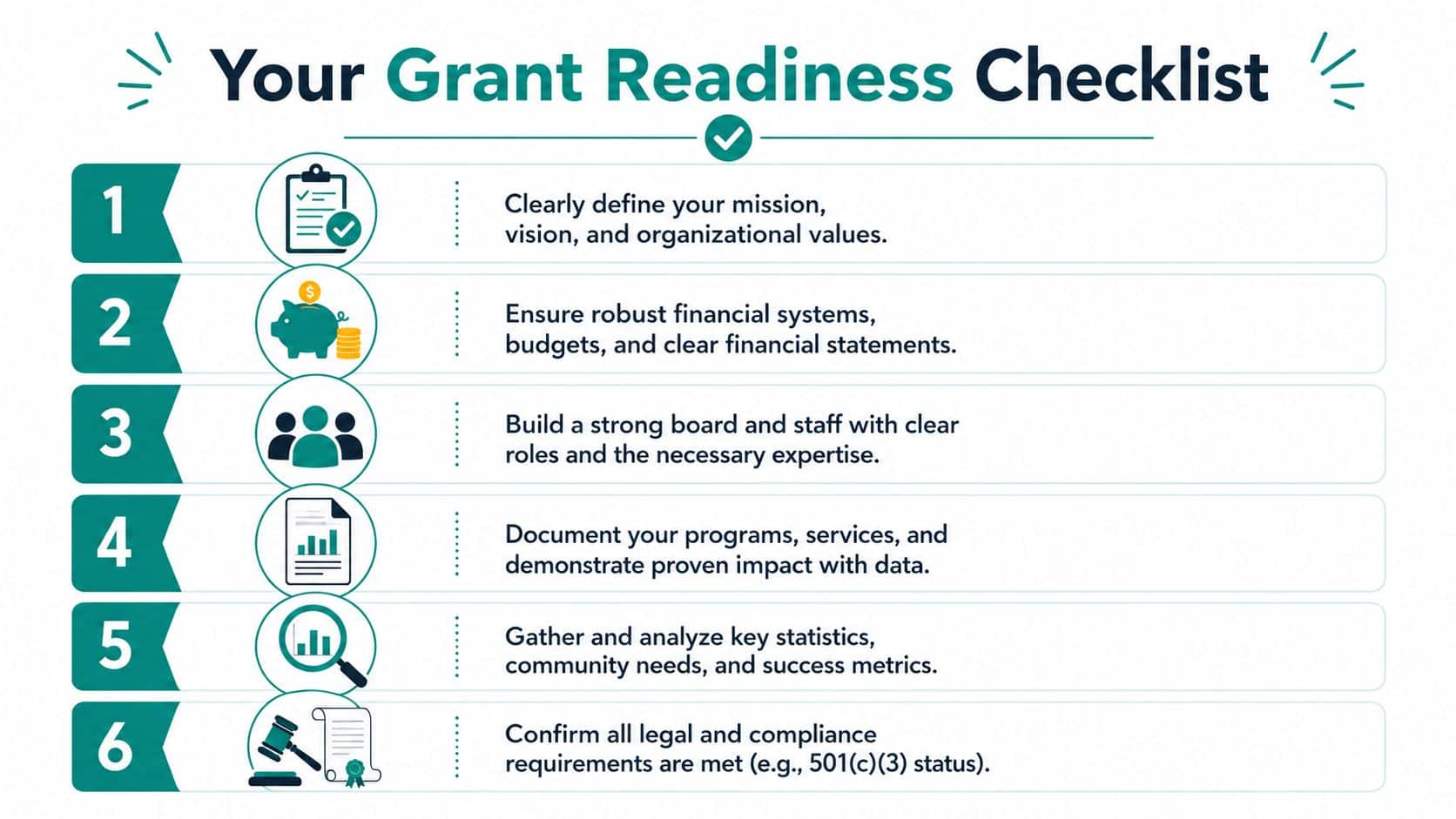
Many organizations start with the grant search. That's usually backward. Readiness comes first because funders don't only fund good ideas. They fund organizations that appear able to steward money responsibly.
The basic screen is often legal and operational, not inspirational. One technical gate matters more than most: 501(c)(3) status. The verified guidance provided for this article notes that failure to maintain that status results in immediate disqualification from approximately 85% of available technology and operational funding. In practice, if your status is unclear, outdated, or poorly documented, many opportunities stop there.
Here's the simplest way to think about readiness. Can you prove who you are, what you do, how you measure it, and how you'll track the money?
What funders want to see
A grant-ready organization usually has these items within easy reach:
- Legal standing: Your IRS determination letter, current registrations, and core compliance records are current and easy to produce.
- Clear mission and program logic: You can explain the need, the program, and the intended result without drifting into vague language.
- Current financial statements: You have recent financials that leadership understands and can explain.
- Board and staff clarity: Reviewers can see who governs the project and who runs it.
- A workable impact trail: You don't need a massive evaluation system, but you do need a credible way to document activity and outcomes.
- A realistic grant budget: You can show how requested funds will be spent and how those costs were estimated.
That last point gets skipped too often. Many teams draft a narrative first, then build the budget from memory. It should be the other way around. The budget tells the truth about whether the project is feasible.
What small or newer nonprofits should do differently
If your organization is newer, don't assume you must compete for the biggest grant available. That often leads to wasted effort. Some opportunities are better matched to smaller teams and simpler infrastructure.
The verified data for this article points to Wisconsin Partnership Program community grants as one example. Those grants are capped at up to $20,000 for up to one year and are intended to support "smaller and/or newer organizations," as described on the Wisconsin Partnership Program community grants page.
Smaller, clearer opportunities often beat larger, famous grants because the reporting burden fits the organization you have today.
A practical readiness review should also ask uncomfortable questions:
| Readiness area | Good sign | Warning sign |
|---|---|---|
| Financial tracking | You can separate restricted and unrestricted activity clearly | You rely on notes or memory to explain restrictions |
| Program measurement | Staff collect the same information consistently | Every program tracks outcomes differently |
| Document access | Key files are easy to find | Files live in personal folders or old emails |
| Budget process | Finance and program staff build budgets together | One person drafts the budget in isolation |
If you need a clean worksheet to organize assumptions before applying, a grant budget template can help your team get aligned.
Grant readiness isn't glamorous. It's paperwork, discipline, and honest self-assessment. But it's also what makes the rest of the process calmer.
Finding the Right Grant Opportunities
Once your house is in order, the question shifts from "Where can we apply?" to "Which grants for nonprofit work fit our capacity, timing, and mission?" That's a better question because the market is broad, and broad markets punish unfocused teams.
The grant space is substantial. Submittable summarizes industry data showing over 900 federal grant programs across 26 federal grant-making agencies, and it reports that U.S. foundations funded $62.8 billion in grants in 2015 across 86,203 foundations. The same summary notes that federal grants to states rose 42% after inflation adjustment between 2008 and 2019. You can review those figures in Submittable's grant statistics overview.
That scale is good news and bad news. There's real opportunity, but there's also no reason to chase everything.
Four channels worth separating
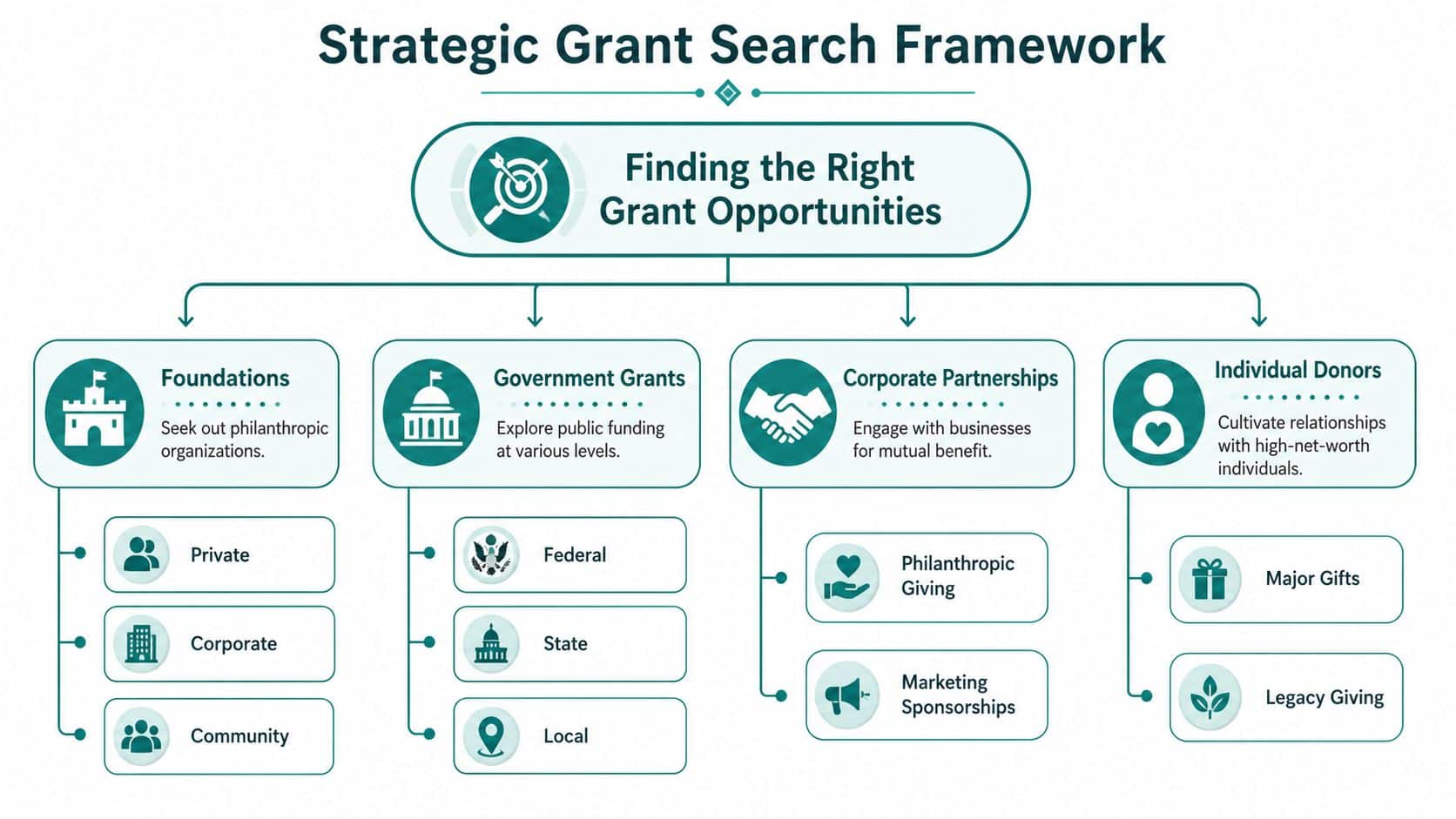
I've found it useful to treat the search like a portfolio problem. Different funder types behave differently, and your team should expect different paperwork, timelines, and follow-up.
Foundations
Private, family, and community foundations can be good fits when your program aligns tightly with a stated priority. They often reward clarity and mission fit. They can also be opaque. Some are invitation-based, and some have preferences they don't spell out fully on the website.
Foundations usually work best when you already know the specific project, the community need, and the amount you can responsibly manage.
Government grants
Government funding can be substantial and recurring, but it usually comes with more formal requirements. That means more documentation, more exact budget categories, and less room for casual tracking after award.
Government grants tend to favor organizations that already have strong financial controls and reporting discipline. If your current process depends on one staff member remembering where things are, slow down before you pursue these.
Corporate and local grants
Many nonprofits overlook a practical opportunity. Search content frequently over-focuses on national foundation cash grants, while teams on the ground regularly patch together support from local corporations, business giving committees, store-level programs, municipal funds, and in-kind support.
The verified data for this article notes that practitioners increasingly rely on Google Ad Grants, donated products and services, local corporate microgrants, and city-council funds, with local and corporate programs often falling in the $250 to $25,000 range, as referenced in the cited discussion of non-cash and local funding pathways.
The right grant isn't always the largest one. It's the one your team can win, manage, and report on without strain.
Match the funding type to the bottleneck
A simple filter saves time. Ask what problem you're trying to solve.
- Need operating flexibility: Look for local unrestricted support, community foundations, or municipal opportunities.
- Need visibility and outreach: In-kind options such as Google Ad Grants may matter more than a cash award.
- Need equipment or software: Product donations and technology-focused awards may move faster than a competitive national cycle.
- Need program expansion: Foundation or government support may fit, but only if you can support the compliance load.
There's also a structural limit with many in-kind technology grants. The verified data provided for this article notes that these grants often have value caps, with first-time applicants commonly seeing support in the $10,000 to $50,000 range, and some programs supporting smaller pilots instead of major infrastructure. That makes them useful for testing, not for every long-term staffing or maintenance need.
If you want a curated starting point, this guide to available grants for nonprofits is a practical place to scan opportunities by type.
The strongest search process is selective. It respects staff time, acknowledges reporting capacity, and treats fit as seriously as need.
Writing a Grant Application That Stands Out
A strong application does two things well. It makes the need feel real, and it makes the implementation feel believable.
Most weak proposals fail on one of those points. Some have heartfelt narratives with no financial discipline behind them. Others have careful budgets but read like they were written by committee. Reviewers notice both problems quickly.
Build the narrative from lived reality
Start with the problem you see in your work. Keep it specific and local. Describe who you serve, what barrier they face, and what your program will do differently or more effectively because of the grant.
Then tighten the story. Funders don't need every detail about your organization's history. They need a clear line from need to action to result.
A useful narrative structure looks like this:
- Need: What is happening in your community that requires action now.
- Response: What program or intervention you will run.
- Capacity: Why your team is equipped to do it.
- Results: What you will track and how you'll know whether the project is progressing.
If you're newer, resist the temptation to sound bigger than you are. Smaller organizations often win by sounding grounded, focused, and manageable. As noted earlier in the verified data, a smaller capacity-fit grant can be more realistic than a heavily publicized opportunity. That's one reason opportunities like the Wisconsin Partnership Program community grants matter. They align with the reality of smaller teams.
Make the budget support the story
The budget is where credibility either strengthens or slips.
A good grant budget shows that you understand your costs, your staffing, and the limits of the award. Every line should connect to the narrative. If you mention outreach, there should be outreach costs. If you promise evaluation, there should be staff time or tools allocated to it.
Here are common budget mistakes I see:
- Round numbers everywhere: That suggests estimation by guesswork, not planning.
- Missing administrative reality: If the project requires coordination, include the staff time required to coordinate it.
- Narrative mismatch: The proposal describes one project, but the budget funds a different one.
- No restriction logic: The budget doesn't make clear what the grant will and won't pay for.
Reviewers forgive modest scale faster than they forgive a budget that doesn't make sense.
This is where true fund accounting matters, even before you win. If your accounting records already reflect programs, funds, and restricted activity correctly, the grant budget comes from actual operating history instead of back-of-the-envelope math. That gives you cleaner assumptions and stronger internal confidence.
If you need a working model, this grant proposal budget template gives a practical structure to start from.
Write for the reviewer's workload
Grant reviewers read a lot of applications. Help them follow your logic without hunting.
| Application part | What helps | What hurts |
|---|---|---|
| Need statement | Clear local context and plain language | Broad claims with no practical connection |
| Program description | Specific activities and timeline | Buzzwords and vague promises |
| Organizational capacity | Named staff roles and working systems | General claims about commitment |
| Budget | Costs tied directly to the project | Numbers that appear detached from operations |
Good applications don't try to impress with complexity. They reduce doubt. They leave the reviewer thinking, "This team knows what it's doing, and the money will be managed carefully."
You Won the Grant Now What
Winning the grant is the beginning of the hard part. From this point on, the issue isn't persuasion. It's stewardship.
Restricted money changes your obligations. Once the award lands, you need to know exactly what the funds can cover, what dates apply, what reporting is due, and how spending will be coded from the first transaction. If that setup is loose for even a month, cleanup later gets expensive in staff time and credibility.
Restricted funds need their own discipline
A grant isn't just revenue. It's money with rules attached.
That means you need a practical way to separate one award from general operations. Not just in theory, and not just with a memo line. You need to see budget, actual spending, remaining balance, and any reimbursable amounts without rebuilding the picture by hand each time.
When organizations don't set this up early, several things usually happen:
- Expenses drift: Charges hit the wrong place and require later corrections.
- Program and finance diverge: Staff members keep separate tracking sheets that don't fully match.
- Cash gets misunderstood: Leadership sees money in the bank and assumes it's available, when much of it is already spoken for.
- Reporting becomes forensic work: Someone has to reconstruct months of decisions from receipts, emails, and spreadsheets.
Why tool choice matters after award
QuickBooks is familiar, and many nonprofits start there. It's good general accounting software. The challenge is that many grant-funded organizations need more than general accounting. They need native restricted fund logic, not workarounds through classes or tags that depend on perfect staff behavior.
Aplos is often a meaningful step up for nonprofit accounting, especially compared with a basic small-business setup. But many teams still find themselves working across separate systems for accounting, donors, events, volunteers, and communications. That separation is what creates duplicate entry and reporting friction.
One option in this category is AlignMint, which combines fund accounting, CRM, volunteers, events, marketing, and team communication in one platform. For grant management, the practical benefit is simple: the financial record, donor record, and program activity don't live in separate silos. The platform also includes plan-based user allowances (1 on Free, up to 10 on Plus, up to 25 on Pro, and unlimited on Enterprise), a built-in marketing suite, Minty, and a free tier for nonprofits under $100K in annual revenue, based on the publisher information provided for this article.
If you have to export data just to understand a grant, your system is adding work instead of removing it.
Set up the award before spending starts
The best post-award routine is boring. That's good news. It means the process is clear.
A clean setup usually includes:
- Review the award letter carefully: Confirm dates, restrictions, payment terms, and required reports.
- Create a distinct fund or grant record: Give the money its own place in your books.
- Map allowable expenses: Make sure staff know what can be charged.
- Assign responsibility: Someone owns spending review, and someone owns reporting.
- Schedule reports early: Put interim and final report deadlines on the calendar at award start, not at month-end panic time.
Most grant trouble doesn't start with fraud or bad intent. It starts with vague setup, delayed coding, and a team that assumes someone else is watching the details.
Grant Reporting and Staying Compliant
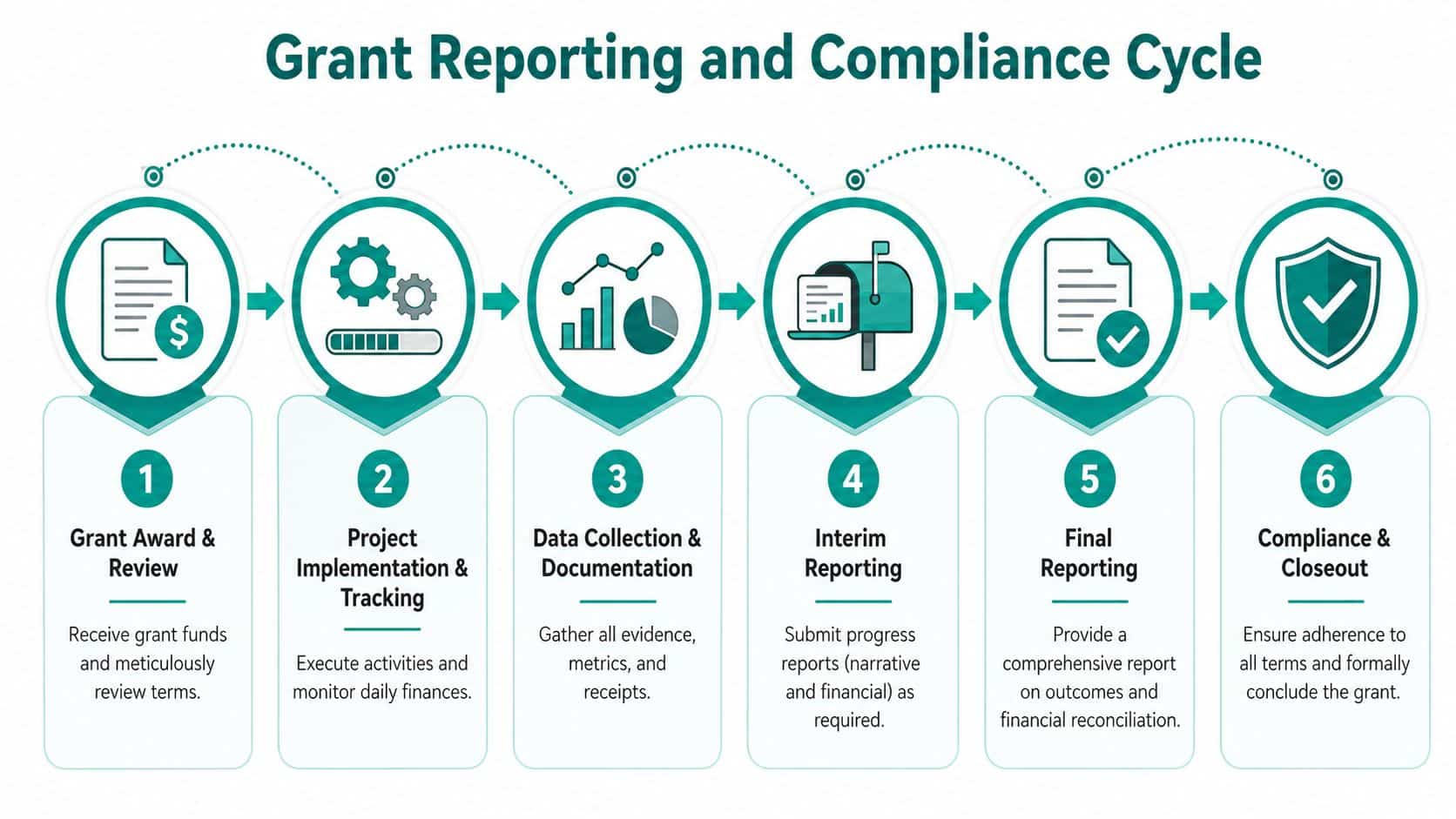
Funder reporting feels difficult when it starts too late. If you've tracked the award properly from the beginning, reporting is mostly an organizing task. If you haven't, reporting becomes an investigation.
That's why compliance isn't a separate project at the end. It's the result of daily habits. Every coding decision, every saved receipt, every program note, and every budget adjustment feeds the final report.
What funders usually expect
Grant reports generally combine two kinds of information. One is financial. The other is programmatic.
Financial reporting often asks for some variation of budget versus actuals, a list of approved expenses, or the amount remaining. Program reporting usually asks what happened, who was served, what changed, and what problems came up during implementation.
The stress comes when those two parts don't line up. If the narrative says the program expanded outreach, but the spending doesn't show outreach-related costs, the report raises questions.
A reliable compliance process usually includes:
- Consistent coding: Expenses hit the correct fund, program, and time period.
- Supporting documentation: Receipts, invoices, contracts, and payroll support are stored in a way staff can retrieve quickly.
- Shared visibility: Program and finance staff can both see the same grant picture.
- Deadline management: Interim and final reports are scheduled and drafted before the due date arrives.
Non-cash support still needs tracking
One area that gets overlooked is non-cash support. Many nonprofits now assemble funding from cash grants, in-kind support, advertising credits, donated tools, and local microgrants.
The verified data for this article notes that practitioners increasingly rely on these less obvious pathways, including Google Ad Grants, donated services, and local corporate microgrants in the $250 to $25,000 range, as discussed in the cited overview of local and non-cash funding pathways.
That mix can be practical, but it also makes compliance more complex. If different support streams fund different parts of the same project, staff need to know which costs belong where and what proof each funder expects.
Good reporting starts on the day the award begins, not the week before the report is due.
Reporting systems should reduce rework
The cleanest reporting process ties daily transactions to the grant record as they happen. Then when you need a receivable, reimbursement support, or a budget-to-actual view, the system can produce it without a manual rebuild.
For nonprofits managing drawdowns or reimbursement grants, a structured record is especially helpful. This overview of grants receivable shows the kind of accounting logic finance teams need available when grants don't arrive as unrestricted cash up front.
There's a second compliance payoff too. When your books are maintained with restricted funds and program activity in mind, annual tasks such as Form 990 preparation become easier. You're not inventing the story at year-end. You're pulling it from records that were structured correctly all along.
A Better Way to Manage Your Mission
Disconnected tools create the very headaches nonprofit leaders complain about most. You lose time reconciling spreadsheets, second-guess restricted balances, and asking staff for information that should already be available.
A calmer approach is to run the full grant lifecycle as one process. Search selectively. Apply with budgets grounded in real costs. Track every award inside a true fund structure. Report from the same records you use every day.
For many organizations, that also means rethinking software. QuickBooks may remain part of the picture for some. Aplos may fit teams focused mainly on accounting. But when grants, donor records, volunteer activity, events, team communication, and outreach all touch the same work, separate systems keep creating friction.
What helps is straightforward. True fund accounting, not class-based workarounds. One place for finance and relationship data. Built-in marketing tools, so fundraising and communication don't sit off to the side. Plan-based user allowances (1 on Free, up to 10 on Plus, up to 25 on Pro, and unlimited on Enterprise), so staff and board access don't trigger extra seat costs. And if your organization is small, a free starting point matters.
That's the larger point. Grants for nonprofit organizations don't just demand better writing. They demand better operating discipline. When your tools support that discipline, you stop managing around the system and start managing the mission.
If you want fewer spreadsheets, clearer restricted balances, and one place to manage accounting, fundraising, volunteers, events, and marketing, take a look at AlignMint. You can start with the free plan if your nonprofit is under $100K, or schedule a demo to see whether the workflow fits the way your team already works.
Ready to try AlignMint with your nonprofit?
Start free — set up donor tools, giving pages, and Minty. Upgrade when you need accounting.